
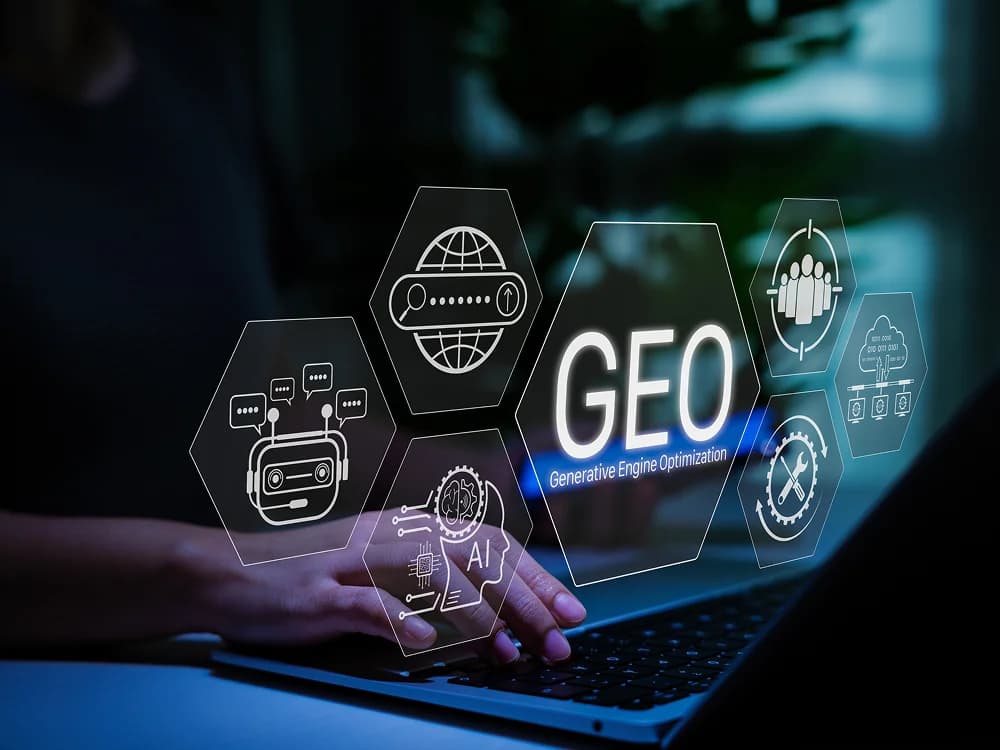
What Do Generative Engine Optimization Services Improve for Brands?
Generative Engine Optimization services help brands improve their representation across AI-led discovery, including ChatGPT search, Google AI Mode, Gemini, Claude, and Perplexity. GEO examines more than a single webpage. It studies the prompts buyers use, the sources that shape generated answers, competitor visibility, brand accuracy, and gaps between owned and external content.
Scribblers India uses these findings to strengthen the information ecosystem around a brand, improve citation readiness, and measure changes in its visibility and representation over time.
What Does Our GEO Agency Examine Before Recommending Changes?
Effective GEO starts with diagnosis. Our GEO agency studies three connected layers before deciding what needs to change.

AI Brand Representation
Tracked prompts reveal where the brand appears, how it is described, which competitors surround it, and where important products, expertise, or differentiators are missing.

Source Ecosystem
Recurring websites, publications, reviews, communities, and owned pages show which sources influence category answers and where the brand has limited supporting visibility.

Evidence and Authority Gaps
Weakly supported claims, inconsistent entity information, outdated facts, and missing expert evidence highlight where stronger content or third-party corroboration is needed.
Why Can a Brand Rank Well on Google but Remain Weak in Generative Answers?
Strong organic rankings do not automatically translate to strong visibility in generative answers. Search rankings can contribute to discovery, but AI-led experiences may retrieve and combine different sources for comparison, recommendation, or category questions. The wording of the prompt, platform, model, location, and timing can also change what appears.
A GEO review therefore looks beyond ranking positions. It checks whether the brand appears across commercially relevant prompts, how accurately it is represented, which URLs or external sources receive citations, and which competitors repeatedly enter the answer instead. This wider view helps teams identify gaps that conventional traffic and ranking reports may not reveal.
What Makes a Brand Easier to Represent Accurately Across AI Search?
Effective GEO for brands starts with a consistent and verifiable information footprint. Product claims, service descriptions, company facts, expert credentials, category positioning, and differentiators should be clear across priority owned assets. Important claims also need credible evidence rather than promotional language alone.
Original research, expert-led insights, case evidence, current examples, and well-supported comparisons can provide information that generic category pages cannot. External mentions, reviews, specialist publications, and other relevant sources may also strengthen corroboration where buyers expect independent validation.
The goal is not to force a model to recommend the brand. It is to reduce ambiguity, improve source quality, and give generative systems stronger information to retrieve and represent accurately.
How Should GEO Performance Be Measured?
GEO performance requires repeatable measurement because a single generated answer cannot establish a reliable trend.
| GEO Signal | What It Reveals | Why It Matters |
|---|---|---|
| Brand Mention Rate | How often the brand appears across tracked prompts | Establishes visibility across priority questions |
| Citation and Source Share | Which owned or external sources receive attribution | Reveals which sources support brand inclusion |
| Recommendation Presence | Where the brand enters comparisons or shortlists | Tracks visibility during evaluation |
| Accuracy and Context | Whether important brand facts are represented correctly | Exposes misinformation or positioning gaps |
| Competitor Share | Which competitors appear when the brand does not | Guides content and authority priorities |

When Should Brands Consider Working With a GEO Agency?
A GEO agency becomes useful when generative visibility begins to influence how buyers research a category, compare providers, or validate a shortlist. Four situations usually deserve closer investigation.
Strong SEO, Weak AI Visibility
Organic rankings may be healthy while the brand appears inconsistently across high-intent prompts. GEO testing helps identify where generative answers favor other sources, competitors, or category narratives despite solid search performance.
Inaccurate or Incomplete AI Representation
Generated answers may describe the company incorrectly, omit an important capability, repeat outdated information, or place it in the wrong competitive set. A structured review shows which facts and sources need clarification.
Competitors Dominate the Source Ecosystem
Competitor websites, reviews, publications, experts, or communities may recur across relevant answers while your brand has little supporting evidence beyond its own site. Source mapping reveals where external validation remains weak.
New Category or Market Positioning
A product launch, repositioning, market entry, or emerging category often creates information gaps. GEO helps align owned content, expert assets, brand facts, and credible external references around the positioning buyers should understand before the new narrative becomes widely established.
What Do Our Generative Engine Optimization Services Deliver?
Each GEO engagement should produce clear evidence of what is happening, why it is happening, and what deserves attention next. Our deliverables are designed around those three decisions, with each recommendation tied to a measurable gap.
Generative Visibility Benchmark
A controlled prompt portfolio records brand appearances, competitor presence, citations or linked sources where available, answer context, and representation gaps across selected platforms. The Generative Visibility Benchmark records platform, prompt wording, location, and test conditions, creating a consistent starting point for later comparisons rather than relying on isolated screenshots.
Brand and Source Gap Map
This analysis shows which owned pages and third-party sources recur around important category questions, where competitors have stronger corroboration, and which brand claims lack clear support. It also identifies outdated facts, inconsistent positioning, and missing authority assets that may weaken representation.
GEO Content and Authority Roadmap
Priority actions connect confirmed gaps with specific updates across owned content, original research, expert-led assets, comparison resources, entity consistency, and legitimate third-party visibility opportunities. The roadmap also defines which prompts, sources, mentions, citations, and referral signals should be reviewed during future measurement cycles.
How Does Our GEO Process Work?
Our GEO process starts with how buyers research the category and ends with repeated measurement. Each stage narrows the next decision instead of treating every mention or citation as equally valuable.
Define the Prompt Portfolio
Buyer questions are grouped across discovery, comparisons, recommendations, objections, use cases, and brand evaluation. Priority prompts reflect commercial importance rather than broad informational curiosity alone.
Baseline Brand Representation
Controlled tests record where the brand appears, how it is described, which competitors are present, what sources are cited, and where important facts are inaccurate or missing.
Map the Source Landscape
Recurring owned and third-party sources are reviewed to understand which domains influence category answers. Gaps in evidence, expertise, positioning, and external validation then become visible.
Strengthen the Information Footprint
Confirmed gaps guide updates to priority pages, original research, expert assets, brand facts, comparison content, and appropriate third-party authority opportunities.
Measure and Recalibrate
Core prompts are rerun under comparable conditions. Trends in mentions, citations, source selection, accuracy, competitor presence, and referral activity inform the next GEO cycle across agreed platforms over time.
FAQs
How do GEO services identify why a brand is missing from AI-generated answers?
GEO work starts by comparing the prompts that matter with how the brand currently appears across generative search platforms. The analysis looks at which competitors are mentioned, which sources are cited, how accurately the brand is represented, and where supporting evidence is weak or absent. Those findings guide changes to owned content, authority signals, and the wider source ecosystem.
What is the difference between GEO, AEO, and SEO?
SEO improves discoverability across search, AEO focuses on making content clearer and more useful for direct-answer experiences, and GEO examines how a brand is represented across broader generative discovery. The disciplines overlap considerably. Scribblers India treats them as connected layers rather than rigid, universally standardized categories.
Does GEO involve getting our content into AI model training data?
No GEO agency can credibly guarantee inclusion in foundation-model training data. Search-based AI experiences can retrieve current web information independently from model training. Our GEO work focuses on the information brands can directly influence: accessible owned content, accurate brand facts, useful evidence, relevant external sources, and measurable representation across selected AI search experiences.
How do you measure GEO when AI answers change between runs?
Measurement uses a fixed core prompt set, documented testing conditions, and repeated observations rather than one-off screenshots. We track brand mentions, citations, source selection, answer accuracy, competitor presence, and recommendation visibility across agreed platforms. Referral traffic and conversions can be reviewed where analytics data is available, and attribution is sufficiently reliable.
How long does GEO take, and can a GEO agency guarantee citations or recommendations?
Timelines vary with existing visibility, content quality, source coverage, crawl and indexing cycles, competition, and the scale of required changes. A GEO agency cannot guarantee that a specific model will cite or recommend a brand. The practical approach is to establish a baseline, strengthen confirmed gaps, and measure whether visibility patterns improve over repeated reviews.

Ready to Improve How AI Search Represents Your Brand?
Build a GEO strategy around prompts, source gaps, and measurable visibility. Talk to Scribblers India about strengthening your brand across generative discovery.
Book Strategy Call