
logo

Scribblers India

Home
Contact
Contact

Let's Talk

501, Vinca Block, Amravati Enclave, Panchkula, Haryana

Call +91 8818073118
SCRIBBLERS*INDIA*
  • Home
  • Resources
  • Contact
  • Privacy Policy
  • Blog
  • Glossary
  • Cookies Policy
  • Terms of Service
  • Visual Content Creating
  • Whitepaper & Case Study Writing
  • Newsletter Writing
  • Academic Content Writing
  • Generative Engine Optimization
  • Annual Report Writing
  • Content Strategy
  • Content Marketing
  • Personal Branding
  • Answer Engine Optimization
  • Digital PR
  • Ghostwriting
  • Ebook Writing
  • Thought Leadership Content Writing
  • Digital PR
  • Copywriting
  • Website Content Writing
  • Bulk Content Writing
  • Social Media Marketing
  • AI Content Editing
PrivacyTermsSitemap

© 2026 Scribblers India. All Rights Reserved.

logo

Scribblers India

Home
Contact
Contact

Let's Talk

501, Vinca Block, Amravati Enclave, Panchkula, Haryana

Call +91 8818073118
SCRIBBLERS*INDIA*
  • Home
  • Resources
  • Contact
  • Privacy Policy
  • Blog
  • Glossary
  • Cookies Policy
  • Terms of Service
  • Visual Content Creating
  • Whitepaper & Case Study Writing
  • Newsletter Writing
  • Academic Content Writing
  • Generative Engine Optimization
  • Annual Report Writing
  • Content Strategy
  • Content Marketing
  • Personal Branding
  • Answer Engine Optimization
  • Digital PR
  • Ghostwriting
  • Ebook Writing
  • Thought Leadership Content Writing
  • Digital PR
  • Copywriting
  • Website Content Writing
  • Bulk Content Writing
  • Social Media Marketing
  • AI Content Editing
PrivacyTermsSitemap

© 2026 Scribblers India. All Rights Reserved.

HomeGlossaryAnswer Engine Optimization (AEO)

Answer Engine Optimization (AEO)

Answer Engine Optimization (AEO)

Search behavior has changed in ways that traditional SEO alone cannot address. Over 60% of Google searches now end without a single click, and platforms like ChatGPT serve more than 800 million users every week. Brands that want to stay visible in this environment need a sharper strategy. Answer Engine Optimization (AEO) is that strategy.

It focuses on structuring content so that AI-powered platforms deliver it as a direct answer to user queries, rather than as a link in a results list. For content marketers and digital brands, AEO has become a measurable, high-priority discipline that determines where and how a brand gets discovered.

What is AEO and Why Does It Matter Today?

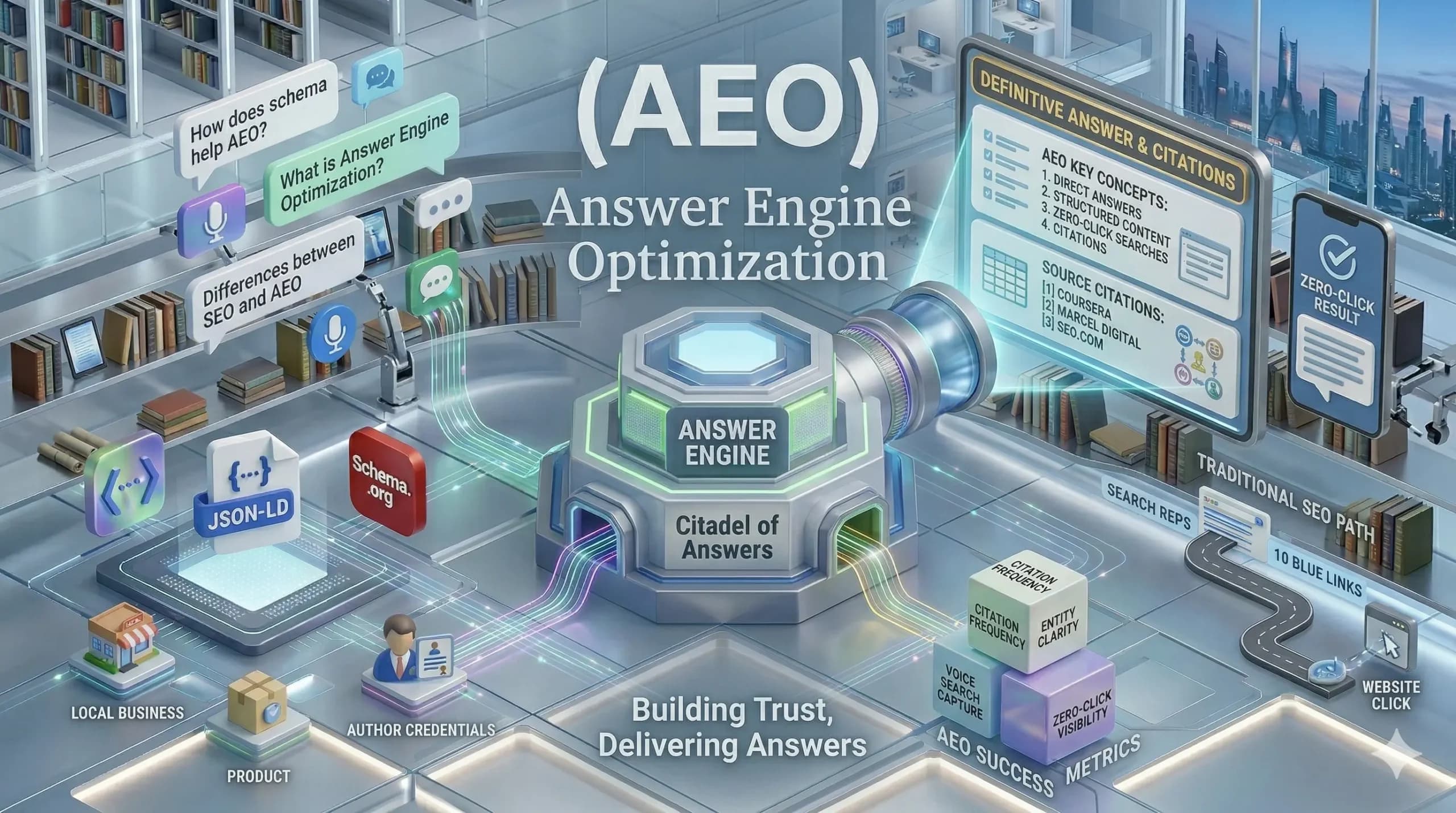
Answer Engine Optimization (AEO) is the practice of structuring content so that AI-driven platforms can extract and surface it as a direct, cited answer to a user query. Platforms like Google AI Overviews, ChatGPT, Perplexity, and voice assistants all operate as answer engines.

Unlike traditional SEO, which targets ranking positions and website clicks, AEO targets the answer itself. The goal is for a brand’s content to become the source that an AI platform cites, summarizes, or reads aloud when a user asks a relevant question.

This shift matters because users today expect instant, trustworthy answers. Voice assistants, AI chatbots, and AI Overviews deliver exactly that, which means brands that do not optimize for answers risk becoming invisible even when their content holds a strong traditional search ranking.

How Does Answer Engine Optimization (AEO) Differ from Traditional SEO?

AEO and SEO share the same foundation, yet they target different outcomes, measurement frameworks, and content formats in meaningful ways.

AEO prioritizes being the source of an answer over earning a click. Traditional SEO measures success through rankings, traffic, and click-through rates. AEO measures success through citations in AI responses, brand mentions in answer engines, and the share of voice a brand holds across AI-powered platforms.

  • Target platform: Traditional SEO targets Google’s ranked link results. AEO targets AI-generated answer surfaces, including AI Overviews, Perplexity responses, voice search outputs, and featured snippets where answers appear above organic results.
  • Content format requirements: Traditional SEO rewards comprehensive, keyword-rich pages. AEO rewards concise, question-forward content that leads with a direct answer in the first 40 to 60 words. This makes it easy for AI systems to extract, synthesize, and deliver to the user.
  • Intent alignment: Traditional SEO ranks pages for broad keyword clusters. AEO demands content that aligns closely with the specific conversational question a user types or speaks. This requires a deeper understanding of natural-language search intent across every topic area.
  • Authority signal weight: AEO places greater emphasis on E-E-A-T signals: experience, expertise, authoritativeness, and trustworthiness. This is because answer engines actively evaluate whether a source is credible enough to be cited in a response that reaches millions of users at once.

What Are the Core Components That Drive AEO Success?

AEO builds on a set of interconnected content, technical, and authority signals that, together, tell answer engines that a brand is worth citing in their responses.

The question-forward content structure is the most fundamental component. Organizing content around the exact questions an audience asks and using those questions as headings allows AI systems to locate and extract answers efficiently. Direct, answer-first writing in the opening sentences of each section signals that the content exists to inform rather than to sell.

  • Structured data and schema markup: These allow answer engines to parse content meaning with precision. FAQPage, HowTo, Article, and Organization schema types signal the nature of content to AI crawlers, improving the likelihood of inclusion in rich results and AI-generated responses across all major platforms.
  • Concise, extractable paragraphs: Paragraphs in the 40 to 60 word range match the format that AI Overviews and featured snippets consistently pull from. Longer, unbroken text blocks are harder for AI systems to summarize and attribute accurately to the correct source.
  • Multi-platform brand presence: Answer engines draw from review platforms, social content, third-party publications, and discussion forums alongside a brand’s own website, which means consistency of brand representation across all surfaces matters significantly for AEO performance.

Why Does E-E-A-T Signal Matter for AEO?

E-E-A-T stands for Experience, Expertise, Authoritativeness, and Trustworthiness. These four signals determine whether an answer engine considers a source credible enough to cite in a direct response to a user query.

Answer engines do not rank blue links. They recommend sources to users who trust those recommendations completely. For an AI platform to cite a brand’s content, it needs clear evidence that the content comes from a genuinely knowledgeable source with a documented track record.

  • Experience: Content that demonstrates first-hand knowledge through case studies, real outcomes, and practitioner insights signals authenticity that AI systems recognize as more reliable than purely theoretical coverage of a subject.
  • Expertise: Clear author profiles, bylines linked to credible sources, and content that demonstrates depth rather than breadth show answer engines that the content comes from someone with genuine authority in the specific subject area being covered.
  • Authoritativeness and Trustworthiness: Third-party mentions, backlinks from reputable sources, accurate statistics, and consistent publishing history build the entity authority that AI platforms use to assess whether a brand deserves a citation in a generated response delivered to users.

What Are the Key AEO Strategies for Digital Marketers?

Effective AEO requires a deliberate shift in how content is planned, structured, and distributed across channels. Brands that lead with answers consistently perform better in AI-generated answer surfaces than those that bury the response in long introductions.

Placing a direct, complete response to the query in the first paragraph of each content section aligns with how AI platforms retrieve and display information. This approach also signals to the platform that the content immediately resolves the user’s question, rather than requiring them to scroll through multiple paragraphs.

  • Build content hubs around specific questions: Organize service pages, blog posts, and glossary content around the precise natural-language questions an audience asks. Tools like Google’s People Also Ask boxes, search autocomplete, and branded search console data reveal the exact phrasing that real users use in relevant queries.
  • Create dedicated FAQ sections on high-value pages: FAQ schema structured around primary search intent gives answer engines a clear format that aligns precisely with how users phrase voice queries and conversational AI prompts. Pairing thought leadership content writing with structured FAQ sections strengthens AEO performance across platforms.
  • Monitor AI mentions and citation frequency: AEO success is not measured by rank position. Brands should track how often their content appears in AI-generated responses across ChatGPT, Perplexity, and Google AI Overviews, using visibility tools or manual prompt testing.
  • Maintain content freshness with regular audits: Answer engines favor content that reflects updated statistics and recent developments. A content strategy built around quarterly content audits: refreshing data points, updating FAQs, and adding new original insights, maintains a brand’s position in the AI retrieval pool.

At Scribblers India, the team delivers AEO services, content marketing, and GEO strategies that position brands as the trusted answer in AI-powered search.

Reach out today to start building AI-era visibility that compounds over time.

FAQs

How does AEO impact brand visibility without generating website clicks?

AEO builds brand authority at the answer layer of search, where users see a brand cited as a trusted source in AI-generated responses and featured snippets. This visibility influences brand recognition, direct search behavior, and downstream conversions, even when the user does not click through to a website. Brands that earn consistent AEO citations build audience trust over time without depending on click-through traffic alone.

What content formats perform best for Answer Engine Optimization success?

FAQ pages, definition articles, how-to guides, and structured comparison content perform strongest for AEO because they align closely with the question-based queries that answer engines resolve. Content that leads with a direct, concise answer and uses structured formatting gives AI platforms the clearest signal for extraction, attribution, and delivery within a synthesized response.

Can small businesses benefit from AEO even without large content teams?

Smaller brands can make meaningful AEO progress by focusing on a narrow set of high-intent questions where they hold genuine expertise. Publishing a smaller volume of well-structured, original content around specific queries outperforms high-volume generic content in earning citations in AI-generated responses. Strategic focus on a defined topic cluster consistently delivers stronger AEO results than broad, unfocused content production.

How does schema markup directly support Answer Engine Optimization performance?

Schema markup provides answer engines with machine-readable context about the content on a page, clarifying whether a section is an FAQ, a how-to guide, or a full article. This additional context increases the likelihood that the content gets extracted and featured in AI-generated answers, rich results, and voice search responses across all major search platforms.

Does AEO influence how a brand appears in voice search results specifically?

Voice search queries are almost always phrased as complete natural-language questions, which is precisely the format that AEO-optimized content builds around. Brands whose content answers questions in concise, conversational language are consistently more likely to be read aloud as the definitive response by voice assistants, including Siri, Alexa, Google Assistant, and other AI-powered voice platforms.

RELATED ARTICLES

Generative Engine Optimization (GEO)

Glossary

Generative Engine Optimization (GEO)
Large Language Model (LLM)

Glossary

Large Language Model (LLM)
HomeGlossaryAnswer Engine Optimization (AEO)

Answer Engine Optimization (AEO)

Answer Engine Optimization (AEO)

Search behavior has changed in ways that traditional SEO alone cannot address. Over 60% of Google searches now end without a single click, and platforms like ChatGPT serve more than 800 million users every week. Brands that want to stay visible in this environment need a sharper strategy. Answer Engine Optimization (AEO) is that strategy.

It focuses on structuring content so that AI-powered platforms deliver it as a direct answer to user queries, rather than as a link in a results list. For content marketers and digital brands, AEO has become a measurable, high-priority discipline that determines where and how a brand gets discovered.

What is AEO and Why Does It Matter Today?

Answer Engine Optimization (AEO) is the practice of structuring content so that AI-driven platforms can extract and surface it as a direct, cited answer to a user query. Platforms like Google AI Overviews, ChatGPT, Perplexity, and voice assistants all operate as answer engines.

Unlike traditional SEO, which targets ranking positions and website clicks, AEO targets the answer itself. The goal is for a brand’s content to become the source that an AI platform cites, summarizes, or reads aloud when a user asks a relevant question.

This shift matters because users today expect instant, trustworthy answers. Voice assistants, AI chatbots, and AI Overviews deliver exactly that, which means brands that do not optimize for answers risk becoming invisible even when their content holds a strong traditional search ranking.

How Does Answer Engine Optimization (AEO) Differ from Traditional SEO?

AEO and SEO share the same foundation, yet they target different outcomes, measurement frameworks, and content formats in meaningful ways.

AEO prioritizes being the source of an answer over earning a click. Traditional SEO measures success through rankings, traffic, and click-through rates. AEO measures success through citations in AI responses, brand mentions in answer engines, and the share of voice a brand holds across AI-powered platforms.

  • Target platform: Traditional SEO targets Google’s ranked link results. AEO targets AI-generated answer surfaces, including AI Overviews, Perplexity responses, voice search outputs, and featured snippets where answers appear above organic results.
  • Content format requirements: Traditional SEO rewards comprehensive, keyword-rich pages. AEO rewards concise, question-forward content that leads with a direct answer in the first 40 to 60 words. This makes it easy for AI systems to extract, synthesize, and deliver to the user.
  • Intent alignment: Traditional SEO ranks pages for broad keyword clusters. AEO demands content that aligns closely with the specific conversational question a user types or speaks. This requires a deeper understanding of natural-language search intent across every topic area.
  • Authority signal weight: AEO places greater emphasis on E-E-A-T signals: experience, expertise, authoritativeness, and trustworthiness. This is because answer engines actively evaluate whether a source is credible enough to be cited in a response that reaches millions of users at once.

What Are the Core Components That Drive AEO Success?

AEO builds on a set of interconnected content, technical, and authority signals that, together, tell answer engines that a brand is worth citing in their responses.

The question-forward content structure is the most fundamental component. Organizing content around the exact questions an audience asks and using those questions as headings allows AI systems to locate and extract answers efficiently. Direct, answer-first writing in the opening sentences of each section signals that the content exists to inform rather than to sell.

  • Structured data and schema markup: These allow answer engines to parse content meaning with precision. FAQPage, HowTo, Article, and Organization schema types signal the nature of content to AI crawlers, improving the likelihood of inclusion in rich results and AI-generated responses across all major platforms.
  • Concise, extractable paragraphs: Paragraphs in the 40 to 60 word range match the format that AI Overviews and featured snippets consistently pull from. Longer, unbroken text blocks are harder for AI systems to summarize and attribute accurately to the correct source.
  • Multi-platform brand presence: Answer engines draw from review platforms, social content, third-party publications, and discussion forums alongside a brand’s own website, which means consistency of brand representation across all surfaces matters significantly for AEO performance.

Why Does E-E-A-T Signal Matter for AEO?

E-E-A-T stands for Experience, Expertise, Authoritativeness, and Trustworthiness. These four signals determine whether an answer engine considers a source credible enough to cite in a direct response to a user query.

Answer engines do not rank blue links. They recommend sources to users who trust those recommendations completely. For an AI platform to cite a brand’s content, it needs clear evidence that the content comes from a genuinely knowledgeable source with a documented track record.

  • Experience: Content that demonstrates first-hand knowledge through case studies, real outcomes, and practitioner insights signals authenticity that AI systems recognize as more reliable than purely theoretical coverage of a subject.
  • Expertise: Clear author profiles, bylines linked to credible sources, and content that demonstrates depth rather than breadth show answer engines that the content comes from someone with genuine authority in the specific subject area being covered.
  • Authoritativeness and Trustworthiness: Third-party mentions, backlinks from reputable sources, accurate statistics, and consistent publishing history build the entity authority that AI platforms use to assess whether a brand deserves a citation in a generated response delivered to users.

What Are the Key AEO Strategies for Digital Marketers?

Effective AEO requires a deliberate shift in how content is planned, structured, and distributed across channels. Brands that lead with answers consistently perform better in AI-generated answer surfaces than those that bury the response in long introductions.

Placing a direct, complete response to the query in the first paragraph of each content section aligns with how AI platforms retrieve and display information. This approach also signals to the platform that the content immediately resolves the user’s question, rather than requiring them to scroll through multiple paragraphs.

  • Build content hubs around specific questions: Organize service pages, blog posts, and glossary content around the precise natural-language questions an audience asks. Tools like Google’s People Also Ask boxes, search autocomplete, and branded search console data reveal the exact phrasing that real users use in relevant queries.
  • Create dedicated FAQ sections on high-value pages: FAQ schema structured around primary search intent gives answer engines a clear format that aligns precisely with how users phrase voice queries and conversational AI prompts. Pairing thought leadership content writing with structured FAQ sections strengthens AEO performance across platforms.
  • Monitor AI mentions and citation frequency: AEO success is not measured by rank position. Brands should track how often their content appears in AI-generated responses across ChatGPT, Perplexity, and Google AI Overviews, using visibility tools or manual prompt testing.
  • Maintain content freshness with regular audits: Answer engines favor content that reflects updated statistics and recent developments. A content strategy built around quarterly content audits: refreshing data points, updating FAQs, and adding new original insights, maintains a brand’s position in the AI retrieval pool.

At Scribblers India, the team delivers AEO services, content marketing, and GEO strategies that position brands as the trusted answer in AI-powered search.

Reach out today to start building AI-era visibility that compounds over time.

FAQs

How does AEO impact brand visibility without generating website clicks?

AEO builds brand authority at the answer layer of search, where users see a brand cited as a trusted source in AI-generated responses and featured snippets. This visibility influences brand recognition, direct search behavior, and downstream conversions, even when the user does not click through to a website. Brands that earn consistent AEO citations build audience trust over time without depending on click-through traffic alone.

What content formats perform best for Answer Engine Optimization success?

FAQ pages, definition articles, how-to guides, and structured comparison content perform strongest for AEO because they align closely with the question-based queries that answer engines resolve. Content that leads with a direct, concise answer and uses structured formatting gives AI platforms the clearest signal for extraction, attribution, and delivery within a synthesized response.

Can small businesses benefit from AEO even without large content teams?

Smaller brands can make meaningful AEO progress by focusing on a narrow set of high-intent questions where they hold genuine expertise. Publishing a smaller volume of well-structured, original content around specific queries outperforms high-volume generic content in earning citations in AI-generated responses. Strategic focus on a defined topic cluster consistently delivers stronger AEO results than broad, unfocused content production.

How does schema markup directly support Answer Engine Optimization performance?

Schema markup provides answer engines with machine-readable context about the content on a page, clarifying whether a section is an FAQ, a how-to guide, or a full article. This additional context increases the likelihood that the content gets extracted and featured in AI-generated answers, rich results, and voice search responses across all major search platforms.

Does AEO influence how a brand appears in voice search results specifically?

Voice search queries are almost always phrased as complete natural-language questions, which is precisely the format that AEO-optimized content builds around. Brands whose content answers questions in concise, conversational language are consistently more likely to be read aloud as the definitive response by voice assistants, including Siri, Alexa, Google Assistant, and other AI-powered voice platforms.

RELATED ARTICLES

Generative Engine Optimization (GEO)

Glossary

Generative Engine Optimization (GEO)
Large Language Model (LLM)

Glossary

Large Language Model (LLM)