
logo

Scribblers India

Home
Contact
Contact

Let's Talk

501, Vinca Block, Amravati Enclave, Panchkula, Haryana

Call +91 8818073118
SCRIBBLERS*INDIA*
  • Home
  • Resources
  • Contact
  • Privacy Policy
  • Blog
  • Glossary
  • Cookies Policy
  • Terms of Service
  • Visual Content Creating
  • Whitepaper & Case Study Writing
  • Newsletter Writing
  • Academic Content Writing
  • Generative Engine Optimization
  • Annual Report Writing
  • Content Strategy
  • Content Marketing
  • Personal Branding
  • Answer Engine Optimization
  • Digital PR
  • Ghostwriting
  • Ebook Writing
  • Thought Leadership Content Writing
  • Digital PR
  • Copywriting
  • Website Content Writing
  • Bulk Content Writing
  • Social Media Marketing
  • AI Content Editing
PrivacyTermsSitemap

© 2026 Scribblers India. All Rights Reserved.

logo

Scribblers India

Home
Contact
Contact

Let's Talk

501, Vinca Block, Amravati Enclave, Panchkula, Haryana

Call +91 8818073118
SCRIBBLERS*INDIA*
  • Home
  • Resources
  • Contact
  • Privacy Policy
  • Blog
  • Glossary
  • Cookies Policy
  • Terms of Service
  • Visual Content Creating
  • Whitepaper & Case Study Writing
  • Newsletter Writing
  • Academic Content Writing
  • Generative Engine Optimization
  • Annual Report Writing
  • Content Strategy
  • Content Marketing
  • Personal Branding
  • Answer Engine Optimization
  • Digital PR
  • Ghostwriting
  • Ebook Writing
  • Thought Leadership Content Writing
  • Digital PR
  • Copywriting
  • Website Content Writing
  • Bulk Content Writing
  • Social Media Marketing
  • AI Content Editing
PrivacyTermsSitemap

© 2026 Scribblers India. All Rights Reserved.

HomeGlossaryLarge Language Model (LLM)

Large Language Model (LLM)

Large Language Model (LLM)

Large Language Models (LLMs) power the AI tools that millions of users now rely on every day. This ranges from AI search platforms and writing assistants to customer support systems and content strategy tools.

Understanding how these models work is no longer limited to data scientists and developers. Marketers, content creators, and brand builders must now learn what Large Language Models are and how they shape digital experiences, because this knowledge is essential for staying relevant and competitive in today’s AI-driven landscape.

What Is a Large Language Model (LLM) and What Can It Do?

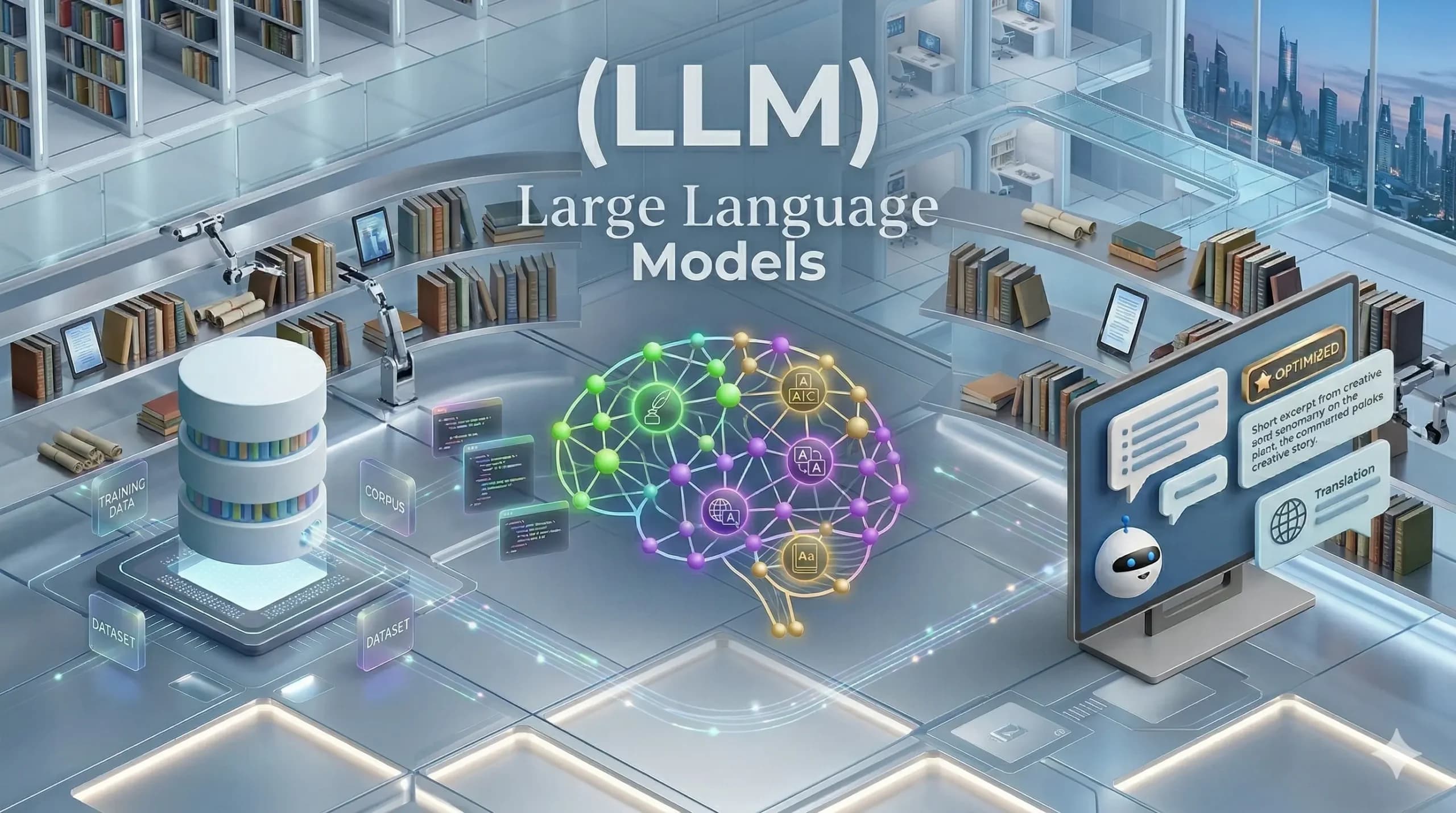
A Large Language Model (LLM) is a type of AI that is trained on massive volumes of text data. This data is drawn from books, websites, articles, and other sources, enabling the model to understand and generate human language at scale. These models learn by recognising patterns, context, and relationships between words, drawing from billions of examples.

LLMs are capable of much more than simple keyword matching. They understand the meaning behind language, which allows them to summarise documents, answer nuanced questions, generate original content, translate languages, and assist with tasks that previously required significant human effort.

The most well-known examples include OpenAI’s GPT-4, Google’s Gemini, and Anthropic’s Claude. Each of these models contains billions of parameters that function as the model’s accumulated knowledge and reasoning capabilities. This enables the model to generate responses that feel natural and contextually appropriate.

Why Is Pre-Training LLMs So Important?

Pre-training is the foundational stage where an LLM builds its core understanding of language, facts, and reasoning. This occurs before the model is customised for any specific task or industry.

  • Establishes the model’s knowledge base: During pre-training, the LLM is exposed to trillions of words from diverse sources. This exposure allows the model to absorb grammar, factual information, linguistic patterns, and contextual reasoning, which inform every response it generates afterward.
  • Determines the model’s strengths and limitations: The quality, diversity, and volume of pre-training data directly shape what a model can do well and where it may fall short. A model trained on narrow or low-quality data will produce limited, unreliable outputs, regardless of how much fine-tuning follows later.
  • Makes fine-tuning faster and more effective: Pre-training provides the model with a broad language foundation. Specialised fine-tuning can then build on this foundation. Organisations that fine-tune a pre-trained model on industry-specific content can achieve high accuracy with much less data than would be required to train from scratch.
  • Shapes how AI tools serve content and marketing teams: LLMs that power AI search and content platforms are built through pre-training processes. This defines their ability to understand intent, generate relevant responses, and cite authoritative sources. This is why content quality and structure are crucial to how these models represent a brand.

What Are the Key Types of Large Language Models (LLMs)?

LLMs vary significantly in their architecture, accessibility, and intended purpose. Understanding these differences helps marketers and content teams select the right tools for their goals.

  • General-purpose LLMs: These models, such as GPT-4 and Gemini, are trained on broad datasets covering virtually every topic. They handle a wide range of tasks from content generation to Q&A, making them the default choice for most marketing and content applications.
  • Domain-specific LLMs: These models are fine-tuned on industry-specific data, such as legal texts, medical literature, or financial reports. As a result, they produce more accurate outputs for specialised fields where generic models may lack the depth or precision required for professional use cases.
  • Open-weight LLMs: Models like Meta’s LLaMA and Mistral release their weights publicly, allowing developers to inspect, modify, and deploy them. This transparency accelerates innovation and gives organisations greater control over how the model is configured for their specific needs.
  • Instruction-tuned LLMs: These models are specifically trained to follow natural language instructions from users. They power most consumer-facing AI tools, including writing assistants and chatbots, because they reliably align their outputs with what users are actually asking for.
  • Multimodal LLMs: The latest generation of models can process and generate text, images, audio, and other data types within a single system. These models are expanding AI capabilities in content production, creative campaigns, and multi-format digital marketing workflows.

How Do Large Language Models (LLMs) Actually Work?

Large Language Models are built on a neural network architecture known as the transformer. This architecture processes text by breaking it into smaller units called tokens, which may be words, word fragments, or characters. The model then analyses the relationships among all tokens simultaneously, rather than reading them one at a time.

At the core of the transformer is a mechanism called self-attention. This allows the model to weigh the importance of different words relative to one another, regardless of how far apart they appear in a sentence. The result is that an LLM can understand context and produce coherent, nuanced responses instead of generic or disconnected outputs.

When a user submits a prompt, the model encodes the input and processes it through multiple neural network layers. It then generates a response by predicting the most likely next token based on all prior contexts. This process, called inference, happens in milliseconds and repeats until the full response is complete. The model draws on everything it absorbed during its pre-training phase.

What Are the Benefits and Challenges of Large Language Models (LLMs)?

LLMs offer powerful advantages for content and digital marketing teams. However, adopting them effectively requires navigating a set of practical challenges.

Benefits of LLMs

  • LLMs greatly accelerate content production, allowing marketing teams to generate drafts, summaries, and research at a pace that would be impossible through manual effort alone.
  • These models make it possible to personalise messaging at scale. Brands can tailor their communication for different audience segments without increasing the manual workload for writers and strategists.
  • LLMs power the AI search platforms that increasingly determine how brands are discovered. Therefore, understanding these models is a core part of any serious content strategy.
  • Organisations that integrate LLMs into their workflows consistently report improvements in output volume, consistency of brand voice, and speed of campaign execution across channels.

Challenges of LLMs

  • LLMs can generate plausible-sounding but factually incorrect information. Human review and expert oversight remain essential before publishing any AI-assisted content.
  • These models reflect biases present in their training data. Without careful management, such biases can appear in marketing content and damage brand credibility and audience trust.
  • Operating and fine-tuning LLMs at scale requires significant technical infrastructure and cost. This presents a meaningful barrier for smaller organisations with limited resources.
  • AI-generated content that lacks original insight, proprietary data, or expert perspective is increasingly deprioritised by AI search platforms. These platforms favour authoritative, human-driven sources.

What Is the Difference Between Large Language Models and Generative AI?

LLMs and Generative AI are closely related terms that are often used interchangeably. However, they do not mean the same thing. Understanding the distinction is important for anyone building an AI-informed content strategy.

  • Scope of the category: Generative AI is the broader category that includes any AI system capable of producing original content. This encompasses text, images, audio, and video. Large Language Models are a specific subset of Generative AI that focus exclusively on understanding and generating human language.
  • Output type: LLMs produce text-based outputs, such as written content, conversation, summaries, code, and similar responses. Other Generative AI systems, such as DALL-E and MidJourney, generate images rather than language, using entirely different architectures.
  • Training approach: LLMs are trained on datasets that are heavily text-based, drawn from the web, books, and other written sources. Other Generative AI models are trained on image, audio, or video data, and their architectures differ substantially depending on the type of content they are designed to produce.
  • Application in marketing: LLMs are the primary AI systems behind content creation, AI search, chatbots, and writing assistants. Broader Generative AI tools extend to visual design, video production, and audio generation, covering the full spectrum of creative output needed by modern marketing teams.
  • Relationship to each other: Every LLM is a form of Generative AI. However, not every Generative AI system is an LLM. Understanding this distinction helps marketers choose the right tool for the task, rather than relying on a single AI system for content needs that require fundamentally different capabilities.

What Are the Key Use Cases of Large Language Models for Content and Digital Marketing?

LLMs are reshaping how marketing and content teams plan, create, and distribute their work. These applications continue to expand as the models themselves improve.

  • Content creation and scaling: LLMs assist with drafting blog posts, website copy, social media content, newsletters, and campaign messaging. Teams that use LLMs for initial drafts and research phases consistently produce more content with greater consistency while freeing human writers to focus on strategy, voice, and original analysis.
  • AI search visibility and GEO: AI platforms powered by LLMs synthesise answers from multiple sources and cite the most credible, well-structured content. Brands aligning their content strategy with how LLMs retrieve and evaluate information position themselves to appear consistently in AI-generated responses across ChatGPT, Perplexity, and Google AI Overviews.
  • Personal branding and thought leadership: LLMs help executives and founders articulate their expertise at scale through LinkedIn articles, ghostwritten pieces, and long-form commentary. The output is most effective when grounded in genuine insight. Human-led ideation combined with LLM-assisted drafting produces the strongest results for driving personal branding.
  • Content strategy and research: LLMs can analyse topics, identify content gaps, map audience intent, and generate briefs that inform an entire editorial calendar. For content strategy agencies, this capability significantly compresses the research and planning phase while maintaining the depth required for high-quality content.
  • Customer engagement and brand communication: LLMs power chatbots, email personalisation engines, and conversational marketing tools. These allow brands to maintain consistent, relevant communication with large audiences across multiple touchpoints simultaneously.

At Scribblers India, our team combines our content marketing services with a comprehensive GEO and AEO strategy to help brands build the kind of authoritative, AI-ready content that LLMs recognise and recommend.

Get in touch today to start building a content presence that performs in the AI era.

FAQs

How do Large Language Models influence AI search results?

AI search platforms like ChatGPT, Perplexity, and Google AI Overviews use LLMs to synthesise answers from multiple sources. Brands whose content is well-structured, authoritative, and information-rich are far more likely to be retrieved and cited by these systems when users ask relevant questions.

What is the difference between an LLM and a traditional chatbot?

Traditional chatbots follow scripted, rule-based decision trees that can only respond within a predefined set of options. LLMs understand natural language and generate contextually appropriate, original responses, allowing them to handle complex, open-ended queries in ways that scripted systems cannot match.

Can LLMs be trained on a company’s own content and data?

Yes, organisations can fine-tune pre-trained LLMs using their proprietary content, internal documents, and brand guidelines. This allows the model to produce outputs that reflect the company’s specific voice, terminology, and domain expertise, instead of defaulting to generic language from its broader training data.

How should content writers adapt their work for an LLM-driven search environment?

Writers should prioritise original research, expert perspective, and clear structure over volume and keyword density. LLMs favour content that contains unique, citable information and is organised so that AI systems can extract and accurately represent key points in a synthesised response.

What role do LLMs play in personal branding for executives?

LLMs help executives publish consistent, expert-led content across platforms like LinkedIn at a frequency that manual writing alone could not sustain. When the content is anchored in genuine experience and original thinking, LLMs handle the drafting and structuring. This enables the executive’s authority and perspective to reach a much wider audience without additional time investment.

HomeGlossaryLarge Language Model (LLM)

Large Language Model (LLM)

Large Language Model (LLM)

Large Language Models (LLMs) power the AI tools that millions of users now rely on every day. This ranges from AI search platforms and writing assistants to customer support systems and content strategy tools.

Understanding how these models work is no longer limited to data scientists and developers. Marketers, content creators, and brand builders must now learn what Large Language Models are and how they shape digital experiences, because this knowledge is essential for staying relevant and competitive in today’s AI-driven landscape.

What Is a Large Language Model (LLM) and What Can It Do?

A Large Language Model (LLM) is a type of AI that is trained on massive volumes of text data. This data is drawn from books, websites, articles, and other sources, enabling the model to understand and generate human language at scale. These models learn by recognising patterns, context, and relationships between words, drawing from billions of examples.

LLMs are capable of much more than simple keyword matching. They understand the meaning behind language, which allows them to summarise documents, answer nuanced questions, generate original content, translate languages, and assist with tasks that previously required significant human effort.

The most well-known examples include OpenAI’s GPT-4, Google’s Gemini, and Anthropic’s Claude. Each of these models contains billions of parameters that function as the model’s accumulated knowledge and reasoning capabilities. This enables the model to generate responses that feel natural and contextually appropriate.

Why Is Pre-Training LLMs So Important?

Pre-training is the foundational stage where an LLM builds its core understanding of language, facts, and reasoning. This occurs before the model is customised for any specific task or industry.

  • Establishes the model’s knowledge base: During pre-training, the LLM is exposed to trillions of words from diverse sources. This exposure allows the model to absorb grammar, factual information, linguistic patterns, and contextual reasoning, which inform every response it generates afterward.
  • Determines the model’s strengths and limitations: The quality, diversity, and volume of pre-training data directly shape what a model can do well and where it may fall short. A model trained on narrow or low-quality data will produce limited, unreliable outputs, regardless of how much fine-tuning follows later.
  • Makes fine-tuning faster and more effective: Pre-training provides the model with a broad language foundation. Specialised fine-tuning can then build on this foundation. Organisations that fine-tune a pre-trained model on industry-specific content can achieve high accuracy with much less data than would be required to train from scratch.
  • Shapes how AI tools serve content and marketing teams: LLMs that power AI search and content platforms are built through pre-training processes. This defines their ability to understand intent, generate relevant responses, and cite authoritative sources. This is why content quality and structure are crucial to how these models represent a brand.

What Are the Key Types of Large Language Models (LLMs)?

LLMs vary significantly in their architecture, accessibility, and intended purpose. Understanding these differences helps marketers and content teams select the right tools for their goals.

  • General-purpose LLMs: These models, such as GPT-4 and Gemini, are trained on broad datasets covering virtually every topic. They handle a wide range of tasks from content generation to Q&A, making them the default choice for most marketing and content applications.
  • Domain-specific LLMs: These models are fine-tuned on industry-specific data, such as legal texts, medical literature, or financial reports. As a result, they produce more accurate outputs for specialised fields where generic models may lack the depth or precision required for professional use cases.
  • Open-weight LLMs: Models like Meta’s LLaMA and Mistral release their weights publicly, allowing developers to inspect, modify, and deploy them. This transparency accelerates innovation and gives organisations greater control over how the model is configured for their specific needs.
  • Instruction-tuned LLMs: These models are specifically trained to follow natural language instructions from users. They power most consumer-facing AI tools, including writing assistants and chatbots, because they reliably align their outputs with what users are actually asking for.
  • Multimodal LLMs: The latest generation of models can process and generate text, images, audio, and other data types within a single system. These models are expanding AI capabilities in content production, creative campaigns, and multi-format digital marketing workflows.

How Do Large Language Models (LLMs) Actually Work?

Large Language Models are built on a neural network architecture known as the transformer. This architecture processes text by breaking it into smaller units called tokens, which may be words, word fragments, or characters. The model then analyses the relationships among all tokens simultaneously, rather than reading them one at a time.

At the core of the transformer is a mechanism called self-attention. This allows the model to weigh the importance of different words relative to one another, regardless of how far apart they appear in a sentence. The result is that an LLM can understand context and produce coherent, nuanced responses instead of generic or disconnected outputs.

When a user submits a prompt, the model encodes the input and processes it through multiple neural network layers. It then generates a response by predicting the most likely next token based on all prior contexts. This process, called inference, happens in milliseconds and repeats until the full response is complete. The model draws on everything it absorbed during its pre-training phase.

What Are the Benefits and Challenges of Large Language Models (LLMs)?

LLMs offer powerful advantages for content and digital marketing teams. However, adopting them effectively requires navigating a set of practical challenges.

Benefits of LLMs

  • LLMs greatly accelerate content production, allowing marketing teams to generate drafts, summaries, and research at a pace that would be impossible through manual effort alone.
  • These models make it possible to personalise messaging at scale. Brands can tailor their communication for different audience segments without increasing the manual workload for writers and strategists.
  • LLMs power the AI search platforms that increasingly determine how brands are discovered. Therefore, understanding these models is a core part of any serious content strategy.
  • Organisations that integrate LLMs into their workflows consistently report improvements in output volume, consistency of brand voice, and speed of campaign execution across channels.

Challenges of LLMs

  • LLMs can generate plausible-sounding but factually incorrect information. Human review and expert oversight remain essential before publishing any AI-assisted content.
  • These models reflect biases present in their training data. Without careful management, such biases can appear in marketing content and damage brand credibility and audience trust.
  • Operating and fine-tuning LLMs at scale requires significant technical infrastructure and cost. This presents a meaningful barrier for smaller organisations with limited resources.
  • AI-generated content that lacks original insight, proprietary data, or expert perspective is increasingly deprioritised by AI search platforms. These platforms favour authoritative, human-driven sources.

What Is the Difference Between Large Language Models and Generative AI?

LLMs and Generative AI are closely related terms that are often used interchangeably. However, they do not mean the same thing. Understanding the distinction is important for anyone building an AI-informed content strategy.

  • Scope of the category: Generative AI is the broader category that includes any AI system capable of producing original content. This encompasses text, images, audio, and video. Large Language Models are a specific subset of Generative AI that focus exclusively on understanding and generating human language.
  • Output type: LLMs produce text-based outputs, such as written content, conversation, summaries, code, and similar responses. Other Generative AI systems, such as DALL-E and MidJourney, generate images rather than language, using entirely different architectures.
  • Training approach: LLMs are trained on datasets that are heavily text-based, drawn from the web, books, and other written sources. Other Generative AI models are trained on image, audio, or video data, and their architectures differ substantially depending on the type of content they are designed to produce.
  • Application in marketing: LLMs are the primary AI systems behind content creation, AI search, chatbots, and writing assistants. Broader Generative AI tools extend to visual design, video production, and audio generation, covering the full spectrum of creative output needed by modern marketing teams.
  • Relationship to each other: Every LLM is a form of Generative AI. However, not every Generative AI system is an LLM. Understanding this distinction helps marketers choose the right tool for the task, rather than relying on a single AI system for content needs that require fundamentally different capabilities.

What Are the Key Use Cases of Large Language Models for Content and Digital Marketing?

LLMs are reshaping how marketing and content teams plan, create, and distribute their work. These applications continue to expand as the models themselves improve.

  • Content creation and scaling: LLMs assist with drafting blog posts, website copy, social media content, newsletters, and campaign messaging. Teams that use LLMs for initial drafts and research phases consistently produce more content with greater consistency while freeing human writers to focus on strategy, voice, and original analysis.
  • AI search visibility and GEO: AI platforms powered by LLMs synthesise answers from multiple sources and cite the most credible, well-structured content. Brands aligning their content strategy with how LLMs retrieve and evaluate information position themselves to appear consistently in AI-generated responses across ChatGPT, Perplexity, and Google AI Overviews.
  • Personal branding and thought leadership: LLMs help executives and founders articulate their expertise at scale through LinkedIn articles, ghostwritten pieces, and long-form commentary. The output is most effective when grounded in genuine insight. Human-led ideation combined with LLM-assisted drafting produces the strongest results for driving personal branding.
  • Content strategy and research: LLMs can analyse topics, identify content gaps, map audience intent, and generate briefs that inform an entire editorial calendar. For content strategy agencies, this capability significantly compresses the research and planning phase while maintaining the depth required for high-quality content.
  • Customer engagement and brand communication: LLMs power chatbots, email personalisation engines, and conversational marketing tools. These allow brands to maintain consistent, relevant communication with large audiences across multiple touchpoints simultaneously.

At Scribblers India, our team combines our content marketing services with a comprehensive GEO and AEO strategy to help brands build the kind of authoritative, AI-ready content that LLMs recognise and recommend.

Get in touch today to start building a content presence that performs in the AI era.

FAQs

How do Large Language Models influence AI search results?

AI search platforms like ChatGPT, Perplexity, and Google AI Overviews use LLMs to synthesise answers from multiple sources. Brands whose content is well-structured, authoritative, and information-rich are far more likely to be retrieved and cited by these systems when users ask relevant questions.

What is the difference between an LLM and a traditional chatbot?

Traditional chatbots follow scripted, rule-based decision trees that can only respond within a predefined set of options. LLMs understand natural language and generate contextually appropriate, original responses, allowing them to handle complex, open-ended queries in ways that scripted systems cannot match.

Can LLMs be trained on a company’s own content and data?

Yes, organisations can fine-tune pre-trained LLMs using their proprietary content, internal documents, and brand guidelines. This allows the model to produce outputs that reflect the company’s specific voice, terminology, and domain expertise, instead of defaulting to generic language from its broader training data.

How should content writers adapt their work for an LLM-driven search environment?

Writers should prioritise original research, expert perspective, and clear structure over volume and keyword density. LLMs favour content that contains unique, citable information and is organised so that AI systems can extract and accurately represent key points in a synthesised response.

What role do LLMs play in personal branding for executives?

LLMs help executives publish consistent, expert-led content across platforms like LinkedIn at a frequency that manual writing alone could not sustain. When the content is anchored in genuine experience and original thinking, LLMs handle the drafting and structuring. This enables the executive’s authority and perspective to reach a much wider audience without additional time investment.