
logo

Scribblers India

Home
Contact
Contact

Let's Talk

501, Vinca Block, Amravati Enclave, Panchkula, Haryana

Call +91 8818073118
SCRIBBLERS*INDIA*
  • Home
  • Resources
  • Contact
  • Privacy Policy
  • Blog
  • Glossary
  • Cookies Policy
  • Terms of Service
  • Visual Content Creating
  • Whitepaper & Case Study Writing
  • Newsletter Writing
  • Academic Content Writing
  • Generative Engine Optimization
  • Annual Report Writing
  • Content Strategy
  • Content Marketing
  • Personal Branding
  • Answer Engine Optimization
  • Digital PR
  • Ghostwriting
  • Ebook Writing
  • Thought Leadership Content Writing
  • Digital PR
  • Copywriting
  • Website Content Writing
  • Bulk Content Writing
  • Social Media Marketing
  • AI Content Editing
PrivacyTermsSitemap

© 2026 Scribblers India. All Rights Reserved.

logo

Scribblers India

Home
Contact
Contact

Let's Talk

501, Vinca Block, Amravati Enclave, Panchkula, Haryana

Call +91 8818073118
SCRIBBLERS*INDIA*
  • Home
  • Resources
  • Contact
  • Privacy Policy
  • Blog
  • Glossary
  • Cookies Policy
  • Terms of Service
  • Visual Content Creating
  • Whitepaper & Case Study Writing
  • Newsletter Writing
  • Academic Content Writing
  • Generative Engine Optimization
  • Annual Report Writing
  • Content Strategy
  • Content Marketing
  • Personal Branding
  • Answer Engine Optimization
  • Digital PR
  • Ghostwriting
  • Ebook Writing
  • Thought Leadership Content Writing
  • Digital PR
  • Copywriting
  • Website Content Writing
  • Bulk Content Writing
  • Social Media Marketing
  • AI Content Editing
PrivacyTermsSitemap

© 2026 Scribblers India. All Rights Reserved.

HomeGlossaryZero-Click Search

Zero-Click Search

Zero-Click Search

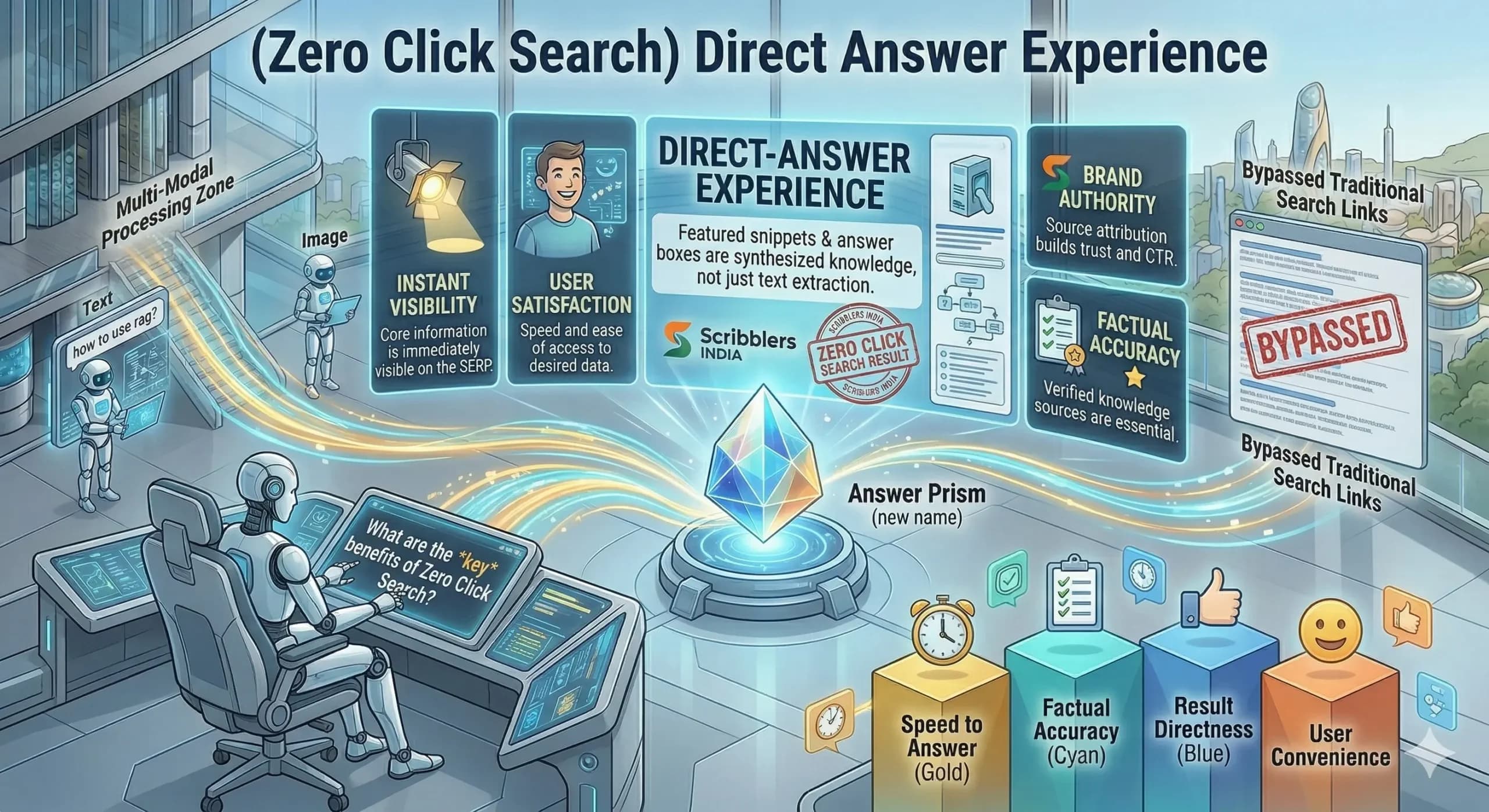
Search engines used to function as directories, pointing users to websites that held the answer. Today, they increasingly function as answer machines. This shift has led to what is known as Zero-Click Search, where users type a question, the search engine delivers the answer directly on the results page, and the user leaves without visiting a single website.

This behavior defines zero-click search, and it is reshaping how brands measure visibility, plan content, and approach digital marketing altogether. According to research, around 60% of all Google searches in 2025 end without a click. On mobile devices, that figure climbs to 77%. For brands that depend on organic search as a primary traffic channel, this represents one of the most significant structural shifts in the history of digital marketing.

What is a Zero-Click Search and What Causes It?

A zero-click search occurs when a user finds the information they need directly on the search results page, without clicking through to any external website. The search engine resolves the query within its own interface, making a website visit unnecessary for the user to complete their information need.

Several search features drive this behavior. Google’s AI Overviews synthesize answers from multiple sources and display them at the top of results. Featured snippets present a highlighted block of text extracted directly from a web page. Knowledge panels surface structured information about entities: brands, people, and locations, without requiring the user to visit any individual source website. Local packs, weather cards, calculator tools, and conversion widgets resolve informational and transactional queries entirely within the search environment.

Voice search accelerates this trend significantly. When a user asks a smart speaker or mobile assistant a question, the device reads a single answer aloud, with no link provided, making the concept of a click entirely irrelevant to how the content is discovered and consumed.

How Does Zero-Click Search Affect Organic Traffic and Content Marketing?

Zero-click search creates a direct tension between traditional content marketing goals and the reality of how modern search now works. Brands that built their traffic models on organic clicks from informational content report measurable declines even when their search rankings remain strong.

The impact is not uniform across all content types. Informational content — definitions, how-to guides, conversion tools, and factual queries — faces the heaviest disruption because these query types are precisely what AI Overviews and featured snippets are designed to resolve. Transactional, commercial, and navigational queries that require a website visit to complete an action are far less disrupted, which is why a diversified content strategy that covers multiple intent types performs more resiliently in a zero-click environment.

  • Impression share grows while click share shrinks: A brand’s content can appear at the top of a search results page and earn significantly fewer clicks than it would have two years ago, because the AI Overview or featured snippet above it already answered the user’s question before they considered clicking.
  • Brand awareness benefits remain substantial: When a brand’s content is cited in an AI Overview or featured snippet, it gains exposure at the exact moment the user is asking a relevant question. This awareness-level visibility influences brand recall, direct search behavior, and downstream conversions even when no click occurs during the session.
  • Content authority becomes the primary competitive advantage: Zero-click search rewards brands whose content is trusted enough to be selected as the source for a displayed answer. Building that trust through thought leadership content writing and original research delivers compounding brand authority that benefits both zero-click visibility and traditional organic performance simultaneously.

What Is the Difference Between Zero-Click Search and AI-Powered Search?

Zero-click search is a behavioral outcome: the user gets the answer without clicking. AI-powered search is the mechanism increasingly responsible for producing that outcome, through features like AI Overviews, synthesized Perplexity responses, and ChatGPT direct answers. The two terms are related but not interchangeable in a content strategy context.

  • Scope of the concept: Zero-click search predates AI-powered search by several years. Featured snippets, knowledge panels, local packs, and weather widgets all produced zero-click outcomes long before AI Overviews launched. AI-powered search has dramatically accelerated the zero-click rate, but the trend itself began well before generative AI entered the search experience.
  • Source attribution patterns: Traditional zero-click features, such as featured snippets, typically attribute the answer to a single source and display the URL clearly below the extracted text. AI-powered search responses may synthesize content from multiple sources simultaneously, citing several or none, making attribution more complex for brands trying to accurately measure their zero-click visibility.
  • Query complexity coverage: Traditional zero-click features resolved simple, factual queries most effectively. AI-powered search extends zero-click behavior into more complex, multi-part, and conversational queries that previously required users to visit multiple websites to fully satisfy their information needs.
  • Optimization approach required: Featured snippets and knowledge panels respond to structured data, concise answer paragraphs, and schema markup. AI-powered search also responds to entity authority, original information gain, and multi-platform brand credibility, which is why AEO and GEO strategies extend the optimization framework well beyond traditional zero-click tactics.
  • Measurement framework differences: Zero-click search performance has traditionally been measured through featured snippet wins and impression share in Google Search Console. AI-powered zero-click visibility additionally requires tracking brand mentions in AI-generated responses, citation frequency across platforms, share of voice in AI-mediated discovery, and downstream branded search volume lift as indirect indicators.

How Can Brands Adapt Their Content Strategy to Zero-Click Search?

Adapting to zero-click search does not mean abandoning organic content investment. It means restructuring how content gets created, measured, and distributed to capture visibility at the answer layer rather than relying solely on click-through traffic as the primary measure of success.

The most effective brands in a zero-click environment take a visibility-first approach. They optimize for citation, brand mentions, and authority signals rather than for clicks. A strong content marketing strategy for the zero-click era integrates traditional SEO with AEO and GEO principles, ensuring the brand performs across all layers of the modern search experience simultaneously.

  • Structure content for extraction: Write answer paragraphs of 40 to 60 words that directly resolve a specific query near the top of each content section. Use question-based headings that mirror how users phrase natural-language searches, which is precisely what AI Overviews and featured snippets extract and display.
  • Invest in original data and branded research: Zero-click surfaces cite the source of the information they display. Brands that produce original research, surveys, and proprietary data earn citation credit in AI Overviews and featured snippets, building brand authority with audiences who encounter the brand as the origin of a trusted insight without requiring a website visit.
  • Build presence across multiple channels simultaneously: Zero-click search reduces reliance on a single organic traffic channel. Brands that distribute authority across personal branding, social media marketing, newsletters, and thought leadership content maintain audience relationships despite fluctuations in website traffic caused by zero-click trends in search.
  • Shift measurement toward visibility metrics: Tracking featured snippet wins, AI Overview citation frequency, brand mention rate in AI responses, and branded search volume provides a far more accurate picture of how a brand performs in a zero-click environment than click-through rates and organic sessions alone can reveal.

What Role Does Zero-Click Search Play in Personal Branding and Thought Leadership?

Zero-click search creates a significant opportunity for executives, founders, and subject-matter experts who invest in personal branding and thought leadership content.

When an AI Overview or featured snippet cites an individual’s research, quotes their expert commentary, or attributes an original framework to them, the brand recognition generated reaches audiences who never visit the website. This form of visibility compounds over time as AI systems increasingly associate the individual’s name with specific areas of authority and credibility.

Executives who publish consistent, original, expert-led content position themselves and their organizations as the default citation sources for the topics they own. In a zero-click world, that citation authority translates into brand awareness, trust, and influence that operates independently of traditional traffic metrics, making it one of the most durable competitive advantages available in an AI-powered search environment.

At Scribblers India, the team combines content marketing, AEO services, and personal branding expertise to help brands build authority that performs across zero-click and AI-powered search environments.

Get in touch today to build search visibility that does not depend on clicks alone.

FAQs

How do zero-click searches affect e-commerce and product-focused businesses specifically?

E-commerce brands face less disruption from zero-click search than information-focused publishers because transactional and product queries still require a website visit to complete a purchase. Informational content that supports the buyer journey faces higher zero-click exposure, which means product-led brands benefit from pairing transactional page optimization with AEO-optimized educational content that drives brand recognition upstream of the purchase decision.

What metrics should brands track to measure performance in a zero-click search environment?

Brands should track featured snippet wins, Google Search Console impression share, AI Overview citation frequency, branded search volume trends, and direct traffic growth alongside traditional click-based metrics. These visibility indicators capture the brand recognition and authority-building that zero-click search produces even when users never click through to the website during their immediate search session.

Can zero-click search actually increase brand awareness for businesses that do not earn clicks?

Yes. When an AI Overview or featured snippet cites a brand’s content as the source of a trusted answer, the brand name and positioning reach the user at the peak of information intent. Answer-layer brand visibility builds trust and influences purchasing decisions without requiring an immediate click.

How does voice search relate to zero-click search for local and service-based businesses?

Voice search is the most complete form of zero-click search because the device delivers a spoken answer with no link. Local and service-based businesses benefit from optimizing their Google Business Profile, building location-specific content with FAQ schema, and ensuring their brand appears in the structured data sources that voice assistants prioritize when users ask for nearby services or recommendations.

Does creating content for zero-click search hurt a website’s ability to generate direct traffic?

Content optimized for zero-click search and content optimized for direct traffic are not mutually exclusive. Structuring content with direct-answer paragraphs, question-based headings, and schema markup improves both AI citation rates and traditional organic performance. Brands that add original insights, interactive tools, and deeper analysis layers give users who encounter a brand in a zero-click result a strong reason to visit the full website for the complete experience.
RELATED ARTICLES

Retrieval-Augmented Generation (RAG)

Glossary

Retrieval-Augmented Generation (RAG)
Answer Engine Optimization (AEO)

Glossary

Answer Engine Optimization (AEO)
Generative Engine Optimization (GEO)

Glossary

Generative Engine Optimization (GEO)
HomeGlossaryZero-Click Search

Zero-Click Search

Zero-Click Search

Search engines used to function as directories, pointing users to websites that held the answer. Today, they increasingly function as answer machines. This shift has led to what is known as Zero-Click Search, where users type a question, the search engine delivers the answer directly on the results page, and the user leaves without visiting a single website.

This behavior defines zero-click search, and it is reshaping how brands measure visibility, plan content, and approach digital marketing altogether. According to research, around 60% of all Google searches in 2025 end without a click. On mobile devices, that figure climbs to 77%. For brands that depend on organic search as a primary traffic channel, this represents one of the most significant structural shifts in the history of digital marketing.

What is a Zero-Click Search and What Causes It?

A zero-click search occurs when a user finds the information they need directly on the search results page, without clicking through to any external website. The search engine resolves the query within its own interface, making a website visit unnecessary for the user to complete their information need.

Several search features drive this behavior. Google’s AI Overviews synthesize answers from multiple sources and display them at the top of results. Featured snippets present a highlighted block of text extracted directly from a web page. Knowledge panels surface structured information about entities: brands, people, and locations, without requiring the user to visit any individual source website. Local packs, weather cards, calculator tools, and conversion widgets resolve informational and transactional queries entirely within the search environment.

Voice search accelerates this trend significantly. When a user asks a smart speaker or mobile assistant a question, the device reads a single answer aloud, with no link provided, making the concept of a click entirely irrelevant to how the content is discovered and consumed.

How Does Zero-Click Search Affect Organic Traffic and Content Marketing?

Zero-click search creates a direct tension between traditional content marketing goals and the reality of how modern search now works. Brands that built their traffic models on organic clicks from informational content report measurable declines even when their search rankings remain strong.

The impact is not uniform across all content types. Informational content — definitions, how-to guides, conversion tools, and factual queries — faces the heaviest disruption because these query types are precisely what AI Overviews and featured snippets are designed to resolve. Transactional, commercial, and navigational queries that require a website visit to complete an action are far less disrupted, which is why a diversified content strategy that covers multiple intent types performs more resiliently in a zero-click environment.

  • Impression share grows while click share shrinks: A brand’s content can appear at the top of a search results page and earn significantly fewer clicks than it would have two years ago, because the AI Overview or featured snippet above it already answered the user’s question before they considered clicking.
  • Brand awareness benefits remain substantial: When a brand’s content is cited in an AI Overview or featured snippet, it gains exposure at the exact moment the user is asking a relevant question. This awareness-level visibility influences brand recall, direct search behavior, and downstream conversions even when no click occurs during the session.
  • Content authority becomes the primary competitive advantage: Zero-click search rewards brands whose content is trusted enough to be selected as the source for a displayed answer. Building that trust through thought leadership content writing and original research delivers compounding brand authority that benefits both zero-click visibility and traditional organic performance simultaneously.

What Is the Difference Between Zero-Click Search and AI-Powered Search?

Zero-click search is a behavioral outcome: the user gets the answer without clicking. AI-powered search is the mechanism increasingly responsible for producing that outcome, through features like AI Overviews, synthesized Perplexity responses, and ChatGPT direct answers. The two terms are related but not interchangeable in a content strategy context.

  • Scope of the concept: Zero-click search predates AI-powered search by several years. Featured snippets, knowledge panels, local packs, and weather widgets all produced zero-click outcomes long before AI Overviews launched. AI-powered search has dramatically accelerated the zero-click rate, but the trend itself began well before generative AI entered the search experience.
  • Source attribution patterns: Traditional zero-click features, such as featured snippets, typically attribute the answer to a single source and display the URL clearly below the extracted text. AI-powered search responses may synthesize content from multiple sources simultaneously, citing several or none, making attribution more complex for brands trying to accurately measure their zero-click visibility.
  • Query complexity coverage: Traditional zero-click features resolved simple, factual queries most effectively. AI-powered search extends zero-click behavior into more complex, multi-part, and conversational queries that previously required users to visit multiple websites to fully satisfy their information needs.
  • Optimization approach required: Featured snippets and knowledge panels respond to structured data, concise answer paragraphs, and schema markup. AI-powered search also responds to entity authority, original information gain, and multi-platform brand credibility, which is why AEO and GEO strategies extend the optimization framework well beyond traditional zero-click tactics.
  • Measurement framework differences: Zero-click search performance has traditionally been measured through featured snippet wins and impression share in Google Search Console. AI-powered zero-click visibility additionally requires tracking brand mentions in AI-generated responses, citation frequency across platforms, share of voice in AI-mediated discovery, and downstream branded search volume lift as indirect indicators.

How Can Brands Adapt Their Content Strategy to Zero-Click Search?

Adapting to zero-click search does not mean abandoning organic content investment. It means restructuring how content gets created, measured, and distributed to capture visibility at the answer layer rather than relying solely on click-through traffic as the primary measure of success.

The most effective brands in a zero-click environment take a visibility-first approach. They optimize for citation, brand mentions, and authority signals rather than for clicks. A strong content marketing strategy for the zero-click era integrates traditional SEO with AEO and GEO principles, ensuring the brand performs across all layers of the modern search experience simultaneously.

  • Structure content for extraction: Write answer paragraphs of 40 to 60 words that directly resolve a specific query near the top of each content section. Use question-based headings that mirror how users phrase natural-language searches, which is precisely what AI Overviews and featured snippets extract and display.
  • Invest in original data and branded research: Zero-click surfaces cite the source of the information they display. Brands that produce original research, surveys, and proprietary data earn citation credit in AI Overviews and featured snippets, building brand authority with audiences who encounter the brand as the origin of a trusted insight without requiring a website visit.
  • Build presence across multiple channels simultaneously: Zero-click search reduces reliance on a single organic traffic channel. Brands that distribute authority across personal branding, social media marketing, newsletters, and thought leadership content maintain audience relationships despite fluctuations in website traffic caused by zero-click trends in search.
  • Shift measurement toward visibility metrics: Tracking featured snippet wins, AI Overview citation frequency, brand mention rate in AI responses, and branded search volume provides a far more accurate picture of how a brand performs in a zero-click environment than click-through rates and organic sessions alone can reveal.

What Role Does Zero-Click Search Play in Personal Branding and Thought Leadership?

Zero-click search creates a significant opportunity for executives, founders, and subject-matter experts who invest in personal branding and thought leadership content.

When an AI Overview or featured snippet cites an individual’s research, quotes their expert commentary, or attributes an original framework to them, the brand recognition generated reaches audiences who never visit the website. This form of visibility compounds over time as AI systems increasingly associate the individual’s name with specific areas of authority and credibility.

Executives who publish consistent, original, expert-led content position themselves and their organizations as the default citation sources for the topics they own. In a zero-click world, that citation authority translates into brand awareness, trust, and influence that operates independently of traditional traffic metrics, making it one of the most durable competitive advantages available in an AI-powered search environment.

At Scribblers India, the team combines content marketing, AEO services, and personal branding expertise to help brands build authority that performs across zero-click and AI-powered search environments.

Get in touch today to build search visibility that does not depend on clicks alone.

FAQs

How do zero-click searches affect e-commerce and product-focused businesses specifically?

E-commerce brands face less disruption from zero-click search than information-focused publishers because transactional and product queries still require a website visit to complete a purchase. Informational content that supports the buyer journey faces higher zero-click exposure, which means product-led brands benefit from pairing transactional page optimization with AEO-optimized educational content that drives brand recognition upstream of the purchase decision.

What metrics should brands track to measure performance in a zero-click search environment?

Brands should track featured snippet wins, Google Search Console impression share, AI Overview citation frequency, branded search volume trends, and direct traffic growth alongside traditional click-based metrics. These visibility indicators capture the brand recognition and authority-building that zero-click search produces even when users never click through to the website during their immediate search session.

Can zero-click search actually increase brand awareness for businesses that do not earn clicks?

Yes. When an AI Overview or featured snippet cites a brand’s content as the source of a trusted answer, the brand name and positioning reach the user at the peak of information intent. Answer-layer brand visibility builds trust and influences purchasing decisions without requiring an immediate click.

How does voice search relate to zero-click search for local and service-based businesses?

Voice search is the most complete form of zero-click search because the device delivers a spoken answer with no link. Local and service-based businesses benefit from optimizing their Google Business Profile, building location-specific content with FAQ schema, and ensuring their brand appears in the structured data sources that voice assistants prioritize when users ask for nearby services or recommendations.

Does creating content for zero-click search hurt a website’s ability to generate direct traffic?

Content optimized for zero-click search and content optimized for direct traffic are not mutually exclusive. Structuring content with direct-answer paragraphs, question-based headings, and schema markup improves both AI citation rates and traditional organic performance. Brands that add original insights, interactive tools, and deeper analysis layers give users who encounter a brand in a zero-click result a strong reason to visit the full website for the complete experience.
RELATED ARTICLES

Retrieval-Augmented Generation (RAG)

Glossary

Retrieval-Augmented Generation (RAG)
Answer Engine Optimization (AEO)

Glossary

Answer Engine Optimization (AEO)
Generative Engine Optimization (GEO)

Glossary

Generative Engine Optimization (GEO)