
Your next customer is asking ChatGPT for a vendor recommendation. Your ideal B2B prospect is running a Perplexity research query about solutions in your category. Google AI Overviews are now reaching over 2 billion users globally. In this new landscape, GEO services can help your business be found where these conversations are happening.
The brand that gets cited in those answers earns the discovery, the trust, and often the deal before a competitor’s website is ever opened. This is the environment where generative engine optimization services have become a strategic priority. GEO is the discipline that determines whether AI platforms cite your brand or your competitor’s when users ask questions you should own.
The GEO market was valued at $848 million in 2025 and is projected to reach $33.7 billion by 2034, a 50.5% compound annual growth rate. This guide explains what is GEO, how it works across every major AI platform, and what a proven GEO optimization strategy looks like for your business.

What Is Generative Engine Optimization (GEO) in Digital Marketing?
Generative engine optimization is the practice of structuring your content, brand signals, and technical setup so that AI-powered platforms select, extract, and cite your brand when generating answers to user queries.
Unlike traditional SEO, which earns a ranked position in a list of links, what is GEO in SEO comes down to one outcome: your brand becomes part of the answer itself. The distinction matters because AI platforms like ChatGPT, Perplexity, and Google AI Overviews do not display a list of results.
They synthesize information from multiple sources into a single conversational response and attribute specific claims to the sources they trust most. GEO services are the structured process of ensuring your content consistently meets the criteria those platforms use to select citation sources.
The Technology Behind GEO: How RAG Works
Most major AI search platforms use Retrieval-Augmented Generation, or RAG. The system retrieves relevant content from its index, evaluates it for factual accuracy and structural clarity, and then generates a human-readable answer incorporating cited claims.
GEO for AI search works by making your content easy to retrieve, easy to evaluate, and easy to incorporate into the generated response. Content that leads with a direct answer, includes verifiable statistics, and uses question-format headings is far more likely to pass the RAG evaluation stage than content buried behind lengthy preambles.
The Scale of the Opportunity
AI-referred web sessions grew 527% year-over-year through mid-2025, according to industry reports. Yet only 20% of brands have begun implementing generative engine optimization. This gap is the first-mover advantage that well-structured GEO services in India can help you capture before the competitive window closes.
Why GEO Is Not a Replacement for SEO
What is GEO in SEO is one of the most frequently misunderstood questions in digital marketing today. Generative engine optimization extends and future-proofs your SEO investment. It does not replace it. Research confirms that 99.5% of Google AI Overview citations come from pages already ranking in the top ten organic results.
This means your SEO foundation directly enables your GEO performance. The brands that win in AI search are almost always the ones with strong traditional SEO underpinning their content authority.
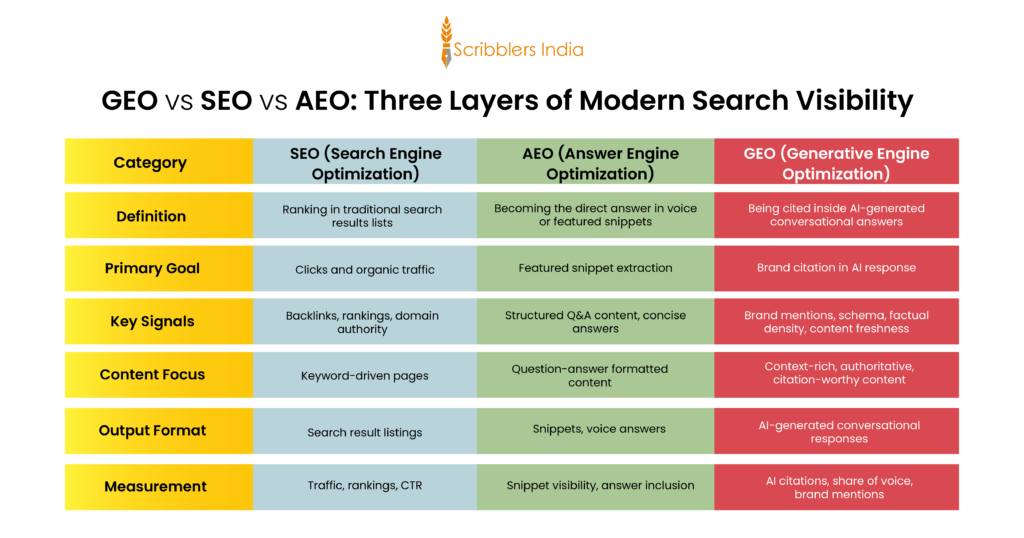
How Is Generative Engine Optimization (GEO) Different from SEO and AEO?
Generative engine optimization differs from SEO and AEO in what it optimizes for, how it measures success, and which signals it prioritizes. SEO earns a ranked position on a results page. AEO earns extraction into a featured snippet or direct answer box.
GEO for AI search earns a citation inside an AI-generated response, where your brand’s data, definition, or expertise becomes part of the answer a user receives without clicking anywhere.
Three Distinct Layers of Modern Visibility
Think of these disciplines as three layers working together. SEO builds the infrastructure that makes content discoverable and authoritative. AEO formats content for quick extraction in answer boxes and voice responses.
GEO services add a third layer: making content citable, quotable, and trustworthy for AI systems synthesizing information from thousands of user queries every minute. Removing any one layer weakens the other two.
How GEO Measures Success Differently?
Traditional SEO teams report on keyword rankings, organic traffic, and click-through rates. GEO optimization strategy requires a different measurement framework. The core metrics are:
- Citation frequency (how often AI platforms mention your brand)
- Share of voice (your citation rate compared to competitors)
- Citation sentiment (whether AI platforms describe your brand positively or neutrally)
- AI-referred traffic in Google Analytics 4.
Brands cited in AI answers convert at 4.4 times the rate of standard organic visitors, according to Frase’s 2025 research, making this a high-value channel despite lower raw traffic volume.
The Competitive Urgency
Between 40% and 60% of cited sources rotate monthly across Google AI Mode and ChatGPT, according to 2026 industry analysis. This volatility creates continuous opportunity for brands that publish consistent, high-quality, structured content.
The GEO services agency that helps you build topical authority and maintain content freshness is the one that gives you durable citation share even as platform algorithms evolve.
How Do You Optimize Your Content to Appear in ChatGPT Search Results and Answers?
Optimizing for ChatGPT requires a different approach from traditional SEO because ChatGPT evaluates content for encyclopedic depth, factual reliability, and entity recognition rather than keyword density or link profiles.
Generative AI optimization for ChatGPT centers on creating comprehensive, self-contained answer passages that the platform can extract and synthesize with confidence.
The Answer-First Content Structure
ChatGPT uses Retrieval-Augmented Generation, which processes the opening content of any page first. The first 200 words of every article must answer the primary question directly and completely.
This BLUF structure (Bottom Line Up Front) mirrors how AI systems parse content during the retrieval stage. A blog post that spends its first three paragraphs building context before reaching the answer will consistently lose citations to a competitor whose opening sentence states the answer plainly.
Entity Authority and Brand Recognition
ChatGPT drives 87.4% of all AI referral traffic to websites, making it the most important platform for citation volume. The platform rewards brands with strong entity recognition across the web.
This means your brand name should appear consistently across LinkedIn, YouTube, industry publications, Wikipedia (where applicable), and authoritative third-party sites in your category. A GEO optimization strategy for ChatGPT always includes an entity-building component that generates brand mentions across these high-authority surfaces.
Statistics as Citation Magnets
Content with verifiable statistics and named citations achieves 30% to 40% higher AI visibility than unoptimized content, according to Princeton University’s foundational GEO research.
Every 150 to 200 words of your content should include a specific, cited data point. “AI referral traffic grew 527% year-over-year” is citable. “AI traffic is growing fast” is not. This distinction separates content that AI systems quote from content they ignore.
Personal branding content that positions your executives as cited experts in industry publications creates exactly the kind of authoritative third-party mentions that boost ChatGPT entity recognition for your brand.
How Does Perplexity AI Select and Cite Sources and How Can Your Brand Get Featured?
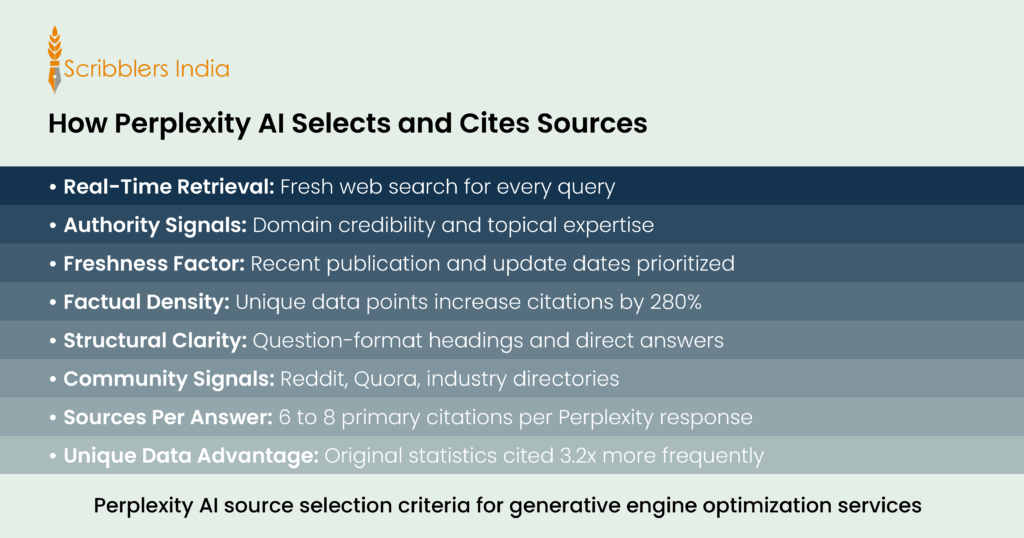
Perplexity selects sources based on relevance, authority, freshness, and structural clarity. It uses real-time web search for every query, which means recency matters significantly.
GEO services targeting Perplexity prioritize regularly updated content, question-format headings, and direct factual statements that the platform can extract as standalone answer chunks.
How Perplexity Evaluates and Retrieves Content?
Perplexity processes approximately 780 million queries per month as of 2026 and uses RAG technology to retrieve and evaluate sources in real time.
- Unlike ChatGPT, Perplexity does not rely on a static training index. It performs a live web search for every query and selects 6 to 8 primary sources per answer.
- The platform evaluates each source on domain authority, topical relevance, factual precision, and the presence of direct, verifiable claims.
- Content with at least three unique data points earns citations 280% more frequently than content without original data, according to BrandMentions’ January 2026 analysis of 10,000 Perplexity queries.
The Role of Community Platforms
Perplexity leans heavily on niche and community signals. Industry-specific directories, Reddit discussions, Quora answers, and review platforms all feed its citation decisions. A GEO services agency targeting Perplexity will build your brand’s presence across these community touchpoints alongside your core content assets.
Content that performs well on Reddit and Quora is more likely to appear in Perplexity responses because the platform uses those community signals as credibility validators.
Freshness as a Competitive Advantage
Perplexity’s visibility begins dropping for content within two to three days of publication without strategic refreshes, according to ALM Corp’s GEO analysis.
Brands that treat content as a living asset, updating statistics, adding new sections, and refreshing examples quarterly, maintain significantly stronger Perplexity citation rates than competitors who publish once and leave content static. A Perplexity-specific GEO optimization strategy always includes a content refresh schedule as part of its standard workflow.
What Is an llms.txt File: Why Is It Critical for Your Generative Engine Optimization Strategy?
An llms.txt file directs AI crawlers to your most valuable pages using a simple, structured markdown format. AI systems like ChatGPT and Claude use it to navigate your site during content retrieval. Your GEO optimization strategy requires this file as a critical technical foundation for AI accessibility.
- What the File Contains and How It Works: The file lists your site name, key page URLs, and one-sentence descriptions in simple markdown format. Without it, AI crawlers must infer your content hierarchy from links alone, frequently missing your highest-value pages. GEO services that include llms.txt implementation give your content a direct path into AI retrieval systems.
- Configuring robots.txt for AI Search Crawlers: Your robots.txt file controls which AI bots access your content, making it a core GEO for AI search configuration. Allowing GPTBot, PerplexityBot, and ClaudeBot ensures your pages are visible across all major AI platforms. Many brands unknowingly block these crawlers through legacy privacy rules, silently removing themselves from every AI citation pool.
- Server-Side Rendering and AI Accessibility: AI crawlers do not execute JavaScript, meaning dynamically loaded content is completely invisible to them. Server-side rendering ensures your content is available in HTML the moment a crawler arrives on your page. This overlooked technical gap can eliminate otherwise well-optimized content from every generative engine optimization citation pool entirely.
- Balancing AI Crawler Access Correctly: The recommended configuration allows search crawlers while blocking training-only crawlers like CCBot. This protects your content from bulk data scraping while keeping your pages fully accessible for AI search citations. A GEO services agency audit verifies your site is correctly configured for every major AI platform from the start.
How Do Brand Mentions Across the Web Affect Your Visibility in AI-Generated Answers?
Brand mentions are the primary trust signal AI platforms use when selecting sources to cite. A recent study of 75,000 brands found brand mentions correlate more strongly with AI visibility than backlinks do. Your generative engine optimization program is incomplete without a structured, proactive mention strategy driving it.
- Why Mentions Outperform Backlinks for GEO: AI platforms use brand entity signals rather than link graphs when selecting which sources to recommend. Wikipedia, YouTube, and Reddit account for a majority of AI-referenced sources across major platforms. Your brand’s presence on these channels builds the entity authority that generative AI optimization systems prioritize when generating answers.
- Personal Branding as a Direct GEO Signal: Founder appearances in industry publications feed the AI entity signals that drive GEO for AI search visibility. Personal branding services and GEO services work in direct alignment for this exact reason. A consistent LinkedIn presence and regular media coverage tell ChatGPT and Perplexity your brand is a credible, citable source.
- How to Build a Structured Mention Strategy: A practical mention strategy covers four channels: digital PR placements, LinkedIn thought leadership, review platforms, and community participation on Reddit and Quora. Each channel contributes a distinct citation signal that AI platforms use to assess your brand’s authority.
- Community Platforms as Citation Sources: Reddit, Quora, and LinkedIn rank among the most-cited sources by major AI platforms, including Perplexity and ChatGPT. Publishing substantive, helpful content on these platforms creates multiple citation paths that AI systems can follow to your brand. A GEO services agency treats community platform presence as a core deliverable, not an optional add-on.
What Role Does Schema Markup Play in GEO and AI Search Visibility?
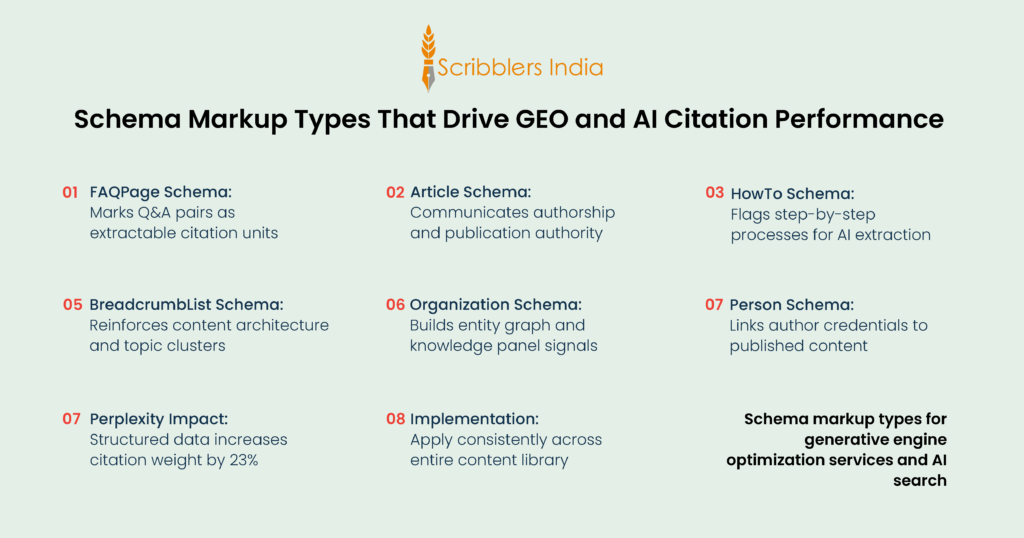
Schema markup gives AI crawlers machine-readable signals about the structure and authority of your content. Without it, AI systems interpret your content through text alone, making accurate extraction harder and less reliable. Every GEO implementation at Scribblers India includes systematic schema deployment across the complete content library.
- FAQPage and Article Schema: FAQPage schema marks your question-and-answer pairs as extractable citation units that AI platforms can directly retrieve. Article schema communicates your content’s authorship, publication date, and last-modified date as verifiable authority signals. Together, these two schema types address the most common eligibility gaps in GEO for AI search content.
- HowTo and BreadcrumbList Schema: HowTo schema marks step-by-step processes, which AI systems extract frequently when users ask instructional questions. BreadcrumbList schema reinforces your site architecture, helping AI crawlers understand the relationship between your hub and spoke pages. Perplexity’s 2026 publisher guidelines confirmed that structured data markup increased citation weight on the platform by approximately 23%.
- Organization and Person Schema: Organization and Person schema identify who created your content and where their credentials can be independently verified. Schema-verified links to your LinkedIn profile and official pages build a connected entity graph that AI platforms use to confirm credibility. Brands with consistent entity data across schema and public profiles earn significantly higher citation rates in generative AI optimization.
- Library-Wide Schema Implementation: Schema markup delivers the strongest results when deployed consistently across every page in your content library, not selectively on individual posts. A GEO services agency deploys schema across all blog posts and service pages as a standard audit deliverable. This library-wide approach signals consistent topical authority to AI systems rather than isolated page-level signals they can easily overlook.
How Does Generative Engine Optimization (GEO) Strategy Work for B2B Companies and SaaS Brands?
GEO is particularly valuable for B2B companies and SaaS brands. Their prospects use AI search platforms for high-intent research queries.
A Chief Technology Officer comparing cloud infrastructure solutions or a Head of Marketing evaluating content agencies will often rely on AI tools like ChatGPT or Perplexity AI for a synthesized market view. Similarly, a CFO researching payroll software will use these platforms to understand options before initiating any vendor conversations.
GEO services for B2B brands focus on three content categories:
- Definitional content that establishes your brand as an authority in your category.
- Comparison content that positions your solution against alternatives.
- Use-case content that demonstrates specific outcomes for named buyer personas.
Each category addresses a distinct phase of the B2B research journey that AI platforms now mediate.
The B2B Research Journey Has Moved to AI
Perplexity launched its enterprise tier in 2025 and saw rapid adoption among B2B buyers and professional researchers. This makes Perplexity citation optimization particularly valuable for B2B brands. Enterprise users turn to the platform for high-stakes, detailed research queries.
Your content must appear in Perplexity responses to questions like “What is the best content strategy agency for SaaS companies?” or “How do B2B companies measure content ROI?.” This will ensure you enter the buyer’s consideration set before your sales team receives a single inbound message.
Building Topical Clusters for B2B GEO
The hub-and-spoke content architecture is the most effective GEO optimization strategy for B2B and SaaS brands. A central hub blog establishes your brand’s authority on a broad topic. Six to seven spoke blogs address specific subtopics in depth, each linking back to the hub.
This architecture signals topical expertise to AI retrieval systems and increases the probability that multiple pages from your site are cited across different user queries in the same category. Thought leadership content, visual comparison assets, and structured whitepapers all contribute to the factual density that B2B-focused generative engine optimization services prioritize.
Measuring GEO Success for B2B
Standard B2B marketing metrics do not capture AI search visibility. A dedicated GEO optimization strategy for B2B brands tracks seven indicators monthly:
- Citation frequency in ChatGPT and Perplexity for target queries
- AI Overview appearances for branded and category terms
- Share of voice compared to named competitors
- Sentiment in AI-generated descriptions of your brand
- AI-referred traffic in Google Analytics 4
- Branded search volume trends in Google Search Console
- Conversion rate of visitors arriving from AI referral sources
B2B visitors from AI platforms convert at significantly higher rates than standard organic visitors. This makes it a priority measurement channel regardless of its current traffic volume.
Why You Need Generative Engine Optimization Services in India?
At Scribblers India, we build generative engine optimization services programs specifically designed to earn your brand citations across ChatGPT, Perplexity, Google AI Overviews, and Gemini. Our process combines technical precision, authority content, and entity signal development to create durable AI search visibility.
Here is what you receive when you partner with us:
- Full GEO Audit: We analyze your AI crawler access, robots.txt configuration, llms.txt status, schema markup, brand entity presence, and current citation performance across all major AI platforms. This helps us identify exactly where and why your brand is being overlooked.
- Hub-and-Spoke Content Architecture: We build a complete topical cluster around your highest-value services. This is in the form of an authoritative hub blog and up to seven spoke blogs structured for AI extraction, internal linking, and passage-level citation eligibility.
- Technical GEO Setup: We implement llms.txt, configure AI crawler access in robots.txt, deploy FAQPage, Article, HowTo, and Organization schema across your content library. We also verify server-side rendering for all key pages.
- Brand Mention and Entity Strategy: We align your GEO program with personal-branding content, thought-leadership placements, and digital PR. This strategy helps generate the off-site brand mentions that AI platforms use as their primary trust signals.
- Monthly GEO Reporting: We deliver a transparent, metric-based report covering citation frequency, AI Overview appearances, Perplexity citation rate, brand mention velocity, and AI-referred traffic growth every month.
Connect with our experts today to request your GEO audit and discover which AI search opportunities your competitors are capturing while your brand remains uncited.
Frequently Asked Questions
What is generative engine optimization in simple terms?
GEO is the process of structuring your content and brand signals so that AI platforms like ChatGPT, Perplexity, and Google AI Overviews cite your brand when generating answers. It prioritizes factual density, structural clarity, and authority signals rather than traditional keyword rankings.
How is GEO different from SEO and AEO?
What is GEO in SEO is a common question. SEO ranks your page in a results list, AEO earns extraction into a featured snippet, and GEO earns citation inside an AI-generated conversational answer. All three are complementary. Research confirms that 99.5% of Google AI Overview citations come from top-ten-ranking pages. So, SEO remains the foundation for GEO for AI search visibility.
How long does it take to see results from GEO services?
Most brands begin seeing measurable improvements in AI citation frequency within 60 to 90 days of implementing GEO services. Technical changes like schema markup and llms.txt show faster results. Content cluster development and brand mention building take 90 to 120 days to generate consistent citation patterns across platforms.
Do B2B companies need a GEO services agency?
Yes. B2B buyers increasingly use ChatGPT and Perplexity for vendor research before initiating any sales conversation. A GEO services agency helps B2B companies appear in those research moments with the right definitional, comparison, and use-case content that AI platforms extract when buyers ask category-level questions.
What content formats work best for generative AI optimization?
Definitional guides, comparison articles, FAQ content, and step-by-step how-to posts perform best for generative AI optimization. These formats naturally include question-format headings, self-contained answer passages, and specific data points.