You have spent years building expertise in your industry. Your clients know your work, and your colleagues value your opinions. However, someone searching for you on LinkedIn may find an outdated profile, a few occasional posts, and very little information about what makes your experience valuable.
You decide to hire a personal branding agency. The proposal promises LinkedIn posts, profile optimization, and improved visibility. Everything looks reasonable until you start wondering how the agency will understand your work well enough to represent you. After all, nobody on its team has worked in your role. This is an important question to ask before signing an agreement.
A personal branding agency helps you identify what you should become known for and develops a consistent public presence around that expertise. The process involves understanding your professional goals, capturing your ideas, developing content, and measuring whether the right audience is responding.
The quality of the engagement depends on how well the agency understands your actual experience. This guide explains how personal branding agencies operate, what to expect during the first 90 days, and how to evaluate their work before committing to a long-term relationship.
Key Takeaways
- A personal branding agency should establish clear positioning before producing regular content.
- Discovery interviews help writers understand how professionals think and make decisions.
- A 90-day engagement should produce defined deliverables and a repeatable editorial process.
- Clients remain responsible for their expertise, professional opinions, and final approvals.
- LinkedIn content should support a larger reputation goal rather than chase engagement alone.
- Strong agencies measure audience quality and relevant opportunities alongside visibility metrics.
- AI search visibility requires accessible, credible information rather than frequent social posting.
- The right agency should reduce your workload without taking control of your professional voice.
What Does a Personal Branding Agency Actually Do?
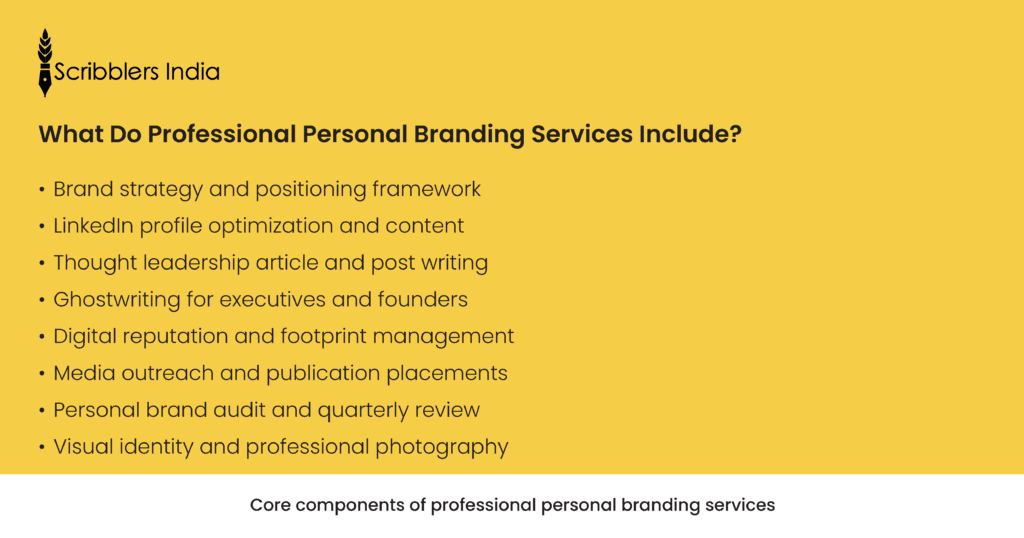
A personal branding agency helps professionals build a recognizable reputation around their expertise. It defines the audience they want to reach, identifies what makes their experience relevant, and develops content that communicates their views. The work may include LinkedIn optimization, ghostwriting, thought leadership, and ongoing performance review.
The agency’s role depends on what you want to achieve. A founder may want prospective customers to understand the thinking behind a new business. A senior executive may want to become more visible within the industry while maintaining appropriate boundaries around their employer.
These goals require different content decisions. Someone building authority in financial technology needs a different strategy from an HR leader who wants to contribute to conversations about workforce transformation. The agency should understand these differences before recommending platforms or committing to a publishing schedule.
What services are included in personal branding?
Most professional engagements involve several connected activities. The exact scope varies according to the client’s objectives and the agency’s capabilities.
| Service | What the agency does | What you should receive |
| Personal brand positioning | Defines your audience and professional expertise | Positioning document |
| Profile optimization | Improves LinkedIn and relevant professional profiles | Updated profile content |
| Voice development | Studies your communication style and opinions | Editorial voice guidelines |
| Content strategy | Identifies themes and publication priorities | Content pillars and calendar |
| Ghostwriting | Turns your ideas into publishable content | Articles, posts, or newsletters |
| Thought leadership | Develops original arguments and professional insights | Long-form authority content |
| Performance review | Tracks visibility and relevant business signals | Periodic reports and recommendations |
You may not need every service immediately. If your positioning is already clear, the agency might begin with content development. If you have an established audience but receive few relevant inquiries, the priority may be improving your messaging rather than increasing posting frequency.

What Should a Personal Branding Agency Help You Achieve?
A personal branding agency should help you achieve a defined professional or business objective. That might involve building credibility in a particular industry, attracting suitable consulting inquiries, or making your expertise easier to discover. The agency should connect these outcomes with specific activities and measurable signs of progress.
Consider two founders who want to improve their LinkedIn presence. The first runs a recruitment technology company and wants HR leaders to understand its approach to hiring. The second operates an investment advisory business and wants to become known for explaining complex financial decisions.
Both founders may publish twice a week, although the subjects and measures of success should differ. The recruitment founder may value discussions with CHROs. The investment professional may care more about invitations to speak at relevant industry events.
How should you define your objectives?
Before starting, agree on the primary outcome and the audience that can help you achieve it.
| Professional goal | Priority audience | Useful signs of progress |
| Build founder credibility | Customers and industry decision-makers | Relevant inquiries and stronger professional recognition |
| Attract consulting work | Prospective clients and referral partners | Qualified conversations and consultation requests |
| Strengthen executive authority | Industry peers and senior leaders | Speaking invitations and informed professional engagement |
| Support recruitment | Relevant professionals and potential employees | Candidate interest and hiring-related conversations |
| Develop industry thought leadership | Decision-makers and specialist communities | Expert discussions, citations, and relevant invitations |
These outcomes will not necessarily appear during the first month. The agency should explain which activities can reasonably be evaluated early, and which require sustained work. This helps prevent disagreements when content receives attention but has not yet produced measurable commercial opportunities.
How Does a Personal Branding Agency Work During the First 90 Days?
A personal branding agency usually spends the first 90 days understanding your expertise, defining your positioning, and establishing a consistent content process. The timeline may vary, but each stage should produce clear deliverables and help you build a recognizable professional presence.
| Period | What the agency does | Your involvement |
| Days 1–15: Discovery and Audit | Reviews your LinkedIn profile, existing content, professional experience, and reputation gaps. | Share your background, goals, and professional experiences through interviews. |
| Days 16–30: Positioning and Strategy | Defines your positioning, content pillars, voice guidelines, and LinkedIn profile improvements. | Approve your positioning and identify topics you want to discuss. |
| Days 31–60: Content Development | Develops and publishes approved content, tests different topics, and refines your writing voice. | Review drafts, share experiences, and provide specific feedback. |
| Days 61–90: Performance Review | Evaluates audience engagement, content performance, and relevant professional opportunities. Refines the strategy accordingly. | Review results and agree on priorities for the next quarter. |
By the end of 90 days, you should have clear positioning, an improved professional profile, an established publishing process, and early performance insights. The goal is to build a reliable foundation for long-term personal branding rather than promise a particular follower count or immediate business inquiries.
How Does a Personal Branding Agency Define Your Positioning?
Personal brand positioning establishes what you want to be known for and why people should associate you with that expertise. An agency develops this position by examining your experience, intended audience, professional goals, and existing market conversations. The final position should be specific enough to guide future content decisions.
This work is particularly useful for experienced professionals whose careers span several roles. A person may have managed sales teams, built new business units, and led digital transformation projects. Listing every achievement does not necessarily communicate what makes their expertise distinctive.
The agency should identify which experiences support the strongest position for the audience you want to influence.
What does effective positioning look like?
Consider a hypothetical founder whose original LinkedIn headline reads:
Before: Founder | Entrepreneur | Business Leader | Technology Enthusiast
The headline provides little information about the founder’s actual work. It could describe thousands of professionals and gives a potential customer no reason to explore their experience further.
After discovery interviews, the agency may recommend:
After: Founder Helping Mid-Market Manufacturers Improve Supply Chain Visibility Through Enterprise Technology
The revised version clearly defines the area of work and identifies a relevant audience. Whether this is the right positioning still depends on the founder’s actual experience and business objectives.
Once the position is agreed upon, it should inform the professional’s About section and future content. Our take on how founder personal branding builds company credibility explores how a founder’s public expertise can also influence how buyers evaluate the business.
How Does an Agency Learn to Write in Your Voice?
A personal branding agency learns your voice through conversations, existing writing, professional experiences, and feedback on early drafts. The objective is to understand how you explain subjects and which opinions you genuinely hold. Strong voice development preserves your reasoning instead of copying a few familiar phrases.
Consider an HR leader who believes employee retention depends heavily on management quality. During an interview, they may describe a situation in which employees received salary increases but continued to leave because managers did not discuss career development.
That experience provides more useful writing material than asking an AI tool to generate a generic post about employee engagement. The agency can explore what the leader observed and how the experience shaped their professional judgment.
What happens during a voice discovery interview?
The writer should ask questions that uncover specific experiences rather than simply request opinions about popular industry topics.
Useful questions include:
- What business problem have you encountered repeatedly in your career?
- Which common industry advice do you disagree with, and why?
- What decision changed your understanding of a particular issue?
- Which mistakes have influenced how you work today?
- What evidence would make you reconsider an opinion you currently hold?
These questions help the writer understand the thinking behind your statements. The answers may also reveal useful stories that have never appeared in your previous content.
How does the writer turn those conversations into content?
After an interview, the writer identifies the strongest ideas and determines which require further explanation. Supporting information is checked where necessary, and the draft is structured around a single central argument.
For example, an executive’s observation about unclear career paths could become a LinkedIn post explaining why performance reviews often fail to address employee aspirations.
The executive then reviews the draft to confirm that the argument reflects their experience. This is where professional ghostwriting services are useful for leaders with valuable insights but limited time to develop each piece themselves.
The writer can handle structure and editing, while the executive remains responsible for the ideas and final judgment.
What Should a Monthly Personal Branding Content Plan Include?
A monthly content plan should identify the subjects you will discuss, the audience each piece serves, and the purpose of the chosen format. The agency should develop this plan based on your positioning and recent professional experiences, rather than filling available dates with generic business advice.
Suppose a founder has agreed to publish eight LinkedIn posts during the month. The agency could divide these posts across a few recurring themes while leaving space for timely observations from the founder’s work.
| Week | Content focus | Example topic |
| Week 1 | Professional insight | Why enterprise software projects get delayed |
| Week 1 | Personal experience | A difficult implementation decision and its lesson |
| Week 2 | Industry perspective | What customers misunderstand about automation |
| Week 2 | Useful framework | Questions to ask before approving new software |
| Week 3 | Business observation | Why user adoption needs management attention |
| Week 3 | Professional experience | What an unsuccessful rollout revealed |
| Week 4 | Industry discussion | Responding to a relevant technology development |
| Week 4 | Practical guidance | How leaders should review implementation progress |
The schedule gives readers a consistent understanding of the founder’s expertise without repeating the same argument. Individual posts can also inform longer articles when a subject requires more evidence or explanation. The agency should review the plan regularly. New client questions or business developments may provide stronger content opportunities than topics selected several weeks earlier.
What Does the Client Need to Do During a Personal Branding Engagement?
The client provides the expertise that makes the personal brand credible. The agency can manage research and content development, although it cannot independently know every professional experience or belief. A successful arrangement therefore needs clear responsibilities for idea collection, review, factual accuracy, and final approval.
This distinction is important for founders who hire an agency because they lack time. Delegating writing can reduce the production workload, although it does not remove the need for professional input.
| Activity | Agency responsibility | Client responsibility |
| Brand positioning | Research and recommend direction | Confirm professional goals and expertise |
| Idea development | Conduct interviews and organize ideas | Share experiences and opinions |
| Content writing | Research, draft, and edit | Verify professional claims |
| Visual content | Develop approved creative assets | Confirm sensitive details |
| Publication | Coordinate agreed posting workflow | Provide required approval or access |
| Performance reporting | Analyze results and recommend changes | Evaluate business relevance |
| Strategy refinement | Identify improvements | Decide priorities and boundaries |
For example, the agency may identify a promising article about a new industry regulation. However, if the article contains statements about how the regulation affects the client’s business, the client should review those statements before publication.
Clear responsibilities also help prevent delays. If the agency needs an interview every two weeks, those discussions should be scheduled in advance. A defined review period makes it easier to maintain consistency without treating every draft as an urgent request.

Is LinkedIn Enough for a Personal Branding Strategy?
LinkedIn can provide a strong starting point for founders and executives, particularly when their intended audience includes business decision-makers. However, a complete personal branding strategy may also require long-form articles, professional websites, or relevant external publications. The appropriate mix depends on how people discover and evaluate your expertise.
A prospective customer may first encounter your LinkedIn post and later search for your name before arranging a meeting. If that search reveals little information about your professional background, the earlier LinkedIn interaction may have limited influence.
The agency should consider the entire discovery experience rather than relying exclusively on social engagement.
How should different channels work together?
- LinkedIn: Use the platform for regular professional commentary and conversations with relevant audiences. Posts can introduce ideas that encourage readers to explore your expertise further.
- Owned website content: Publish detailed articles or resources that explain subjects requiring greater depth. These pages can also provide accessible information about your professional experience.
- External publications: Contribute relevant insights to credible industry outlets when there is a genuine editorial opportunity. Independent coverage may help readers assess expertise from sources outside your own channels.
- Newsletters and long-form resources: Develop relationships with readers who want more detailed information. These formats can support recurring professional engagement without depending entirely on social media distribution.
The agency should choose channels according to your goals and available time. An executive who cannot support a monthly newsletter may benefit more from publishing one carefully researched article each quarter.
Where does thought leadership fit?
Regular content helps audiences recognize your interests, while thought leadership shows how you interpret important professional issues. The distinction becomes clear when you move from explaining familiar advice to presenting an argument based on experience.
For example, an HR leader could publish general tips about employee retention. A stronger piece might explain why traditional retention programs overlook career mobility and show how organizations can examine that problem.
These deeper arguments are often better developed through thought leadership content writing, especially when the executive has observations that deserve a more detailed explanation than LinkedIn allows.
How Should a Personal Branding Agency Manage Content Approval and Confidentiality?
A personal branding agency should establish a clear approval process before publishing content under your name. The process needs to identify who reviews drafts, which claims require verification, and how confidential material is handled. These safeguards become especially important for executives working in regulated industries or publicly listed companies.
An executive may discuss an internal restructuring during an interview because it provides useful context. That does not mean the agency can publish details about the restructuring. The writer should understand which information can be shared and which must remain private.
A real-life approval workflow can include four stages:
- Editorial review: The writer checks whether the argument is clear and relevant to the agreed content strategy.
- Factual verification: Supporting claims are checked, and any unclear client-specific statements are flagged.
- Client approval: The executive reviews the content for accuracy and alignment with their opinions.
- Publication control: Only approved content is scheduled or published through the agreed process.
For sensitive assignments, legal or corporate communications teams may also need to review subjects. These additional steps should be included in the engagement plan rather than introduced after a publishing problem occurs.
The agency should also explain whether subcontractors or AI tools can access interviews and unpublished documents. Confidentiality arrangements should cover the information involved and the way it is stored or reused.
How Do You Measure the Results of a Personal Branding Agency?
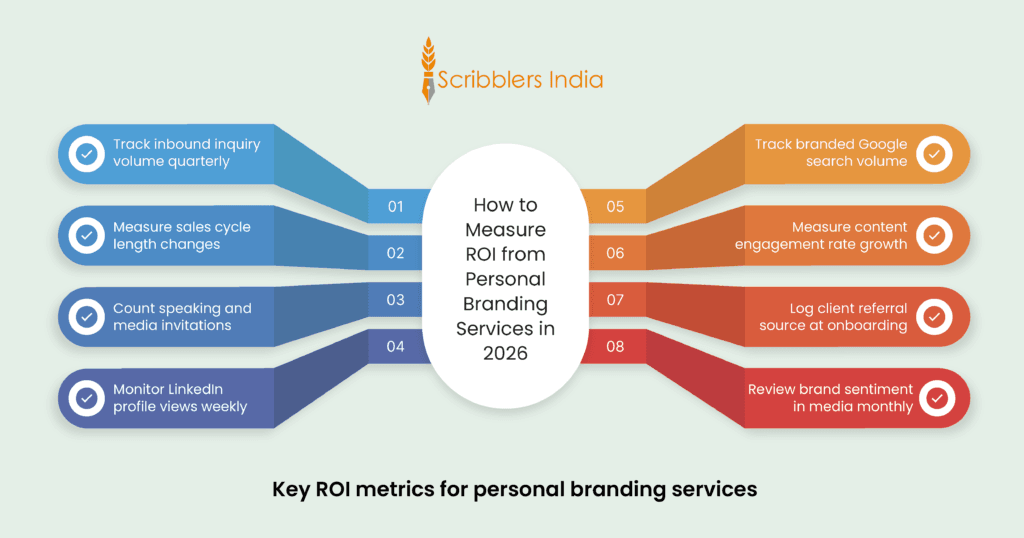
You measure personal branding performance by comparing visibility and audience engagement with the professional objectives established at the beginning. Follower growth and impressions can show whether content is reaching people. However, relevant conversations and opportunities provide stronger evidence that the reputation being developed is useful.
A founder may receive fewer reactions than a popular industry creator and still achieve better business results. If the founder’s content attracts questions from potential enterprise customers, those conversations may be more valuable than large numbers of unrelated followers.
The measurement system should therefore record both audience response and meaningful professional outcomes.
What should a monthly personal branding report include?
| Measurement area | Metrics to review | What the agency should explain |
| Content reach | Impressions and profile views | Whether relevant audiences are discovering the content |
| Audience engagement | Comments, reposts, and saves | Which ideas are attracting useful responses |
| Audience relevance | Roles, industries, and companies where data is available | Whether the right professionals are engaging |
| Professional opportunities | Enquiries, referrals, and invitations | Whether the content supports the original goals |
| Content performance | Results by topic and format | Which subjects deserve further development |
| Search visibility | Relevant name searches and public content discovery | Whether expertise is becoming easier to find |
| AI visibility | Relevant mentions and citations where observable | Whether public information is represented accurately |
These metrics should be reviewed against the starting baseline. A report showing that impressions increased by 40% may appear impressive, but it offers limited information unless the agency also explains which audience and content were responsible for the change.
The agency should then recommend an action. For example, if posts about business transformation consistently attract senior decision-makers, the next month could feature a deeper article on the topic.
How soon should you expect results?
Some changes can be completed immediately. Profile positioning and content guidelines may improve within the first month, while audience recognition requires repeated exposure. Relevant inquiries may arise early, but they should not be promised within a fixed period.
The 2025 Edelman-LinkedIn B2B Thought Leadership Impact Report found that 56% of target decision-makers and 55% of hidden decision-makers in its US survey use thought leadership to help evaluate potential vendors.
This suggests that professional content can influence decisions before a direct sales conversation. However, the survey does not establish how quickly any individual personal branding program will generate business opportunities.
Can a Personal Branding Agency Help You Appear in AI Search Results?
A personal branding agency can support AI search visibility by making your expertise easier to understand across public digital sources. Accurate professional profiles and useful articles can give search systems more information about your work. However, no agency can guarantee that AI assistants will mention or recommend you.
For example, a founder who regularly writes about enterprise AI implementation may have useful articles on their website and credible external references to their expertise. Those materials provide more public context than a LinkedIn profile containing only a job title.
The agency can help identify gaps in that information and recommend where additional content may be useful. Google’s guidance on AI features confirms that foundational SEO requirements remain relevant to AI Overviews and AI Mode. There are no special technical requirements that guarantee inclusion in these experiences.
This is where personal branding can naturally connect with generative engine optimization services. An agency can review how consistently the professional’s expertise is presented across accessible sources and develop useful content that strengthens those associations.
The aim should be accurate representation and meaningful discoverability. Publishing more articles or adding AI-related terminology does not automatically increase citations.
How Much Does a Personal Branding Agency Cost in India?
Personal branding agency fees vary according to the work involved. A one-time LinkedIn profile project generally requires fewer resources than an ongoing executive program with positioning, interviews, ghostwriting, and long-form content. Agency experience and the amount of client coordination can also affect the price.
Two agencies may quote similar monthly fees while offering very different levels of support. One may deliver a fixed number of LinkedIn posts using information you provide. Another may conduct interviews and develop original ideas, with senior editors involved in the review process.
Before comparing proposals, establish what is included in each package. Our guide on personal branding services cost in India examines different pricing models and the factors that affect the total investment.
What should you check in a proposal?
Pay attention to the following terms:
- The number and type of monthly content deliverables.
- Whether positioning and strategy are included in the quoted fee.
- The frequency of interviews and expected client involvement.
- The number of revision rounds and approval responsibilities.
- Whether design and publication are part of the engagement.
- Which reporting activities and review meetings are included.
- The treatment of additional projects or scope changes.
A proposal should also explain whether the relationship is project-based or ongoing. If you are commissioning a defined profile refresh, a project fee may be suitable. Recurring ghostwriting generally requires a more sustained arrangement.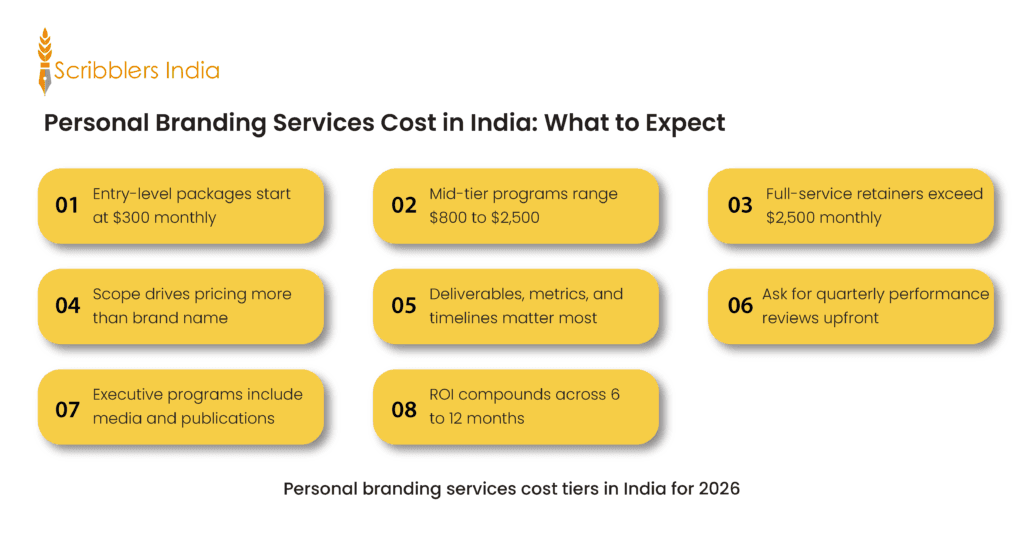
How Can You Choose the Right Personal Branding Agency?
Choose an agency that can explain how it will develop your positioning and work with your expertise. Review the people responsible for strategy and writing, as well as the approval process and reporting approach. Avoid selecting a provider solely because it promises more posts or faster follower growth.
During the initial conversation, ask the agency to explain how it would approach your specific circumstances.
Here are the key questions you should ask the agency before signing:
- How will you understand my professional background? The agency should describe its discovery process and the materials it needs from you. A generic questionnaire may be insufficient for complex executive roles.
- Who will work on my account? Ask who conducts interviews, writes the content, and provides editorial oversight. This helps you understand whether the proposed team matches the expertise presented during the sales discussion.
- What will I receive during the first month? A clear agency should explain the initial deliverables and the decisions you will need to approve before publishing begins.
- How much time will I need to contribute? Discuss interview frequency and review expectations. A good arrangement should make participation manageable without removing your involvement in important professional claims.
- What happens when a draft does not sound like me? Ask how the team handles feedback and whether it maintains voice guidelines to prevent recurring problems.
- How will we evaluate progress? The agency should define meaningful reporting measures before work begins. These should reflect your objectives rather than relying entirely on social media engagement statistics.
You can compare different provider approaches in our review of personal branding agencies in India. The objective is to find an agency whose working model fits your requirements rather than assume that one provider suits every professional.
When Should You Avoid Hiring a Personal Branding Agency?
Hiring an agency may be premature when your professional objectives remain unclear or you cannot provide meaningful input. It may also be unnecessary if you enjoy developing your own content and can maintain a consistent publishing process without external support.
For example, an early-stage consultant may benefit from writing their own LinkedIn posts as they learn which problems interest potential clients. Once their positioning becomes clearer, an agency could help turn those observations into a more structured content program.
However, founders and executives with substantial experience may need support for a different reason. Their ideas exist, although demanding schedules prevent them from developing that expertise into consistent public content.
The decision should therefore depend on what is holding back your professional visibility. If the problem is unclear positioning, prioritize strategy. If the problem is writing capacity, ghostwriting may be more useful than a large branding engagement.
How Does Scribblers India Approach Personal Branding for Founders and Executives?
At Scribblers India, we help founders and senior professionals develop personal brands around their actual expertise. Our work begins with understanding what the individual wants to be known for, and which audiences need to recognize that expertise.
We develop positioning and editorial direction before building a regular publishing program. Interviews and existing professional material provide the basis for ghostwritten content, while ongoing reviews help refine the voice and subject matter.
Our personal branding services connect LinkedIn content with longer thought leadership assets when the client’s objectives require greater depth. We also consider how the professional’s expertise appears across public digital sources, including search and AI-assisted discovery.
The objective is to develop a professional presence that accurately reflects the person behind it. We focus on useful content and consistent positioning rather than promising follower counts or guaranteed media coverage.
If you want to build a personal brand around your professional expertise, book a 1:1 call with our team to discuss your objectives and the support required.
Frequently Asked Questions
How long does a personal branding agency take to show results?
A personal branding agency can complete positioning and profile improvements within the initial engagement period, depending on the scope. Audience recognition and professional opportunities usually require more time. Evaluate early progress by content quality and relevant engagement and review business outcomes over longer periods rather than expecting immediate results.
How much time should I spend working with a personal branding agency?
Your involvement depends on the engagement, although most programs require regular interviews and content approvals. A structured process can reduce the time spent on routine drafting. You should still provide professional experiences and review important claims, so the content reflects your actual knowledge rather than generic industry opinions.
Can a personal branding agency manage my LinkedIn account?
An agency may support content planning and publishing through an agreed workflow. However, account access and permitted management methods must comply with LinkedIn’s rules and security practices. You should retain control of your account and understand who can publish content. Sensitive messages and professional conversations may require your direct involvement.
Is personal branding different from executive branding?
Personal branding develops an individual’s professional reputation across relevant audiences. Executive branding applies this approach to senior leaders whose public communication can also affect their organizations. Executive programs often require closer coordination with corporate messaging and stronger approval controls. The appropriate strategy depends on the leader’s role and professional objectives.
Can a personal branding agency write content without my involvement?
An agency can manage most of the writing process, although it needs access to your ideas and professional experiences. Existing interviews and published material may reduce the need for repeated input, but important claims still require approval. The content is more credible when the agency reflects your judgment rather than inventing opinions on your behalf.
Should I choose a personal branding freelancer or an agency?
A freelancer may be well-suited to a focused assignment when you have a clear strategy and need specialist writing support. An agency may be more appropriate for ongoing programs involving positioning, content planning, and multiple formats. Compare the actual people delivering the work and the level of editorial oversight rather than choosing solely by price.
What should I receive from a personal branding agency every month?
Monthly deliverables depend on the contract and may include approved content, an updated editorial calendar, and performance reporting. You should also receive meaningful recommendations based on audience response. The agency should explain what it completed and what needs to change next, rather than treating the number of published posts as proof of success.
Can personal branding help me appear in ChatGPT or Google AI results?
Personal branding can improve the availability of accurate public information about your expertise. Search and AI systems may use relevant articles or professional profiles when generating responses. However, mentions and citations are not guaranteed. Focus on original content and consistent professional information across accessible sources rather than promises of AI visibility.