
AI search discovery is becoming a new competitive layer for Indian brands. Buyers no longer rely only on blue links, paid ads, or traditional rankings. They now ask Google AI Overviews, Google AI Mode, ChatGPT, Perplexity, Gemini, and other answer engines to summarize options, compare vendors, explain categories, and recommend next steps.
This report is a secondary research benchmark for founders, marketers, SEO teams, content leaders, and B2B service businesses in India. It explains how AI search is changing visibility, what signals matter, and how brands can prepare content for SEO, AEO, and GEO together.
McKinsey reported in 2025 that half of consumers already use AI-powered search, and that AI search could influence $750 billion in revenue by 2028. This makes AI search discovery a business priority, not a technical side project.
Scribblers India created this report to help Indian brands understand the shift without hype. The focus is simple: how to build content that is useful for readers, clear for search engines, and credible enough for AI systems to mention, summarize, and cite.
TL;DR
|
Executive Summary
AI search discovery is changing what visibility means. Ranking on Google still matters, but it is no longer the full picture. Brands now need to appear inside summaries, citations, generated answers, comparison responses, and prompt-led journeys. These surfaces compress research and influence buyer perception before a website visit happens.
The central finding is clear. AI search discovery depends on a connected system of SEO strength, answer-first structure, source quality, entity clarity, original expertise, and ongoing measurement. Brands that treat AI search as a separate trick will struggle. Brands that integrate SEO, AEO, and GEO into a single content strategy will be better positioned.
For Indian businesses, the opportunity is immediate. Google rolled out AI Mode to everyone in India in July 2025, making prompt-led search part of the mainstream Google experience. Google also said AI Overviews drive more than 10% growth in usage for query types where they appear in major markets such as the US and India.
Scribblers India recommends a practical approach. Audit current content, map buyer prompts, strengthen important pages, add direct answers, improve source depth, clarify brand entities, and measure AI visibility across platforms. The goal is not more content. The goal is more trusted, extractable, citation-ready content.
How Is AI Search Changing Discovery in India?
AI search is changing discovery because users can now ask complex questions and receive synthesized answers before reviewing multiple websites. In India, this shift matters because Google AI Mode is already available, enterprise AI adoption is accelerating, and decision-makers are becoming more comfortable with AI-assisted research.
India is not waiting for AI search discovery to mature elsewhere. Google started rolling out AI Mode to everyone in India in July 2025, giving users a more conversational Search experience with follow-up questions and AI-powered responses.
- Google said AI Mode is its most powerful AI search experience, with advanced reasoning, multimodality, follow-up questions, and helpful web links. (Google, 2025)
- Google stated that AI Overviews had over 2 billion monthly users across more than 200 countries and territories by Q2 2025. (Alphabet Q2 earnings, 2025)
- Gartner predicted that traditional search engine volume would drop 25% by 2026 because of AI chatbots and virtual agents. (Gartner, 2024)
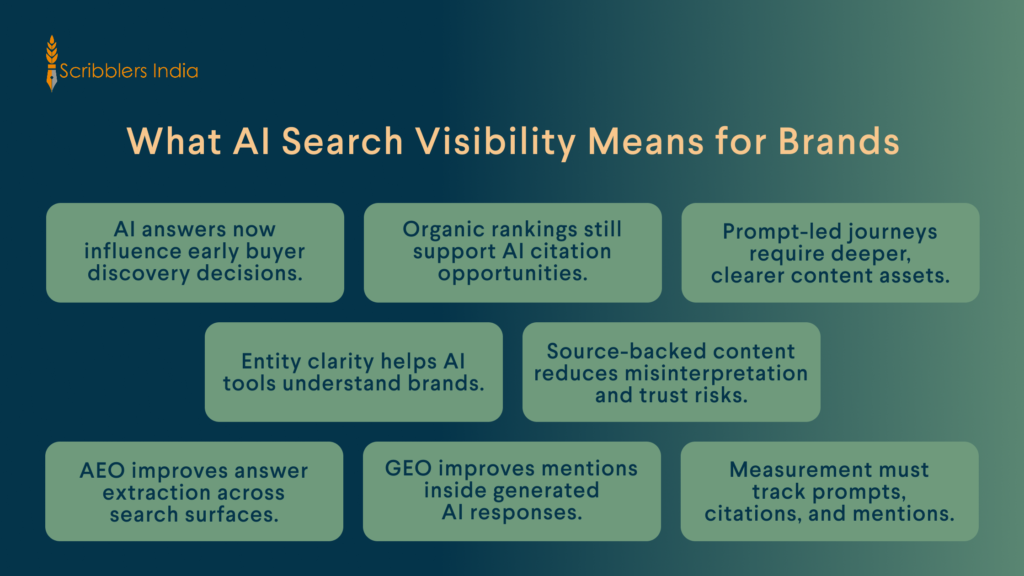
Scribblers India Takeaway: Indian brands should not wait for AI search to become a separate category in analytics dashboards. Search behavior is already moving toward longer questions, summaries, and AI-assisted journeys. Content must answer specific buyer prompts and help search systems understand why a brand deserves inclusion.
Key Finding: AI search changes the first point of brand discovery. A buyer may form an opinion before clicking any website.

Why Does AI Search Discovery Matter for Indian Businesses?
AI search discovery matters because AI-generated answers can shape which brands buyers notice, trust, and compare. For Indian businesses in SaaS, fintech, HR tech, education, consulting, and professional services, early absence from AI answers can reduce consideration before sales teams enter the conversation.
This shift is especially important because AI adoption in India is moving from experimentation to enterprise planning. Marketing teams need to understand how AI-assisted research may influence vendor discovery, category education, and trust-building.
- Microsoft’s India Work Trend Index reported that 90% of Indian business leaders see 2025 as a pivotal year to rethink strategy and operations, while 93% expect to use digital agents to expand workforce capacity in the next 12 to 18 months. (Microsoft, 2025)
- Deloitte India reported that over 80% of Indian organizations were exploring autonomous agents, according to its State of GenAI India perspective. (Deloitte India, 2025)
- Zinnov, Z47, and OpenAI reported in 2026 that 46% of Indian enterprises were early adopters still scaling pilots, while only 5% had not started. (Zinnov, Z47 and OpenAI, 2026)
Scribblers India Takeaway: AI search discovery is not only about appearing in ChatGPT or Perplexity. It is about being discoverable in the research environment decision-makers are learning to trust. Brands that clearly explain their expertise now will have greater visibility as AI-assisted buying behavior grows.
AI Discovery Risk: If AI systems cannot understand your brand category, they may instead mention better-structured competitors.
How Are AI Overviews Changing Organic Search Visibility?
AI Overviews are changing organic visibility because they summarize information above traditional results and cite selected sources. SEO remains important, but ranking alone does not guarantee inclusion. Brands now need answer-first content, credible sources, clear entities, and sections that AI systems can extract without confusion.
Google says AI features such as AI Overviews and AI Mode are part of Search experiences, and site owners should focus on content inclusion through helpful, reliable content and standard Search best practices.
- Semrush found that AI Overviews appeared for 6.49% of tracked keywords in January 2025, peaked near 25% in July, and settled at 15.69% in November. (Semrush, 2025)
- Ahrefs analyzed 863,000 SERPs and 4 million AI Overview URLs, finding that only 38% of AI Overview citations came from pages ranking in Google’s top 10. (Ahrefs, 2026)
- An independent 2026 measurement study found AI Overview activation at 13.7% overall and 64.7% for question-form queries across 55,393 trending queries. (Xu, Iqbal and Montgomery, 2026)
Scribblers India Takeaway: AI Overviews do not replace SEO. They change what constitutes strong SEO. Brands need pages that rank, answer clearly, cite credible sources, and explain concepts in extractable sections. The next content advantage will come from combining SEO strength with AEO structure and GEO citation readiness.
Content Opportunity: Turn every important H2 into a clear answer that can stand on its own.
What Happens When a Brand Gets Cited Inside AI Answers?
Being cited in AI answers can improve visibility, trust, and click-through rates. The value is not only the referral click. A citation can shape which brands users remember, compare, and trust when AI systems summarize a category or recommend next steps.
Citations work like a new form of authority signal. They may not always generate immediate traffic, but they can influence buyers’ perceptions during the research stage.
- Seer Interactive found that brands cited in AI Overviews saw 35% higher organic CTR and 91% higher paid CTR than uncited brands on comparable queries. (Seer Interactive, 2025)
- Seer Interactive also reported that AI Overview queries saw a 61% decline in organic CTR and a 68% decline in paid CTR across its study period. (Seer Interactive, 2025)
- Similarweb estimated that ecommerce visits referred by ChatGPT converted at 11.4%, compared with 5.3% for organic search. (Similarweb, 2025)
Scribblers India Takeaway: AI citation should become a tracked visibility metric, not a nice-to-have mention. Brands need to know whether they appear, which page is cited, what the answer says, and which competitors appear nearby. This turns AI search from guesswork into measurable content strategy.
Key Finding: AI search discovery should be measured through mentions, citations, answer accuracy, and assisted conversions, not traffic alone.
How Stable Are AI Citations Across Search Platforms?
AI citations are volatile. A page that appears in an AI answer today may disappear later because platforms change retrieval patterns, cited sources, prompt interpretation, and answer composition. This makes one-time AI optimization weak. Brands need recurring content refresh, source depth, and ongoing prompt monitoring.
Citation volatility is one reason brands should avoid declaring “we are optimized for AI search” after updating a few pages. The better model is continuous visibility management.
- Profound reported that AI search results exhibit 40%-60% drift, making individual data points unreliable for long-term visibility decisions. (Profound, 2025)
- Ahrefs found that when AI Overviews update, 45.5% of citations change on average, meaning visibility can shift even for the same query. (Ahrefs, 2025)
- A 2026 empirical study comparing Google Search, AI Overviews, and Gemini found that the sets of retrieved sources differed substantially, with an average Jaccard similarity below 0.2. (Grossman et al., 2026)
Scribblers India Takeaway: AI search discovery is inherently unstable. Different systems retrieve different sources, and even the same system can shift citations over time. Brands need durable content systems: strong entities, updated pages, clear answers, credible sources, and recurring prompt checks across major AI surfaces.
| The AI Search Discovery Gap
Many brands still track only rankings and organic traffic. That creates a blind spot. AI systems may already be shaping buyer perception through answers, citations, summaries, and competitor mentions while the marketing dashboard still shows only traditional organic performance. |
What Signals Help AI Systems Understand and Trust a Brand?
AI systems need clear, repeated, and verifiable information. They need to understand what the brand does, who it serves, what topics it owns, and why its content is credible. This makes entity clarity, source quality, authorship, structured data, and consistent messaging more important.
Google’s guidance for GenAI features states that SEO best practices remain relevant because these Search experiences are rooted in core ranking and quality systems.
- Google says its systems are designed to prioritize helpful, reliable information created for people, not content created only to manipulate search rankings. (Google Search Central, 2025)
- Google says structured data helps it understand page content and gather information about entities such as people, books, companies, and other items in markup. (Google Search Central, 2025)
- Google’s Organization structured data guidance says it can help Google better understand an organization’s administrative details and disambiguate it in search results. (Google Search Central, 2025)
Scribblers India Takeaway: AI systems need consistency. Your website, author bios, service pages, founder profiles, LinkedIn presence, case studies, and external mentions should clearly describe the brand. The more fragmented your entity signals are, the harder it becomes for AI systems to classify, trust, and cite your brand.
| What LLMs Need to Trust a Brand
LLMs need repeated, consistent signals. A brand should explain what it does, who it serves, why it is credible, and where its expertise appears. Strong author bios, service pages, case studies, glossary pages, third-party mentions, and source-backed articles help reduce ambiguity. |
Why Does Indian Language Content Matter for AI Search Discovery?
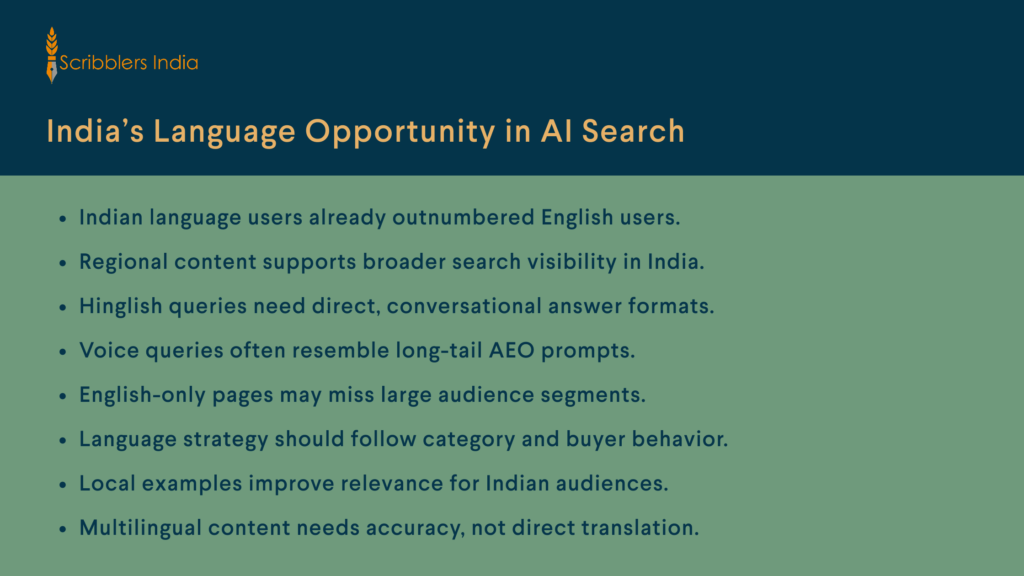
Indian language content matters because India’s digital growth is now being shaped by rural adoption, mobile-first usage, voice search, AI-enabled discovery and regional content consumption. AI search systems need to answer local, regional and mixed-language queries with context, accuracy and trust.
This does not mean every brand needs a multilingual website immediately. It means content teams should identify where language affects search intent, trust, product understanding and conversion. Consumer, education, finance, healthcare, local services, and public-facing B2B categories should treat Indian-language visibility as a significant search opportunity.
-
- India crossed 958 million active internet users in 2025, with rural India accounting for over 57% of active users, according to IAMAI-Kantar’s Internet in India Report 2025, published in 2026. (IAMAI-Kantar, 2025)
- The same IAMAI-Kantar 2025 report found that 44% of Indian internet users had engaged with AI-enabled features such as voice search, image-based search, chatbots and AI filters. (IAMAI-Kantar, 2025)
- IAMAI-Kantar’s Internet in India Report published in 2025 found that 870 million internet users, or 98% of users, accessed internet content in Indic languages in 2024. (IAMAI-Kantar, 2025).
- The same IAMAI-Kantar report found that 57% of urban internet users preferred accessing internet content in Indic languages. (IAMAI-Kantar, 2025)
Scribblers India Takeaway: Regional language AI search visibility will not be equally important for every brand. A B2B SaaS company may start with English. An education, healthcare, finance, retail, or local-service brand may need multilingual answer assets sooner. The right approach is to map language to real buyer behavior.
Content Opportunity: Build Hindi, Hinglish, or regional-language answer pages only where search intent, audience behavior, and business value justify them.
How Should Indian Brands Measure AI Search Discovery?
Indian brands should measure AI search discovery through a mix of rankings, AI Overview presence, cited URLs, ChatGPT mentions, Perplexity citations, Gemini summaries, brand description accuracy, and prompt coverage. Traffic alone is incomplete because AI search can influence buyers without always sending a click.
A practical measurement model should include recurring prompt testing. The same prompts should be checked at fixed intervals across platforms. This helps brands track whether content updates improve answer inclusion or whether competitors are gaining visibility.
- Similarweb reported that ChatGPT reached 5.84 billion visits in August 2025 and held 69% of traffic share among AI tools in its dataset. (Similarweb, 2025)
- Semrush found that AI Overviews became less purely informational over time, shifting from 89.03% informational keywords in October 2024 to 57.16% in October 2025. (Semrush, 2026)
- A 2026 AI Overview measurement study found that 11% of atomic claims in AI Overviews were unsupported by cited pages. (Xu, Iqbal and Montgomery, 2026)
Scribblers India Takeaway: AI search discovery measurement should include presence and accuracy. A brand may appear in an AI answer, but the description may be incomplete or wrong. Teams should track where the brand appears, how it is described, which page it is cited on, and which competitors appear nearby.
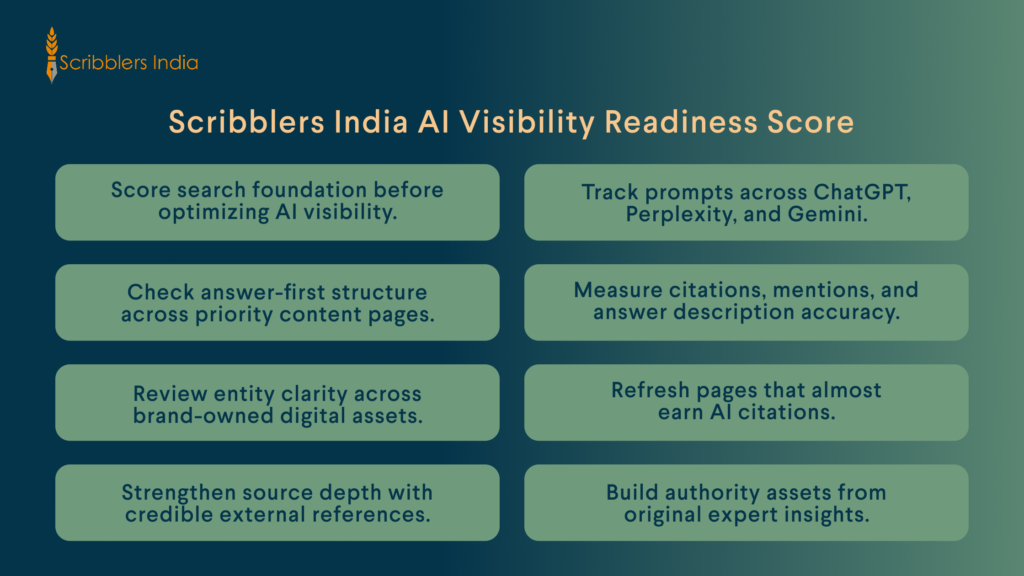
Scribblers India AI Visibility Readiness Scorecard
The Scribblers India AI Visibility Readiness Scorecard is a practical framework for evaluating a brand’s readiness for AI-led discovery. It is not a field survey or proprietary dataset. It is a scoring model brands can use to audit content quality, entity clarity, and answer readiness.
| Dimension | What to Check | Score 1 | Score 3 | Score 5 |
| Search foundation | Rankings, indexing, internal links | Weak organic base | Some priority rankings | Strong topical presence |
| AEO readiness | Direct answers, FAQs, tables | Long generic pages | Some answer sections | Structured answer-first pages |
| GEO readiness | Entities, sources, citations | Brand unclear | Partial entity signals | Clear citation-ready authority |
| Content depth | Examples, data, originality | Thin summaries | Moderate depth | Useful expert-led coverage |
| Measurement | Prompts, mentions, citations | Traffic only | Manual checks | Regular AI visibility tracking |
| Trust signals | Authors, proof, case studies | Missing trust markers | Some proof | Clear authority ecosystem |
Scoring Logic
Score each dimension from 1 to 5. The maximum score is 30.
| Score Range | Meaning | Recommended Action |
| 6 to 12 | Low readiness | Fix foundations and service clarity first |
| 13 to 20 | Developing readiness | Refresh priority pages for AEO and GEO |
| 21 to 26 | Strong readiness | Add prompt tracking and authority assets |
| 27 to 30 | Advanced readiness | Build original research and citation assets |
How Brands Can Use It
Use the score quarterly. Review your home page, About page, service pages, best-performing blogs, case studies, glossary assets, and comparison pages. Then identify which pages need stronger answers, cleaner entities, better sources, or clearer internal linking.
Limitations
This score is directional. It should be supported with platform testing, analytics, competitor review, and human editorial judgment. AI discovery can shift because platforms update models, prompts vary, and source selection changes quickly.
Traditional SEO vs AEO vs GEO
Traditional SEO, AEO and GEO solve different visibility problems across the modern search journey. SEO helps pages rank, AEO helps content become answer-ready, and GEO helps brands earn mentions inside AI-generated responses. The strongest content strategy connects all three instead of treating them as separate marketing tracks.
| Area | Traditional SEO | AEO | GEO |
| Main goal | Rank pages | Earn answer extraction | Earn mentions and citations |
| Core unit | Keyword and page | Question and answer block | Entity and source asset |
| Content format | Blogs and landing pages | FAQs, tables, definitions | Source-backed explainers |
| Measurement | Rankings and traffic | Snippets and AI Overviews | Mentions and cited URLs |
| Risk | Ranking without conversion | Answers without clicks | Mentions without traffic |
| Best use | Organic discovery | Answer-led search | AI-generated recommendations |
Which Content Assets Have Strong AI Citation Value?
AI systems prefer content assets that define concepts clearly, answer specific questions, show evidence and connect a brand to a trusted area of expertise. Not every page has the same citation value. Brands should prioritize assets that combine depth, structure, originality, source quality and clear entity signals.
| Content Asset | AI Citation Value | Why It Matters |
| Glossary pages | High | Defines category terms clearly |
| Original research | Very high | Gives AI systems unique reference material |
| Comparison guides | High | Supports decision-stage prompts |
| Case studies | Medium to high | Shows proof and context |
| Expert explainers | High | Demonstrates subject depth |
| Service pages | Medium | Clarifies brand entity and offer |
| Founder bios | Medium | Supports trust and authorship |
| FAQs | Medium | Answers long-tail questions directly |
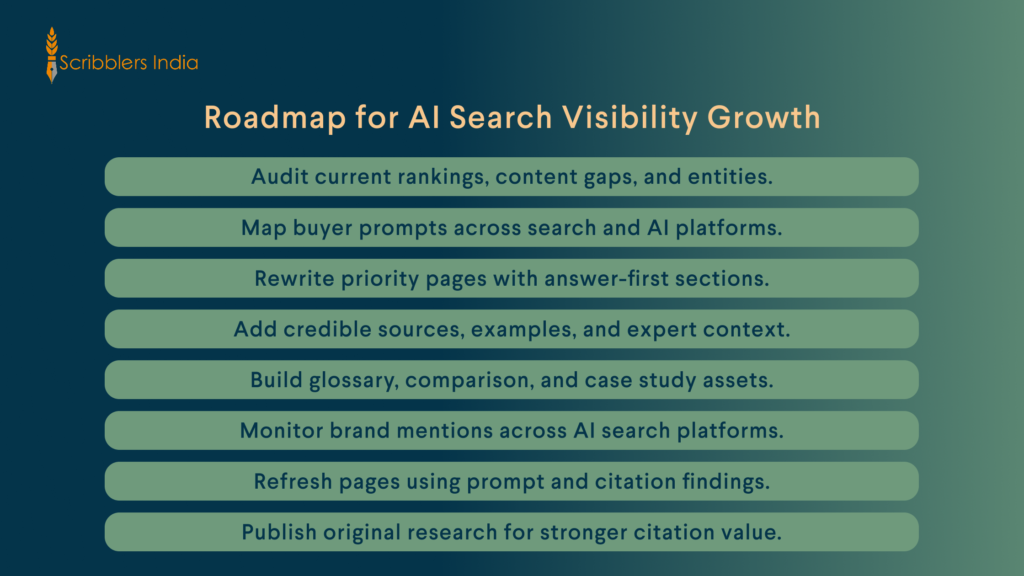
AI Search Discovery Action Plan for Indian Brands
Indian brands should treat AI search discovery as a phased operating system, not a one-time content update. The first step is to audit what already exists, then improve priority pages, test prompts, publish stronger authority assets, and build a recurring review cycle across AEO and GEO.
- First 30 Days: Audit your current website for rankings, indexed pages, service clarity, internal links, author bios, and content gaps. Build a prompt list from buyer questions, People Also Ask results, sales objections, comparison searches, and customer conversations. Identify ten priority pages for refresh.
- 60 Days: Rewrite priority pages with direct answers, stronger H2s, credible sources, clearer examples, and sharper CTAs. Add FAQs where useful. Strengthen internal links between service pages, blogs, case studies, glossary pages, reports, and founder content.
- 90 Days: Begin prompt testing across Google AI Overviews, Google AI Mode, ChatGPT, Perplexity, and Gemini. Track which competitors appear, which pages are cited, and how your brand is described. Refresh content where prompts show weak or missing coverage.
- 6 Months: Publish citation-worthy assets such as original research, benchmark reports, glossary hubs, comparison guides, and expert-led thought leadership. Add recurring AI discovery reviews to your content calendar. Build a repeatable SEO, AEO, and GEO operating rhythm.

How Can Scribblers India Help Improve AI Search Discovery?
Scribblers India helps brands build content systems for Google Search, AI Overviews, ChatGPT, Perplexity, Gemini, and AI Mode. We integrate SEO, AEO, GEO, thought leadership, ghostwriting, content refresh, and personal branding into a single strategy. Our goal is useful content that improves discovery, trust, and buyer confidence.
- AI Search Content Audit: We review your current pages, rankings, content gaps, entities, and answer readiness. This shows which assets need restructuring, better sources, clearer headings, or stronger internal links before chasing AI discovery.
- AEO and GEO Content Strategy: We build question-led structures, direct answers, FAQs, glossary assets, and citation-ready pages. This helps search engines and AI systems understand what your brand does and why it deserves attention.
- Thought Leadership and Authority Assets: We help founders and brands publish expert-led articles, case studies, reports, and original insight pieces. These assets strengthen topical authority and give AI systems more credible context around your expertise.
- Content Refresh and Optimization: We improve existing pages instead of always creating new ones. Refreshes can add stronger answers, better examples, recent sources, internal links, metadata, and clearer buyer pathways.
- AI Visibility Measurement Support: We help teams define prompt sets, monitor AI mentions, review cited pages, and track competitor visibility. This turns AI search from guesswork into a repeatable content improvement process.
Talk to Scribblers India to build a content system designed for AI-led search discovery.
Frequently Asked Questions
What is AI search discovery?
AI search discovery means your brand appears, gets cited, or is accurately described inside AI-generated search experiences. These include Google AI Overviews, Google AI Mode, ChatGPT, Perplexity, and Gemini. It goes beyond rankings, as users may form opinions before clicking on any website.
How is AI search discovery different from SEO?
SEO focuses mainly on ranking pages in search results and earning organic clicks. AI search discovery also tracks answer inclusion, brand mentions, cited pages, prompt coverage, and entity accuracy. Strong SEO still matters, but brands now need AEO and GEO to support AI-led discovery.
Can small businesses improve AI search discovery?
Yes, small businesses can improve AI search discovery by focusing on specific buyer questions, clear service pages, useful FAQs, and source-backed content. They do not need huge content volume. They need sharper positioning, consistent entities, and pages that answer real decision-stage queries well.
What content works best for AI Overviews?
AI Overviews often reward content that gives clear answers, useful definitions, strong examples, credible sources, and structured sections. Glossaries, comparison guides, FAQs, expert explainers, and updated service pages can help. Content should be written for readers first, while remaining easy for systems to extract.
How do you measure AI search discovery?
Measure AI search discovery through recurring prompt testing, brand mention tracking, cited URL checks, AI Overview presence, Perplexity citations, ChatGPT answers, and Gemini summaries. Also track whether your brand description is accurate. Combine these signals with rankings, impressions, clicks, conversions, and content refresh outcomes.
Does AI search reduce website traffic?
AI search can reduce clicks when users receive enough information in a single answer. However, it can also send high-intent traffic from platforms such as ChatGPT or Perplexity. Brands should therefore track both traffic and influence signals such as mentions, citations, answer accuracy, and assisted conversions.
Why should Indian brands act now to improve their AI search discovery?
Indian brands should act now because Google AI Mode is already available in India, and AI-assisted research is becoming the norm for decision-makers. Waiting creates a content gap competitors can fill first. Early action helps brands build authority, prompt coverage, and citation readiness before the space becomes crowded.