Before a hiring decision, funding conversation, partnership request or sales call begins, people usually search online first. They check your LinkedIn profile, published articles, website bio, public opinions and search results. That is why you need a personal branding strategy that builds trust before the first conversation.
A 2025 Aurora University study found that 50% of American professionals believe a strong personal brand matters more than a strong resume. The number rises to 61% among business executives. For founders, this shift matters because reputation now influences buyers, investors, talent and partners before direct interaction.
This guide explains how to build a personal branding strategy in 2026 using positioning, LinkedIn, thought leadership, ghostwriting, AI search visibility and owned audience systems. If you need support turning your expertise into a structured visibility engine, Scribblers India’s personal branding services can help you build the foundation.
TL;DR
|
Why You Need a Comprehensive Personal Branding Strategy in 2026?
A comprehensive personal branding strategy in 2026 can help you become known, trusted, and discoverable across search, LinkedIn, AI platforms, and professional networks. It integrates your positioning, proof, publishing rhythm, audience ownership, and measurement into a single system, so your expertise builds trust before the first conversation begins.
You cannot build a strong personal brand by posting randomly when time permits. You need to define what you want to be known for, who should remember you, and which content assets will continue to build authority when you are not actively online.
If you are starting out without an audience, you can also read our guide to building a personal brand with zero followers. It explains how early authority can begin with positioning, profile clarity, and searchable content before audience size grows.
A useful personal branding strategy should answer five questions before content creation begins.
| Strategic Question | Why It Matters |
| What should you be known for? | It creates category recall around your expertise. |
| Who should trust you? | It keeps your content focused on the right audience. |
| What proof supports your authority? | It makes your expertise believable and specific. |
| Where should you publish? | It prevents platform overload and scattered visibility. |
| What action should readers take? | It connects visibility with business outcomes. |

Why Does Personal Branding Matter for AI Search Visibility?
Personal branding matters for AI search visibility because AI systems increasingly summarize people, companies and service providers from multiple sources. If your positioning, author profiles, LinkedIn presence, and website content are consistent, you give AI systems stronger signals to understand and accurately describe your expertise.
Your personal brand is no longer limited to social reach. Your name, company profile, website bio, service pages, articles, reports, guest posts and third-party mentions can influence how you appear across Google AI Overviews, ChatGPT, Perplexity, Gemini and other discovery surfaces.
- Google reported in 2026 that AI Overviews reached 2 billion monthly users across 200 countries and territories.
- OpenAI reported in 2026 that ChatGPT had 700 million weekly active users during its usage study.
- HubSpot reported in 2026 that nearly 24% of marketers are exploring SEO updates for generative AI search.
- A 2026 empirical study found that Google Search, Gemini and AI Overviews retrieve substantially different source sets.
Scribblers India Takeaway:
You should not treat personal branding as a LinkedIn-only activity. You need a connected authority footprint across your website, founder profile, long-form content, social presence and third-party mentions so humans and AI systems can understand your expertise consistently. Our GEO strategy guide can help you evaluate those gaps more clearly.
What Are the Core Elements of a Founder Personal Brand?
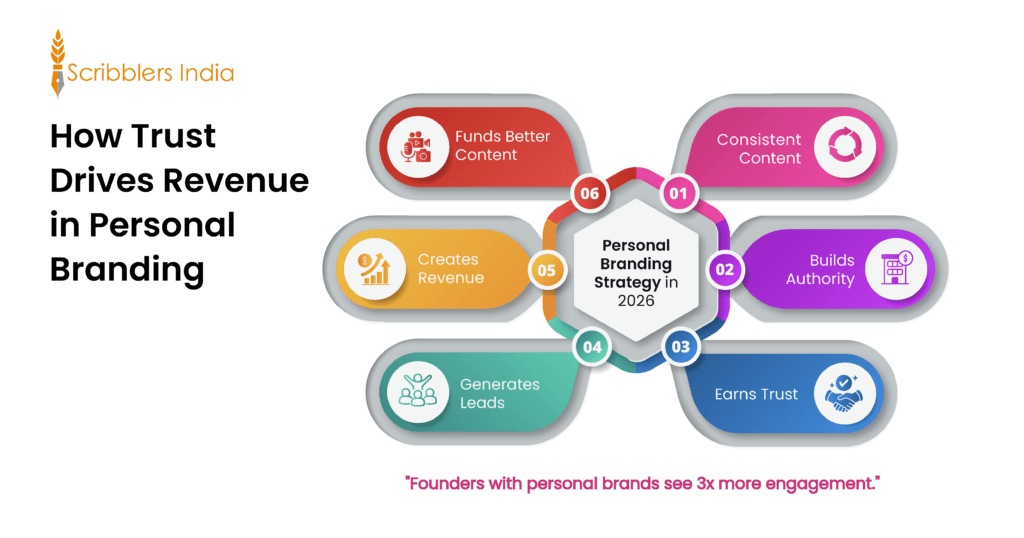
Your founder personal brand needs clear positioning, credible proof, focused content pillars, platform consistency and measurable business outcomes. Without these elements, your content becomes activity rather than strategy. The goal is to connect your expertise with the exact audience, problem and category you want to own.
Here is what the Scribblers India founder authority framework looks like:
| Pillar | What It Covers | Why It Matters |
| Positioning | What you should be known for | Creates recall and category association |
| Proof | Experience, stories, results and examples | Makes expertise believable and specific |
| Publishing | LinkedIn, blogs, newsletters and videos | Builds consistent visibility across platforms |
| Search Visibility | SEO, AEO, GEO and AI discoverability | Helps AI systems understand your authority |
| Owned Audience | Newsletter, website and lead magnets | Reduces dependence on rented platforms |
| Measurement | Profile visits, leads, mentions and branded search | Shows whether authority is converting |
This framework keeps your personal branding strategy focused on business value. It prevents you from copying creators, chasing short-lived trends or publishing disconnected content that earns attention but does not build trust, recall or demand.
Positioning: Define Your Authority Territory
Your positioning should explain the exact area where your experience, audience need and market opportunity overlap. If you write about “business growth,” you blend into the crowd. If you write about “AI search visibility for B2B service firms,” you become easier to remember and recommend.
Proof: Make Your Expertise Believable
Your proof does not always need dramatic numbers. It can include client patterns, anonymized examples, lessons from execution, founder stories, frameworks, research notes and practical decision guides. The goal is to show how you think and why your perspective deserves attention.
Consistency: Align Every Public Signal
Your LinkedIn headline, About section, website bio, author profile, podcast introduction and guest article bio should reinforce the same authority territory. Readers and AI systems both need repeated signals before they associate your name with a specific area of expertise.
How Should You Use LinkedIn for Personal Branding?
You should use LinkedIn as a trust-building and demand-shaping channel, not only as a posting platform. A strong LinkedIn personal branding strategy connects your profile positioning, content pillars, founder opinions, comments, newsletters, documents and website links into one consistent visibility system.
LinkedIn reports that advertisers can reach more than one billion professionals worldwide. This scale matters for B2B founders because buyers, investors, partners, employees, and industry peers often use LinkedIn to verify credibility before engaging.
- Profile Clarity: Your profile should instantly explain who you help, what you help them solve and why your experience matters. Treat your headline, banner, About section, and Featured section as a landing page rather than a digital resume.
- Content Pillars: Choose three topics you can discuss for at least one year without sounding repetitive. These pillars should reflect your expertise, buyer questions, and category direction. Avoid switching between unrelated themes only because they seem popular.
- Founder Opinions: Share reasoned viewpoints that help your audience make better decisions. Strong opinions should be specific, useful, and defensible. Avoid generic motivation, vague leadership advice, or dramatic statements that do not match your professional credibility.
- Strategic Engagement: Comment on posts from customers, partners, analysts, journalists and category voices. Thoughtful comments can build visibility faster than posting into silence. Your comments should add context, examples or practical disagreement, not empty appreciation.
- Website Connection: Link important LinkedIn content back to your website, reports, guides, case studies and service pages. This strengthens the connection between your founder identity, company entity and owned authority assets. If consistency is difficult to maintain internally, Scribblers India’s ghostwriting services can help you turn founder thinking into regular LinkedIn, website and newsletter content.
How Can AI Support Personal Branding Without Hurting Authenticity?
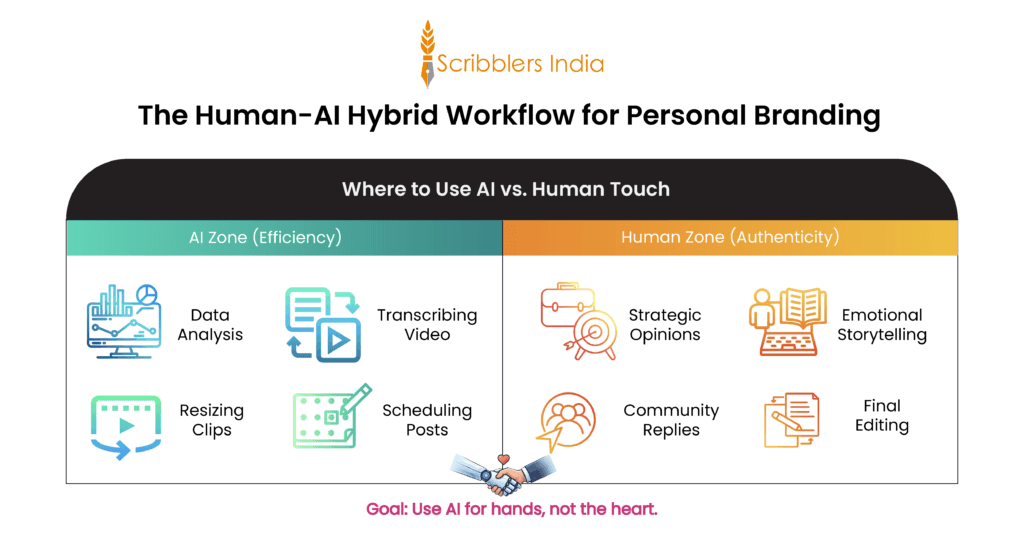
AI can support your personal branding efforts by improving research, structure, repurposing, editing and content operations. It should not replace your original judgment, lived experience or point of view. The best AI personal branding workflow keeps thinking human and uses AI for speed and distribution.
AI-generated content becomes risky when it sounds polished but empty. Your audience can quickly sense generic patterns, and you lose trust when every post feels interchangeable. Use AI to convert real thinking into better formats, not to manufacture expertise that does not exist.
- Analyze audience questions from comments, sales calls, webinars, reviews and objections to identify themes worth addressing in content.
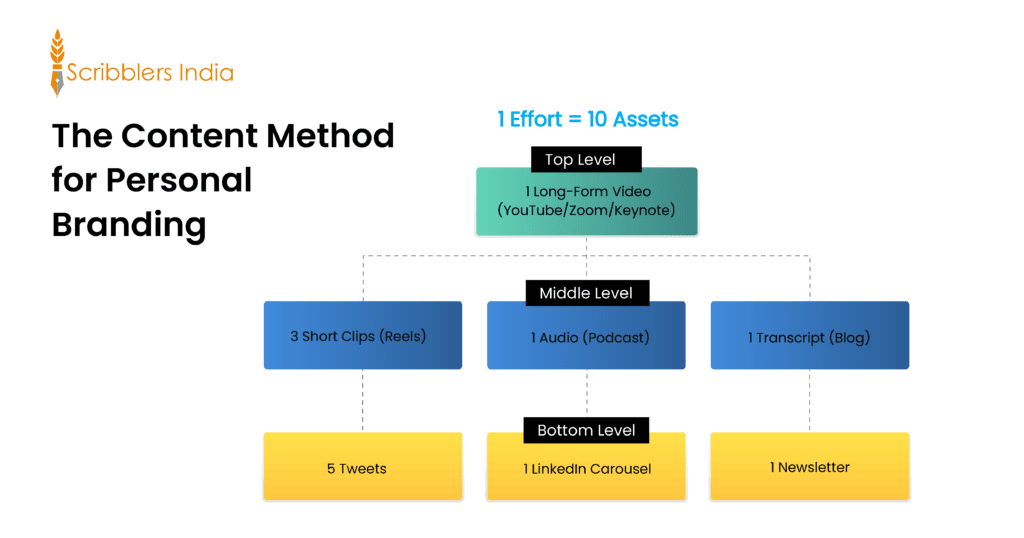
- Turn one founder interview into LinkedIn posts, long-form articles, newsletters and video scripts for consistent distribution across channels.
- Organize rough ideas into clear outlines, then add personal experience before approving the final draft for publication anywhere.
- Map content gaps across your website, LinkedIn profile and competitor pages before planning new authority topics each month.
- Test whether your positioning sounds clear, specific and differentiated before publishing profile updates or thought leadership content online.
A practical workflow works better than occasional AI experimentation. Record one founder interview every two weeks, extract the strongest ideas, build content from your actual language, then use AI only to structure, edit and repurpose the material.
AI Visibility Risk: If your content sounds like everyone else’s AI-assisted output, it weakens your authority. You need original examples, strong opinions, lived experience and source-backed thinking to make your personal branding strategy in 2026 credible. Our AEO services can help you structure content for answer-led discovery and wider discoverability.
Which Content Formats Build Founder Authority Fastest?
The strongest content formats build trust, explain your thinking and give people something useful to reference later. Short posts create awareness, but long-form, source-backed assets build authority. You need a mix of social visibility, search visibility, and owned audience content.
| Content Format | Authority Value | Best Use |
| LinkedIn posts | Medium to high | Build regular visibility and audience trust |
| Long-form blogs | High | Capture search intent and explain expertise |
| Founder newsletters | High | Build owned audience and recurring attention |
| Guest articles | High | Earn third-party credibility and citations |
| Case studies | Medium to high | Show applied thinking and execution proof |
| Research reports | Very high | Build citation value and original authority |
| Frameworks | Very high | Create branded methodology and recall |
| Podcasts or webinars | Medium to high | Humanize expertise and expand distribution |
A strong personal branding strategy uses LinkedIn for visibility, your website for authority, newsletters for retention, and third-party platforms for credibility. This mix gives your expertise more places to be discovered and trusted.
- Thought Leadership Articles: These help you explain a specific market shift, challenge, or opportunity in depth. A strong article should not repeat what everyone already knows. It should give your audience a useful decision lens they can apply. Our thought leadership content services can help you turn expertise into publishable authority assets.
- Case Studies and Stories: These help readers understand how your thinking works in real situations. Use anonymized examples when needed, but avoid unsupported numbers. A credible story with clear context is better than a dramatic claim without evidence.
- Reports and Frameworks: These give your personal brand original information gain. A report, scorecard, or framework can earn backlinks, citations, newsletter shares, and AI visibility because it gives the web something distinct to reference. Professional report writing and designing services from Scribblers India support your efforts here.
How to Build an Owned Audience With Your Personal Branding Strategy?
You should build an owned audience because social platforms control reach, rules and visibility. Your newsletter, website, and lead magnets give you a direct relationship with your audience. This matters when algorithms change, social reach declines or your best prospects are not active every day.
Your LinkedIn followers are valuable, but you do not fully control access to them. A newsletter gives you a more stable channel for deep thinking, curated insights and relationship-building. It also helps you convert casual visibility into a more committed audience.
Your website should become your authority hub. It should host your bio, articles, services, reports, case studies, media mentions, and lead magnets. When someone searches your name or asks an AI tool about your expertise, your owned assets should provide clear, structured context.
A simple owned audience system can include one monthly newsletter, one lead magnet, one founder bio page, one flagship guide, and one clear consultation CTA. To make this practical, pair your newsletter with a resource such as a personal branding case study, so readers have a reason to engage beyond reading.
Which Metrics Show Your Personal Branding Strategy Is Working?
You should measure your personal branding strategy through business and authority signals, not only likes and follower growth. The right metrics show whether your visibility is improving trust, discovery, conversations, search demand, AI mentions and qualified inbound opportunities.
| Metric | What It Shows | Why It Matters |
| Profile views | More people are checking your credibility | Early visibility signal |
| Branded search | More people are searching your name | Recall and curiosity signal |
| Inbound leads | Prospects are taking action | Commercial value signal |
| Content saves | Readers find your content useful | Depth and relevance signal |
| Newsletter subscribers | Audience wants repeated access | Owned trust signal |
| Speaking invites | Market sees you as an expert | Authority signal |
| AI mentions | AI systems associate you with a topic | GEO visibility signal |
| Referral traffic | External platforms send visitors | Distribution signal |
You should review these metrics monthly rather than reacting to every post. One post with low likes can still influence the right buyer, investor or journalist. Personal branding tactics best when you measure compounding authority instead of chasing daily validation.
Other Key Metrics to Track
Here are some additional metrics you must monitor to determine the success of your personal branding efforts:
- Share of Voice: Track whether your ideas, name or company appear more often in category conversations. This shows whether your content is shaping the market rather than merely joining it.
- Prompt Visibility: Test whether ChatGPT, Perplexity, Gemini and Google AI Overviews mention your name, company or content for relevant prompts. Track accuracy, sentiment, missing context and competitor mentions.
- Conversion Quality: Track whether inbound conversations match your ideal customer profile. A smaller audience that attracts better-fit prospects is more valuable than a large audience that never converts.
If you want to connect founder visibility with AI-led discovery, use a personal brand audit to review prompt mentions, source citations, content gaps and entity clarity. You can also read our AEO and GEO strategy guide to understand how search visibility is changing.
How Does Scribblers India Build Personal Branding Systems for Founders and Leaders?
At Scribblers India, we help you build a personal branding strategy that connects positioning, ghostwriting, thought leadership, LinkedIn, website authority and AI search visibility. Our work is designed for founders, CXOs, consultants and service-led businesses that want clearer authority, stronger discoverability and better-qualified inbound opportunities.
- Personal Brand Positioning: Every engagement begins with clarity around what you should be known for, who you should reach and which category associations matter most. This gives your content clear direction before we plan LinkedIn posts, blog posts, newsletters, or thought leadership assets.
- Ghostwriting and Founder-Led Content: Your voice is captured through structured interviews, notes and editorial review before we write anything. We then turn your ideas into LinkedIn posts, articles, newsletters, website content, and bylined pieces that sound like your thinking, not generic outsourced content.
- LinkedIn Personal Branding Strategy: Your profile, content pillars, posting rhythm, Featured section, and engagement approach are optimized to enhance professional visibility. The goal is to make your LinkedIn presence clear, credible and connected to your broader website and business goals.
- Thought Leadership and Authority Assets: Blogs, reports, frameworks, guides, and opinion-led assets help you explain your expertise in depth. These assets support search visibility, AI discovery, sales conversations and long-term trust across founder, brand and category touchpoints.
- AI Search Visibility Support: Stronger entity clarity across your website, LinkedIn, author bios, service pages and external content helps search engines understand your expertise. This supports SEO, AEO and GEO while improving how AI systems describe your authority.
If you want to build authority without posting random content every day, book a 1:1 demo with our team for a strategy discussion.
Frequently Asked Questions (FAQs)
Is it too late to start a personal branding strategy in 2026?
No, it is not too late to start a personal branding strategy in 2026. AI has increased content volume, but it has also made credible human expertise more valuable. Start with a specific audience, clear positioning and useful content instead of trying to appeal to everyone across every platform available.
How much time does personal branding take each week?
You can manage personal branding in two to three focused hours each week if you follow a structured workflow. Use that time for idea capture, content review, comments and relationship-building. A ghostwriting partner can handle research, drafting, editing and repurposing between your review cycles without slowing your core business priorities.
Do you need to post daily to build a personal brand?
No, you do not need to post daily to build a strong personal brand. Consistency matters, but consistency does not mean constant publishing. One strong article, two useful LinkedIn posts, one newsletter note and thoughtful comments each week can outperform daily generic content over time for serious founder authority growth.
What is the biggest mistake founders make with personal branding?
The biggest mistake is publishing before defining your positioning. If you speak about too many topics for too many audiences, people struggle to remember why they should trust you. Your personal branding strategy should start with a narrow authority territory, clear proof and repeatable content pillars before publishing anything regularly.
Can AI help with personal branding?
Yes, AI can help with research, structuring, editing, repurposing and content planning. It should not replace your original insights, opinions or real-world examples. The strongest AI personal branding workflow keeps your thinking at the center and uses AI to improve speed, consistency and distribution quality without flattening your voice or credibility.
Why should founders invest in LinkedIn personal branding?
LinkedIn personal branding helps you build trust with buyers, investors, partners, employees and industry peers. A strong profile and consistent content can support inbound conversations before a formal sales or hiring process begins. It also strengthens your professional authority across Google, AI search platforms and professional networks over time consistently.
How can a personal branding agency India help founders?
A personal branding agency India can help you define positioning, create content pillars, manage ghostwriting and build a consistent LinkedIn and website presence. The right partner should connect your visibility with authority, trust and business outcomes. It should act as a strategic partner, not only a writing vendor for growth.