

AI content editing has become the difference between publishing a fast draft and publishing a credible content asset. AI tools can help teams move faster, but raw drafts often need sharper facts, stronger voice, clearer structure, and better search alignment before they deserve a place on your website.
That gap matters more in 2026 because search engines, AI Overviews, and readers now reward content that feels useful, original, and trustworthy. A draft that sounds polished but says nothing new can still weaken engagement, rankings, and brand credibility. This is why editing can no longer be treated as a quick grammar check.
This guide shares twelve practical editing tips to help you turn AI-assisted writing into publishable content. You will learn how to verify claims, remove predictable AI phrasing, add first-hand expertise, improve brand voice, restructure sections for answer-first SEO, and strengthen E-E-A-T signals before publication.
TL;DR:
|
How To Improve AI Content With a Genuine Human Voice?
AI content editing turns a fast machine-written draft into content that feels clear, credible, and genuinely human. AI tools can produce a starting point in minutes, but speed alone does not make a draft ready for readers, search engines, or brand-led publication.
The issue is quality. Content Marketing Institute reports that only 17% of B2B marketers rate AI-generated content as excellent or very good, while 44% call it good. That gap shows why human review must go beyond grammar and surface-level cleanup.
A strong editing process verifies claims, removes predictable AI phrasing, adds first-hand insight, and restores brand voice. This guide shares twelve practical ways to make AI-assisted content more useful, original, and publication-ready for serious content marketing teams today.

Why Is AI Content Editing Important Before Publishing?
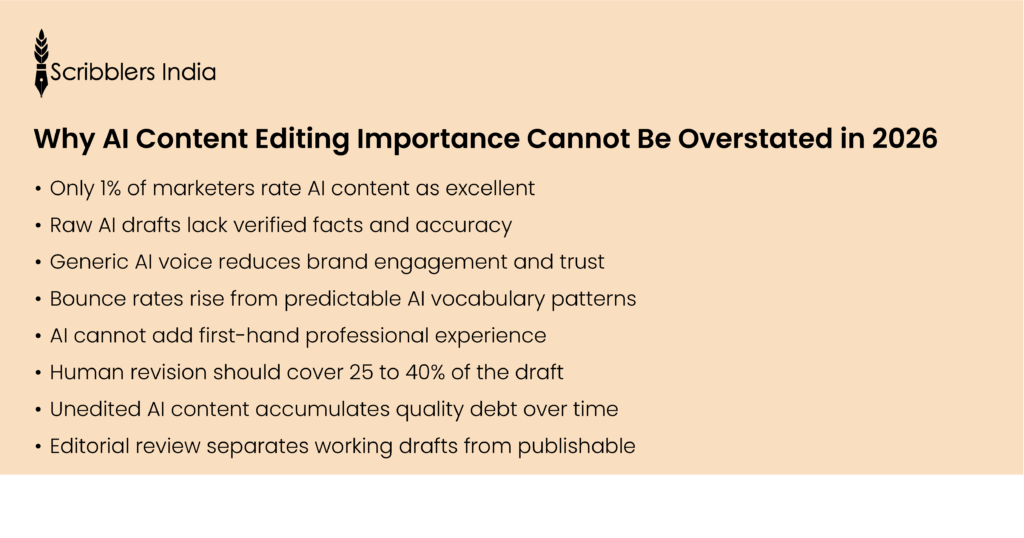
The importance of AI content editing comes down to one commercial reality. Raw AI drafts consistently fall short across four dimensions: factual accuracy, brand voice, original insight, and audience trust. Publishing them without review creates quality debt that accumulates across a content library over time.
The failure is not in the AI tool. It is in the workflow that bypasses the editorial layer that separates a working draft from a publishable asset.
- AI content lacks verifiable accuracy by default: AI language models generate confident-sounding claims that are sometimes factually incorrect. They fabricate statistics, attribute quotes to the wrong people, and state outdated information as current fact. Without human verification, these errors reach your audience and damage the credibility your brand has built through its entire content history.
- Raw AI drafts carry no brand personality or genuine voice: AI tools produce a generalized professional register that sounds competent and impersonal in equal measure. According to experts, consistency in tone determines whether audiences stay or dismiss a brand. A draft that reads like no one wrote it fails to build the relationship your audience is looking for with your brand.
- Unedited AI content actively reduces user engagement signals: When readers encounter generic AI vocabulary patterns, they bounce. When Google’s quality systems register that bounce, they demote the page. The importance of AI content editing is therefore both a brand-quality argument and a direct SEO argument that affects every page on the domain.
- AI cannot contribute genuine first-hand experience: E-E-A-T requires demonstrable experience. AI tools synthesize publicly available information but cannot describe real professional outcomes, genuine client results, or lessons learned through direct work in a field. Only human editing AI writing can add the experience layer that Google’s quality raters look for when evaluating content authority.
What Are the Biggest Challenges with AI Content Editing?
The biggest challenges with AI content editing fall into four categories. These are: factual hallucinations, generic vocabulary, missing first-hand experience, and structural bloat. Identifying these four problem categories before you edit AI content helps you prioritize editing passes that deliver the highest quality improvement per hour of editorial effort.
Knowing the specific failure patterns significantly speeds up every editing session.
Predictable vocabulary patterns that signal AI generation
AI tools overuse a recognizable set of words and phrases across nearly every draft they produce. These include “delve into,” “it is worth noting,” “comprehensive,” “leverage,” “seamlessly,” and “it is important to understand.” Readers recognize these patterns quickly and associate them with low-effort content production.
Replacing them with direct, specific, conversational alternatives during the editing pass is one of the highest-impact improvements available per minute of editorial time spent.
Hallucinated statistics and fabricated source attributions
AI models generate plausible-sounding facts with complete confidence regardless of their accuracy. A statistical claim that cannot be traced to a verifiable primary source should be removed or replaced during every editing pass. This is the most consequential category of problems with AI-generated content. A single published hallucination can trigger a Google quality demotion that affects the entire domain rather than just the page in question.
Structural bloat that delays the actual answer
AI drafts frequently open sections with multiple context-setting paragraphs before reaching the main point the reader came to find. According to a February 2026 industry analysis, 44% of AI citations in search responses come from the first 30% of a content piece. Restructuring AI drafts so that every section leads with the direct answer rather than building toward it makes the content more useful for human readers and more extractable for AI citation systems simultaneously.
What are the Key Tips to Edit AI Content for Accuracy and Voice?
AI content editing should begin with two priorities: factual accuracy and human voice. Raw AI drafts often sound fluent, but they may include weak claims, generic phrasing, missing context, or a tone that does not match the brand.
The first editing stage should therefore separate what is usable from what needs verification, rewriting, or removal. This applies to blogs, landing pages, product pages, email sequences, thought leadership articles, and long-form guides. Use the first two editorial passes to fix the foundation. Once the facts are reliable and the voice sounds human, subsequent SEO, structure, and authority improvements become easier to apply.
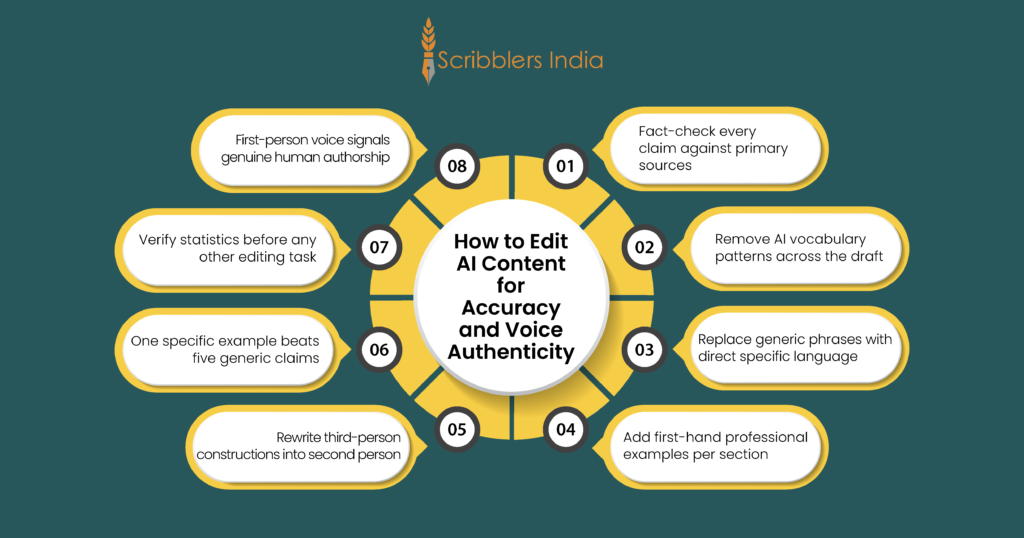
Tip 1: Fact-check every claim against a verifiable primary source
The first AI content editing pass should focus only on verification. Check every statistic, attribution, regulatory reference, product specification, trend claim, and historical detail against a reliable primary source before improving the language.
Remove claims that cannot be verified. Replace weak or outdated references with current, credible sources. This protects brand credibility and prevents factual errors from weakening reader trust, especially in technical, legal, healthcare, finance, and B2B SaaS content.
Tip 2: Remove AI vocabulary patterns and use direct language
The second pass should identify phrases that make the draft sound machine-generated. AI tools often overuse expressions such as “delve into,” “unlock,” “seamlessly,” “leverage,” “it is important to note,” and “in today’s digital landscape.”
Replace these with direct, specific language. For example, “This approach leverages cutting-edge solutions” can become “This approach uses structured data markup.” Specific writing builds more trust than broad claims because readers can immediately understand what the sentence means.
Tip 3: Add first-hand experience and real professional examples
AI tools can summarize public information, but they cannot add lived professional experience. They cannot explain what happened during a client project, how a campaign performed, where a process failed, or what an expert learned through direct work.
This is where human editors add real value. Add at least one relevant example, observation, workflow, client insight, or practical lesson in every major section. These details make the content more useful, more credible, and harder for competitors to replicate.
Tip 4: Rewrite distant AI voice into first or second person
AI drafts often sound distant because they rely on third-person constructions such as “research shows,” “statistics indicate,” or “it is generally understood.” This creates a polished but impersonal tone that does not build a strong connection with the reader.
During AI content editing, rewrite key sections in second person or first person where appropriate. For example, “businesses should consider” can become “you should review,” while expert-led sections can use phrases such as “in our experience working with SaaS brands.” This makes the writing sound more human without changing the structure.
How Does AI Content Editing Improve Brand Voice and Structural Quality?
AI content editing should not stop at correcting facts and removing awkward phrases. The next stage is to make the draft sound like your brand, flow like human writing, and answer the reader’s query without unnecessary delay.
This means improving tone, sentence rhythm, original insight, and section structure. A raw AI draft may be readable, but it often lacks the judgment, hierarchy, and distinct point of view that make content memorable. Use these four tips during the second and third editing passes. They help convert a competent AI draft into content that feels polished, useful, and aligned with your brand’s editorial standard.
Tip 5: Align the full draft with your documented brand voice
Every brand has a communication style that its audience learns to recognize. Some brands sound direct and technical. Others sound advisory, conversational, or founder-led. AI tools usually produce a neutral professional tone that does not fully belong to any brand.
During AI content editing, compare the draft against your brand voice guidelines, approved content samples, and audience expectations. Rewrite sections that sound too generic, too promotional, or too distant. The final piece should sound like your company, not like a capable but anonymous writing tool.
Tip 6: Vary sentence length and structural rhythm throughout
AI drafts often use similar sentence lengths across the page. This creates a mechanical rhythm even when the grammar is correct. Readers may not always notice the pattern consciously, but the content can start to feel flat.
Improve rhythm by mixing short, clear sentences with longer analytical ones. Break dense paragraphs where needed. Combine choppy sentences when the idea needs more depth. This variation makes the reading experience smoother and helps the content sound more naturally written.
Tip 7: Add original data and expert perspectives
Original insights make AI-assisted content more valuable. AI tools can summarize what already exists online, but they cannot add your internal observations, client learnings, campaign results, product experience, or expert judgment unless you provide them.
Add proprietary data, expert quotes, practical workflows, examples, benchmarks, or lessons from real projects wherever possible. These additions help the content move beyond generic explanation. They also make the piece more useful for readers already familiar with the basic information on the topic.
Tip 8: Restructure every section with an answer-first SEO format
AI-generated content often takes too long to reach the actual answer. It may begin with broad context, repeat the search query, or explain why the topic matters before giving the reader what they came to find.
During AI content editing, restructure each section so the first 40 to 50 words answer the heading directly. Follow that with explanation, examples, and supporting details. This answer-first format improves readability, supports featured snippet opportunities, and makes the content easier for AI search systems to understand and cite.

How Does AI Content Editing Strengthen SEO and Authority Signals?
AI content editing should end with a focused review of SEO, authority, and publication readiness. At this stage, the draft should already be fact-checked, rewritten for voice, and cleaned for structure. The final pass should ensure it is credible, complete, and sufficiently useful to publish.
This includes adding E-E-A-T signals, improving section flow, removing repeated ideas, and checking whether every paragraph adds real value. These details help readers trust the content and help search engines understand its quality, context, and relevance. Use these four tips during the final review pass before publication approval.
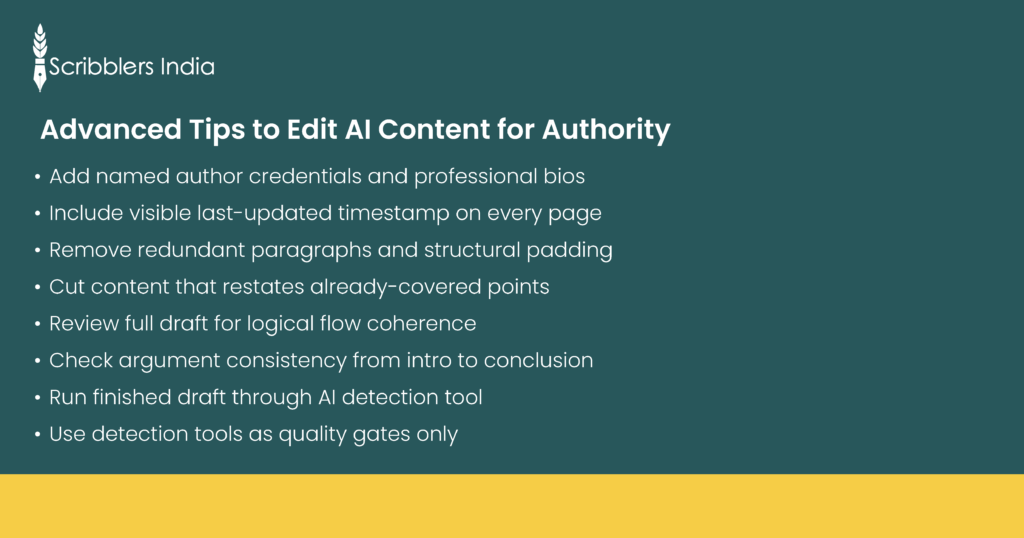
Tip 9: Add named author credentials and E-E-A-T signals
Every AI-assisted piece prepared for publication should include a named author, a relevant author bio, a visible publication date, and, where appropriate, a last-updated date. These details show that the content has editorial ownership and subject-matter accountability.
During AI content editing, also add expert inputs, first-hand examples, source citations, case references, and practical insights wherever relevant. These signals help the content feel more trustworthy than a generic AI summary and support stronger credibility for readers evaluating the advice.
Tip 10: Remove redundant paragraphs and structural bloat
AI drafts often use extra words to meet length targets. They may repeat the same idea, add unnecessary context, include weak transitions, or summarize points that the reader already understands.
Cut these sections during the final AI content editing pass. Keep the explanation tight, useful, and information-rich. Removing bloat improves readability, strengthens engagement, and helps each section deliver clearer value. A lean, specific paragraph usually performs better than a long paragraph that restates familiar ideas.
Tip 11: Review logical flow and argument coherence across sections
AI drafts can sound coherent section by section but still feel disconnected when read as a complete article. One section may introduce a point that another section ignores. Another may repeat an idea with slightly different wording. Some transitions may feel abrupt or mechanical.
Read the full draft from start to finish before approval. Check whether the introduction sets up the article properly, each section builds on the previous one, and the conclusion brings the argument together. This pass improves the reader’s experience and makes the final piece feel intentionally written.
Tip 12: Use AI detection tools as a final quality check
AI detection tools such as Originality.ai, GPTZero, or Grammarly’s AI detector can help identify sections that still sound too machine-written. They should not be treated as ranking predictors or final proof of content quality.
Use them only as a quality check. If a section receives a high AI-likelihood score, review it for generic phrasing, repetitive rhythm, weak examples, and missing human perspective. Then rewrite the section manually. The real goal is not to pass a tool, but to publish content that sounds useful, specific, and credible.
Why Do You Need AI Content Editing Services in India to Publish with Confidence?
AI has made content production faster, but it has also increased editorial risk. Many teams now create drafts at a pace their internal reviewers cannot match. As output grows, small issues such as weak sourcing, generic tone, repeated ideas, inaccurate claims, and shallow explanations can spread across blogs, landing pages, newsletters, and thought leadership assets.
AI content editing services address this gap by adding a structured human-review layer before publication. The goal is not only to make AI content sound less mechanical. The goal is to make every draft accurate, brand-safe, useful, and aligned with the way real readers search, compare, and make decisions. A skilled editor checks facts, sharpens the argument, removes filler, improves flow, strengthens examples, and ensures the content reflects the brand’s voice.
For Indian businesses and global teams working with Indian content partners, this support is especially useful when publishing at scale. It helps marketing teams maintain quality without slowing production. At Scribblers India, we help businesses turn AI-assisted drafts into credible, polished, and search-ready content that protects reader trust, brand authority, and long-term content performance.
How Does Scribblers India Edit AI-Generated Content?
At Scribblers India, we follow a structured AI content editing workflow that improves accuracy, voice, structure, authority, and publication readiness. Each draft goes through defined editorial checks rather than a quick grammar-level review.
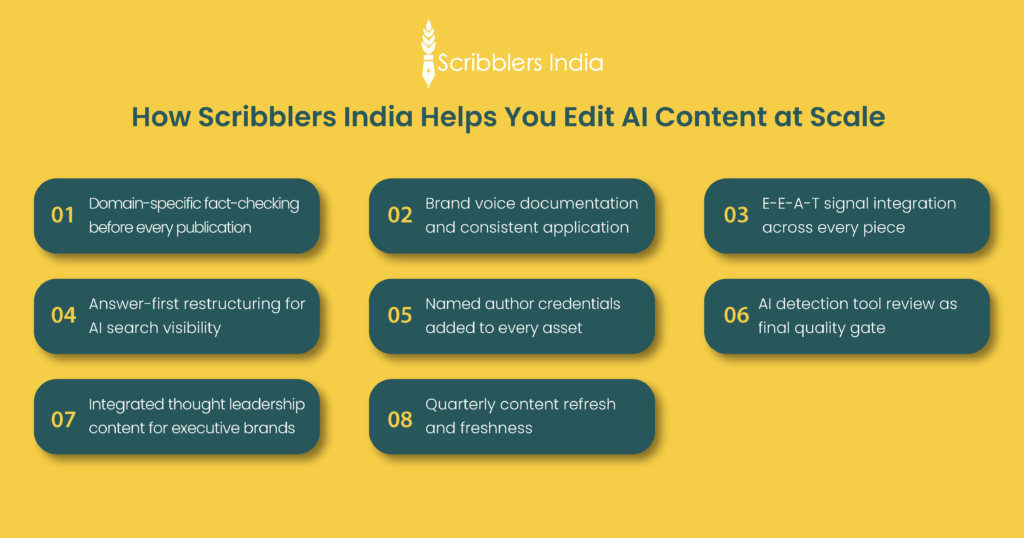
- Domain-specific fact-checking: We verify statistics, technical claims, product details, regulatory references, and source attributions before approval. This helps remove hallucinations and weak claims that automated grammar tools may miss.
- Brand voice alignment: We review the client’s approved content, messaging guidelines, vocabulary preferences, and audience expectations. Then we rewrite generic AI phrasing so the final piece sounds consistent with the brand.
- E-E-A-T signal integration: We strengthen the content with author credentials, expert inputs, first-hand examples, case references, practical insights, and credible citations wherever relevant. This turns a generic summary into a more authoritative asset.
- Answer-first restructuring: We rewrite sections so each heading receives a direct answer within the opening lines. This improves readability and supports SEO, AEO, featured snippet, and AI search visibility.
- Thought leadership refinement: For founder-led and executive content, we add sharper opinions, original perspectives, and human context. This ensures AI-assisted writing carries a distinctive voice, not a recycled industry summary.
At Scribblers India, our AI content editing process is also informed by our broader work in AEO, GEO, SEO content strategy, and executive-led thought leadership. We do not treat AI-assisted content as a grammar-cleanup task. We assess whether the content can earn search visibility, support AI search discovery, reflect a credible expert voice, and move the reader toward a clear business decision.
Connect with Scribblers India today to build an AI content quality control workflow that publishes at AI speed without sacrificing the editorial standard your brand requires.
FAQs
How much of an AI draft should a human editor rewrite?
There is no fixed percentage that applies to every draft. In most cases, strong AI content editing should rewrite enough of the draft to verify facts, remove generic phrasing, improve flow, add examples, and align the content with brand voice. If the editor changes only grammar, the draft may still sound mechanical. If the editor rewrites most of it, the original prompt likely needs improvement.
What are the most common problems AI content editing should fix?
AI content editing usually fixes five recurring problems: inaccurate claims, generic vocabulary, missing first-hand experience, weak structure, and repetitive explanations. These issues can make content look complete while still feeling shallow to readers. A proper editing process checks whether every section adds useful information, clearly answers the search intent, and reflects a credible human perspective.
Does AI content editing protect content from Google SEO issues?
AI content editing can reduce SEO risk by improving quality, accuracy, originality, and usefulness. Google does not reject content only because AI helped produce it. The concern is low-value content that lacks expertise, original insight, or reader benefit. Human editing helps AI-assisted content meet stronger quality standards by adding verified sources, expert inputs, better structure, and clearer answers.
What is the right order for AI content editing before publishing?
The best order is to verify facts first, then improve voice, structure, and authority signals. Start by checking claims, statistics, product details, and source references. Then remove AI-style phrasing, improve sentence rhythm, add examples, and restructure each section with an answer-first format. The final pass should review E-E-A-T signals, internal links, metadata, readability, and publication readiness.
Can small content teams manage AI content editing without full-time editors?
Yes, small teams can manage AI content editing with a clear checklist. Each AI-assisted draft should undergo factual verification, voice improvement, structure cleanup, and authority enhancement before publication. However, high-priority blogs, landing pages, reports, and thought leadership assets often require more in-depth editorial support. For these assets, teams can work with a specialist partner like Scribblers India.
How can AI content editing improve thought leadership content?
AI content editing helps thought leadership content move beyond generic industry commentary. Editors can add founder perspectives, practical lessons, original arguments, client examples, and sharper opinions that AI tools cannot create on their own. This is especially important for executives who want their personal brand to sound credible, personal, and differentiated across LinkedIn, blogs, newsletters, and media platforms.
Can AI content editing improve visibility in AI search results?
Yes, AI content editing can support AI search visibility when the content is structured for direct answers, clear entities, credible sources, and depth of topic. AI search systems are more likely to surface content that explains concepts clearly, answers related questions, and includes original insight. Resources such as the Scribblers India AI Search Discovery Benchmark 2026 can help teams understand how visibility is changing across AI-led discovery channels.
How do you measure whether AI-assisted content is ready to publish?
A publishable AI-assisted draft should pass five checks. It should be factually accurate, aligned with brand voice, useful for the reader, structurally clear, and supported by credible authority signals. Teams can also use AI detection tools, readability checks, SEO review, and internal editorial review as final quality gates. You can use the Scribblers India AI Visibility Scorecard to help identify where content needs stronger search and AI discovery signals.