

So, you have decided to stop being the industry’s best-kept secret. Good call. You know you are excellent at what you do, yet does Google know? Does your LinkedIn network know? Or are you shouting into the void (ignoring all core elements of a personal brand), hoping someone notices your brilliance?
Posting random memes or sporadic updates is not branding. Real influence requires a strategy that converts casual observers into loyal believers. Credibility is not magic; it is a recipe with specific ingredients that you must master to win in the digital age.
In this guide, we will break down the 7 non-negotiable core elements of a personal brand. These are the pillars that transform you from another face in the crowd into a recognized authority who commands respect and revenue.

What Defines a Strong Personal Brand in 2026?
A strong personal brand is not just about having a pretty logo or a viral post. It is the cumulative result of trust, reputation, and visibility working in perfect harmony. It is the difference between chasing clients and having them chase you. To achieve this level of influence, you must intentionally design and master the core elements of a personal brand rather than leaving your reputation to chance.
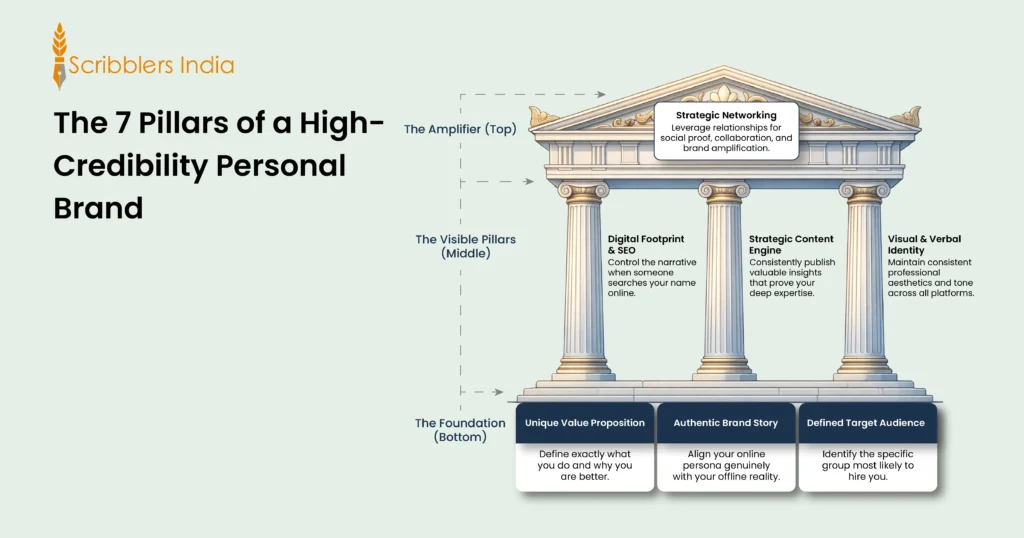
Here are the seven pillars we will cover:
- Unique Value Proposition (UVP): Defining exactly what you bring to the table.
- Authentic Brand Story: Connecting your history to your future mission.
- Defined Target Audience: Knowing exactly who you serve and ignoring the rest.
- Visual and Verbal Identity: Creating a consistent look and voice across platforms.
- Strategic Content Engine: delivering value that proves your expertise daily.
- Digital Footprint and SEO: Controlling what Google says about you.
- Strategic Networking: Leveraging relationships to amplify your reach.
Now that you see the blueprint, we will discuss each of these in detail to help you implement them effectively.
1. Define a Unique Value Proposition
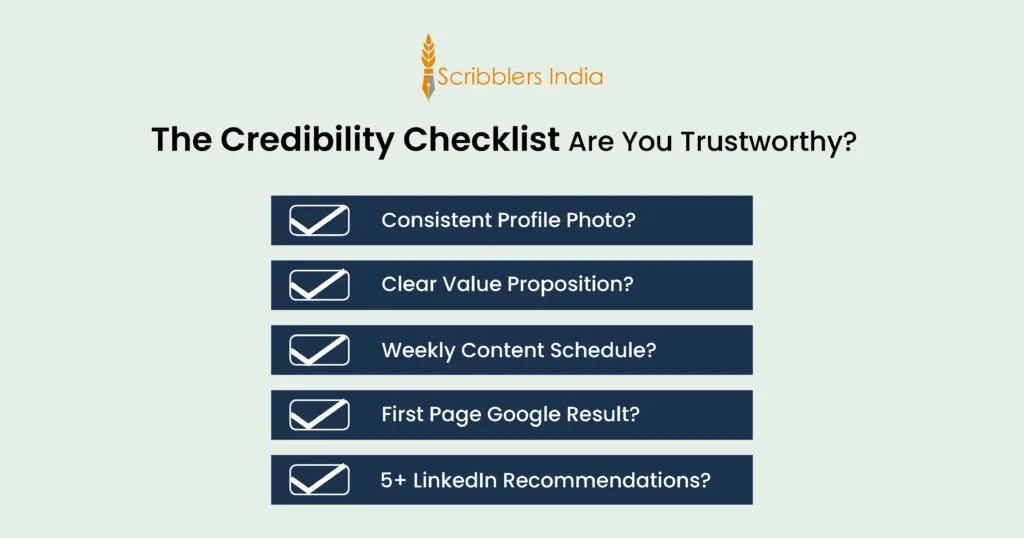
Your Unique Value Proposition (UVP) is the specific promise of value you deliver to your audience. It clarifies what you do, who you do it for, and why you do it better than anyone else. A strong UVP is one of the most critical elements of a personal brand because it immediately differentiates you.
You cannot simply say you are a “consultant” because that is far too broad to be effective. You must drill down into the specific problem you solve, creating a sharp hook that captures the attention of the exact people willing to pay for your solution.
- The Formula: Structure your UVP using the formula: “I help [Target Audience] achieve [Result] by [Methodology].” This simple sentence instantly communicates your value and filters out unqualified leads who do not fit your specific client profile.
- The Differentiator: Identify the one thing you do that competitors ignore or do poorly. Highlighting this unique gap in the market positions you as a specialist rather than a generalist, allowing you to charge premium rates.
- The Emotional Hook: You must explain to the client, on a personal level, why this matters. Connecting your service to their internal desires, such as status or security, makes your proposition far more compelling than logic alone.
- The Tangible Outcome: Define the specific metric or change you deliver to the client. Promising concrete results, such as revenue growth or time saved, makes your value proposition measurable and much easier for clients to justify buying.
2. Create an Authentic Brand Story
Authenticity means aligning your online persona with your offline reality. It is the heart of the core elements of a personal brand because humans connect with humans, not curated robots. Faking a persona creates a disconnect that audiences can sense immediately, leading to a loss of trust and engagement.
If you hate wearing suits, do not wear a suit in your profile picture just to impress others. You will look uncomfortable, and we can all tell. Authenticity is about comfort in your own skin, which translates into confidence that attracts the right opportunities.
- Vulnerability: You should share your failures because they make your successes look more attainable and real. Vulnerability creates a deep emotional bond with your audience, showing them that you are a resilient human being rather than a perfect image.
- Voice Consistency: Ensure you sound the same in emails as on LinkedIn. A disjointed voice confuses your audience, while a consistent tone reinforces your personality and makes your brand instantly recognizable across platforms.
- Values Alignment: You must speak up about issues that matter to you to attract like-minded peers. Taking a stand on relevant topics acts as a filter, repelling those who don’t fit and magnetically attracting your ideal tribe.
- Behind the Scenes: You should show the messy process of your work, not just the polished result. Documenting your journey demonstrates transparency and allows your audience to appreciate the hard work and skill that goes into your final product.
3. Identify Your Target Audience
Your target audience is the group most likely to benefit from your expertise. Defining this group is essential to a personal brand’s core elements because trying to appeal to everyone results in appealing to no one. You need to niche down to scale up.
You might fear missing out on business by narrowing your focus, yet the opposite is true. Specialists get paid more than generalists because they solve specific, expensive problems. Knowing exactly who you serve allows you to tailor every piece of content to their specific needs.
- Demographics: Define their age, location, title, and industry to target them effectively. Understanding these basic parameters helps you choose the right platforms and language to reach the decision-makers who can actually hire you.
- Psychographics: Understand their fears and daily frustrations to write compelling copy. Digging into their internal motivations allows you to craft messages that resonate on an emotional level and drive them to take action.
- Pain Points: Identify the specific “migraine” problems they need you to fix immediately. Focusing on urgent and painful issues positions your services as a necessity rather than a luxury, significantly increasing your conversion rates.
- Hangout Spots: You need to know where they consume content so you can be there consistently. Whether it is LinkedIn, Twitter, or industry forums, meeting your audience where they already are is far more effective than waiting for them.
4. Maintain a Consistent Visual and Verbal Identity
Visual and verbal consistency ensures your brand is instantly recognizable across all platforms. It involves using the same profile photo, color palette, and tone of voice across all platforms. This consistency builds familiarity, which is one of the foundational core elements of a personal brand that breeds trust.
Your visual identity acts as a uniform that tells people who you are before you say a word. If your visuals are chaotic, your audience assumes your work is chaotic. A polished, cohesive look signals professionalism and attention to detail.
- Profile Photos: Use a high-quality headshot that reflects your industry standards and personality. A professional photo builds immediate trust and ensures you look competent, approachable, and ready to do business with high-level clients.
- Color Psychology: Choose colors that evoke the right emotion for your brand message. Using colors strategically, like blue for trust or red for energy, subtly influences how your audience perceives your personality.
- Banner Images: Use this prime real estate to state your value proposition clearly. Your banner is a billboard that should instantly tell visitors what you do and why they should follow you within seconds of landing.
- Font Choices: Stick to readable, professional fonts for all your graphics and documents. Consistent typography reinforces your brand identity and ensures that your content is easy to digest across different devices and platforms.
5. Build a Robust Content Strategy
Content strategy is the engine that drives your personal brand. It involves creating valuable, relevant content that demonstrates your expertise rather than just claiming it. Integrating a robust content strategy is one of the active core elements of a personal brand that positions you as a thought leader.
You do not need viral hits; you need value that solves problems for your ideal client. Examples of strong personal brands always have a library of deep insights. Consistently publishing high-quality content proves you have the depth to back up your claims.
- Educational Posts: Teach your audience how to solve small problems for free using your expertise. Giving away value establishes you as a generous expert and builds the reciprocity needed to convert followers into paying clients.
- Opinion Pieces: Share your unique take on industry news to demonstrate true leadership. Innovative opinions separate you from the echo chamber and demonstrate that you have the foresight to navigate complex industry changes.
- Personal Stories: Connect lessons from your life to business principles to make them relatable. Weaving personal anecdotes into business advice humanizes your brand and makes your insights more memorable and engaging for your readers.
- Case Studies: Prove your results with data and client success stories whenever possible. Concrete evidence of your past success is the ultimate credibility booster, eliminating doubt and proving that your methodology works in the real world.
Pro Tip: To truly cement your authority, consider publishing an ebook. Our ebook writing services help you create a high-value asset that captures leads and proves your expertise.
According to an industry report, 47% of buyers view 3 to 5 pieces of content before engaging with a sales rep, underscoring that content is your best salesperson.
6. Optimize Your Digital Footprint and SEO
Your digital footprint is everything that appears when someone Googles your name. Optimizing this presence through SEO is vital among the core elements of a personal brand. You must control the narrative by ensuring high-quality, relevant search results dominate the first page of Google.
If you do not define your brand, Google will do it for you, often with outdated or irrelevant results. You need to ensure the core elements of a personal brand are visible to search engines so potential clients find your best self.
- Owned Assets: Ensure your personal website and LinkedIn profile rank first for your name. Owning the top spots gives you control over the first impression and ensures clients see exactly what you want them to see.
- Guest Blogging: Write for reputable sites to build backlinks and domain authority for your brand. Publishing on high-authority platforms signals to Google that you are a trusted entity, boosting your overall search rankings.
- Social Profiles: Clean up old accounts that do not align with your current image. Removing embarrassing or outdated content protects your reputation and ensures that every search result reinforces your professional credibility.
- Keyword Optimization: Use personal-branding related keywords naturally in your bio to drive traffic. Optimizing your profiles for relevant search terms ensures that people looking for your specific services can find you easily.

7. Leverage Strategic Networking
Your network serves as your net worth and acts as a powerful amplifier for your brand. Leveraging relationships for social proof, collaborations, and mentorship is a dynamic core element of a personal brand. You cannot build a reputation in isolation; you need others to validate it.
You are the average of the five people you interact with most online, so choose them wisely. Engaging with the right people signals to the algorithm and your industry that you belong in the room with top-tier players.
- Strategic Commenting: You should add value to industry leaders’ posts to get noticed by their audiences. Thoughtful comments act as mini-auditions that can drive high-quality traffic back to your own profile and content.
- Collaborations: You need to go live or host webinars with peers to cross-pollinate your audiences. Partnering with other experts allows you to borrow their credibility and reach new potential clients who already trust your partner.
- Testimonials: You must actively ask for recommendations to build permanent social proof on your profile. Glowing reviews from respected peers serve as a permanent asset, convincing future clients of your reliability and skill.
- Mentorship: Seek guidance from those ahead of you and help those behind you. This dual approach accelerates your own learning while establishing you as a generous leader willing to uplift the next generation.
Why You Need a Personal Branding Agency in India?
Let us be real: building a brand while running a business is exhausting. Sometimes, you need a team that understands the nuances of the Indian market to turn your reputation into revenue. You need experts who can seamlessly integrate the core elements of a personal brand.
We understand that you cannot do it all alone without sacrificing the quality of your work. Partnering with Scribblers India allows you to maintain a high-impact presence without the burnout.
- Strategic Clarity: We do not just post; we plan. We map your expertise to the exact gaps in your industry to position you as the only logical choice for your ideal clients.
- Ghostwriting That Sounds Like You: Our ghostwriting services ensure your LinkedIn and blog stay active with high-quality thoughts, even when you are too busy to type a single word yourself.
- Visual Consistency: From your banner to your bio, we align every pixel to ensure you look as professional online as you are in person, reinforcing the visual core elements of a personal brand.
- Authority Building Assets: We help you launch specific credibility boosters, like e-books or whitepapers, that separate you from the noisy influencers and establish deep authority.
- Balanced Approach: Unlike solo consultants, we offer a full-stack team including writers, strategists, and designers working in sync to scale your brand faster and more efficiently than you could on your own.
Your personal brand is your biggest asset, so do not leave it to chance or a sporadic posting schedule. Let us build a reputation that opens doors before you even knock.
Final Remarks
Building a reputation requires discipline, strategy, and a commitment to the core elements of a personal brand. From defining your UVP to mastering your digital footprint, every step adds a layer of trust to your name.
You have the blueprint. Now, go build the skyscraper. Or, just drop us a line and we will bring the cranes.
Ready to amplify your authority and master the core elements of a personal brand? Contact Scribblers India today and let us turn your expertise into a legacy.
FAQs
How long does it take to build a credible personal brand?
Building a credible brand is a marathon, not a sprint. Typically, it takes 6 to 12 months of consistent effort to see significant traction and ROI. You must patiently implement the core elements of a personal brand before you expect to see major inbound opportunities.
Do I need to be on every social media platform?
No, you should not spread yourself thin. Pick one or two platforms where your target audience hangs out and master them. For B2B professionals, LinkedIn is a critical personal branding channel.
Can I build a personal brand if I am an introvert?
Absolutely. Introverts make excellent thought leaders because they often listen better and think deeply before speaking. You can build a massive brand through writing and curated content without ever needing to be loud or performative on video.
What is the difference between a personal brand and a business brand?
A personal brand is built around you as a human, while a business brand is built around an entity. However, they should support each other. The core elements of a personal brand often humanize the business brand, making it more approachable and trustworthy.
Is hiring a personal branding agency worth the investment?
Yes, if you value your time and reputation. A personal branding agency in India saves you hundreds of hours of writing and designing while preventing amateur mistakes. They ensure the core elements of a personal brand are executed professionally from day one.