LinkedIn personal branding can still produce little professional value when the profile looks polished but the positioning remains unclear. Your headline may sound credible, your About section may read well, and you may publish consistently. Yet visitors can still leave without understanding what you genuinely know, why your experience matters, or where your expertise fits.
Effective LinkedIn personal branding solves that problem by connecting positioning, proof, content, relationships, discovery, and measurement. Your profile explains who you are and your work supports the claim. Your content demonstrates how you think, while relevant conversations help the right people encounter those ideas repeatedly.
This guide explains how to build a personal brand on LinkedIn as a connected reputation system. You will learn how to define your position, strengthen your profile evidence, build content grounded in real expertise, grow the right network, improve discoverability, measure progress, and create a practical 90-day operating plan.
Key Takeaways:
|
Which Questions Do You Need to Answer Before Starting LinkedIn Personal Branding?
Before you optimize your profile, define who should recognize your expertise, what they should associate with your name, what evidence supports that position, and what professional action matters next. These decisions give your profile, content, network, and measurement system one clear strategic direction.
Who Needs to Recognize Your Expertise?
Avoid broad audiences such as “everyone in technology” or “business leaders.” A founder may need recognition among buyers, investors, analysts, senior hires, or partners. A consultant may care about decision-makers facing one defined problem, while a job seeker may prioritize hiring managers and relevant industry peers.
Your choice of audience affects the evidence you emphasize and the conversations worth joining. If you want enterprise buyers to understand your work, your profile needs different proof from someone seeking a board role. Clear audience priorities also make later analytics easier to interpret.
What Should They Associate With Your Name?
Choose an expertise territory that is specific enough to become memorable. “Marketing leader” provides limited context, whereas “B2B SaaS positioning and category strategy” establishes a clearer professional association. “Technology executive” stays broad, while “enterprise AI governance and model-risk implementation” gives people a more useful reason to remember you.
Strong personal branding on LinkedIn does not require you to discuss one narrow subject forever. Your territory can contain several related themes, provided those themes strengthen the same professional association rather than prompting your audience to infer a new professional identity with every post.
What Evidence Makes the Position Credible?
Before you claim expertise, identify what proves it. Useful evidence can include operating experience, projects, measurable outcomes, original frameworks, research, recommendations, conference sessions, credentials, interviews, products, teams, or programs you helped build. The strongest proof depends on the professional decision you want to influence.
What Should Someone Do After Understanding Your Position?
The next action depends on your objective. A consultant may want relevant prospects to start a conversation. A founder may want industry peers or buyers to follow their thinking. An executive may prioritize stakeholder visibility, while a professional planning a career move may want recruiters to understand fit.
Your goal should guide the profile without turning every section into a sales pitch. If the positioning still feels unclear, use our guide to creating a personal brand statement before editing LinkedIn sections. Once the position is clear, the profile needs to prove it.
How Should You Optimize Your Profile for LinkedIn Personal Branding?
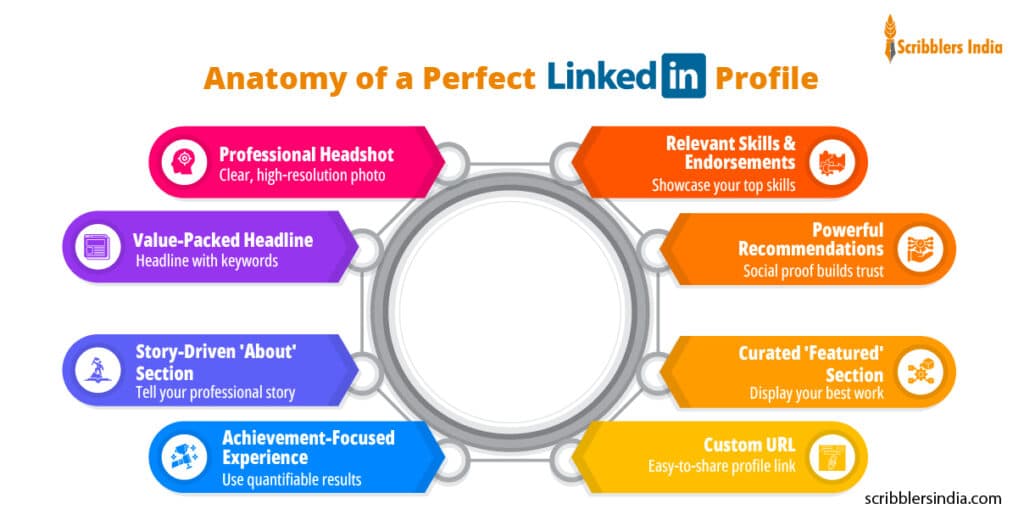
A strong LinkedIn profile should help visitors quickly understand your professional relevance and provide enough evidence to investigate further. Effective profile optimization aligns your photo, banner, headline, About section, Experience, skills, recommendations, Featured assets, and contact information around the same professional position.
Profile Photo and Banner: Establish Recognition and Context
Your profile photo mainly needs to make the account identifiable and appropriate for your professional setting. The banner has a different role. It can reinforce your expertise through one relevant message, visual, research asset, company context, event, or professional theme without competing with the introduction card.
Headline: Explain Your Professional Relevance
A job title often tells visitors where you sit inside an organization without showing why your expertise matters. A useful headline can combine your role or expertise, the problem or category you understand, and enough context to make the position meaningful to the audience.
Executives may need to keep an official title prominent. Independent experts often have greater freedom to foreground the problem or category they understand best. In either case, your headline should sound natural to people rather than be a string of terms added purely for LinkedIn search visibility.
About Section: Connect Positioning With Evidence
Your About section should help a visitor move from understanding your headline to understanding why you have a credible perspective. Open with the professional territory, explain the experience behind it, add selected evidence, show how you think about the field, and provide appropriate engagement context.
Avoid turning the About section into a complete autobiography. Detailed career history belongs in Experience. The strongest version helps someone understand your current professional relevance while giving enough evidence to continue exploring your profile, Featured assets, recent content, or external work.
Experience: Show What You Actually Owned
Strong Experience sections explain more than responsibilities. Where disclosure allows, show the problems you were responsible for solving, the scale involved, initiatives you led, functions or markets affected, changes implemented, supported outcomes, and specialist knowledge you developed through the work.
Recommendations, Featured, and Contact Details: Reduce Uncertainty
Recommendations add value when they describe observed work rather than broad praise. Featured assets can then give visitors direct evidence through articles, presentations, interviews, case studies, frameworks, research, or public work. Contact details and a clean profile URL reduce friction when someone wants to continue the conversation.
What Proof Strengthens LinkedIn Personal Branding?
Strong proof makes your professional positioning credible because it lets people inspect the expertise behind your claims. Experience establishes context, featured assets demonstrate work or thinking, recommendations add third-party validation, and published content shows how you interpret problems rather than asking visitors to trust self-description alone.
Use the Featured Section as a Proof Layer
Choose Featured assets according to the professional claim you need to support. A founder might feature original research or a category article. A consultant could show a case study or diagnostic framework. An executive may feature a conference session, interview, or article demonstrating specialist judgment.
Align Proof Across the Profile
Evidence becomes stronger when different sections reinforce one another. If your headline positions you around enterprise AI strategy, Experience should establish relevant responsibility, featured assets should demonstrate compatible work, and recommendations should add credible third-party context. Your recent content should also continue developing the same expertise territory.
A strong LinkedIn personal brand therefore gives a visitor a clear path from claim to verification. The profile says what you understand, your professional history shows where that expertise developed, and your public work gives people additional material to evaluate before deciding whether your perspective is relevant.
Separate Credentials From Evidence of Thinking
Credentials show formal qualification or recognition. Content shows how you think. A certification can verify knowledge, while an article can demonstrate interpretation. A case study shows application, and a recommendation adds external context. Each form of proof answers a different evaluation question for the person viewing your profile.
How Should Content Support LinkedIn Personal Branding?
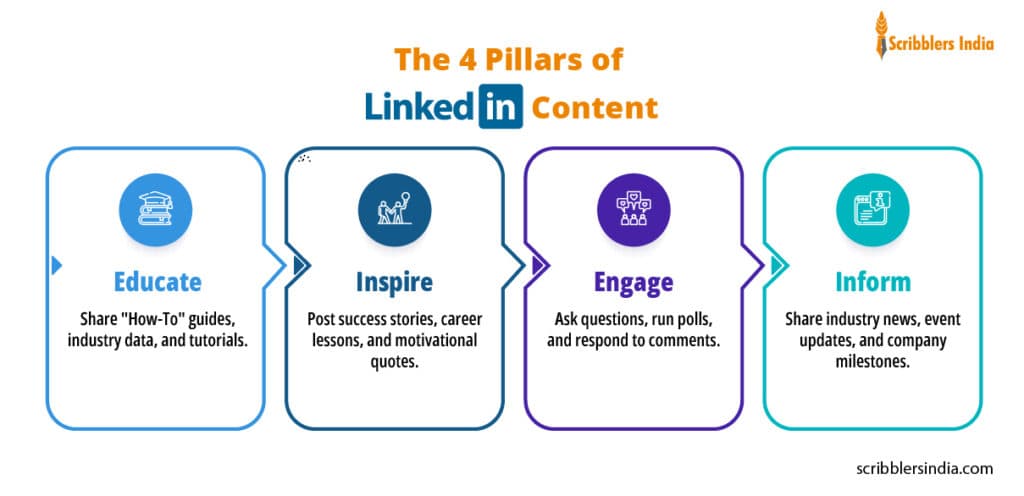
Your content should support the broader strategy by demonstrating how you approach problems within your area of expertise. The strongest ideas usually come from customer questions, decisions, research, presentations, project lessons, and market changes. This makes content more specific, credible, and useful than generic advice created to maintain posting frequency.
Build an Expertise-to-Content Pipeline
Useful source material already exists inside most experienced professionals’ working lives. Customer questions, project decisions, sales objections, failed approaches, internal presentations, conference notes, team questions, industry reports, regulatory changes, and recurring patterns can all serve as useful content inputs when captured systematically.
For deeper market-facing ideas, our thought leadership services support research, argument development, and editorial production. If you have the expertise but limited writing time, professional ghostwriting services can turn your input into publishable content while keeping the ideas genuinely yours.
Give Your Content Themes Distinct Jobs
A useful content system can include expertise, interpretation, evidence, and professional perspective. Expertise explains problems you understand deeply. Interpretation helps your audience understand market changes. Evidence shows frameworks or examples. A professional perspective explains the experiences that shaped how you make decisions.
This approach improves personal branding on LinkedIn because consistency does not have to mean repetition. Your posts can cover the same expertise territory through different questions, examples, research, experiences, and formats, while still giving your audience a consistent professional association to remember.
Build the Argument Before Choosing the Format
Start with the idea, then choose whether it belongs in a text post, document, video, article, newsletter, or visual framework. Ask what you observed, what evidence supports it, who needs the explanation, which assumption needs clarification, and what the audience should understand afterward.
This sequence protects content quality. A format cannot rescue a weak idea. If your strategy begins with “we need three carousels and two videos,” production starts driving the thinking. Stronger content starts with a useful argument and then selects the format that best communicates it.
Treat Publishing Frequency as an Operating Decision
There is no universal posting cadence for every professional. A senior executive producing one substantive piece every two weeks operates under different constraints from a creator publishing daily. A consultant with a strong source library may sustain more frequent output without sacrificing depth.
Choose a cadence you can maintain while protecting quality. Then review performance across a meaningful set of posts rather than reacting to a single unusually strong or weak result. LinkedIn’s post and audience analytics can help you compare patterns once you have enough activity to evaluate.
Repurpose Ideas Without Duplicating Assets
Repurposing works when you preserve the central insight and change the expression. One long article could be condensed into a post that explains the main argument, presents a visual framework, offers a practical example, highlights a deeper implication, and addresses a likely objection.
How to Build the Right Network for Personal Branding on LinkedIn?
For personal branding on LinkedIn, build your network around your professional objective rather than connection volume. Prioritize peers, relevant decision-makers, subject experts, connectors, and potential collaborators whose conversations overlap with your expertise. Then use useful participation to create familiarity before expecting those relationships to generate opportunities.
- Build a Target-Network Map: A useful network usually contains several groups. Peers work on related problems. Decision-makers may eventually need your expertise. Connectors bridge relevant communities. Experts improve your understanding. Future collaborators may include partners, speakers, researchers, or specialists whose capabilities complement your own.
- Use Comments to Contribute Thinking: A good comment should improve the conversation. You can add a relevant example, explain an overlooked consequence, challenge an assumption respectfully, contribute useful evidence, connect the topic to another development, or ask a question that moves the discussion forward.
- Move to Direct Messages After Context Exists: A useful comment exchange, a shared professional interest, an event conversation, or a mutual introduction gives you a stronger starting point for direct communication than an immediate cold pitch. Keep the first message proportional to the relationship and the amount of context already established.
Senior leaders can use our executive branding guide to understand where public visibility begins to require stronger governance, stakeholder mapping, and review boundaries. That distinction becomes important when your LinkedIn presence represents more than your individual career.
How Can You Improve Search and AI Discovery With LinkedIn Personal Branding?
Improve search and AI discovery by using precise, recognizable language for your role, expertise, industries, technologies, and professional focus. Keep those signals consistent with credible information elsewhere online. Your LinkedIn presence should contribute to a coherent digital identity rather than operate as an isolated keyword or AI-visibility tactic.
Use the Language Your Audience Recognizes
If your market uses a term such as “product-led growth,” avoiding it everywhere in favor of a clever personal phrase can reduce clarity. Use established expertise language naturally across your headline, About, Experience, relevant skills, content, and Featured assets without repeating phrases mechanically.
Keep Professional Entities Consistent
Your role, employer, expertise, industries, technologies, frameworks, and specialties should be described consistently when they refer to the same thing. The same principle should extend beyond LinkedIn to your company biography, speaker bio, author pages, personal website, interviews, and other authoritative profiles.
This consistency makes your professional identity easier for people to verify across multiple sources. It can also strengthen the wider entity footprint available to search and generative systems. LinkedIn alone cannot guarantee AI visibility, but it can contribute to a more consistent body of corroborating information.
For the reputation layer, our guide on building a personal brand online explains how LinkedIn should connect to digital assets. Brands and leaders working specifically on generative-search representation can extend that work through our Generative Engine Optimization services.
Connect Profile Language With Published Expertise
If your profile positions you as a supply-chain transformation expert while your most recent posts discuss broad motivation and productivity, your professional signal becomes fragmented. Your content can explore adjacent themes, but the overall body of work should continue to reinforce the expertise you want people to associate with your name.
Where your website and wider content ecosystem also need clearer answers to professional or category questions, our Answer Engine Optimization services can support question coverage, evidence structure, and answer-led discovery beyond LinkedIn. Once discovery improves, measurement needs to show whether that attention is useful.
How Should You Measure LinkedIn Personal Branding?
Measure your LinkedIn strategy as a progression from discovery to professional response. Impressions indicate exposure; profile visits indicate curiosity; search appearances indicate discoverability; audience demographics indicate relevance; and inbound conversations indicate whether attention is beginning to influence professional behavior. No single metric can represent your entire reputation system.
LinkedIn currently provides post, audience, profile, and search-related analytics that can help you compare these signals. Use the metrics together instead of treating reach as the outcome. A smaller audience of relevant decision-makers may create more professional value than a much larger audience with limited connection to your objective.
| Pattern | Likely Interpretation | What to Review Next |
| Low Reach + Low Profile Activity | Content may lack distribution, relevance, or consistency | Topic Choice, Network Fit, Openings, Sample Size |
| Good Reach + Few Profile Visits | Posts attract attention without enough professional curiosity | Positioning Connection, Author Context, Topic Relevance |
| Strong Profile Visits + Few Conversations | Profile may not explain expertise or next step clearly | Headline, About, Proof, Featured Section |
| Strong Engagement + Wrong Audience | Distribution is occurring outside the intended network | Topics, Network Composition, Commenters, Examples |
| Many Reactions + Few Meaningful Comments | Content may be easy to agree with but offer limited depth | Specificity, Evidence, Argument Quality |
| Relevant Comments + Moderate Reach | Smaller distribution may still create useful professional signals | Continue Testing Before Optimizing for Volume |
| Search Appearances for Wrong Roles | Profile language may communicate broad or outdated expertise | Headline, About, Experience, Skills |
| Relevant Inbound Conversations | Profile, content, and network may be reinforcing one another | Track Originating Themes and Repeatable Patterns |
These patterns become more useful when you interpret them through two separate lenses: who is responding to your content and whether that attention is translating into meaningful professional outcomes. The next step is to evaluate audience quality first, then separate platform activity from business or career results.
Measure Audience Quality Alongside Reach
A founder seeking CFO buyers should care whether relevant finance leaders are entering the audience. A consultant targeting HR teams should look for CHROs, HR leaders, and operators. Reach tells you how far content traveled; audience quality tells you whether that distribution supports your objective.
Separate Platform Metrics From Professional Outcomes
Keep operational LinkedIn metrics separate from professional outcomes. Your platform dashboard may include impressions, profile views, search appearances, relevant follower growth, saves, comments, and inbound messages. Your outcome record may include qualified inquiries, speaking invitations, media requests, partnerships, recruiting conversations, referrals, or introductions.
This prevents reporting from pretending every impression creates equal value. Our guide to the benefits of personal branding explains the wider outcomes these signals can support, while the personal branding ROI analysis covers direct and assisted impact in greater depth.
Use First-Party Evidence Carefully
A Scribblers India engagement for a study-abroad consultant used different channels for different roles. Instagram handled much of the discovery work, while LinkedIn supported advisory content and deeper professional positioning. Across the measured 30-day campaign window, profile visits increased by more than 135%.
That result belongs to the combined campaign rather than LinkedIn alone. The personal branding case study for a study-abroad consultant provides the broader context and shows why channel-level attribution should remain explicit when evaluating a multi-platform personal branding program.
What Common Mistakes Weaken LinkedIn Personal Branding?
Common mistakes weaken your LinkedIn strategy when posting volume replaces positioning, generic content replaces expertise, reach attracts the wrong audience, or the profile lacks evidence behind public claims. These problems can make an account look active while doing little to change how relevant professional audiences understand or remember you.
- Publishing Generic AI-Written Content: AI can support research, transcription, organization, outlining, and editorial workflows. Problems begin when broad generated advice becomes the substance of your professional presence. If posts contain little real experience, evidence, interpretation, or judgment, the audience learns very little about the professional behind them.
- Posting More When Positioning Is Unclear: Higher volume amplifies the signal you already have. If your profile spans several unrelated areas and your content adds more unrelated topics, frequent publishing can make your professional identity harder to understand rather than easier to understand.
- Copying Hooks Without the Underlying Idea: A strong opening can create curiosity, but it cannot create expertise. When many professionals use the same dramatic structures, contrarian openings, and predictable revelations, differentiation must come from the argument, evidence, experience, or insight behind the format.
- Keeping Your Best Proof Hidden: Some professionals publish useful content even as their profiles still feature generic headlines, weak Experience sections, limited recommendations, and empty Featured areas. The post creates curiosity, but the profile gives visitors little reason to deepen their interest or understand the expertise behind it.
- Letting Profile and Content Tell Different Stories: Your profile may position you as a healthcare technology executive while your recent content increasingly resembles broad creator advice. Not every post needs to discuss healthcare technology, but the overall pattern should still support a recognizable professional association.

How Do You Turn LinkedIn Personal Branding Into Professional Value?
You turn LinkedIn activity into professional value when positioning, evidence, content, relationships, discovery, and measurement reinforce the same identity. Your profile establishes the position, your proof supports it, your content develops it, and relevant conversations help the right people connect your name with that expertise.
The goal is not to win every post or become visible to everyone. You want the right people to understand what you know, find evidence that supports it, remember your perspective, and have a clear reason to engage when a relevant opportunity or professional need appears.
If you need managed positioning, profile development, content strategy, and ongoing editorial support, Scribblers India’s personal branding services connect these elements around your expertise, intended audience, and reputation goals rather than treating LinkedIn as a stand-alone publishing channel.
A strong personal LinkedIn brand is useful when it reduces uncertainty for the people who matter. They should be able to answer three questions more easily: what do you understand, what proves it, and why should they remember or contact you when that expertise becomes relevant?
Frequently Asked Questions
What Is LinkedIn Personal Branding?
LinkedIn personal branding is the deliberate process of shaping how professional audiences understand your expertise, experience, judgment, and relevance on LinkedIn. It connects positioning, profile evidence, published ideas, relationships, and platform activity so that the right people develop a clearer, more credible association with your work.
How Do You Build a Personal Brand on LinkedIn From Scratch?
Start by defining your target audience, expertise territory, evidence, and professional objective. Then align your headline, About, Experience, Featured assets, and recommendations around that position. Build content from real professional source material, join relevant conversations, and use analytics to see whether the intended audience is responding.
Can You Build a Strong LinkedIn Personal Brand Without Posting Every Day?
Yes. A strong LinkedIn personal brand does not require daily publishing. Choose a cadence that lets you contribute substantive ideas without reducing quality. Profile clarity, credible proof, network relevance, useful comments, and the consistency of your expertise signal remain important even when you publish less frequently.
What Should You Do if LinkedIn Posts Get Low Reach?
Review the wider system before increasing volume. Check whether your topics match your intended audience, your network includes relevant people, and your posts demonstrate specific expertise. Compare several posts rather than one result, then examine profile activity and audience patterns before changing your content strategy.
How Long Does LinkedIn Personal Branding Take to Work?
There is no universal timeline for LinkedIn personal branding because existing reputation, profile quality, expertise, network strength, content quality, publishing consistency, and objectives vary. Early progress may appear as clearer positioning and more relevant profile activity, while stronger recognition, relationships, and opportunities usually require repeated exposure over time.
Should You Use a Personal Profile or Company Page for the Same Topic?
Give each account a distinct role. Your personal profile can interpret a topic through your expertise and experience. A company Page can publish institutional research, product information, customer evidence, employer content, and official company perspectives. Related themes can appear on both without duplicating every post word-for-word.
Can LinkedIn Personal Branding Improve AI Search Visibility?
It can contribute by providing consistent information about your role, expertise, experience, and published ideas. AI-search visibility depends on a broader ecosystem of sources, so LinkedIn should support accurate representation across your website, company biography, author pages, interviews, media coverage, and other credible professional sources.
How Should You Measure a LinkedIn Personal Brand?
Measure a LinkedIn personal brand across several layers rather than a single metric. Track reach, profile activity, search appearances, audience relevance, meaningful comments, inbound conversations, referrals, speaking requests, recruiting discussions, and qualified opportunities. The right mix depends on the professional outcome your LinkedIn strategy is designed to support.