thought leadership

Scribblers India is a leading ghostwriting agency

Which Are the Best Ghostwriting Agencies in India for 2026?

You have a groundbreaking idea for a book, a series of thought leadership articles, or a memoir that needs to be told. However, like most successful leaders, you lack the hundreds of hours required to sit down and type it all out. This is a common dilemma. The solution lies in finding one of the best ghostwriting agencies in India that can extract your thoughts and translate them into professional prose while you retain full credit. Writing is a demanding craft that requires focus, structure, and emotional intelligence. Most CEOs, founders, and industry experts struggle to find the bandwidth for deep work amidst their daily operations. This is where a professional agency steps in to bridge the gap between your vision and the final manuscript. In fact, the total market size for ghostwriting services is expected to reach $7.6 billion by 2033, indicating the growing demand for professional ghostwriters. India has emerged as a global hub for high-quality writing talent, offering a blend of native-level English proficiency and cost-effective pricing. This guide will help you navigate the crowded market to find the best ghostwriting agencies in India. We will analyze the top players, discuss costs, and explain exactly how to choose a ghostwriter who aligns with your voice and goals.   What Services Do Best Ghostwriting Agencies in India Offer For Clients? Ghostwriting agencies provide professional writers who create valuable content on your behalf while assigning you 100% of the legal copyright. They handle everything from book manuscripts and speeches to LinkedIn articles, case studies and newsletter writing.  Their process involves deep interviewing to capture your unique voice, followed by rigorous drafting, editing, and proofreading to ensure the final output sounds exactly like you. Beyond Books Many people assume professional ghostwriting services in India are only for celebrity memoirs. In reality, agencies today produce a vast array of corporate assets. They write business books that function as high-end business cards, whitepapers that generate leads, and speeches that define industry trends. If it involves words and your name is on it, a ghostwriter likely wrote it. The Collaborative Process The relationship is a partnership rather than a simple transaction. The agency starts with a “discovery phase” where they interview you to understand your tone, values, and objectives. You provide the raw material—the stories, the data, the arguments—and they provide the structure and polish. You remain the architect of the idea, while they serve as the builders who lay the bricks. Agency vs. Freelancer Hiring a freelance writer often carries risk regarding reliability and bandwidth. A freelancer might get sick or overwhelmed, leaving your project in limbo. An agency offers a layer of security with project managers, multiple editors, and backup writers. They ensure consistency and adherence to deadlines, which is critical for long-form projects like books.   Why Should You Work With A Ghostwriting Agency from India? India offers a massive pool of highly educated, English-speaking talent that rivals Western markets in quality while offering significant cost advantages. When you hire a ghostwriter in India, you benefit from a “value arbitrage” where you pay mid-market rates for premium, global-standard output.  Additionally, Indian writers are culturally adaptable and experienced in servicing global clients across diverse industries.   Global Quality Standards India has the second-largest English-speaking population in the world. The top agencies recruit writers with advanced degrees in literature, journalism, and business. These professionals are trained to write in US or UK English, ensuring that your content resonates with your specific target audience without any linguistic friction. Cost-Effectiveness The cost of living difference allows Indian agencies to offer book writing services in India at a fraction of the cost of US-based competitors. A high-end manuscript that might cost $50,000 in New York could cost $10,000 to $12,000 in India for the same level of editorial rigor. This allows you to allocate more budget toward marketing and distribution. Cultural Adaptability Indian writers have decades of experience working with Western companies. They understand global business trends, pop culture references, and corporate nuances. This cultural agility ensures that your ghostwriter can step into your shoes and write from your perspective, regardless of where your business is located.     How to Choose the Best Ghostwriting Agency for Your Needs? You must look for a diverse portfolio that demonstrates the agency’s ability to adapt its voice to different clients. A valid agency will always insist on interviewing you to capture your tone; avoid any service that skips this step.  You should also verify their confidentiality protocols, specifically asking for a Non-Disclosure Agreement (NDA), and check if they have specific experience in your industry niche.   Portfolio Check: You need to review samples to see if the agency has range. If every book they write sounds the same, they are not true ghostwriters. Good ghostwriters are chameleons who disappear into the client’s persona. You should see a distinct difference between a CEO’s leadership guide and a fiction novel in their portfolio. The Interview Process: The quality of the input determines the quality of the output. If an agency claims they can write your book without talking to you, they are likely running a “content mill” that produces generic text. A premium agency will schedule regular calls to extract your specific anecdotes and insights. Confidentiality Protocols: Your reputation is on the line. You must ensure the agency signs a strict NDA that forbids them from ever claiming authorship. Professional agencies have robust legal frameworks to protect your intellectual property. You should own the full copyright from the moment the payment is made. Specialization Matches: You should ask if they have writers who understand your specific field. A writer who excels at romance novels may struggle to write a technical B2B whitepaper. The Best Ghostwriting Agencies in India have specialized teams for different genres, ensuring that your subject matter expert is actually an expert.   Which Are the Best Ghostwriting Agencies in India? Finding the perfect partner is critical for your manuscript’s success. We have analyzed the market

Which Are the Best Ghostwriting Agencies in India for 2026? Read More »

Scribblers India offers personal branding services

Is Your Image Ready for the Future? The Ultimate Personal Branding Strategy for 2026

Have you noticed that the era of the ‘perfect’ influencer is officially over? The perfectly curated feeds, the studio lighting, and the generic motivational quotes are vanishing from your screen. In their place, a messy, raw, and undeniable shift is happening right before your eyes. If you have been scrolling lately, you know that the polished aesthetic of 2024 is dead. The landscape has shifted, and now developing your personal branding strategy in 2026 will require a new approach. We are entering the age of radical authenticity & AI integration. It is no longer about looking good; it is about being trustworthy in an era of deepfakes and algorithmic noise. In 2026, your personal brand is not a vanity project; it is your ultimate career insurance policy. Whether you are a CEO or a freelancer, your digital reputation is your new resume. This guide moves beyond the basic advice of ‘post more content.’ We will cover the real personal branding strategy in 2026 that matters: building micro-communities, owning your data, and mastering the human-AI hybrid model to ensure you stay relevant. You will learn how to navigate the changing algorithms and build a reputation that withstands the test of technology.   Why Is Authenticity the New Currency for Personal Branding in 2026? Audiences now reject high-production polish in favor of ‘lo-fi’ content because perfection feels artificial. Your personal branding strategy in 2026 must prioritize raw, handheld footage and honest storytelling to prove you are human. Trust is now built through vulnerability and imperfection rather than through curated success reels.  The Lo-Fi Movement: Handheld camera videos and unedited audio are outperforming studio productions because they signal real-time honesty to skeptical viewers. You should film content in your car or walking down the street to show that you are prioritizing the message over the production value. Vulnerability vs. Oversharing: Authenticity means sharing the ‘struggle behind the success’ to build relatable authority, not just airing personal grievances. You need to strategically share business failures or learning moments that humanize your success without making you look incompetent to your potential clients. The 80/20 Reality Rule: You should aim for 80% value-driven expertise and 20% personal struggle to maintain professional respect while being relatable. This balance ensures that your audience respects your knowledge while feeling connected to your journey as a real person. Building in Public: Documenting your journey as it happens, including the failures, builds deeper loyalty than sharing a polished ‘after’ photo. You invite your audience to be part of the process, which creates emotional investment in your eventual success and long-term growth.   Client Success Story: We recently worked with a fintech founder who was hesitant to share his struggles. We advised him to document the loss of a major client. The post received 10x times his average engagement because it was real. By showcasing his resilience, he attracted three new partners who valued transparency, validating that a raw personal branding strategy in 2026 drives real connection.   How Will AI Change Your Personal Branding Strategy in 2026? You should not use AI to write your opinions, but you must use it to scale your output. A successful personal branding strategy in 2026 uses AI for personal branding to handle data analysis and formatting while keeping the core messaging 100% human to avoid the ‘generic’ trap.  You cannot ignore AI, but you also cannot let it be your voice. The winning strategy involves using AI as a staffer, not a creator. AI for Data Analysis: Use tools to analyze audience sentiment and predict what topics will resonate before you even write a single word. You can scan thousands of comments in seconds to find the exact pain points your audience is facing right now. Scaling Content Output: You can record one video and use AI to transcribe, resize, and format it into newsletters and tweets instantly. This allows you to be present on multiple platforms without spending your entire day editing or writing captions manually. The Generic Content Trap: If you copy-paste ChatGPT outputs, you will destroy your reputation because audiences can smell synthetic thought leadership instantly. You must use AI only for structure and ideation, ensuring that the final output is dripping with your unique perspective. Preserving Your Voice: You must ensure that every piece of content retains your unique idioms, opinions, and tone to prove it was written by a human. You should train your AI tools on your previous writing so they learn to mimic your specific style.     Which Social Media Platforms Should You Prioritize for Personal Branding? You cannot be everywhere without burning out, so you must focus on high-impact channels. Personal branding strategy in 2026 dictates prioritizing LinkedIn for B2B authority and video-first platforms like YouTube Shorts for reach. The real value, however, is shifting to ‘Dark Social’ communities where deep trust is built.  The days of being famous everywhere are gone. You require a strategy that masters one platform before expanding to others. LinkedIn 3.0 Evolution: It is no longer just a resume site; how to build a personal brand on LinkedIn is now about video, newsletters, and community. You need to treat your profile like a media channel where you broadcast industry news and personal insights daily. The Rise of Dark Social: The most important conversations happen in private DMs, WhatsApp Channels, and Discord servers where you cannot buy ads. You must create content that is so valuable that people privately share it with their colleagues and friends in closed groups. Video-First Strategy: You need a ‘face-to-camera’ presence on YouTube or Instagram to prove you are a real person in an AI world. Static text posts are easy to fake, but a video of you speaking builds immediate trust and credibility. Depth Over Width: It is better to have 1,000 raving fans on one platform than 10,000 passive followers scattered across five different apps. You should focus your energy on the platform where your specific target audience spends their money and time.

Is Your Image Ready for the Future? The Ultimate Personal Branding Strategy for 2026 Read More »

turn your LinkedIn posts into an ebook with Scribblers India

How to Turn Your LinkedIn Posts into a Lead-Generating eBook: Stepwise Guide

You are likely sitting on a digital goldmine without realizing it. You have spent months, perhaps even years, crafting thought leadership posts that resonated with your LinkedIn network. These posts received excellent engagement for forty-eight hours, only to disappear into the algorithmic abyss forever. It is frustrating to see valuable intellectual property vanish so quickly. Consider compiling those LinkedIn posts into an ebook to preserve and share your insights. You know you need a permanent lead magnet, like a professionally written eBook, to capture email addresses and build deeper trust with prospects. However, the thought of writing five thousand new words from scratch probably feels impossible with your current executive schedule. The good news is that you do not have to start from a blank page. According to recent research, 61 % of B2B marketers say their content-strategy effectiveness improved in the past year. You can tap into this momentum by turning your LinkedIn posts into an ebook that works for you around the clock. This process allows you to “excavate” your own feed and package your best insights into a cohesive asset. In this guide, we will show you the exact auditing, organizing, and polishing process to transform scattered social media updates into an authoritative book that generates leads on autopilot.   Why Should You Turn LinkedIn Posts into an Ebook? You should turn LinkedIn posts into an ebook because it creates a permanent business asset from fleeting social media content. This process deepens audience trust by providing substantial value while significantly reducing the time required to create a high-quality lead magnet from scratch. Deepening Trust with Your Audience: A standard LinkedIn post is a snack, while a well-written eBook is a full meal. By offering long-form content, you prove to your prospects that you have depth and substantive expertise beyond the character limit of a social media update. Creating a “Forever” Asset: Social media posts have a disturbingly short lifespan, often becoming irrelevant within two days. An eBook is an evergreen asset that can continue to educate your audience and build your reputation for years after its initial creation. Gaining Lead Capture Capability: You cannot “gate” a LinkedIn post to ask for contact information. You can, however, require an email address to download your eBook, instantly turning anonymous readers into reachable leads for your sales team. Achieving Maximum Efficiency: Writing a book from scratch is a daunting task that often leads to procrastination. When you turn LinkedIn posts into an ebook, nearly 60% of the hard work is already done, making completion far more realistic. How Do I Choose The Right Posts For My Ebook? To choose the right posts when you turn LinkedIn posts into an ebook, focus on high-engagement content that addresses enduring problems. You must conduct a ruthless audit of your past activity to find distinct patterns and themes rather than selecting random successful updates. Look for your “Greatest Hits” Start by using your LinkedIn analytics to identify your top 20-performing posts from the last year. High engagement usually indicates high resonance with your target audience, making these posts ideal candidates for your core chapters. Identify recurring thematic patterns Do not merely grab random posts that performed well. Look for clear patterns in your writing. If you have written fifteen times about “remote work culture challenges,” you have found the central theme for your new book. Ignore highly time-specific content You must leave out posts that comment on fleeting news events or temporary trends. Your eBook needs to be “evergreen” to remain relevant for a long time, so focus on timeless principles rather than passing fads.   What Tools Can Help Me Turn LinkedIn Posts Into An eBook Faster? The best tools to help you turn LinkedIn posts into an ebook efficiently are simple ones you likely already use. You need basic analytics software to identify your best content and a robust word processor to organize and expand that content into a manuscript. Analytics for Content Auditing: Use LinkedIn’s native analytics or third-party tools like Shield to sort your entire posting history by engagement rate quickly. This data-driven approach removes guesswork when deciding which topics your audience truly cares about. After all, 65% of B2B marketers say content relevance and quality are the top performance drivers. Organizational Writing Platforms: Standard tools like Google Docs work well for the initial “dump and sort” phase. For more complex structures, software like Scrivener can help you drag and drop different posts into various chapters to test different flows. Transcription Services for Expansion: If you prefer speaking over typing, use tools like Otter.ai. You can read your old post out loud and then verbally riff on it for ten minutes to generate the new content needed for a full chapter. What Are The Steps To Convert Scattered Posts Into Chapters? The steps to turn LinkedIn posts into an ebook involve gathering your raw materials, organizing them logically, and then significantly expanding them. You must move beyond simple copy-pasting to ensure the final product reads like a cohesive book rather than a disjointed collection of old updates. Step 1: The “Dump and Sort” Method Begin by copying every relevant post you identified during your audit into a single massive document. Do not worry about the order at this stage; your only goal now is to get the raw text off LinkedIn and into a workable format. Step 2: Create a Logical Flow Arrange your posts by theme rather than chronological order. Group them into a logical narrative arc: general philosophy at the beginning, specific tactical advice in the middle, and relevant case studies or future predictions at the end. Step 3: Expanding the “Meat” LinkedIn forces brevity, but books require depth. You must now add the context you originally cut out to save space. Add concrete examples, supporting data, and deeper explanations to flesh out each original post into a full chapter. Step 4: Writing the Bridges You need smooth transitions to ensure a good reading experience. It is

How to Turn Your LinkedIn Posts into a Lead-Generating eBook: Stepwise Guide Read More »

Scribblers India is a leading thought leadership content agency

Your Ultimate Guide to Thought Leadership Content!

Are you eager to establish yourself as a respected authority in your field? Do you want to shape the conversation and inspire others with your expertise? Then, thought leadership content is the answer. As a powerful tool, thought leadership content allows you to share your unique insights and perspective on industry trends, challenges, and innovations. In fact, more than 65% of companies are already leveraging thought leadership as a part of their content marketing strategy. But what exactly is the meaning of thought leadership? It’s a concept that involves influencing and guiding others through your knowledge and experience. To excel in thought leadership, you need a strategy. Craft compelling content that sparks conversations, educates, and adds value to your audience. In over 50% of enterprises, high-level management and CEOs are responsible for creating thought leadership content. Examples of thought leadership range from insightful articles and whitepapers to engaging podcasts and TED talks. By leveraging thought leadership marketing, you can expand your reach and establish your brand as a trusted resource. So, dive into the world of thought leadership content strategy and make your mark on the industry. “People look to thought leaders for a reason, because they don’t always say what everyone else is saying. Be bold. Get behind what you’re saying and say it with conviction. It’s okay to be a little controversial.” – Heather Kernahan What is thought leadership meaning? Are you curious about thought leadership meaning? Well, then let’s break it down. Thought leadership is about being a trusted authority in your field. It’s not just about having thoughts on leadership; it’s about sharing them with others. This is where thought leadership content comes to the fore by allowing you to express your ideas, insights, and expertise. To succeed, you need a thought leadership content strategy that aligns with your goals. From thought leadership articles to engaging podcasts, there are countless ways to showcase your knowledge. By leveraging thought leadership marketing, you can amplify your reach and influence. Remember, thought leadership isn’t just about promoting yourself; it’s about providing value to your audience. If you want to take it a step further, consider partnering with a thought leadership content agency in India. The experts can help refine your content and maximize the impact. Embrace the power of content writing and make your mark in your industry. Over 90% of C-level decision-makers consider that thought leadership content has an impact on opinions around their enterprise. Who are thought leaders? Thought leaders are individuals who have established themselves as experts and influential figures in their respective fields. They possess deep knowledge, unique insights, and a strong ability to communicate their ideas effectively. Thought leaders are sought after for their expertise and are recognized as authorities by their peers and the industry as a whole. Over 68% of people believe that experts in their niche are thought leaders. They inspire others through their innovative thinking, research, and visionary perspectives. Thought leaders often contribute to their field through thought leadership content, such as articles, speeches, books, and other forms of media. They play a crucial role in shaping industry trends, driving innovation, and guiding the conversation around important topics. Why is thought leadership important? Thought leadership is crucial for establishing authority, enhancing brand reputation, driving innovation, expanding networks, and generating business opportunities. Embrace the power of thought leadership to make a lasting impact in your field. Wondering why thought leadership is important? Here are some of the standout benefits of thought leadership marketing: Establishing your expertise Thought leadership allows you to position yourself as a trusted authority in your field. You will be sharing your unique thoughts on leadership and industry trends. This will help demonstrate your expertise and build credibility among your audience. Building brand reputation When you consistently produce valuable thought leadership content, you enhance your brand’s reputation. You become known as a reliable source of information and a go-to resource, attracting a loyal following. In fact, over 66% of marketers believe that thought leadership is a major priority for their organizations. Driving innovation Thought leaders are at the forefront of driving innovation. By sharing your forward-thinking ideas through high-quality content writing, you inspire others to challenge the status quo. This helps with fostering a culture of innovation within your industry. Source Expanding your network Thought leadership opens doors to new connections and collaborations. As you share your thoughts and engage with others, you attract like-minded individuals, potential partners, and industry influencers. They all can contribute to the success of your thought leadership strategy. Generating business opportunities Thought leadership marketing can lead to tangible business benefits. By showcasing your expertise, you attract attention from potential clients, investors, and collaborators. Your thought leadership content strategy serves as a powerful marketing tool. It helps with driving lead generation and opening doors to new business opportunities. To optimize your thought leadership content strategy, learn more about these incredible benefits of thought leadership content marketing for personal branding. What is thought leadership content? Thought leadership content refers to the creation and dissemination of valuable and influential ideas, insights, and expertise in a specific field. It goes beyond simple thoughts on leadership and aims to shape industry conversations and inspire others. Thought leadership content can take various forms, including articles, blog posts, whitepapers, videos, podcasts, and social media content. The benefits of mastering thought leadership content creation are significant. It establishes you as an expert and authority in your field, enhancing your reputation. It helps build credibility, attracting new clients, partners, and opportunities. Thought leadership content sparks conversations, drives innovation, and positions you as a go-to resource. It allows you to share your unique perspectives, solve industry challenges, and provide valuable insights to your audience. Through thought leadership content writing and marketing, you can expand your reach, connect with like-minded individuals, and create a lasting impact. You can produce thought leadership articles yourself or collaborate with a thought leadership content marketing agency in India. This content strategy empowers you to lead and make a

Your Ultimate Guide to Thought Leadership Content! Read More »

Avail professional ghostwriting services from Scribblers India

When Is It the Right Time to Hire a Ghostwriter for Your Business?

You are a fantastic writer. You know how to turn a phrase, craft a compelling argument, and engage your audience. The idea of hiring someone else to write for you might seem strange. Why would a great writer ever need to hire a ghostwriter? Many people believe ghostwriting is only for those who lack writing skills. This is a common misconception. The decision to work with a ghostwriter is a strategic move for smart, busy professionals, authors, and entrepreneurs who want to scale their impact. It is about leveraging your time and expertise effectively. This guide will explain exactly when and why even the best writers use professional writing assistance. You will learn how to leverage this “secret weapon” to achieve your goals. What Exactly Does a Ghostwriter Do? A ghostwriter is a professional writer you engage to create content that will be officially credited to you. Their job is to translate your ideas, knowledge, and unique voice into polished, well-structured text. The process is a close collaboration, ensuring the final product truly represents you. The scope of a ghostwriter’s work extends far beyond books. Professionals often hire a ghostwriter for many different content needs. These assignments can include: In-depth articles and blog posts Compelling thought leadership content Authoritative whitepapers and case studies Lead magnet ebooks Engaging email newsletters Strategic social media content Why Would a Good Writer Hire a Ghostwriter? Excellent writers choose to hire a ghostwriter for strategic reasons that go beyond writing ability. It is a business decision focused on efficiency, scalability, and impact. It allows you to delegate the time-consuming task of writing while you focus on core business functions and high-level strategy. Do You Have the Time to Write Consistently? Yes, you have to hire a ghostwriter if you lack the time to write consistently. Many skilled professionals running a business or leading a team cannot dedicate the required hours. A ghostwriter provides the dedicated focus to produce regular, high-quality content while you focus on your core responsibilities. Consistent content creation is a significant time commitment. According to a survey by Orbit Media, a typical blog post now takes over four hours to write. For important thought leadership pieces, this time can be much longer. When you use a ghostwriter, you are effectively buying back your time. Do You Need an Outsider’s Perspective? You need to hire a ghostwriter for an outsider’s perspective if you are an expert in your field. Experts can struggle to explain complex topics simply due to the “curse of knowledge.” A ghostwriter acts as a translator, ensuring your brilliant ideas are clear, engaging, and accessible. Your brilliant ideas might get lost in technical jargon or complex explanations. A ghostwriter serves as your first reader, making sure your message connects with your target audience. This is a primary reason people seek professional ghostwriting services, as it ensures the content has the intended impact. Are You Trying to Scale Your Content? You should hire a ghostwriter when you need to scale your content production. A single person has limited output, which can hinder an ambitious content strategy. A ghostwriter acts as a force multiplier, helping you publish consistently to build your audience and improve your search rankings. If your marketing strategy involves publishing multiple blog posts per week, writing a series of ebooks, or a consistent stream of articles, you will need support. A ghostwriter helps you maintain a robust and consistent publishing schedule, which is critical for growing your personal brand’s online presence. Is Writing Draining Your Creative Energy? If writing drains your creative energy, it is a good reason to hire a ghostwriter. Your mental energy is a finite resource better spent on high-level strategy and innovation. Delegating the writing task allows you to conserve this valuable asset for your most critical business functions. Writing is mentally demanding work, even for those who enjoy it. Your creative energy is a finite resource. Many successful leaders choose to hire a ghostwriter specifically to protect their time and energy for the tasks that only they can perform within their organization. Do You Need Specific Format Expertise? Yes, you should hire a ghostwriter when you need expertise in a specific format. Strong writing skills in one area, like emails, do not always translate to books or speeches. A specialist ghostwriter understands the unique rules and structure of different content types, ensuring a professional result. Each content format has its own best practices. Professional ghostwriters are specialists. You can find a writer with deep expertise in structuring a compelling business book, writing a viral LinkedIn post, or scripting a captivating keynote speech. This ensures your content is perfectly tailored to the medium. When Should You Seriously Consider Hiring a Ghostwriter? You should consider hiring a ghostwriter when a writing project is critical for your goals, yet you lack the time or specific format expertise to execute it yourself. This decision is about recognizing when a professional partner can help you achieve a better outcome more efficiently. Writing a Book: Writing a book is an immense undertaking requiring hundreds of hours of focused effort. The process includes outlining, research, writing, editing, and structuring. A professional ghostwriter for a book acts as your project manager, author, and coach. They guide the process from concept to completion, transforming your expertise into a polished manuscript. Establishing Thought Leadership: Consistent, high-quality content is the foundation of thought leadership. Busy executives and experts need to publish articles, blogs, and white papers to build a personal brand. When you hire a ghostwriter, you can maintain a robust public presence without being pulled away from your primary responsibilities. Data shows that 88% of decision-makers say thought leadership is effective in enhancing their perceptions of a company. Launching a New Website or Blog: A new website needs a strong foundation of content to make a good first impression and attract search traffic. A ghostwriter can help you develop the core pages, pillar articles, and initial blog posts. This allows you to launch

When Is It the Right Time to Hire a Ghostwriter for Your Business? Read More »

Scribblers India offers professional personal branding services

Why Must You Optimize Your Personal Brand for AI Search and AI Overview Now?

You have a question, so you turn to Google. Instead of the familiar list of ten blue links, you get a complete, conversational answer at the top. To stay relevant in this landscape, it’s crucial to optimize your personal brand for AI search. The search engine did not simply find sources for you; it became the source. This is the new reality of search. This is Google’s AI Overview, the result of its Search Generative Experience project. This technology represents the most significant shift in how we find information in over a decade. It forces us to ask a critical question. If the search engine provides the answer directly, what happens to your website, content, and personal brand? This guide will demystify the new era of AI search. It will explain what AI Overviews are and how they will impact your visibility. Most importantly, it will provide an actionable roadmap to AI search optimization, enabling you to thrive in the future of discovery. What Is an AI Overview or AI Search? An AI Overview is an AI-generated summary that directly answers a user’s query at the very top of the search results page. It synthesizes information from multiple web sources to provide a single, comprehensive answer, reducing the need for users to click on multiple links. Think of it less like a librarian pointing you to the right books and more like an expert researcher reading those books for you and giving you a complete summary. This conversational, answer-first model is the direction all major tech companies are moving toward. This new approach requires a fresh personal branding strategy. The term “Search Generative Experience” was the original name for Google’s project, and understanding what is Search Generative Experience helps contextualize this evolution. How Will AI Overviews Change How People Find You? AI Overviews will fundamentally alter user behavior by prioritizing direct answers over clickable links. This change means your visibility will depend on your content being used as a source for the AI’s summary, rather than your website simply ranking in the top position. From a List of Links to a Direct Answer: This change represents a shift from a “search and click” model to a “search and done” experience. AI Overviews aim to satisfy a user’s intent immediately within the search results page. This efficiency for the user means a new challenge for brands seeking to attract website traffic. The Rise of “Zero-Click” Searches: A “zero-click” search occurs when the AI summary provides a sufficient answer, so the user never clicks on a website link. The AI Overview impact on SEO is significant, as a large portion of searches could end on the results page itself, making inclusion in the AI summary critical. A New Emphasis on Trust and Verifiable Facts: AI models are designed to pull information from sources they deem authoritative, factual, and trustworthy. The new search prioritizes content from well-established entities with a history of expertise. You must optimize your personal brand for AI search by demonstrating verifiable credibility across the web. Why Is Your Current Personal Brand Strategy at Risk? Your current personal brand strategy is at risk because AI search redefines digital visibility. If your brand is not recognized as a primary, authoritative source by AI models, you risk becoming invisible, losing traffic, and having your reputation shaped by algorithms you do not control. Your Website Traffic Could Disappear A strategy that relies solely on ranking number one for a keyword is now vulnerable. The AI Overview box sits above the top organic result, capturing the user’s initial attention. If your content is not featured in that summary, you could lose a significant amount of traffic. Your Expert Content Might Get Lost AI may use your content to generate a summary without linking back to your site. This process makes your expertise anonymous. It can absorb your carefully crafted insights into a generic answer, stripping you of credit and authority. Your Reputation is Now in the Hands of an AI An AI model will summarize who you are based on the information it finds across the entire web. If it misinterprets your content or pulls from a negative or inaccurate source, it could damage your reputation in a very public and impactful way. You must actively optimize your personal brand for AI search. How Can You Optimize Your Personal Brand for AI Search? You can optimize your personal brand for AI search by transitioning from a keyword focus to an entity focus through the following strategies: Focus on Becoming a Recognized “Entity”: To optimize your personal brand for AI search, you must be seen as a recognized “entity.” An entity is a distinct person, place, or concept that a search engine can identify and understand. The goal is for Google’s Knowledge Graph to know who you are and what you are an expert in. Create Comprehensive, Expert-Driven Content: The new personal branding strategy requires depth. You need to create pillar pages and detailed guides that answer questions so comprehensively that your site becomes an indispensable source. A recent Edelman-LinkedIn report found that 63% of decision-makers will pay a premium to work with organizations that articulate a clear vision, which is achieved through expert content. Prioritize Factual Accuracy and Clear Citations: To be trusted by an AI, your content must be factually verifiable. This means citing your sources, linking to authoritative studies, and maintaining an up-to-date and accurate digital presence. Every claim should be backed by evidence, proving your commitment to truth and accuracy. Build Brand Authority Online Across Multiple Platforms: AI search verifies your expertise across the web. Your authority needs to be visible on your blog, in guest posts, on podcasts, in YouTube videos, and in reputable publications. This creates a network of trust signals that AI algorithms can easily identify and validate. Structure Your Data for Machines: To properly optimize your personal brand for AI search, you should use Schema markup. This is like adding descriptive labels to your website’s code.

Why Must You Optimize Your Personal Brand for AI Search and AI Overview Now? Read More »

Scribblers India offers personal branding services

Why Founders Need a Community-Led Personal Brand for Lasting Growth?

Are you tired of shouting into the social media void? You post insightful content, share valuable tips, and engage with your industry, yet it often feels like you are speaking to an empty room. Embracing a community-led personal brand could be the shift you need to break through. This is a common frustration in today’s crowded digital landscape. The old model of personal branding, which involves being a guru on a stage broadcasting to a passive audience, is broken. It is time for a fundamental shift in thinking. The future of personal branding is not about building a bigger megaphone; it is about building a bigger table. You need to transition from simply collecting followers to cultivating a thriving community. This guide will walk you through the what, why, and how of building a powerful personal brand—a brand built with your audience, not for them. Get ready to unlock a more sustainable and rewarding path to growth with your own community-led personal brand. What Is a Community-Led Personal Brand Anyway? A community-led personal brand is an identity and reputation built collaboratively with your audience. Instead of a top-down approach where you publish thought leadership content, this model positions you as a facilitator who brings people together. You unite them around a shared interest, purpose, or identity, fostering a sense of belonging and collective ownership. Building a community-led personal brand is about shared value. Community-Led Personal Brand vs Traditional Brand: Key Differences The primary difference between these two approaches lies in the direction of communication and value creation. A traditionally robust personal brand is a monologue where you broadcast your expertise to a passive audience. A community-led personal brand is a dialogue. It creates a space where members connect with you and, more importantly, with each other. Aspect Traditional Personal Brand Community-Led Personal Brand Communication Style One-way broadcast of expertise to a mostly passive audience Two-way dialogue where members connect with you and each other Core Focus Building an audience that mainly consumes your created content Nurturing a community that actively participates and co-creates value Your Role Seen as the expert standing alone on the stage Act as the host, guiding conversations like at a dinner party Value Creation Content-centric approach with limited interaction beyond your posts Relationship-centric approach that fosters trust, collaboration, and shared growth   The Modern Rise of Online Communities The shift towards community is a direct response to the modern digital environment. With organic reach on social media platforms declining and audiences craving authentic connection, community building has become an effective strategy for creating lasting impact. A community-led personal brand is a move from borrowed attention on social media to owned relationships. According to reports, the organic reach for a typical Facebook post is as low as 1.65%. This means over 94% of your followers will not see your content. A community provides a direct line to your most dedicated supporters, bypassing unpredictable algorithms and fostering genuine audience engagement for personal branding. How Can a Community-Led Personal Brand Skyrocket Your Growth? Adopting a community-led strategy directly fuels sustainable growth. It creates a loyal, engaged, and self-perpetuating ecosystem around your brand. It moves beyond fleeting metrics like likes and views to build tangible assets like trust and powerful word-of-mouth marketing. A strong community-led personal brand creates a significant competitive advantage. Building Unbreakable Trust and Loyalty This approach builds deep trust by making people feel seen, heard, and valued. When you create a space for genuine interaction and shared experiences, you move beyond transactional follower relationships. This fosters psychological safety and belonging, turning casual followers into loyal advocates for your community-led personal brand. Creating a Constant Stream of Content Ideas Your community is your ultimate research and development team. By actively listening to their questions, discussions, and challenges, you gain direct insight into their most pressing needs. This feedback loop provides an endless well of relevant content ideas, ensuring your community-led personal brand is always valuable. Turning Followers Into Your Best Marketing Team A vibrant community becomes a powerful engine for organic, word-of-mouth marketing. Happy and engaged members naturally become advocates who share your work and recommend your services. This authentic promotion is far more effective than any paid advertisement, showcasing the true benefits of a strong personal brand. Real-World Networking and Collaboration The value extends beyond your connection with members; it is in the connections they form with each other. You become the central node of a valuable network, which can lead to powerful collaborations and partnerships. Facilitating these connections elevates your status from a content creator to an indispensable industry leader. How Do You Actually Build a Community-Led Personal Brand from Scratch? Building a thriving community-led personal brand is a strategic process that starts with purpose. It is maintained through consistent engagement and co-creation. It involves defining your mission, choosing the right platform, sparking conversations, encouraging participation, and actively listening to your members. Step 1: Define Your Purpose and “Why” Before gathering people, you must give them a compelling reason to come together. Your purpose is your North Star. It is the shared mission or transformation that your community will rally around. This goes deeper than your niche; it is the core belief that unites everyone. Step 2: Choose Your Community’s Home Choosing the right platform is crucial for fostering interaction. You should build your home where your ideal members feel most comfortable and the tools support your community goals. Choose what is right for the culture you want to create, rather than what is simply popular. This is key for your community-led personal brand. For real-time chat & collaboration: Consider Discord or Slack. For structured discussions & courses: Look into platforms like Circle.so or Mighty Networks. For leveraging an existing network: A Facebook Group or LinkedIn Group can be a simple starting point. Step 3: Create Content That Sparks Conversation The key to engagement is shifting from declarative content (“Here is what I know”) to interrogative content (“What do you think?”). Your goal is to

Why Founders Need a Community-Led Personal Brand for Lasting Growth? Read More »

Scribblers India helps you leverage AI for personal branding

Can I Use AI for Personal Branding?

Artificial Intelligence is making waves everywhere, and the world of personal branding is no exception. With tools that can write, design, and analyze at superhuman speeds, a compelling question arises: Is the human element of a personal brand becoming obsolete? It is easy to see the appeal of automation, but it is crucial to understand its limitations. The truth is, while technology evolves, the core of what makes a brand influential and trusted remains deeply human. AI will never replace a strong personal brand. Instead, the conversation is shifting toward a more powerful concept: using AI for personal branding as a strategic partner. This approach allows you to harness AI’s efficiency to amplify your most human qualities—your stories, your perspective, and your ability to connect. This blog explores why your humanity is your ultimate asset. We will cover how to use AI for personal branding strategically, the foundational elements AI cannot replicate, and practical ways to build a strong personal brand that is not just relevant but truly irreplaceable in the age of automation. What is AI’s Real Role in Building a Personal Brand? AI is not a replacement for your brand’s soul; it is a powerful engine for its operations. It can significantly enhance your branding efforts by automating repetitive tasks and providing data-driven insights, freeing you to focus on high-impact, human-centric activities. Using AI for personal branding effectively means treating it as a highly capable assistant. In fact, research from Semrush indicates that 65% of companies using AI for content are reporting better ROI. Content Ideation and Drafting: AI tools can brainstorm topics, generate outlines, and write initial drafts, helping you overcome writer’s block and accelerate your content pipeline. Data Analysis and Strategy: AI can analyze market trends and audience engagement data to help you refine your content strategy, ensuring you are creating what your audience wants. Streamlining Operations: From scheduling social media posts to managing email lists, personal branding AI tools can handle the logistical side of your brand, saving you valuable time. Enhancing Visual Content: AI image and video generators can create custom visuals for your brand, providing a cost-effective way to produce high-quality, engaging media. Why a Strong Brand Can’t Be Replaced: Challenges with Using AI for Personal Branding AI falls short where genuine humanity begins; it cannot replicate your unique life experiences, build authentic trust, or show true empathy. These are the cornerstones of a strong personal brand, and they remain exclusively human domains. Lacks Lived Experience AI can access and process information from the internet, but it has not lived your life. It cannot share a story about a lesson learned from a past failure or a moment of personal triumph. This authentic storytelling is the bedrock of a relatable brand. Cannot Build Genuine Trust Trust is built through consistency, vulnerability, and genuine interaction. An audience trusts a person, not an algorithm. The nuances of building relationships are far beyond the current capabilities of AI, making the human element indispensable for a strong personal brand. Has No Real Empathy AI can be programmed to use empathetic language, but it cannot feel empathy. A strong personal brand connects with its audience by understanding their struggles and celebrating their wins on a genuinely emotional level, a core part of human connection. Cannot Possess a Unique Perspective Your worldview is shaped by your unique journey. AI generates content based on existing data, often leading to consensus-driven or generic viewpoints. Your unique, and sometimes unconventional, perspective is what makes your brand stand out. This is why AI for personal branding is a supportive, not a leading, role. Why is Human Connection Necessary for Personal Branding? In a digital world becoming more automated, your humanity is no longer a soft skill, it is your most significant competitive advantage. This is the core of the future of AI and personal branding. Human connection remains the most critical factor in branding because it fosters loyalty, creates community, and drives meaningful engagement in a way that technology alone cannot. People follow people, not just content. An impactful and relevant personal brand is built on this very principle. Authenticity as the Ultimate Differentiator In a sea of polished, AI-generated content, your authentic voice, complete with its quirks and passions, cuts through the noise. This realness is what your audience craves and what builds a lasting, strong personal brand. Storytelling That Resonates Facts inform, but stories connect. Authentic storytelling about your journey—the challenges, the learning moments, the victories—creates an emotional bond that turns casual followers into loyal advocates. This is a skill no AI can master. Building a Real Community A community is not just a list of followers; it is a group of people connected by shared values and interests, led by you. Fostering this requires genuine interaction, active listening, and empathy—all deeply human traits that are central to a strong personal brand. Long-Term Loyalty Over Short-Term Clicks AI might be good at generating content that gets clicks, but human connection is what builds long-term loyalty. When your audience feels genuinely connected to you, they will stick with you far longer than any algorithmically-driven trend. This is the goal of using AI for personal branding smartly. How Can You Use AI to Be More Human, Not Less? You can use AI to become more human by delegating low-level, time-consuming tasks to technology, which frees up your time and energy for high-value human interactions. The strategic use of AI for personal branding is about automation enabling greater authenticity. Automate the Mundane: Use personal branding AI tools to schedule your posts, transcribe your videos, and manage your personal branding analytics. Reinvest Your Time: Take the hours you have saved and pour them into activities that build human connection. Engage More Deeply: Spend more time in your comments section, host live Q&A sessions, or network one-on-one. Think and Create: Use your newfound mental space for deep thinking, developing unique ideas, and crafting the compelling stories that only you can tell. This is the essence

Can I Use AI for Personal Branding? Read More »

Personal branding services help establish your authority

How To Measure the True ROI of Personal Branding?

You have likely noticed the constant conversation around personal branding. It is no longer a concept reserved for celebrities or CEOs; it is a critical tool for anyone looking to advance their career, grow a business, or build influence in their industry. Its rise is undeniable. In simple terms, your personal brand is your professional reputation. It is the story people tell about your skills, experience, and character when you are not in the room. It is how you are perceived by colleagues, clients, and your industry at large. This all sounds promising, but it leads to a crucial question: “Is the effort really worth it?” You invest significant time and sometimes money into building your presence. How do you know if these actions are actually paying off in a meaningful way? This uncertainty is a common challenge. This guide is designed to demystify this process. We will break down how to measure the ROI of personal branding. We will provide you with a clear framework and actionable metrics to prove the value of your efforts and make smarter strategic decisions for your future. What Does ROI Mean for Your Personal Brand? ROI, or Return on Investment, is the value you receive back from the resources you put in. For a personal brand, your investment includes time spent creating content, money for tools or courses, and consistent networking efforts. The “return,” however, is often more complex than a simple dollar figure. Unlike traditional marketing, where ROI might be a direct sales number, personal branding ROI is a mix of tangible and intangible benefits that unfold over the long term. A strong brand might not lead to a sale today, but it could land you a major promotion or a game-changing client six months from now. According to a recent study, 86% of B2B decision-makers say that thought leadership content has a significant impact on their purchasing decisions, showcasing the indirect but powerful financial return of a strong professional reputation. Why is Measuring ROI of Personal Branding Important? Tracking your progress is not just about numbers; it is about strategy and validation. When you track personal brand metrics, you empower yourself to build a more effective and rewarding professional life. Justify Your Investment: Clearly show yourself, your boss, or your partners that the time and resources you are dedicating are yielding positive results. Optimize Your Strategy: Data reveals what resonates with your audience. You can see which content, platforms, or topics are working and double down on them. Make Smarter Decisions: Your metrics guide your next steps, helping you decide whether to focus on LinkedIn, start a newsletter, or pursue speaking engagements. Attract Better Opportunities: When you can articulate the impact and reach of your brand, you become a more attractive candidate for high-level jobs, clients, and collaborations. What Do You Want Your Personal Brand to Achieve? You cannot measure the ROI of personal branding without first defining what “return” means to you. Your ROI is only meaningful when it is directly connected to clear, specific, and measurable goals. Without a target, you are just collecting data without purpose. Before you look at any metric, you must ask yourself: “What is the primary objective of this effort?” Setting clear personal brand goals transforms your activities from random acts of content into a focused strategy for success. Here are some common goals: Secure a new job, promotion, or career transition. Attract more qualified clients for your freelance or consulting business. Become a recognized thought leader or go-to expert in your niche. Increase your overall earning potential through salary or business revenue. Build a powerful and supportive professional network. Drive sales for a specific product, course, or service you offer. How Do Goals Help Measure Personal Branding Success? Goals provide the context for your metrics. They are the foundation of any effort to measure the ROI of personal branding because they tell you which numbers actually matter. Connect Metrics to Goals: If your goal is to attract more clients, your most important metrics are not just likes and shares, but qualified leads and conversion rates. Tailor Your Measurement: If your goal is to become a thought leader, you will focus more on media mentions, content shares, and speaking invitations rather than direct sales. Different goals require different yardsticks for personal brand success. How Do You Measure Brand Awareness and Visibility of Personal Branding? This is the top of your funnel. It measures how many people know you exist and see your content. Increased brand visibility is the first step toward achieving larger goals and a key indicator of your growing influence. Search Volume for Your Name/Brand: This metric shows how many people are looking for you specifically. You can use tools like Google Trends to see if searches for your name are increasing over time. A rising trend indicates your reputation is growing and people are actively seeking you out. Website Traffic (Organic & Referral): This is the number of visitors to your personal website or blog. Pay close attention to organic traffic (from search engines) and referral traffic (from other sites or social media). An increase shows your content is being discovered and valued. Social Media Reach/Impressions: Reach is the number of unique people who see your content, while impressions are the total number of times it was displayed. Growing reach means you are expanding your audience and getting your message in front of new eyes, which is fundamental to personal branding ROI. Media Mentions & Press: This tracks every time you are featured in articles, quoted by journalists, or appear on podcasts. Each mention acts as a third-party endorsement, significantly boosting your credibility. Set up Google Alerts for your name to track this automatically. Google Search Rankings for Keywords: When you create content, you should target specific keywords related to your expertise. Tracking your rank for these terms (e.g., “B2B marketing consultant”) shows if you are becoming a recognized authority on those topics in the eyes of search engines. How

How To Measure the True ROI of Personal Branding? Read More »

Scribblers India offers the best personal branding services

How to Build a Powerful Personal Brand on LinkedIn?

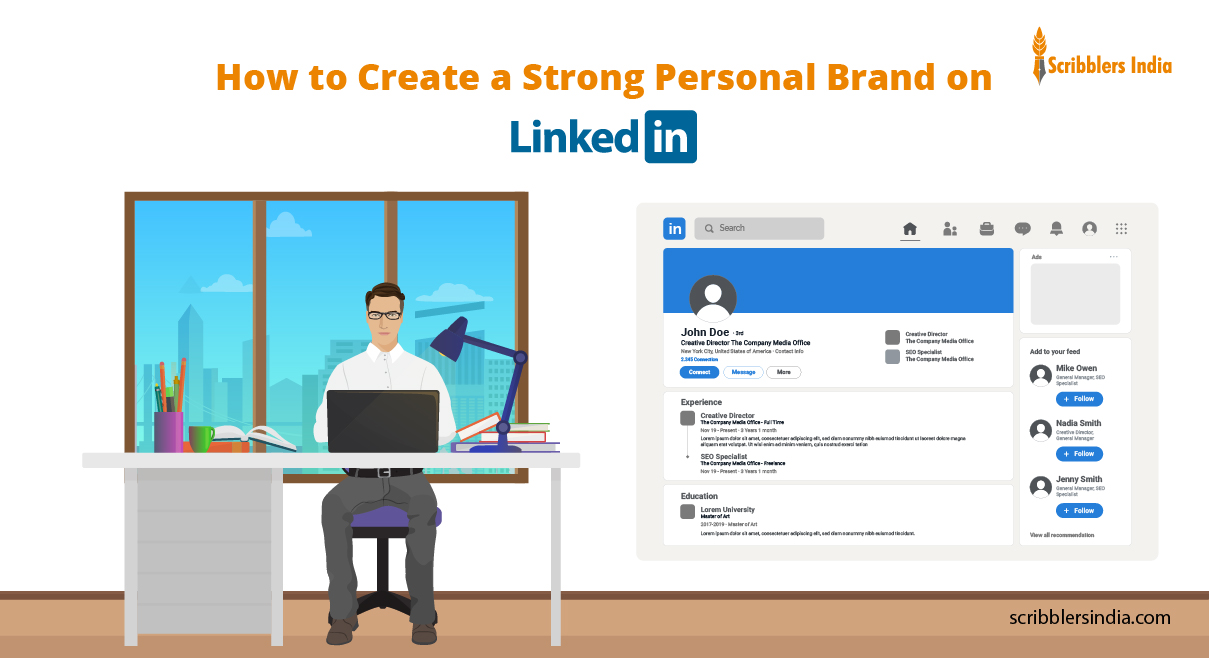
In the modern professional ecosystem, having a LinkedIn profile alone is no longer sufficient. With over a billion professionals on the platform, the real question is: are you truly standing out? Your profile is the cornerstone of your professional reputation and a strong personal brand on LinkedIn is a powerful tool for advancing your career. Personal branding is the conscious effort to shape the public perception of your skills, experience, and values. It is what builds trust, establishes credibility, and sets you apart from others. A strong personal brand on LinkedIn serves as your professional advocate, working on your behalf even when you are not. LinkedIn is the world’s premier platform for professional networking and branding. It provides the perfect ecosystem to showcase your expertise, connect with industry leaders, and unlock new opportunities. This guide will provide you with a step-by-step framework to transform your profile into a powerful branding asset. Why is a Strong Personal Brand Important for Your Career? A strong personal brand on LinkedIn is your career accelerator in dynamic modern markets. It moves you from being a passive participant to an active architect of your professional journey, creating a distinct identity that attracts success. Stand Out from the Crowd: In a job market with millions of talented individuals, a strong personal brand helps you get noticed by recruiters and collaborators for the right reasons. Build Trust and Credibility: A well-maintained profile with consistent, valuable content establishes you as a reliable and knowledgeable professional in your field, fostering trust among your connections. Attract High-Value Opportunities: Your brand works 24/7, drawing in job offers, speaking invitations, client leads, and collaboration requests that align with your career aspirations. Showcase Your Expertise: It provides a platform to demonstrate your skills and insights, positioning you as a go-to expert and a thought leadership figure in your niche. Enable Long-Term Career Growth: A powerful brand on LinkedIn is an asset that grows with you, opening doors for promotions, career pivots, and entrepreneurial ventures throughout your professional life. Amplify Your Networking Power: Networking becomes more effective when people are more likely to connect with and respond to a professional with a clear and compelling brand identity. What Do You Need For a Strong Personal Brand on LinkedIn? A standout LinkedIn profile is a strategic blend of professional presentation and personal storytelling. It immediately communicates your value proposition, making a memorable first impression that encourages viewers to learn more about you and your work. Here are the key elements you need for a strong personal brand on LinkedIn: Professional Headshot & Banner Your profile picture is your digital handshake. Use a high-quality, professional headshot where you appear approachable. Your banner image should be a visual representation of your professional field, brand, or passion, adding another layer of context. Compelling Headline Move beyond just your job title. Your headline is prime real estate to showcase your core value. Use keywords to describe what you do, who you help, and the results you deliver. For example, “Content Strategist helping SaaS startups drive organic growth.” Impactful ‘About’ Section This is your brand’s story. Write in the first person, narrating your professional journey, your mission, and your key achievements. Infuse relevant keywords naturally to enhance your LinkedIn profile optimization and end with a clear call to action. Detailed Experience Section Do not just list your responsibilities. Frame your experience in terms of impact and quantifiable achievements. Use bullet points with action verbs to describe how you added value in each role, like “Increased lead generation by 30% through targeted content campaigns.” Skills & Endorsements List skills that are relevant to your industry and future goals. A profile with at least five skills is viewed up to 17 times more. Endorsements from your network act as social proof, validating your expertise and boosting your credibility. Recommendations and Featured Section Recommendations are powerful testimonials. Request them from colleagues, clients, and managers. Use the ‘Featured’ section to showcase your best work, such as articles you have published, projects you have led, or presentations you have given. This provides tangible proof of your abilities and helps establish a strong personal brand on LinkedIn. How Can a Consistent Content Strategy Build a Strong Personal Brand on LinkedIn? A proactive LinkedIn content strategy transforms your profile from a static resume into a dynamic platform for thought leadership. Sharing valuable content consistently demonstrates your expertise, keeps you top-of-mind, and builds a community around your brand. Let’s understand how a well-planned LinkedIn content strategy helps establish your thought leadership in your niche: Define Your Niche: Identify your area of expertise and your target audience. Ask yourself what unique insights you can offer and who you want to reach. This focus makes your content more impactful. Share Diverse Content Types: Mix your content formats to keep your audience engaged. Share text posts, articles, carousels, infographics, and short videos. Each format serves a different purpose in telling your professional story. Maintain Consistency: Develop a content calendar and post regularly. Whether it is twice a week or five times a week, consistency is crucial for building momentum and staying visible to your network and the LinkedIn algorithm. Provide Genuine Value: Your content should aim to educate, inspire, or solve a problem for your audience. Focus on giving value freely rather than constantly promoting yourself. This approach builds trust and loyalty. Leverage Personal Stories: Authenticity resonates deeply. Share personal career lessons, challenges, and successes. This humanizes your brand and creates a stronger, more relatable connection with your audience. Adapt to the Indian Context: Discuss local market trends, industry challenges, and success stories relevant to India. This contextualization makes your content more relatable and valuable to your primary audience. How Can You Engage and Expand Your Network on LinkedIn for Personal Branding? Effective networking on LinkedIn is about building meaningful relationships, not just collecting connections. A strategic approach to engagement and outreach helps you expand your influence and create a supportive professional community that fosters mutual growth. Here are the

How to Build a Powerful Personal Brand on LinkedIn? Read More »

Scribblers India offers professional personal branding services

Personal Branding vs. Company Branding: Which One is More Effective?

Is Elon Musk’s brand Tesla’s brand, or is it his own? When you think of Virgin, do you picture the logo or Richard Branson’s adventurous smile? This brings up a common point of confusion in our digital-first world. Many people mix up personal branding and company branding, yet they are two distinct and powerful tools in your strategic arsenal. A personal brand is the unique story and reputation of an individual. A company brand represents the collective identity of an organization. Understanding the difference between a personal and corporate brand is crucial for success. This blog will demystify the personal branding vs company branding debate. We will explore the unique power of each, their symbiotic relationship, and how you can strategically use both. This is especially vital for entrepreneurs, freelancers, and experts who are often both the face of their work and the business itself. What is the Real Difference Between Personal Branding vs Company Branding? The fundamental difference amongst personal branding vs company branding is focus. A personal brand centers on an individual’s unique identity, skills, and values. In contrast, a company brand is built around the organization’s collective mission, its products or services, and its overall corporate identity, designed to exist beyond any one person. Defining Personal Branding Your personal brand is the intentional cultivation of your public reputation. It is how the world perceives your unique combination of skills, experiences, and personality. Your personal brand is your story, expertise, and values rolled into one authentic package. Individual Focus: It is fundamentally about you as a distinct professional entity. Your name is the brand name. Showcases Expertise: It highlights your specific knowledge and authority within a niche. Builds Relationships: It leverages your personality to build direct connections and a loyal following. Prime Examples: This is the realm of thought leaders, coaches, artists, and specialized freelancers. Defining Company Branding A company brand, or corporate brand, is the identity of a business. It encompasses the organization’s mission, vision, and core values. It is communicated through its name, logo, customer service, and the entire customer experience. Organizational Focus: It represents the collective, not a single person’s identity. Promotes Offerings: It is built around the products or services the business provides to the market. Creates Consistency: It ensures a uniform and predictable experience for all customers and stakeholders. Prime Examples: Think of large corporations like Apple, startups like Notion, or any e-commerce business. Key Distinctions at a Glance: Comparing Personal Branding vs Company Branding   Distinction Personal Brand Company Brand Primary Focus Individual identity, expertise, and relationships Organizational identity, products/services, and market positioning Target Audience Professional network, followers, and direct clients Customers, investors, partners, and the broader market Communication Style Often more authentic, conversational, and personality-driven Typically more consistent, professional, and strategically crafted Flexibility Can pivot quickly based on individual growth and interests Changes require more strategic planning and stakeholder buy-in Longevity Usually tied to your career lifespan or personal presence Designed for long-term scalability and potential transition of ownership   Why Do People Trust Personal Brands More Than Company Brands? People fundamentally trust other people more than they trust faceless corporations. A personal brand cuts through the noise of corporate advertising by creating a genuine, human-to-human connection that feels more authentic and relatable, fostering a deeper level of trust and loyalty. This preference for the personal touch is backed by data. A recent report highlights that 88% of consumers trust recommendations from individuals over branded content, even if they do not know them personally. This statistic reveals a powerful truth about modern consumer psychology. Authenticity and Relatability: Personal brands can share real stories, including struggles and successes. This vulnerability makes them more relatable than a polished corporate message. Direct Engagement: It is easier to have a one-on-one conversation with an individual on social media than it is with a large company, building real relationships. Overcoming Skepticism: In an era saturated with ads, consumers are skeptical. A recommendation from a trusted individual carries more weight than a corporate promise. The Human Connection: We are wired to connect with faces, voices, and stories. A strong personal brand provides a human anchor in a digital world. What are the Main Benefits of Having a Strong Personal Brand? A strong personal brand creates immense opportunities for both individuals and the businesses they lead. Individuals can establish authority and attract better career prospects. Businesses can humanize their company by building a bridge of trust and loyalty with customers through personal connections. For Individuals: Building Your Professional Equity Developing your personal brand is an investment in your own professional future. It separates you from the competition and makes you a magnet for new opportunities. Boosts Visibility: A clear brand makes you more recognizable and memorable in your field. Establishes Authority: You become the go-to expert, building credibility and trust. Attracts Opportunities: This leads to speaking gigs, media features, and collaborations. Enhances Networking: Your brand acts as a conversation starter, drawing like-minded professionals to you. For Businesses: The Human-Centered Advantage The benefits of a personal brand for businesses are significant, especially in a market where consumers crave authenticity. The founder’s or CEO’s personal brand can become a powerful asset. Humanizes the Company: It provides a relatable face and a human story behind the logo. Builds Customer Loyalty: Customers who trust you are more likely to be loyal to your company. Acts as a Marketing Channel: A leader’s influential social media presence can drive significant sales. Attracts Top Talent: People want to work for leaders they admire and respect.       Is a Company Brand Still Important if I Have a Strong Personal Brand? Absolutely, when you compare personal branding vs company branding, it becomes clear that a company brand is essential for long-term growth, scalability, and creating an entity that can thrive independently of you. While your personal brand can provide the initial spark, a company brand builds the sustainable fire that can outlast any single individual’s involvement. Relying solely on an individual branding vs business

Personal Branding vs. Company Branding: Which One is More Effective? Read More »

What Are the Key Benefits of a Personal Brand: Your Comprehensive Guide

Did you know that 50% of professionals with a strong personal brand received interest from new employers compared to only 14% of those with a weak personal brand. Your personal brand is your professional reputation. In the modern digital-first world, it is the curated story of your skills, experiences, and values, showcased online and offline. It is how the world perceives your expertise. The benefits of personal brand are not merely metrics; they are transformative forces that can unlock unparalleled growth. Mastering your personal brand is essential for navigating the modern professional ecosystem. This comprehensive guide explores the tangible advantages of a strong personal brand, from enhancing your credibility to unlocking new personal brand opportunities. Keep reading to learn more. What Is a Personal Brand and Why Does It Matter? A personal brand is the unique combination of skills and experiences that make you who you are. It is the deliberate process of shaping the public perception of your professional identity. It goes far beyond having a strong social media presence; it’s about building a reputation that precedes you. In the digital age, personal branding has shifted from handshake networking to creating a dynamic online footprint. Professionals now build relationships and showcase expertise on a global scale through digital platforms. This evolution is critical because 85% of HR professionals state that a candidate’s online reputation influences their hiring decisions. A strong brand ensures you are a recognized voice within it. The impact of personal branding on your career is now more significant than ever. Why Is Personal Branding Important: 10 Key Benefits of Personal Brand Understanding why personal branding is important is the first step toward leveraging its power. Here are ten key benefits of a personal brand that can redefine your professional journey. 1. Enhances Professional Credibility and Authority A strong personal brand establishes you as a thought leader in your field. It provides a platform to consistently demonstrate your knowledge and expertise, which naturally builds trust with your audience, clients, and peers. This credibility becomes a cornerstone of your professional identity. This “trust factor” is essential in all professional relationships. Here’s how it works: Expert Positioning: Your brand allows you to share insights and commentary, positioning you as a go-to expert. Industry Recognition: Leaders like Seth Godin or Brené Brown built their empires on the foundation of a credible personal brand that offers unique value. Trust as a Currency: When people trust your expertise, they are more likely to engage with you, hire you, or buy from you. Opportunity Magnet: This enhanced credibility directly translates into more and better business opportunities, as people seek out trusted voices. 2. Expands Network and Valuable Connections A well-defined personal brand acts as a magnet, attracting like-minded professionals, mentors, and collaborators to your orbit. It moves you beyond actively seeking connections to having valuable contacts seek you out, creating a powerful and authentic professional network. The advantages of a strong personal brand extend your reach significantly. Attracting a Tribe: Your content and professional positioning draw in people who share your values and interests. Unlocking Second-Degree Connections: Your strengthened network opens doors to opportunities you would not otherwise have access to. Focusing on Quality: A strong brand helps you build fewer, more meaningful connections rather than collecting contacts. Leveraging Digital Platforms: Tools like LinkedIn and industry-specific forums become powerful assets for connecting with peers and leaders globally. 3. Greater Career Advancement Opportunities The impact of personal branding on your career is profound, directly influencing recruitment decisions and internal promotions. A visible and respected personal brand makes you a more attractive candidate in a competitive job market and a valuable asset within your current organization. Recruiters actively seek out professionals with a strong digital footprint. Increased Visibility: Over 70% of employers use social media to screen candidates, making your personal brand a key factor in getting hired. Competitive Edge: In a crowded field of applicants, a compelling personal brand helps you stand out and articulate your unique value proposition. Internal Promotions: Employees with strong brands are often seen as leaders and are more likely to be considered for advancement opportunities. Case Study Evidence: Professionals frequently report a significant shift in their career trajectory, with more inbound job offers after investing in their brand. 4. Increases Income Potential and Negotiating Power Yes, a strong personal brand directly correlates with higher income potential and gives you significant leverage in financial negotiations. When you are recognized as an expert, you can command premium rates for your services and justify a higher salary. This is one of the most tangible benefits of a personal brand. Premium Pricing Power: Entrepreneurs and freelancers with strong brands can charge more because clients are paying for proven expertise. Salary Negotiation Leverage: During salary discussions, your established authority and market visibility serve as powerful arguments for better compensation. Attracting High-Value Clients: A respected brand attracts clients who are willing to pay for top-tier talent and results. Long-Term Financial Growth: Consistently building your brand is an investment that yields compounding financial returns over your entire career. 5. Business Growth and Client Attraction For entrepreneurs and business leaders, a personal brand is a powerful engine for growth. It helps attract and retain clients by building a loyal community around your expertise and values, fundamentally shifting your lead generation from outbound to inbound. Personal branding for entrepreneurs is no longer optional; it is essential. Inbound Lead Generation: Your content and reputation attract qualified leads, reducing the need for cold outreach and expensive advertising. Building Client Trust: Clients are more likely to do business with people they know, like, and trust. Your personal brand builds that connection. Enhancing Client Retention: A strong brand fosters loyalty, turning one-time clients into long-term partners who value your ongoing insights. Measurable Business Impact: Track metrics like lead quality, conversion rates, and customer lifetime value to see the direct impact of your brand. 6. Thought Leadership Positioning A personal brand provides the platform to establish yourself as a thought leader. By

What Are the Key Benefits of a Personal Brand: Your Comprehensive Guide Read More »

Scribblers India for B2B Social Media Campaigns

How to Create the Best B2B Social Media Campaigns: Analyzing 14 Successful Examples

B2B social media campaigns drive business growth by establishing brand authority, generating quality leads, and fostering meaningful relationships with decision-makers in target organizations. When executed strategically, these campaigns can transform your digital presence and significantly impact your bottom line. In the modern digital ecosystem, B2B social media campaigns have evolved beyond mere brand visibility tools. They have become advanced mechanisms for engaging potential clients, showcasing thought leadership, and driving measurable business outcomes. Recent statistics show that 90% of B2B marketers distributed content on social media platforms in the past year, making it the most widely-used distribution channel. As we navigate through 2025, the social media ecosystem continues to evolve rapidly, presenting both challenges and opportunities for B2B marketers. This comprehensive guide will analyze powerful social media campaigns, explore how to create effective campaign strategies, and provide actionable insights to help you leverage social platforms for maximum impact. What is the Importance of B2B Lead Generation? B2B growth is essential because it enables companies to expand their client base, increase revenue streams, and build sustainable business relationships in an increasingly competitive marketplace. Prioritizing growth strategies keeps your business relevant and competitive. Understanding the dynamics of B2B growth is crucial for any organization looking to thrive in today’s business environment. Here is why it matters: Market expansion opportunities allow businesses to tap into new industries and geographic regions, diversifying revenue streams. Competitive advantage comes from growing faster than rivals, capturing market share, and becoming an industry leader. Financial stability results from a broader client base and recurring revenue models, reducing dependence on single clients. Innovation catalyst emerges when growth demands new solutions, driving product development and service improvements. Talent attraction becomes easier as growing companies offer better career advancement opportunities and stability. How Does B2B Lead Generation Set You Up For Success? B2B lead generation sets you up for success by creating a consistent pipeline of qualified prospects, allowing for more predictable revenue forecasting and strategic resource allocation. This foundation is crucial for sustainable business growth. Effective lead generation serves as the backbone of successful B2B Social Media Campaigns. When implemented correctly, it transforms your content marketing strategy  from guesswork into a systematic approach for business development. Quality over quantity focuses resources on prospects with genuine interest and buying potential, maximizing conversion rates. Shortened sales cycles occur when marketing efforts pre-qualify leads, reducing time spent on unproductive prospects. Data-driven decision making improves as lead generation activities provide valuable insights about prospect behavior and preferences. Enhanced customer targeting becomes possible through analysis of successful conversions, revealing ideal customer profiles. Better ROI measurement allows marketing teams to track performance metrics from initial contact through to final conversion. How Can Your Website Support Your B2B Lead Generation Activities? Your website supports B2B lead generation by serving as a 24/7 sales representative, offering valuable content, capturing visitor information, and providing meaningful analytics about prospect behavior. A strategically designed website is your most powerful lead generation asset. Your website is often the first substantial touchpoint potential clients have with your business. Optimizing it for lead generation can dramatically improve your marketing outcomes. Strategic CTAs (Call-to-Actions) guide visitors toward conversion points throughout their journey on your site. Value-driven content establishes authority and builds trust while addressing specific pain points of your target audience. Lead capture mechanisms like targeted landing pages and optimized forms collect visitor information efficiently. Customer testimonials and case studies provide social proof and demonstrate real-world value of your offerings. Analytics integration provides valuable insights about visitor behavior, helping refine your lead generation approach. What Are The Most Effective B2B Social Media Marketing Strategies For 2025? The most effective B2B social media campaigns feature video-first content approaches, purpose-driven marketing, B2B thought leadership content, and personalized engagement at scale. These strategies leverage changing buyer behaviors and platform capabilities. As we move through 2025, specific social media strategies have proven particularly effective for B2B organizations looking to stand out in crowded digital spaces. Video marketing dominates with 69% of B2B marketers increasing their video investment, recognizing its power to explain complex offerings effectively. Thought leadership content continues gaining traction with 53% of B2B marketers increasing investment, as 60% of decision-makers willingly pay premiums to work with companies demonstrating strong B2B thought leadership. LinkedIn-focused approaches yield significant results with 84% of B2B marketers reporting LinkedIn delivers the best value among social platforms. Purpose-driven marketing connects with buyers who increasingly prefer brands committed to causes, demonstrating diversity, equity, and inclusion values. Data-driven personalization enables targeted messaging that resonates with specific decision-makers within target organizations. What Can You Learn From 14 Powerful Social Media Campaigns? From powerful B2B social media campaigns, you can learn the importance of authentic storytelling, platform-specific optimization, consistent branding, engaging formats, and measurement frameworks. These successful examples provide actionable inspiration for your own campaigns. 1. Microsoft’s “Make What’s Next” Campaign Microsoft’s “Make What’s Next” campaign brilliantly combined purpose-driven marketing with practical career guidance. The campaign encouraged young women to pursue careers in STEM fields while subtly showcasing Microsoft’s technology solutions. What made it work was the perfect alignment between Microsoft’s business objectives and a genuine social cause. The campaign generated significant engagement by addressing a real issue (gender disparity in STEM) while positioning Microsoft as a solution provider and thought leader in the technology space. Key takeaway: Align your social media campaigns with authentic purpose that connects to your core business offerings. 2. LinkedIn’s “#FindTheBalance” Campaign LinkedIn’s “#FindTheBalance” campaign addressed the blurring boundaries between professional and personal life during the remote work era. Using relatable content and personal stories from professionals, LinkedIn created a powerful campaign that showcased the platform’s understanding of modern work challenges. The simple, relatable hashtag communicated everything needed: finding balance between work and life and its impact on mental health. The campaign generated substantial engagement, with countless professionals sharing personal stories, each exposure expanding LinkedIn’s brand reach. Key takeaway: Create campaigns that tap into universal experiences your audience faces, encouraging authentic participation. 3. Adobe’s “Reshaping the Client Experience” Campaign Adobe collaborated with

How to Create the Best B2B Social Media Campaigns: Analyzing 14 Successful Examples Read More »

Scribblers India helps you understand how to build a personal brand online

How to Build a Strong Personal Brand Online: A Comprehensive Guide

Did you know that 82% of people are more likely to trust a company when its senior executives have a strong personal brand online? This powerful connection between leadership presence and trust highlights the importance of knowing how to build personal brand online. Your personal brand is the unique combination of skills, experiences, and personality traits that you want the world to see. In the digital era, building your personal brand online has become essential for career advancement and professional growth. This guide will walk you through the essential steps on how to build personal brand online, from foundational planning to advanced strategies. This will help you craft an impactful online personal branding strategy that opens doors to new opportunities. What Is a Personal Brand and Why Does It Matter? A personal brand is the intentional representation of your professional identity, values, and expertise across digital channels. It goes beyond a simple social media presence to encompass your overall reputation and the perception others have of you in professional contexts. The concept of how to build a personal brand online has evolved dramatically in the digital age. What once required media connections or industry fame now simply needs strategic online presence. In fact, research indicates that 77% of consumers are more likely to engage with a business when the company leaders are active on social media. Strong online brands deliver tangible results: Professionals with optimized LinkedIn profiles are 40% more likely to receive opportunities through the platform 86% of consumers say authenticity is important when deciding which brands to support Consider figures like Gary Vaynerchuk, Brené Brown, or Mark Cuban. Each has distinct personal branding strategies that amplify their expertise. Without actively managing your online presence, you risk others defining your narrative or, worse, becoming professionally invisible. How to Prepare Before Building Your Online Personal Brand? Beginning your personal brand building journey requires establishing solid foundations before creating content for expanding your reach. Your first step toward understanding how to build personal brand online, is conducting a comprehensive personal brand audit. Search your name online, review your social profiles through an objective lens, and identify content that doesn’t align with your desired brand image. Identifying Your Unique Value Proposition Determine what makes you distinctive in your field. This could be specialized knowledge, unique experiences, or a particular approach to solving industry problems that others don’t offer. Defining Your Target Audience Clarity about whom you’re trying to reach is crucial. Research demographics, professional backgrounds, and online behaviors of your ideal audience to tailor your messaging effectively. Setting Clear Branding Goals Establish specific, measurable objectives for your personal brand. Whether it’s generating speaking opportunities, attracting clients, or positioning for advancement, these goals will guide your strategy. Creating Your Personal Brand Statement Develop a concise statement (1-2 sentences) that articulates who you are professionally, whom you serve, and the unique value you provide. This statement will guide all your online activities. What Are the Steps to Build Your Personal Brand Online? Building your personal brand online requires a systematic approach that moves from planning to execution to optimization. Follow these seven essential steps to create a strong professional presence that resonates with your target audience. Define Your Brand Purpose and Positioning Clarify your professional “why” and identify where you fit within your industry landscape. Your positioning should highlight your unique strengths while addressing specific audience needs. Audit and Clean Up Your Current Online Presence Search your name online and review all social profiles critically. Remove or update outdated content and ensure privacy settings align with your personal branding strategy. Optimize Your Primary Digital Platforms Select 2-3 key platforms based on your audience research. Create comprehensive profiles with professional photos, compelling bios, and consistent visual elements across all channels. Develop Your Content Strategy Create a strategy around what content types will showcase your expertise best. Create a sustainable publishing schedule that balances quality with consistency to build audience expectations. Build Strategic Professional Networks Connect intentionally with peers, industry leaders, and target audience members. Focus on quality over quantity, establishing meaningful relationships rather than collecting connections. Monitor and Manage Your Online Reputation Set up alerts to track mentions of your name and respond promptly to feedback. Address negative comments professionally and amplify positive feedback to strengthen your brand perception. Measure Results and Refine Your Approach Track engagement metrics, audience growth, and professional opportunities generated. Use data insights to adjust your strategy, doubling down on what works and revising what doesn’t. When learning how to build a personal brand online, following a proven framework increases your chances of success. These steps provide a roadmap that professionals across industries can adapt to their specific needs and goals.   What Are the Core Elements of a Strong Online Personal Brand Strategy? A successful online personal branding strategy combines several essential elements that work together to create a cohesive professional identity. The foundation of your strategy for how to build personal brand online begins with your brand voice, the distinctive tone and style that reflects your personality while maintaining professionalism. This voice should remain consistent whether you are writing blog posts or responding to comments. Here are the core elements of a robust online personal branding strategy: Visual Branding Elements: Select consistent colors, typography, and imagery that reflect your personal brand attributes. Research shows people remember visual elements 65% more effectively than text alone. Content Pillars: Identify 3-5 core topics that showcase your expertise and align with audience interests. These content pillars will guide your content creation and establish topical authority in your field. Cross-Platform Consistency: Maintain cohesive messaging across platforms while adapting to each platform’s unique strengths. Your LinkedIn profile should connect thematically with your Twitter presence, even with different content formats. Authenticity vs. Curation: Finding the balance between showing your authentic self and maintaining professional standards is crucial. According to Stackla, 86% of consumers say authenticity is important when deciding which brands to support. Which Online Platforms Should You Use to Build Your Personal Brand? Platform

How to Build a Strong Personal Brand Online: A Comprehensive Guide Read More »

Personal Branding Is Important for Founders

Why Personal Branding Is Important: From Startup Founder to Industry Leader

Personal branding is the strategic process of creating, positioning, and maintaining a distinctive professional identity that showcases your expertise, values, and unique offerings to your target audience. For startup CEOs, it’s the difference between being just another business leader and becoming a recognized industry authority. An incredible 43% of your company’s market value depends on your reputation as a CEO. This reveals why personal branding is important for modern business leaders. In fact, 82% of people trust companies more when their senior executives maintain an active social media presence. Have you considered how your online presence affects your bottom line? The impact of personal branding extends beyond trust-building. Specifically, leads generated through personal branding convert seven times more frequently than traditional company branding efforts. Furthermore, with 77% of consumers more likely to buy from companies whose CEOs engage on social media, your personal brand directly influences your business success. This comprehensive guide will show you how to transform your professional image from a startup CEO to an industry leader, covering everything from building your foundation to scaling your influence alongside your business growth. Why Personal Branding is Important for Startup CEOs? Personal branding has become a strategic necessity for startup CEOs as the business landscape undergoes rapid transformation. The traditional boundaries between professional and personal spheres continue to blur, creating new opportunities and challenges for leadership visibility. How does personal branding affect investor confidence? Personal branding has become a strategic necessity for startup CEOs as the business landscape undergoes rapid transformation. The traditional boundaries between professional and personal spheres continue to blur, creating new opportunities and challenges for leadership visibility. Leadership patterns have shifted dramatically, primarily due to technological advancements and changing stakeholder dynamics. Modern CEOs must adapt their leadership approach to remain effective in an increasingly complex business environment. Consequently, those who master self-promotion gain a significant advantage in attracting investors and building customer trust. Branding demands commitment; commitment to continual re-invention; striking chords with people to stir their emotions; and commitment to imagination. It is easy to be cynical about such things, much harder to be successful. ~ Sir Richard Branson Impact of digital transformation on personal visibility The digital age has fundamentally altered how CEOs connect with their audiences. Your online reputation as a CEO directly influences your company’s market perception and stakeholder relationships. Platforms like LinkedIn have proven that video posts receive significantly more engagement than text-based updates. The rise of digital channels has created unprecedented opportunities for CEOs to showcase their expertise and build authority. Your personal brand helps cut through the noise and establishes an authentic voice in a crowded digital landscape. This visibility becomes particularly crucial as: Employees seek leaders who demonstrate authentic leadership Investors evaluate founders based on their digital presence and thought leadership Customers increasingly trust companies with visible, engaging leadership Partners and stakeholders expect regular, meaningful interactions Rising expectations from stakeholders What do your stakeholders really want from you beyond quarterly results? Stakeholder management has evolved into a complex responsibility that demands strategic personal branding. Studies show that transparent communication from CEOs significantly impacts stakeholder trust and engagement. Therefore, your role extends beyond operational leadership to building and maintaining relationships with various stakeholder groups. The modern stakeholder landscape requires CEOs to maintain open lines of communication and demonstrate strong leadership qualities. Your professional identity serves as a bridge between your company’s vision and stakeholder expectations, creating an environment where collaboration thrives. Building trust through personal branding becomes particularly vital as stakeholders now expect regular updates about company performance, future plans, and potential challenges. This transparency helps foster stronger relationships and ensures stakeholders feel valued and heard throughout their journey with your company. How to Build Your Foundation as an Entrepreneurial Brand? A strong personal brand starts with authenticity, a clear value proposition, and a compelling mission statement that resonates with your target audience. Defining your authentic leadership voice Self-awareness forms the cornerstone of authentic leadership. Studies show that leaders who understand their strengths, values, and emotions create stronger connections with their teams. Subsequently, this self-awareness enables you to communicate with clarity and confidence, essential traits for establishing trust with stakeholders. To develop your authentic voice, focus on aligning your verbal, vocal, and visual communication channels. Indeed, your words, tone, and body language must complement each other to project credibility. Although receiving conflicting advice about leadership style is common, staying true to your natural tendencies while incorporating constructive feedback creates a more genuine presence. Identifying your unique value proposition Your value proposition serves as a promise of value to be delivered, setting you apart from other leaders in your industry. What specific problem do you solve better than anyone else in your field? Essentially, it must address three crucial elements: Relevancy: How you solve specific problems Quantified value: Clear benefits you provide Differentiation: Why stakeholders should choose you A compelling value proposition primarily focuses on outcomes rather than services. Your unique value should reflect highly desired results that your audience seeks, creating what experts call a “castle in the mind” for your stakeholders. Creating your personal brand mission statement A personal brand mission statement is a concise declaration that articulates your purpose, values, and the unique impact you aim to make in your industry and beyond. Your personal brand mission statement encapsulates who you are, what you do, and the impact you aim to make. Notably, this statement should be brief yet powerful, typically spanning 4-5 sentences. Meanwhile, it must embody your expertise, tell your brand story, and define your core values. When crafting your mission statement, focus on transparency and authenticity. A study in the Leadership and Organization Development Journal reveals that authentic leadership serves as the strongest predictor of job satisfaction. Your mission statement should reflect this authenticity while highlighting your commitment to continuous growth and excellence. How to Leverage Digital Platforms for Brand Growth? Selecting the right digital platforms forms the cornerstone of a successful personal brand strategy. According to recent data, 58% of Inc. 5000 CEOs

Why Personal Branding Is Important: From Startup Founder to Industry Leader Read More »

Thought leadership metrics are crucial to monitor.

20 Crucial Thought Leadership Metrics: How to Leverage Them For Personal Branding

Thought leadership metrics, your essential tool, gauge the effectiveness of your personal branding initiatives. They unveil insights that guide your thought leadership content strategy, aligning it with your brand’s objectives. A proficient thought leadership content agency in India, armed with these metrics, can supercharge your outreach. Working with a thought leadership content writing agency ensures your content resonates with your audience. Expertise in thought leadership content writing is key to crafting compelling narratives. Thought leadership KPIs specifically, allow measuring, analyzing, and improving your content. With a thought leadership content marketing agency in Delhi and other cities, you optimize these KPIs for maximum ROI. Embrace thought leadership content services that turn data into actionable strategies. Thought leadership content marketing thrives on these thought leadership metrics, forming a synergy that powers your brand’s influence. A data-driven thought leadership content strategy benefits your brand, showcasing your thought leadership. Harness thought leadership content writing services to amplify your brand’s voice today. Which are the Top 20 Thought Leadership Metrics? Navigating the world of thought leadership can be challenging. Knowing the right metrics and how to measure them can empower your personal branding strategy. Here are 20 crucial thought leadership metrics and their measurement methods. 1.    Audience Reach This thought leadership metric gauges how wide your content spreads. It’s a critical starting point for any thought leadership content strategy. 2.    Unique Visitors It measures the new audience exposed to your thought leadership. It’s a sign of successful thought leadership content marketing. 3.    Returning Visitors This thought leadership KPI shows the loyalty of your audience. Consistency in thought leadership content writing can boost this metric. 4.    Engagement Rate The effectiveness of your thought leadership content is highlighted by this metric. It’s a crucial measure for any thought leadership content agency in India. 5.    Bounce Rate A lower bounce rate indicates your content holds visitor interest. Thought leadership content writing services work to minimize this metric. 6.    Click-Through Rate (CTR) The CTR shows your thought leadership’s appeal. An effective thought leadership content marketing agency improves this KPI. 7.    Social Shares This thought leadership metric indicates content virality. It’s a clear indication of a successful thought leadership content strategy. 8.    Social Engagement It shows the interaction between your audience and content. Expertise in thought leadership content writing can boost social engagement. 9.    Conversion Rate A critical thought leadership KPI, it demonstrates the direct impact on your business goals. It’s crucial for every thought leadership content marketing strategy. 10.  Lead Generation A crucial thought leadership metric, it quantifies the number of potential customers you gain. Thought leadership content marketing services are experts in this field. 11.  Time Spent on Page It signifies your content’s ability to retain audience interest. A successful thought leadership content strategy prioritizes this metric. 12.  Organic Traffic It indicates the natural interest in your thought leadership. A proficient thought leadership content writing agency in India can improve this KPI. 13.  SEO Ranking High SEO rankings prove your thought leadership’s visibility. Thought leadership content marketing agencies work on this KPI diligently. 14.  Email Open Rates The metric reflects the effectiveness of your email-based thought leadership content. Effective thought leadership content writing can enhance this metric. 15.  Subscriber Growth It’s a measure of your thought leadership’s sustainability. Thought leadership content services focus on this metric for long-term success. 16.  Content Download This metric showcases the value of your thought leadership resources. Your thought leadership content marketing agency in Delhi and other cities should strive for higher downloads. 17.  Event Attendee Count It quantifies the success of your thought leadership events. Successful thought leadership content strategy includes engaging event creation. 18.  Cost Per Lead (CPL) It measures the efficiency of your thought leadership content marketing. A lower CPL is always beneficial for your brand. 19.  Customer Retention Rate This KPI indicates the influence of your thought leadership on customer loyalty. It’s essential for any thought leadership content agency in India. 20.  Referral Traffic A higher referral traffic indicates a strong brand influence. Harness thought leadership content writing services to enhance this metric today. What are the Most Prominent Thought Leadership Challenges? Venturing into thought leadership presents unique challenges, from creating engaging content to justifying personal branding investments. By understanding these hurdles, you can devise strategies to overcome them. Here are the top ten challenges of thought leadership. 1.    Identifying the Right Metrics Deciding which thought leadership metrics are most relevant can be challenging. It requires a deep understanding of your objectives and audience. 2.    Content Differentiation In a saturated market, making your thought leadership content stand out is tough. Innovative thought leadership content writing is essential for differentiation. 3.    Maintaining Consistency Delivering thought leadership content consistently can be challenging. Yet, consistency is key for building credibility and establishing your brand as a thought leader. 4.    Measuring Impact Quantifying the impact of thought leadership content marketing can be difficult. Thought leadership KPIs help, but they require accurate interpretation. 5.    Attracting the Right Audience Your content may reach many, but are they the right people? Attracting your target audience is a common challenge in thought leadership. 6.    Budget Constraints High-quality thought leadership content writing services come at a cost. Balancing the budget while maintaining content quality is a significant challenge. 7.    Long-term Commitment Thought leadership is a long-term strategy. It can be challenging to maintain this commitment, especially if short-term results are not as expected. 8.    Creating Engaging Content Keeping your audience engaged is a continuous challenge. Collaborating with a skilled thought leadership content writing agency in India can help you overcome this hurdle. 9.    Evolving Audience Expectations Audience preferences evolve over time. Keeping up with these changes and adjusting your thought leadership content strategy accordingly is a constant challenge. 10.  Justifying the Investment Thought leadership often requires significant investment. Demonstrating the value of this investment to stakeholders can be challenging without the right thought leadership KPIs. How to Leverage Thought Leadership KPIs to Overcome Personal Branding Challenges? Steering through thought leadership challenges can be daunting. With precise goals

20 Crucial Thought Leadership Metrics: How to Leverage Them For Personal Branding Read More »

Having a well-defined Thought Leadership Content Strategy is crucial for personal branding.

11 Incredible Tips to Create a Powerful Thought Leadership Content Strategy!

Thought leadership is about sharing your thoughts on leadership to position yourself as an industry authority. To achieve this, you need a robust thought leadership content strategy. This strategy involves crafting valuable and insightful thought leadership content writing to engage your audience and build credibility. Remember, almost 66% of marketers consider thought leadership as a top priority for their companies. Look for thought leadership examples to learn from and tailor your approach accordingly. Thought leadership articles play a pivotal role in showcasing your expertise and perspectives. Remember, thought leadership marketing is essential to reach a wider audience and make an impact. Embrace the true meaning of thought leadership content strategy and use it to make a lasting impression in your industry. To fully leverage the benefits of a thought leadership content strategy, you may consider partnering with a thought leadership content writing agency in India. An experienced thought leadership content marketing agency can provide guidance, and content creation support, and help amplify your message to reach a broader audience. “If you want the coming generations to become thought leader, inculcate and introduce the Value system to them.” ― Balkrishnna Sanmotrra Benefits of a Robust Thought Leadership Content Strategy Are you ready to take your professional reputation to new heights? A comprehensive thought leadership content strategy can be the game-changer you need. After all, over 90% of C-level decision makers believe that thought leadership has an impact on their opinions of a company. Establish Your Authority A comprehensive thought leadership content marketing strategy helps you position yourself as an industry authority. By consistently sharing your thoughts on leadership, you demonstrate your expertise and gain the trust of your audience. Build Credibility Thought leadership content writing allows you to showcase your knowledge and insights. When you provide valuable information and unique perspectives, you establish credibility among your peers and potential clients. Stand Out from the Crowd With a thought leadership strategy, you differentiate yourself from the competition. By offering thought leadership examples and sharing your unique experiences, you become a go-to resource in your field. 52% of marketers leverage thought leadership content to learn more about best practices. Expand Your Network Thought leadership articles and marketing efforts attract a wider audience. As your content reaches more people, you have the opportunity to connect with industry influencers, potential partners, and clients, expanding your professional network. Increase Brand Awareness Through thought leadership marketing, you increase brand visibility. By consistently sharing valuable content and insights, you create a lasting impression in the minds of your audience, leading to enhanced brand recognition. Drive Business Growth A comprehensive thought leadership content strategy can directly impact your business growth. By positioning yourself as a thought leader, you attract new clients, generate leads, and ultimately drive revenue for your organization. Remember, consistency is key, so strive to share a leadership thought of the day or regularly publish thought leadership articles that resonate with your target audience. Availing of the services of the best thought leadership content strategy agency in Delhi or other cities will certainly help your cause. “Thought leadership is when a leader’s thoughts are being used by leaders to lead others.” ― Onyi Anyado Tips to Create Brilliant Thought Leadership Content Strategy Thought leadership is not an overnight achievement. It requires consistency, dedication, and a genuine commitment to sharing valuable insights. Embrace the thought leadership definition and let your unique perspective shine through. Afterall, 63% of customers believe that thought leadership is crucial for understanding if a business can genuinely solve certain business challenges. With a brilliant thought leadership content strategy in place, you’ll be well on your way to becoming an influential industry leader. 1.    Define Your Thought Leadership Goals Clarify your objectives. Are you aiming to position yourself as an expert in a specific industry or tackle thought-provoking topics? Defining your goals will guide your content creation and ensure your strategy aligns with your overall vision. 2.    Identify Your Target Audience Understand who you want to reach with your thought leadership content. Consider their needs, interests, and pain points. For example, if you’re targeting tech professionals, your content may focus on emerging technologies, industry trends, and leadership in the digital age. 3.    Find Your Unique Voice Differentiate yourself by expressing your thoughts on leadership distinctly and authentically. Share personal anecdotes, provide original insights, and showcase your personality. Your unique voice will captivate your audience and make you memorable. 4.    Conduct In-Depth Research Stay informed and gather valuable insights. Dive into industry reports, news articles, and thought leadership examples from influential leaders. This research will not only enhance your knowledge but also enable you to offer fresh perspectives and contribute to relevant conversations. 5.    Create Valuable Content Craft thought leadership articles, blog posts, videos, or podcasts that provide genuine value to your audience. Share actionable tips, industry insights, and thought-provoking ideas. For example, if you’re a marketing expert, you can create content on innovative marketing strategies or effective brand storytelling. 6.    Foster Engagement and Interaction Encourage dialogue with your audience. Respond to comments, address questions, and participate in industry discussions. This interaction builds relationships and demonstrates your commitment to sharing knowledge. It’s not just about broadcasting your thoughts; it’s about creating a community that actively engages with your content. 7.    Leverage Multiple Content Channels Diversify your content distribution by utilizing various channels. Publish thought leadership articles on your website or industry publications, share insights on social media platforms, or deliver speeches at industry events. A multi-channel approach maximizes your reach and enables you to connect with different audience segments. 8.    Stay Consistent Regularly publish thought leadership content to stay top of mind with your audience. Consistency builds trust and reinforces your position as a thought leader. 81.4% of marketers believe that thought leadership content helps generate organic traffic. Develop a content calendar and stick to it, whether it’s sharing a leadership thought of the day or publishing an article every week. 9.    Collaborate with Industry Influencers Partnering with influential thought leaders in your industry can expand your

11 Incredible Tips to Create a Powerful Thought Leadership Content Strategy! Read More »

Thought leadership content writing

Here are 10 Fantastic Tips for Thought Leadership Content Writing!

Thought leadership content writing is all about becoming a trusted authority in your field by leveraging its the key elements. Let’s define thought leadership: it’s the ability to inspire and influence others with your innovative perspectives and forward-thinking ideas. When it comes to leadership, thoughts matter. Crafting thought leadership content is a strategic approach to showcasing your expertise and establishing credibility. By creating compelling articles, blogs, or whitepapers, you can demonstrate your industry knowledge and provide valuable solutions. Thought leadership content marketing is a powerful tool to enhance your brand’s reputation and attract a loyal following. Whether you’re an individual or an agency, thought leadership content writing will help you make an impact and stand out. As a matter of fact, 85% of companies agree that thought leadership plays a pivotal role in their enterprise. So, get ready to unlock your leadership potential and inspire others with your daily dose of wisdom and insights. “Great leaders are almost always great simplifiers, who can cut through argument, debate and doubt to offer a solution everybody can understand.”   – Gen. Colin Powell What are the benefits of thought leadership content writing? By consistently sharing your unique perspectives and expertise, you position yourself as a trusted authority. This helps differentiate your brand and create opportunities for growth and collaboration. Remember, leadership is not just about thoughts, but the impact those thoughts can make on others. Around 57% of companies agree that thought leadership has an impact on the company revenue by driving customer conversations. Are you curious about the benefits of thought leadership content writing? Get ready to uncover the advantages that await you: ·         Establishes Authority Thought leadership content writing positions you as an expert in your field. By sharing your unique perspectives and insights, you gain credibility and become a go-to resource for industry-related information. ·         Builds Trust When you consistently provide valuable and relevant content, you foster trust with your audience. Thought leadership demonstrates your expertise, knowledge, and commitment to delivering high-quality information, which helps you build long-term relationships. ·         Drives Brand Awareness Thought leadership content writing boosts your brand’s visibility. By sharing your ideas and expertise across various platforms, you attract attention and generate interest in your brand. This increased exposure can lead to more opportunities and potential collaborations. ·         Creates Differentiation In a crowded marketplace, thought leadership sets you apart from the competition. You must showcase your unique perspectives and innovative thinking. This way you can establish a distinctive brand identity and attract those seeking fresh ideas and insights. ·         Boosts Thought Leadership Marketing Thought leadership content serves as the backbone of your content strategy. It provides a steady stream of valuable content to engage your target audience, attract new followers. Ultimately, it helps drive organic traffic to your website or social media platforms. ·         Inspires Collaboration and Partnership Thought leadership content marketing opens doors to new connections and collaborations. As you gain recognition for your insights, you become an attractive partner for joint ventures. Then you can leverage speaking engagements and industry events for expanding your network and opportunities. Which are the popular content types to establish thought leadership? Remember to focus on delivering valuable insights, maintaining consistency, and engaging with your audience. Through diverse content formats, you’ll expand your reach, inspire others, and make a lasting impact in your industry. Here are the popular content types through which you can establish your thought leadership: 1.    Thought Leadership Articles Write informative and insightful articles that offer unique perspectives, industry trends, and actionable advice. Share your expertise through well-researched and thought-provoking content. 2.    Whitepapers and Research Reports Conduct in-depth studies, analysis, and surveys related to your industry. Publish comprehensive reports that provide valuable insights and establish you as a trusted source of data. 3.    Case Studies Showcase successful projects or client collaborations that highlight your problem-solving abilities and demonstrate the tangible results you’ve achieved. Share real-world examples to inspire and educate your audience. 4.    Interviews and Q&A Sessions Collaborate with industry experts, influencers, or respected professionals for interviews or Q&A sessions. These interactions provide valuable perspectives and give your audience access to diverse viewpoints. Around 25% of thought leaders collaborate with influencers and opinion builders from their industry. 5.    Webinars and Podcasts Host webinars or podcasts to discuss relevant topics, share industry knowledge, and engage with your audience in an interactive format. These mediums allow for in-depth conversations and audience participation. 6.    E-books and Guides Compile your expertise into comprehensive e-books or guides that offer practical advice, step-by-step processes, or frameworks to solve industry-specific challenges. Deliver valuable resources that establish you as an authority in your field. 7.    Infographics and Visual Content Present complex information in a visually appealing and easily digestible format. Infographics, charts, and diagrams can effectively communicate data, statistics, and trends to engage and educate your audience. 8.    Social Media Posts Share bite-sized insights, quick tips, or thought-provoking questions on social media platforms. Craft concise and impactful posts that generate discussions, attract followers, and drive engagement. 9.    Speaking Engagements Secure speaking opportunities at industry conferences, webinars, or panel discussions. Use these platforms to share your expertise, connect with a wider audience, and establish yourself as a thought leader. 10.  Opinion Pieces and Editorials Submit thought-provoking opinion pieces to industry publications or news outlets. Express your unique viewpoints on current trends, challenges, or emerging technologies to contribute to the industry dialogue. More than 90% of C-level decision makers believe that thought leadership has an impact on the opinions of their companies. “The greatest leader is not necessarily the one who does the greatest things. He is the one that gets the people to do the greatest things.”   – President Ronald Reagan Are there any useful tips for thought leadership content writing? Thought leadership content writing is an ongoing process of learning and growth. Continuously seek feedback, stay updated with industry trends, and refine your writing skills to maintain a strong thought leadership presence. Stay true to your unique voice, deliver valuable insights, and

Here are 10 Fantastic Tips for Thought Leadership Content Writing! Read More »

Thought leadership content marketing strategy is essential for aspiring thought leaders.

Here are 12 Excellent Personal Branding Tips to Establish Your Thought Leadership!

Thought leadership is all about showcasing your expertise and unique insights in your industry. It’s about sharing your thoughts on leadership and providing valuable content that sets you apart. Crafting thought leadership content requires a strategic approach. You need a well-defined thought leadership content marketing strategy that aligns with your goals. Writing compelling thought leadership content in the form of articles, blogs, case studies, and others is crucial. These pieces demonstrate your knowledge and establish you as an authority in your field. You must always look for real-life thought leadership examples to get inspired and understand the essence of this approach. As a matter of fact, over 54% of individuals agree that thought leadership content helps draw attention to important topics that news media might not cover but are relevant to them. To effectively market your thought leadership content, consider partnering with a thought leadership content marketing agency in India. They can guide you in creating and distributing compelling content, ensuring it reaches the right audience. Remember, thought leadership is more than a buzzword. It’s about sharing meaningful ideas, providing value, and leaving a lasting impact. Start building your personal brand through thought leadership and become a leader in your industry. “Not all thought leaders are immediately recognized, many are disregarded at first. Great thought leaders have the fortitude to keep moving forward in the face of adversity because they see the value [they] can bring to society in the long run”. – Peter Arvai Roadmap to Becoming a Thought Leader Remember, thought leadership is about making a meaningful impact. Stay true to your values, be authentic, and always provide value to your audience. With dedication and perseverance, you’ll carve your path as a thought leader and inspire others with your thoughts on leadership. In fact, more than 47% of customers agreed that they engage with a company that was not amongst category leaders due to their thought leadership content. Ready to embark on the journey of becoming a thought leader? Here’s your roadmap to success: 1.    Define your expertise Identify your niche and determine the area in which you want to establish yourself as a thought leader. Reflect on your experiences, skills, and passions to find your unique perspective on leadership. 2.    Craft a thought leadership strategy Develop a clear plan outlining your goals, target audience, and the platforms you’ll use to share your thoughts on leadership. Your content strategy should align with your personal brand and long-term aspirations. 3.    Create compelling thought leadership content Invest time in thought leadership content writing. Craft articles, blog posts, or even videos that showcase your expertise and provide valuable insights to your audience. Use storytelling techniques and practical examples to engage and inspire. 4.    Learn from thought leadership examples Study successful thought leaders in your industry. Analyze their content, style, and the way they present their thoughts. Take inspiration from their strategies, but also strive to bring your unique voice and perspective to the table. 5.    Leverage thought leadership marketing Building a personal brand requires effective marketing. Promote your thought leadership content through various channels, such as social media, industry events, guest blogging, or podcasts. Consider collaborating with a thought leadership content writing agency in Delhi and beyond to amplify your reach. 6.    Stay consistent Consistency is key when establishing yourself as a thought leader. Develop a cadence for publishing your thought leadership articles or content and stick to it. Regularly engage with your audience, respond to comments, and foster meaningful conversations. 7.    Continuously educate and innovate Thought leadership is a journey of continuous learning. Stay updated on industry trends, research, and new insights. Share your thoughts on emerging topics and offer fresh perspectives. Embrace new formats, technologies, and mediums to deliver your message effectively. How Thought Leadership Content Marketing Cements Your Personal Branding Efforts? Thought leadership content marketing is a powerful tool for cementing your personal branding efforts. It establishes your expertise, defines your unique perspective, and increases your visibility. It also builds trust, fuels networking opportunities, and inspires others. Over 53% of customers state that its crucial for new enterprises to cultivate thought leadership if they desire that buyers select them. Embrace thought leadership content marketing to elevate your personal brand and leave a lasting impression on your audience. ·         Establishes expertise Thought leadership showcases your thoughts on leadership and positions you as an authority in your field. By consistently providing valuable insights through thought leadership content, you build credibility and establish yourself as an expert. ·         Defines your unique perspective Your personal brand is all about what sets you apart. Thought leadership allows you to share your unique thoughts on leadership, giving your audience a glimpse into your perspective and what makes you special. ·         Demonstrates value Thought leadership content writing focuses on delivering valuable information and solutions to your audience’s challenges. By consistently offering valuable insights, you demonstrate your commitment to adding value to others, further enhancing your personal brand. ·         Sets you apart from the competition In a crowded marketplace, thought leadership differentiates you from others in your industry. By sharing your expertise, experiences, and ideas through thought leadership articles, you position yourself as a standout professional. 64% of individuals agree that thought leadership content challenges the way readers think. ·         Increases visibility Thought leadership marketing helps increase your visibility. When your content resonates with your target audience, it gets shared, discussed, and attracts attention. This boosts your personal brand’s visibility and expands your reach. ·         Builds trust and credibility When you consistently deliver high-quality thought leadership content, you earn the trust and respect of your audience. Your personal brand becomes synonymous with reliability and expertise, leading to stronger connections and opportunities. ·         Fuels networking opportunities Thought leadership sparks conversations and invites engagement. It attracts like-minded individuals, potential collaborators, and industry leaders who are interested in your thoughts on leadership. This opens doors to valuable networking opportunities. ·         Inspires others Thought leadership isn’t just about personal branding; it’s about making an impact. By sharing your thoughts on

Here are 12 Excellent Personal Branding Tips to Establish Your Thought Leadership! Read More »

Thought leadership content marketing is an extremely useful strategy for your personal branding.

10 Incredible Benefits of Thought Leadership Marketing That You Must Know!

Are you curious about the evolution of thought leadership for personal branding? Wondering about the benefits of thought leadership? Well, let’s explore. Thought leadership is a powerful tool to establish yourself as an expert in your field and build your personal brand. As a thought leader, you can shape opinions, influence others, and inspire change. In fact, 39% of content creators and sellers consider thought leadership as extremely useful for lead generation. The benefits of thought leadership are numerous. It enhances your credibility, boosts your visibility, and opens doors to exciting opportunities. By sharing your unique insights and perspectives, you can differentiate yourself from the competition and gain a competitive edge. Crafting compelling thought leadership content and implementing a thoughtful content strategy can help you attract a loyal following and create meaningful connections. Leveraging thought leadership marketing techniques and partnering with a thought leadership agency can amplify your reach and impact. So, embrace the leadership thought of the day and unleash your potential as a thought leader, reaping the rewards of being at the forefront of your industry. “The label of ‘Thought Leader’ is not one you can give yourself. Leaders have to earn that distinction through persistence and by constantly sharing solutions to real customer problems. Thought Leadership is not about being unique or smart or clever but about being uniquely valuable. And it’s never something to put on your LinkedIn profile.”  – Michael Brenner How has thought leadership evolved over the years? Did you notice the incredible rise in the popularity of thought leadership after the pandemic in 2020? It skyrocketed! People craved expert insights and guidance during uncertain times. Even today, 55% of decision-makers say they use thought leadership as an important way to vet business. Thought leadership became a trusted source of information and inspiration and the benefits of thought leadership became even more evident. Being a thought leader meant gaining credibility, influence, and recognition. It helped you stand out in a crowded digital landscape. Sharing valuable thought leadership content became essential in connecting with your audience and building a loyal following. A well-thought-out strategy guided your efforts, ensuring maximum impact. Thought leadership marketing became a powerful tool to expand your reach and engage with a wider audience. Collaborating with a thought leadership agency amplified your influence, giving you a competitive edge. So, seize the opportunity to be a thought leader, start sharing your thoughts on leadership, and become an authority in your industry. What are the key qualities of a thought leader? Remember, thought leadership is a journey, and it requires dedication, perseverance, and a commitment to delivering value to your audience. A cohesive thought leadership strategy driven by well-rounded thought leadership content plays a crucial role in this journey. This strategy will allow you to leverage the comprehensive benefits of thought leadership strategy. Here are the key qualities you must imbibe to emerge as a thought leader in your niche: Expertise: As a thought leader, you need to possess deep knowledge and expertise in your field. Your insights and perspectives should offer valuable and unique perspectives to your audience. Authenticity: Be genuine and true to yourself. Authenticity establishes trust and credibility with your audience. Let your personality shine through your thought leadership content. Vision: A thought leader has a clear vision for the future. Your ideas and thoughts should be forward-thinking, inspiring others to see beyond the present and envision new possibilities. Communication: Strong communication skills are essential for thought leaders. Articulate your ideas clearly and concisely, making complex concepts understandable to a wide audience. Your thought leadership content should be engaging and compelling. Continuous Learning: Stay hungry for knowledge and always strive to learn and grow. A thought leader is never stagnant but consistently seeks new information and experiences to enhance their expertise. Influence: Thought leadership is about influencing others. Build relationships and engage with your audience through thought leadership content marketing strategies. Inspire others to take action and make a positive impact. “A thought leader’s goal is never to show off, to confuse with industry jargon, or to leave anyone in the dust. They promote intelligent discourse by bringing issues to life, fostering conversations, and helping to educate everyone from fellow executives to the consumer.”  – John Rampton What are the benefits of thought leadership? Thought leadership is a powerful concept for individuals and organizations. In fact, so interesting are the benefits of thought leadership that over  65% of businesses have already started including thought leadership in their content marketing efforts. By establishing yourself as a thought leader, you position yourself as an expert in your field and gain credibility among your peers and target audience. Let’s explore the key benefits of thought leadership and why it’s worth considering for your personal or professional growth. Enhanced Reputation Thought leadership helps you build a strong reputation as a knowledgeable and trusted authority in your industry. When people view you as an expert, they are more likely to seek your advice, collaborate with you, and value your insights. Increased Visibility By consistently sharing valuable and insightful content, you can increase your visibility and reach a wider audience. Thought leadership enables you to amplify your message, attract new followers, and engage with a community of like-minded individuals who value your expertise, thus giving you a competitive advantage in your industry. Competitive Advantage Thought leaders are recognized as pioneers and innovators in their fields, setting the pace for industry advancements. By consistently staying ahead of the curve and offering valuable insights, you gain a competitive edge over your competitors. You become the go-to person for industry trends and insights, solidifying your thought leadership position. Expanded Network As a thought leader, you have the opportunity to forge connections with industry experts, influencers, and professionals. Building a strong network not only expands your reach but also opens doors to collaborations, partnerships, and opportunities. These connections can significantly enhance your career or business prospects, fostering growth and success. Better Marketing One of the standout benefits of thought leadership

10 Incredible Benefits of Thought Leadership Marketing That You Must Know! Read More »

STILL NOT SURE WHAT TO DO?

To get in touch, please give us a call at +91 9056645115, or else fill out the form below. We will quickly get in touch with you.

    X
    CONTACT US