
An effective AEO strategy helps brands appear inside direct answers, AI summaries, cited sources, and answer-led search experiences. It connects user questions to content that search engines and AI platforms can quickly understand. This approach expands visibility beyond traditional rankings without replacing established SEO foundations.
Search behavior now begins with longer questions, comparisons, recommendations, and follow-up prompts. Buyers may evaluate several options before opening a website or contacting a provider. Brands therefore need pages that answer clearly, show credible expertise, and guide readers through each stage of the decision journey.
Strong AEO planning combines prompt research, answer-first structure, technical accessibility, original evidence, and consistent authority signals. It also requires repeatable measurement across mentions, citations, answer accuracy, prompt coverage, and referral quality. This article explains how businesses can build an evidence-led system for stronger visibility across Google Search and leading conversational discovery platforms.
TL;DR
|
What Is an AEO Strategy and How Does It Work?
An AEO strategy is a structured plan to make content easy to discover, understand, extract, and reference within answer-led search experiences. It combines question research with answer-first writing, technical accessibility, source quality, and performance measurement. SEO remains the foundation because answer engines still depend on accessible web content.
A comprehensive strategy usually connects five operating areas.
- Question portfolio: Map buyer questions across category education, problem discovery, comparisons, objections, and implementation needs. This portfolio keeps AEO planning tied to complete research journeys rather than to isolated keywords or high-volume topics lacking clear commercial relevance.
- Answer architecture: Create direct answer blocks beneath question-led headings, then add evidence, examples, and practical guidance. Each section should remain understandable on its own while contributing to a larger page that supports deeper research and confident decisions.
- Evidence system: Define which claims need original data, expert input, case evidence, or credible external sources. This prevents vague summaries and gives answer engines clearer material for factual responses, comparisons, recommendations, or procedures across important prompts.
- Authority network: Connect owned pages with founder expertise, partner contributions, reviews, and relevant external coverage. Consistent information across these surfaces helps answer engines understand the brand, its category, intended audience, and expertise supporting each claim.
- Measurement loop: Track prompts, mentions, citations, answer accuracy, competitor presence, and referral quality through repeatable reviews. Use confirmed gaps to guide updates, then compare later results against the original baseline rather than relying on isolated screenshots or one-time wins.
A strong answer engine optimization strategy therefore functions as a content system. It connects user demand with useful answers, dependable evidence, technical access, and ongoing visibility measurement across every priority topic.

Why Do Businesses Need an AEO Strategy in 2026?
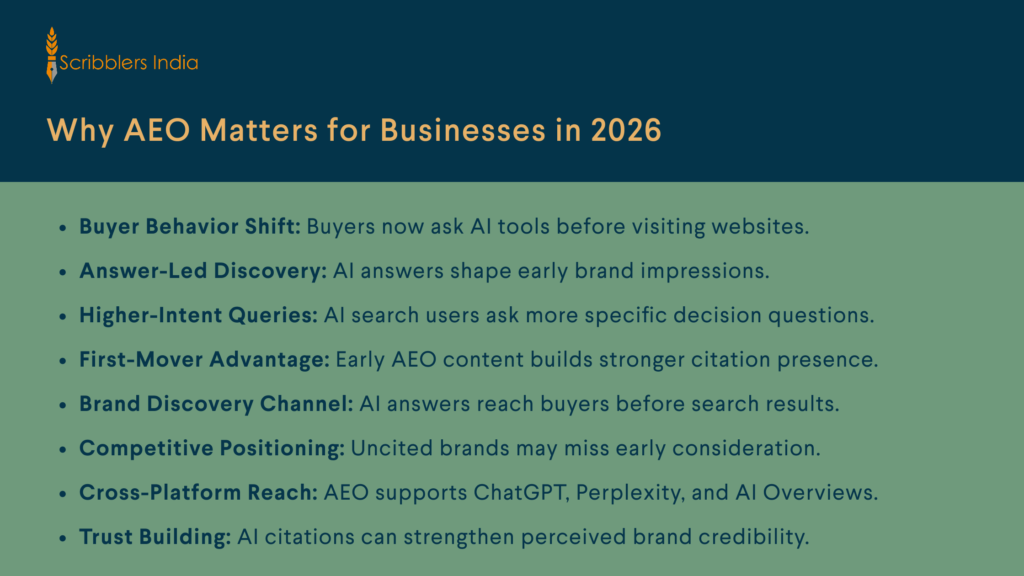
Businesses need an AEO strategy because answer-led search now influences discovery before a website visit occurs. Buyers can research categories, compare providers, or address objections in a single generated response. Brands need useful content that supports these conversations while preserving strong SEO foundations and accurate public positioning.
Google now explicitly recognizes AEO and GEO as terms used for AI search visibility work. However, its guidance states that established SEO practices still support generative search because AI features use core ranking systems, retrieval, and indexed web content.
A 2026 study of 55,393 trending queries found AI Overviews appeared for 64.7% of question-form searches. Nearly 30% of cited domains did not appear within the accompanying first-page results, suggesting that citation selection can differ from conventional ranking outcomes.
This does not mean businesses should chase every question or platform. The opportunity lies in answering commercially relevant prompts with distinctive evidence and clear positioning. A strong content strategy connects that visibility work with buyer needs and business outcomes.
How Should Businesses Research Prompts Before Creating AEO Strategy?
Prompt research identifies the real questions buyers ask across education, evaluation, implementation, and purchase decisions. It prevents teams from building AEO content solely around keyword variations. A strong prompt map connects user language with business value, suitable content formats, and measurable visibility goals across each buyer stage.
- Map the buyer journey: Group questions around problem discovery, category education, comparisons, implementation, objections, and final validation. This framework reveals whether existing content supports the complete journey or concentrates on broad informational demand without helping buyers evaluate available options.
- Use customer-facing inputs: Review sales calls, support tickets, discovery notes, customer interviews, and proposal discussions. These sources reveal detailed questions that keyword tools may miss, including concerns about costs, implementation effort, expected outcomes, and service suitability.
- Separate prompt intents: Distinguish definitional questions from comparison, recommendation, troubleshooting, and procedural prompts. Each intent needs a different content response. A definition page cannot replace a balanced comparison, while a service page cannot answer every implementation concern.
- Study query fan-out: Google explains that AI features may issue related searches across connected subtopics before producing an answer. Your research should therefore cover the main question and the supporting questions needed for a complete response.
- Score commercial importance: Prioritize prompts using buyer stage, business relevance, current visibility, content gaps, and authority potential. This step prevents broad educational questions from consuming resources that should be allocated to high-value comparison or decision-stage conversations.
Our content strategy services turn these findings into connected pillar pages, supporting articles, glossary assets, comparison resources, and refresh priorities. Every planned asset should close a defined information or visibility gap.
Which Content Types Should an AEO Strategy Prioritize?
Your AEO strategy should prioritize formats that answer complete questions and contribute distinctive evidence. The strongest mix depends on buyer intent rather than one universal template. Businesses should combine foundational explainers with decision-stage resources, original expertise, and proof assets that answer engines can retrieve for different research needs.
- Definition and glossary pages: Explain one important concept with a direct definition, relevant context, examples, and related terms. These pages support category education while helping answer engines connect the brand with clearly defined topics and entities.
- Comparison and alternative pages: Compare products, services, or approaches through fair decision criteria. Strong pages explain fit, limitations, implementation requirements, pricing factors, and use cases rather than relying on promotional scorecards that hide meaningful trade-offs.
- Implementation guides: Break complex processes into clear stages with practical instructions, prerequisites, risks, and expected outcomes. These assets support procedural prompts that require action rather than another surface-level explanation of the category.
- Original research assets: Publish surveys, benchmarks, audits, or proprietary observations that contribute information unavailable elsewhere. Original evidence gives publishers a clearer reason to cite the brand and gives readers a stronger basis for decisions.
- Case studies and proof pages: Explain the starting problem, intervention, evidence, and measurable outcome. These assets can support vendor evaluation prompts by showing how expertise works in practice rather than relying on unverified marketing claims.
- Expert explainers: Turn founder knowledge or specialist expertise into useful articles that address difficult questions. Expert-led content can clarify assumptions, challenge common advice, and introduce frameworks that generic summaries cannot reproduce credibly.
A 2026 cross-platform study found that high-influence cited pages often contain definitions, numerical evidence, comparisons, and procedural guidance. It also distinguished citation selection from citation absorption, where a source materially shapes the generated answer.
How Should Teams Structure AEO Content for Extraction and Trust?
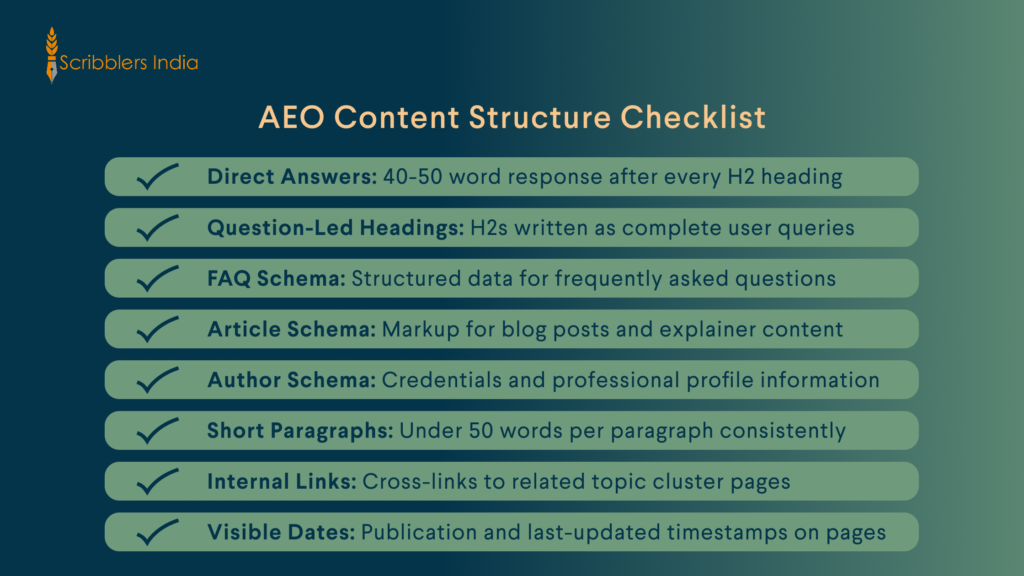
AEO content should give readers a complete answer before expanding into evidence, examples, or practical guidance. Clear structure helps answer engines identify useful passages, while strong context protects accuracy. Teams should design every section for human comprehension first and extraction second, rather than writing fragmented copy for machines.
- Open with a direct answer that addresses the H2 question before introducing background, examples, or supporting evidence.
- Use descriptive, question-led headings that communicate the section’s scope without forcing readers to interpret vague labels or marketing language.
- Keep each paragraph focused on a single connected idea while providing enough context to prevent misleading extraction or oversimplification.
- Place evidence beside claims so readers can verify statistics, quotations, comparisons, or recommendations without searching across the page.
- Use tables for structured decision-making when readers need to consistently compare options, metrics, stages, or evaluation criteria.
- Show authorship and update details where expertise, freshness, or accountability affects whether readers should trust the information.
- Connect related pages contextually through internal links that help readers explore definitions, services, comparisons, or supporting evidence.
Google recommends clear organization and useful, non-commodity content, but it rejects the idea that pages need artificial “chunking” for AI systems. It also warns against creating many query variations primarily to manipulate generative responses.
Our AEO content services combine direct answers with evidence, context, and logical navigation. This approach improves answer readiness without reducing detailed topics into disconnected paragraphs written only for retrieval systems.
How Should Technical SEO Support AEO Planning?
Technical SEO makes AEO content available for retrieval before writing quality can influence selection. Pages need crawlable text, stable URLs, indexability, and snippet eligibility across Google Search. Other answer platforms may use separate crawlers, so teams should review access controls and referral tracking for every priority discovery channel.
Google states that pages must be indexed and eligible for search snippets before they can appear within generative Search features. Crawlability, JavaScript accessibility, canonical signals, and overall page experience therefore remain relevant parts of AEO planning.
Google also states that no special schema, AI text file, or llms.txt implementation is required for its generative features. Structured data can still support eligible rich results, but teams should never treat schema as a direct guarantee of citation.
ChatGPT Search uses OAI-SearchBot for web discovery. OpenAI states that publishers that allow this crawler can identify referrals via the utm_source=chatgpt.com parameter, which supports platform-specific traffic analysis in analytics tools.
Technical reviews should therefore confirm crawler access, indexability, visible text, canonical accuracy, mobile usability, and analytics configuration. These checks establish the eligibility and measurement foundations, while content quality determines whether a page provides sufficient value for selection.
How Should AEO Work Alongside SEO and GEO?
SEO, AEO, and GEO should operate as a single, connected visibility program with distinct responsibilities. SEO supports discovery and indexation. AEO improves answer extraction, while GEO strengthens source authority across owned and external channels. Shared planning prevents conflicting messages and connects rankings with citations, mentions, and business outcomes.
- SEO establishes eligibility: Technical access, indexing, useful pages, internal links, and search demand remain essential. A page that cannot be discovered or understood through search systems has limited opportunity to support answer-led experiences.
- AEO improves answer readiness: Direct responses, clear section scope, supporting evidence, and practical detail help content answer specific questions. AEO planning focuses on whether the page efficiently and accurately solves the user’s information need.
- GEO strengthens source authority: A well-rounded GEO strategy extends beyond owned pages to include external references, founder expertise, research, and credible public sources. These signals help generative systems validate entities, claims, and category associations.
- Shared governance ensures consistency: Marketing, SEO, editorial, brand, and subject-matter experts should use a single positioning framework. Conflicting service descriptions or outdated proof can weaken answer accuracy even when individual pages perform well.
Google considers AEO and GEO part of the broader search experience rather than replacements for SEO. Businesses should therefore connect established search practices to answer structure and external authority rather than creating isolated optimization teams.
How Can Brands Build Authority Beyond Their Own Website?
Answer engines evaluate more than a company website when describing brands or recommending providers. External articles, credible reviews, expert profiles, public discussions, and partner sources can strengthen understanding of the entity. Brands should build genuine authority around topics they can support with experience, evidence, and consistent public positioning.
- Publish original research: Surveys, benchmarks, market analyses, and structured audits can give journalists or industry writers useful evidence to reference. The research must disclose methodology and limitations so external coverage can represent the findings accurately.
- Develop founder expertise: Consistent thought leadership content helps connect a founder with defined category themes. Strong perspectives should reflect genuine experience, useful frameworks, or informed disagreement rather than generic commentary written only for visibility.
- Earn relevant coverage: Digital PR, partner contributions, podcast discussions, or expert quotations can expand the brand’s public evidence base. Quality matters more than volume because unrelated mentions rarely clarify expertise or service positioning.
- Maintain entity consistency: Founder profiles, company descriptions, author biographies, service pages, and external interviews should explain the brand consistently. Conflicting language can make it harder for readers or answer systems to understand what the business does.
External authority should come from useful expertise and legitimate relationships rather than manufactured forum activity or fabricated reviews. Our personal branding services and ghostwriting services help founders publish credible expertise without losing their natural voice or category focus.
How To Measure The Performance of Your AEO Strategy?
Measuring the success of your AEO strategy requires multiple metrics, as no single metric captures answer-led visibility. Teams should track presence, source selection, accuracy, stability, and commercial influence across fixed prompts over time. The reporting method must preserve consistent platforms, competitors, locations, and review periods so later changes support dependable decisions.
| Metric | What It Measures | Review Cycle | Business Question |
| Prompt coverage | Visibility across tracked buyer questions | Quarterly | Which buyer conversations remain uncovered? |
| Brand mention rate | Answers that name the brand | Monthly | How often do relevant answers include us? |
| Citation rate | Answers linking to owned pages | Monthly | Which pages earn source visibility? |
| Citation influence | How much a source shapes an answer | Quarterly | Are cited pages contributing meaningful evidence? |
| Answer accuracy | Correctness of brand descriptions | Monthly | Do platforms describe the brand properly? |
| AI share of voice | Visibility compared with competitors | Monthly | Which brands lead priority conversations? |
| Recommendation position | Placement inside suggested shortlists | Monthly | Where does the brand appear during evaluation? |
| Citation stability | Repeat appearance across tests | Monthly | Are visibility gains remaining consistent? |
| AI referral quality | Visits from identifiable AI platforms | Monthly | Which platforms send useful traffic? |
| Conversion contribution | Leads or actions influenced by AI discovery | Quarterly | Does visibility support commercial outcomes? |
Google introduced dedicated Search Console views for impressions within generative AI features during June 2026. Teams can use these reports for Google visibility while maintaining separate prompt-level measurement for ChatGPT, Perplexity, or other platforms.
Citation counts also need context. Research shows that a source may receive a citation without contributing meaningful language or evidence to the answer. AEO performance should therefore distinguish simple source selection from actual answer influence.
An AI search visibility scorecard can consolidate these measures into a single review process without obscuring the individual signals behind the composite score.
What 90-Day AEO Strategy Roadmap Should Brands Follow?
A 90-day AEO roadmap should begin with measurement, then move into content improvement and authority development. Each phase needs defined owners, priority prompts, and expected outcomes. Teams should avoid rewriting every page, as focused work on commercially valuable questions usually yields stronger learning and faster operational progress.
- Days 1–15, establish the baseline: Select priority platforms and build a fixed prompt library around buyer stages. Record mentions, citations, competitors, answer accuracy, source ownership, and referral data before making any content changes.
- Days 16–30, complete the readiness audit: Review high-value pages for technical access, direct answers, source gaps, outdated claims, weak internal links, and unclear entity signals. Rank improvements using business value and expected visibility impact.
- Days 31–60, improve priority assets: Refresh existing pages before creating unnecessary new ones. Add clear answers, stronger evidence, better comparisons, current examples, and supporting internal links. Create missing pages only when the audit confirms a genuine content gap.
- Days 61–90, strengthen authority and remeasure: Publish expert-led assets and pursue credible external contributions around priority themes. Repeat the original prompt tests under comparable conditions, then compare performance against the baseline and document remaining weaknesses.
The first 90 days should focus on creating a working measurement system rather than on results. Each review cycle should improve the prompt library, content roadmap, authority plan, and reporting process without unnecessarily changing historical methods.
What Common Mistakes Can Weaken Your AEO Strategy?
Weak AEO strategies usually fail through poor research, generic content, technical barriers, or inconsistent measurement. Many teams also chase unsupported tactics instead of strengthening useful pages. A disciplined review should separate structural problems from authority gaps, then assign the right fix to each confirmed visibility weakness.
- Treating AEO as separate from SEO creates pages that answer questions but lack indexing strength, authority, or internal support.
- Creating pages for every prompt variation produces repetitive content that adds little value and weakens editorial quality.
- Chasing unsupported technical hacks distracts teams from crawlability, useful evidence, accurate entities, and strong reader experiences.
- Publishing commodity summaries at scale gives answer engines little reason to select one brand over stronger original sources.
- Measuring one prompt once turns normal answer variation into misleading conclusions about progress, competitors, or citation losses.
Google specifically advises publishers to ignore special AI markup, artificial chunking, or inauthentic mentions for generative Search. Its guidance prioritizes technical accessibility and unique content that readers find useful.
A practical AEO program should diagnose why a page remains absent before rewriting it. Targeted repairs can outperform generic optimization because different citation failures require different content, technical, or authority responses.
How Can Scribblers India Help Build Your AEO Strategy?
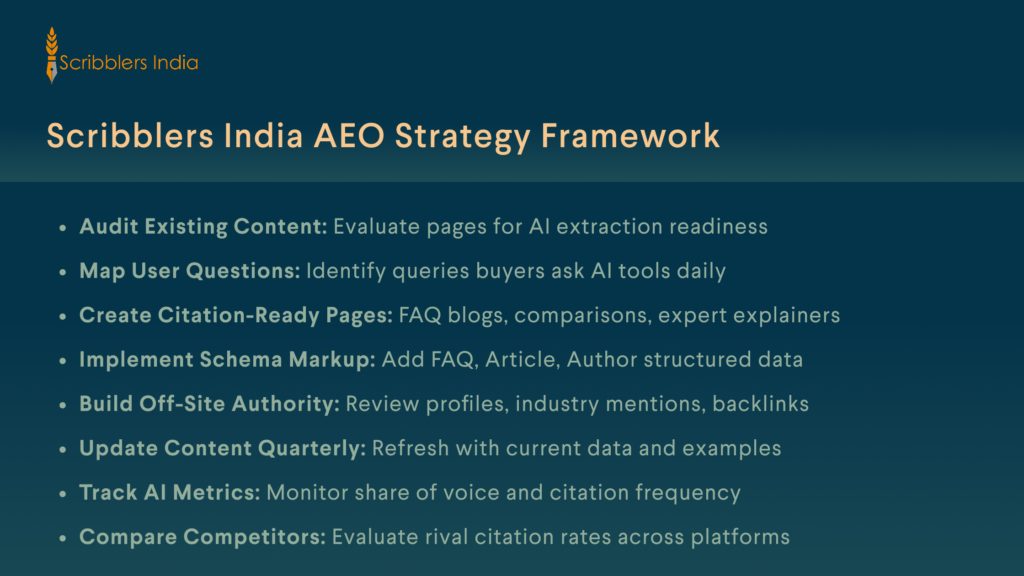
Scribblers India turns AEO strategy into an operational content program. We connect buyer questions with answer-ready pages and credible authority. Each service supports measurable improvements across search visibility, citations, brand accuracy, and commercial discovery for growing businesses.
- AEO visibility audits: Priority prompts, current citations, competitor presence, answer accuracy, source ownership, and technical eligibility form the basis of our audit. The findings establish a measurable baseline and identify which pages or authority signals require focused improvement first.
- Prompt-led content strategy: Buyer questions across education, comparisons, objections, implementation, and decision validation shape the content roadmap. Our content strategy services turn these findings into connected pillars, supporting assets, and practical editorial priorities aligned with visibility goals.
- Answer-ready content creation: Glossary pages, comparisons, service pages, research-led blogs, and detailed guides are developed around specific buyer questions. Our AEO services combine direct answers with credible evidence, useful context, and strong editorial flow across every priority asset.
- Authority-led brand content: Founder expertise becomes original research, bylines, informed commentary, and practical frameworks through our editorial process. Our thought leadership and personal branding programs strengthen associations with public topics beyond owned pages and promotional service descriptions.
- Ongoing performance optimization: Repeatable reviews track prompts, citations, answer accuracy, competitor movement, and referral quality across reporting periods. Confirmed gaps then guide content refreshes, internal linking changes, authority development, or new asset creation across future planning cycles.
Book a 1:1 consultation with our team to build an evidence-led AEO strategy that connects useful content, credible authority, technical readiness, and measurable visibility across Google Search and AI answer platforms.
FAQs
How Long Does an AEO Strategy Take to Work?
An AEO strategy can show early changes after priority pages are crawled and tested across relevant prompts. Broader gains often require several review cycles because authority, citations, and entity consistency develop over time. The timeline depends on technical access, the quality of existing content, competition, and how quickly teams implement confirmed improvements.
Is AEO Different From GEO and Traditional SEO?
SEO helps pages become discoverable and competitive within traditional search results. AEO improves how content answers questions, while GEO strengthens authority across owned and external sources used by generative systems. Businesses need one connected program because indexing, extraction, source selection, and brand recognition influence different parts of the same discovery journey.
Which Pages Should Businesses Optimize for AEO First?
Start with pages that already support valuable buyer questions or receive meaningful search impressions. Service pages, comparison guides, glossary entries, implementation resources, and strong educational articles often deserve priority. Updating proven assets can accelerate learning because teams already understand their audience, performance history, and commercial role on the website.
Does Schema Markup Improve Answer Engine Visibility?
Schema can help search engines understand eligible content and support rich results when the markup matches the visible information. However, Google states that no special structured data is required for generative AI search. Treat schema as a supporting SEO practice rather than a shortcut that guarantees citations, mentions, or inclusion in answers.
How Many Prompts Should an AEO Plan Track?
There is no universal prompt count for every AEO strategy. Start with a balanced library covering buyer education, comparisons, use cases, objections, and decision validation across priority services. A smaller set with clear commercial relevance provides better insight than hundreds of repetitive prompts that create measurement work without guiding useful content action.
Can Small Businesses Benefit From AEO Content?
Small businesses can build AEO visibility by answering narrow questions with stronger detail than broad competitor pages. Focused expertise, clear evidence, useful examples, and credible external mentions can enhance visibility in valuable niches. Start with questions aligned with genuine strengths, then expand after repeated testing confirms stable progress in those areas.
How Often Should Businesses Refresh AEO Content?
Review priority AEO pages quarterly and monitor fast-changing topics more frequently. Refreshes should correct outdated facts, strengthen direct answers, add useful evidence, and improve internal links where reader needs have changed. Teams should update content after confirming gaps rather than rewriting strong pages whenever a single citation or answer changes.
Which Tools Can Measure AEO Performance?
Use Search Console for Google visibility, analytics for identifiable AI referrals, and structured prompt tracking for mentions or citations across other platforms. Third-party tools can scale monitoring, but teams must review their sampling methods and scoring rules. Manual accuracy checks remain important because automated counts can miss misleading descriptions or weak recommendation context.