

Google AI Mode has rewritten how users interact with search, and its visibility now determines which brands enter the consideration set. Buyers type long questions rather than short keyword phrases. Google reads each prompt, breaks it into subtopics, and synthesizes a response from multiple sources at once.
According to Google, AI Mode has surpassed 1 billion monthly active users globally, and AI Mode queries run longer than traditional Search queries. That growth has reshaped what counts as useful content for Google search across every industry vertical we work with today.
Brands that still write for single keywords lose visibility within these AI Mode answers. Brands that write for full questions and complete decision journeys win more citations across the subqueries AI Mode generates from every user prompt during a research session.
This requires a broader AI search visibility strategy that connects content structure with the prompts buyers use throughout their research. This blog covers the ten content formats that win the most Google AI Mode citations across the audits we run for SaaS, services, and B2B brands in 2026.
TL;DR
|
What Is Google AI Mode and How Does It Work?
Google AI Mode is an AI-powered search experience built on Gemini that handles long, conversational queries. It breaks each prompt into smaller subtopics, runs parallel searches, and combines results into a synthesized answer. Users can ask follow-up questions inside the same session.
- AI Mode lives in a separate tab in Google Search and handles queries that require reasoning, comparison, or planning depth.
- The experience supports text, voice, and image inputs, letting users mix media across layered questions about location, style, or fit.
- AI Mode does not show a list of blue links; instead, it displays a single synthesized answer plus a small set of cited sources.
- The brands cited in the answer gain visibility even when no clicks occur, which shifts the entire content ROI model.
- Follow-up questions hold session context, so AI Mode keeps refining answers as users add constraints or shift research direction.

Why Is AI Mode Different From Regular Google Search?
AI Mode answers the broader intent behind a query instead of presenting only a ranked list of pages. It synthesizes information from multiple sources, so Content built only for traditional rankings may need AEO optimization before it can perform consistently within AI-generated answers.
| Comparison area | Regular Google Search | Google AI Mode |
| Query length | Queries typically contain three to four words and often target a specific keyword or topic. | Queries may reach 70 to 80 words because users can ask detailed, conversational questions. |
| Response format | Google displays ranked links, snippets, and other search features that encourage users to visit external pages. | AI Mode produces a consolidated answer that addresses the question by synthesizing information from multiple sources. |
| Source selection | Pages are primarily ranked using established SEO signals, including relevance, authority and technical performance. | Sources may be selected for their ability to answer individual subtopics, even when they do not rank on page one. |
| User journey | Users move between search results and websites as they research different aspects of a topic. | Users can continue asking follow-up questions and move from research to evaluation within the same interaction. |
| Visibility outcome | Visibility is commonly measured through rankings, impressions, clicks, and website sessions. | Visibility may come from a brand mention or citation within the generated answer, even when the user does not click. |
| Content requirements | A focused page can rank when it matches a target keyword and satisfies the immediate search intent. | Comprehensive content performs better when it answers the main question and covers the related subtopics AI Mode may investigate. |
What Are the 10 Content Formats That Perform Best in Google AI Mode?
Ten content formats consistently win the most Google AI Mode citations across the audits we run for SaaS, services, and B2B brands. Each format answers a specific type of subquery generated by AI Mode through query fan-out. Together, they cover the prompt journey from research through decision across every category we work in.
1. Detailed Explainers
Detailed explainers cover a topic from definition to use case in a single comprehensive resource. They answer the core question and the follow-up questions readers would ask next. AI Mode favors these pages because they satisfy several subtopics from a single source.
A good explainer covers what the topic means, why it matters, how it works, and where it applies. It includes named entities, current examples, and clear sections. Brands publishing explainers as central hub pages earn citations across many Google AI Mode answers in the same category over time. For founder-led brands, these explainers can also support a broader thought-leadership content strategy by turning specialist knowledge into accessible category education.
2. Step-by-Step Guides
Step-by-step guides walk readers through a process in clear, ordered stages. AI Mode pulls from these pages when users ask how-to or process questions. The structure helps the engine extract clean, citation-ready instructions across procedural prompts.
A structured AEO content strategy can help identify the process questions, prerequisite queries, and follow-up prompts each guide should answer. Each step uses a short heading, a clear instruction, and a brief example. Pages following this format appear across procedural prompts where users search for setup, configuration, or onboarding help within their workflow.
3. Comparison Content
Comparison content covers how two or more options differ on price, features, use cases, and support. Google AI Mode relies on these pages to answer middle-funnel prompts. Users often ask questions such as “X versus Y for small teams” or “alternatives to X for enterprise scale”. These pages are more effective when they are part of a broader GEO optimization strategy that covers evaluation- and purchase-stage prompts.
Strong comparison content uses structured tables, balanced commentary, and named use cases. Pages that compare options honestly earn citations, even when prompted to name competitors directly. Brands skipping comparison content hand the category narrative to aggregator sites that cover comparisons in greater depth and with greater credibility.
4. Decision-Support Pages
Decision-support pages help readers choose between options based on their own context. They blend frameworks, scoring criteria, and use-case mapping into a single resource. Google AI Mode prefers these pages because decision-stage users ask layered questions with many constraints.
A decision-support page covers buyer goals, evaluation criteria, decision frameworks, and recommendations by user type. These pages perform across prompts such as “best CRM for a 10-person agency” or “right project tool for a remote team”. Few brands publish them, leaving wide opportunity across every category.
5. Original Research Reports
Original research reports give AI Mode the proprietary data it favors when answering trend and benchmark queries. Surveys, audits, and proprietary datasets earn citations in hundreds of related prompts because no other sources can replicate the data as quickly. Original studies also strengthen thought leadership positioning because they give executives proprietary evidence to contribute to industry conversations
A single research report can drive Google AI Mode visibility across an entire category for years. Brands publishing quarterly studies become the default source AI Mode pulls from when users ask category questions. The investment compounds because each citation strengthens future visibility across follow-up subqueries.
6. Definitions and Glossary Pages
Glossary entries and definition pages perform strongly inside AI Mode when users ask “what is” style questions across categories. Google AI Mode pulls clean, concise definitions from well-structured glossary pages and uses them inside the opening lines of synthesized answers.
A useful glossary entry covers the definition, the context, the use case, and the related terms. Each entry runs 200 to 400 words and links to related glossary items. Brands publishing category glossaries become the source AI Mode uses for educational subqueries across thousands of prompts.
7. Case Studies With Named Outcomes
Case studies with named outcomes give Google AI Mode the real-world proof it needs for outcome-focused queries. They cover the client’s situation, the work delivered, and the measurable results with verifiable detail throughout the entire engagement.
AI Mode rewards case studies because they ground claims in named brands and specific numbers. A page describing how a named client achieved a specific outcome becomes citation-ready for prompts asking about results, ROI, or before-and-after stories across the category your brand serves directly.
Brands without internal writing resources can use professional ghostwriting services to turn interviews, project records, and client outcomes into credible case-study narratives.
8. FAQ Hub Pages
FAQ hub pages collect 15 to 30 related questions on one topic with clean, direct answers under each heading. AI Mode favors these pages because they map cleanly to the subqueries generated through query fan-out across long user prompts.
Each FAQ entry runs 50 to 80 words with a direct answer in the first sentence. Schema markup helps Google AI Mode extract entries cleanly. Brands publishing FAQ hubs see citation lifts in follow-up subqueries that single-topic blogs never achieve within the same AI Mode session.
9. Topic Cluster Hub Pages
Topic cluster hubs organize 8 to 20 related blog posts under a single pillar page, with clean internal links throughout the cluster. AI Mode rewards this structure because the engine signals topical authority to brands covering subjects from many angles in one place.
A strong hub page introduces the topic, links to supporting blog posts, and summarizes the key subtopics within the cluster. Google AI Mode treats hub pages as authoritative entry points and pulls citations from both the hub and the supporting blogs across related subqueries.
10. Updated Pricing and Plans Pages
Pricing pages with clear plan details, feature breakdowns, and use-case fit give AI Mode the commercial data it needs to support shortlist queries. Google AI Mode references these pages when users ask cost, plan, or value questions during decision-stage research sessions.
A useful pricing page covers each plan, its features, the ideal customer profile, and the value drivers. Updated annually with current pricing and feature lists, these pages become reliable sources AI Mode pulls from when handling decision-stage prompts comparing your brand against alternatives.
How Should Brands Write for Prompt-Led Search Journeys?
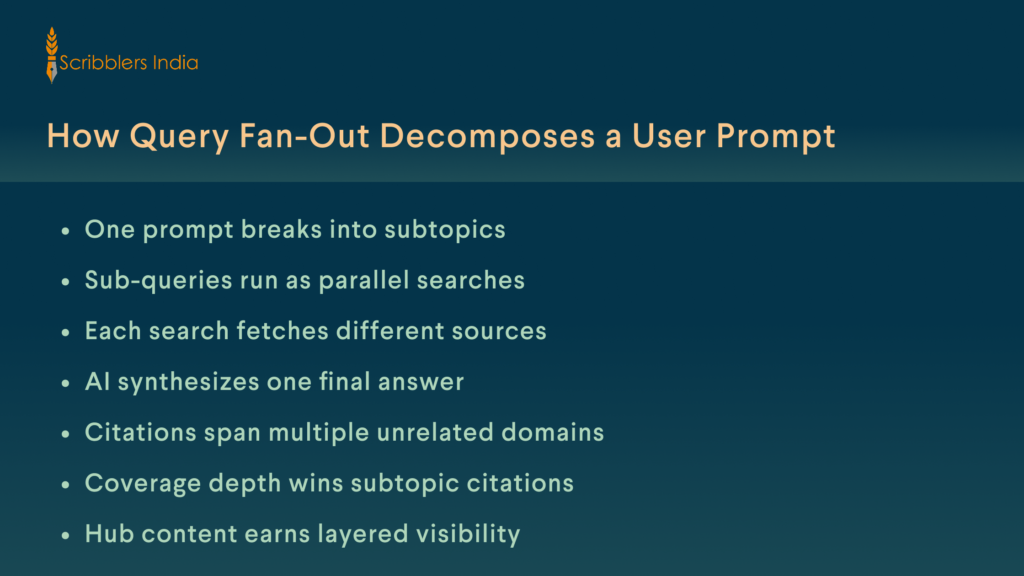
Brands should write for prompt-led search journeys by mapping the full set of subtopics users ask about, structuring content around those subtopics, and answering each one directly. AI Mode breaks every prompt into smaller queries using query fan-out. Content that covers the fan-out wins more citations than content built around a single keyword.
Understanding query fan-out shapes every writing decision.
- Map subtopics before writing: Build a list of the 8 to 15 subtopics AI Mode might generate for your priority prompts. This becomes the writing brief. Each subtopic gets a clear answer either within the article or in a linked cluster.
- Write modular sections: Each H2 should answer one subtopic in 200 to 300 words. A modular structure helps AI Mode pull clean citations even when context is lost between user follow-ups within the session.
- Anticipate follow-up questions: Users keep asking inside the same AI Mode session. Add sections answering the next question your buyer would ask. This earns repeat citations across the user journey.
- Use clear entity language: Google AI Mode reads named brands, tools, frameworks, and concepts. Write the brand names, the product names, and the specific technical terms in full. This matters particularly for founder-led companies, where a clear personal branding strategy helps search systems connect individual expertise with the company and its subject area.
- Link across the cluster: Internal links signal topical depth to AI Mode. A hub page linking to supporting blogs across subtopics earns layered visibility for the subqueries within a single user session.
How Can You Turn These Formats Into Measurable AI Mode Visibility?
You can turn these formats into measurable AI Mode visibility by tracking citation count, prompt coverage, share of voice, and subquery presence across your priority topics. Traditional analytics tools miss these signals because they track sessions rather than citations inside synthesized answers across AI Mode sessions.
| Format Type | Quick Fix | Impact on AI Mode |
| Explainers and guides | Add direct 40-60 word answers after each H2 | Improves clean subquery extraction |
| Comparison content | Build structured comparison tables with named alternatives | Wins middle-funnel citations |
| Decision pages | Add scoring frameworks and user-type recommendations | Captures decision-stage queries |
| Glossary entries | Publish 20+ definitions with schema markup | Lifts educational subquery coverage |
| Topic clusters | Link supporting blogs under one hub page | Signals topical authority to engine |

What Mistakes Weaken Brand Visibility in Google AI Mode?
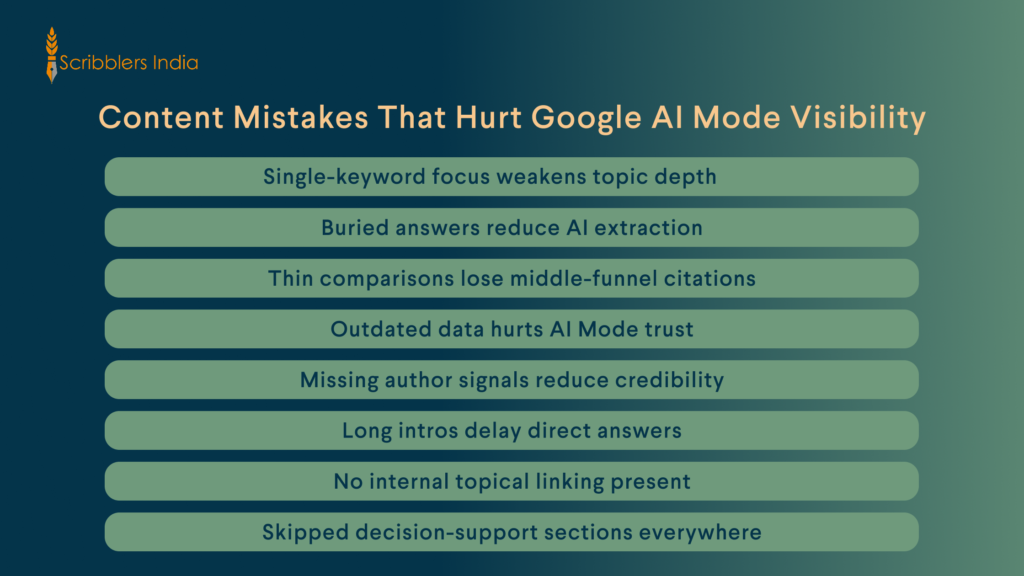
Common mistakes that weaken AI Mode visibility include thin content, single-keyword focus, weak structure, and missing decision-support sections. These mistakes reduce the chance of being picked when AI Mode runs its subqueries. Fixing them lifts citation share across the prompts your buyers use during research and purchase journeys.
Each mistake feeds the next. Single-keyword writing leads to thin topic coverage, which hides direct answers, which weakens entity signals. The fix begins with treating subtopic coverage as the new content brief baseline across every blog and service page your brand publishes.
- Single-keyword writing: Pages built around one keyword fail to cover the subtopics AI Mode generates from real user prompts. Map full topic coverage before writing each blog or service page across your content library.
- Buried direct answers: Many pages bury the answer under long introductions or scene-setting paragraphs. AI Mode needs direct answers near every heading. Place the core answer in the first 40 to 60 words of each section.
- Missing comparison depth: Vague comparisons hurt middle-funnel citations across every category. AI Mode favors pages with structured tables, named alternatives, and balanced commentary on price, scope, and use cases.
- Outdated data and examples: Old stats and stale case examples erode trust in AI Mode over time. Refresh data quarterly and update examples to reflect the current market state your buyers care about today.
- No author or expertise signals: AI Mode reads named authors and credentials carefully. Pages without bylines or author bios lose citations to sources that clearly demonstrate who wrote the content and why they have authority.
How Does Scribblers India Help Brands Create AI Mode-Ready Content?
At Scribblers India, we help brands plan, write, and refine content that performs in Google AI Mode and other AI search platforms. Our work blends content strategy, AEO planning, GEO development, and topic cluster building. We start with research and end with content libraries that earn citations.
We work with founders, SaaS teams, agencies, and service brands that want measurable AI Mode visibility. Each engagement begins with a prompt audit across your category. We map the subqueries AI Mode generates from your priority prompts and design content that covers each subquery with the right depth.
- AI Mode content strategy and mapping: We study the prompts your buyers use, map the subtopics AI Mode generates from those prompts, and build a content plan covering each subtopic with the right depth and structure.
- Modular blog content for prompt-led search: We write blogs with clear H2s, direct answers, and short paragraphs. Each section answers a single subtopic cleanly, helping AI Mode pull citations from many user questions in the same session.
- Comparison and decision-support content: We build comparison pages, alternatives content, and decision frameworks for middle and bottom-funnel prompts. These pages capture citations that aggregator sites usually win across your category today.
- Topic cluster planning and internal linking: We design topic clusters built around hub pages, supporting blogs, and clean internal links. This structure signals topical authority, which improves your share of voice across AI Mode answers.
- Content audits and refresh cycles: We audit existing pages, identify content gaps in subtopic coverage, and rebuild weak sections. This refresh work lifts citation share without rewriting your entire content library from scratch.
Get in touch with our team to build content ready for Google AI Mode visibility.
FAQs
How does Google AI Mode pick which sources to cite?
Google AI Mode selects sources based on their ability to answer specific subtopics within the larger user prompt. The engine runs parallel searches across subqueries and pulls citations from pages that offer the cleanest answer for each subquery. Content depth, modular structure, and entity clarity matter more than traditional ranking position when the engine selects its citation sources.
Will AI Mode replace traditional Google Search results?
AI Mode runs alongside traditional search rather than replacing it across most query types. Users choose AI Mode for research, comparison, and planning queries while sticking with classic search for navigational or simple factual lookups. Both surfaces will coexist for years, so brands need content strategies that perform well across blue-link rankings and AI Mode citations.
How long should content be to win AI Mode citations?
Content length matters less than subtopic coverage and modular structure inside AI Mode. A 1,500-word blog covering several subtopics with clear H2 sections can outperform a 4,000-word page with weak structure. Focus on covering the subqueries AI Mode generates from your priority prompts, then write the depth each subtopic genuinely needs.
Does AI Mode use the same ranking factors as regular Google Search?
AI Mode shares some signals with regular Google Search yet weighs them differently across query types. Page experience, entity clarity, and content depth all matter for both. AI Mode places greater emphasis on direct answers, a modular structure, and subtopic coverage because the engine needs extractable answers rather than ranked links during synthesis.
Can small brands compete with large brands in Google AI Mode?
Yes, small brands compete strongly in Google AI Mode when their content demonstrates clear expertise and comprehensive subtopic coverage. Domain authority matters less than entity clarity and answer quality inside AI Mode. A small brand with sharp comparison content and decision-support pages can earn citations on prompts where larger competitors fail to appear in answers. Consistent thought leadership content and visible subject-matter expertise can further strengthen this advantage.