
A modern content marketing guide should help brands earn attention across search results, AI answers, professional platforms, and owned channels. It must connect buyer questions with useful content, credible expertise, and measurable business goals. Publishing more articles without this system usually creates cost without durable visibility.
Buyer research now moves between Google Search, ChatGPT, AI Overviews, newsletters, videos, and trusted professional voices. Prospects may compare providers or test objections before visiting any company website. Your content must therefore influence discovery before the first direct interaction.
This guide explains how to research audience needs, select formats, structure AEO content, strengthen authority, distribute ideas, and measure business value. It treats content marketing as a connected operating system rather than a publishing calendar. Use it to plan campaigns, refresh existing assets, or evaluate agency support.
TL;DR
|
Why Does Your Brand Need a Fresh Content Marketing Guide?
Your brand needs an updated content marketing guide because discovery, evaluation, and conversion now happen across several connected surfaces. Traditional rankings remain valuable, yet buyers increasingly use AI-generated answers during research. Content must therefore earn attention, provide evidence, and support decisions before a website visit occurs.
AI Search Has Become a Buyer Research Channel
Forrester reported that 94% of B2B buyers used AI during their purchase process in its 2025 Buyers’ Journey Survey. Buyers also rated generative AI or conversational search above many traditional information sources. This behavior places content inside earlier discovery and evaluation stages. Your content must answer the questions buyers ask before they know your brand. It should also clarify which problems you solve and where your offer fits.
Generative Search Has Reached Mainstream Scale
Google reported more than 2.5 billion monthly active users for AI Overview by May 2026. AI Mode also passed one billion monthly users within its first year. These experiences now represent a major layer within Google Search rather than a niche experiment. This growth does not remove the value of SEO. It increases the need for useful, indexable, and source-worthy pages.
Click Patterns Are Becoming Less Predictable
Pew Research found that users clicked on conventional results in 8% of visits that included an AI summary. The rate reached 15% when no summary appeared. The March 2025 analysis shows why traffic alone can no longer measure content influence. Brands also need visibility metrics covering citations, accurate mentions, branded searches, and assisted conversions.
Trust Requires Verifiable Expertise
Generic articles can explain common knowledge, yet they rarely prove why a specific brand deserves attention. Buyers need informed opinions, current examples, and transparent evidence. Your content marketing strategy should transform internal expertise into useful public assets. These assets can include research reports, detailed guides, founder commentary, case evidence, and clear service explanations.

What Should a Content Marketing Guide Include for AI Search Visibility?
For AI search visibility, a practical content marketing guide should define business goals, audience needs, editorial positioning, content formats, distribution, governance, and measurement. It should explain why each asset exists and how it supports the buyer journey. Without these foundations, a publishing calendar becomes activity rather than a business strategy.
| Content System Element | Core Question | Expected Output |
| Business goals | What commercial outcome should content support? | Defined objectives and success measures |
| Audience research | Which questions shape buyer decisions? | Buyer needs and objection map |
| Editorial positioning | Which ideas should the brand own? | Clear point of view |
| Content gap analysis | What is missing or underperforming? | Prioritized refresh and creation plan |
| Format planning | Which asset suits each intent? | Funnel-based content portfolio |
| Search planning | How will users discover the content? | SEO and prompt research |
| Distribution | Where should each idea travel? | Channel-specific promotion plan |
| Conversion design | What should readers do next? | Relevant internal links and CTAs |
| Governance | Who reviews facts and positioning? | Editorial ownership workflow |
| Measurement | What shows meaningful progress? | Reporting framework and review cadence |
This framework turns content into a managed business asset. It also prevents teams from publishing disconnected pieces that compete for the same intent.
How to Build Your Content Marketing Guide Around Buyer Intent?
A well-rounded content marketing guide should feature questions buyers ask as they identify problems, compare options, validate claims, and make decisions. Search volumes reveal demand, yet they cannot explain the complete buying context. Teams need customer evidence before choosing topics, formats, or publication priorities.
Review Search and Prompt Behavior
Search Console, keyword platforms, People Also Ask results, and AI prompt tests reveal how people describe a topic. Group similar questions by intent rather than creating one page for every phrase. Google warns against producing many pages for minor prompt variations. Its systems can understand semantic relationships without exact keyword repetition.
Study Sales Conversations
Sales teams hear questions that rarely appear inside keyword platforms. Common examples include implementation concerns, pricing expectations, proof requirements, and doubts about switching providers. These insights often support comparison pages, objection articles, case studies, and service-page improvements.
Use Customer and Support Inputs
Customer interviews reveal why buyers selected the brand and which information influenced them. Support tickets show where existing explanations remain unclear. Both sources can improve onboarding content and help teams identify useful retention resources.
Analyze Competitor Coverage
Competitive research should identify gaps in information rather than duplicate topics. Review which questions competitors answer and which assumptions remain unsupported. A meaningful gap may involve stronger evidence, clearer examples, deeper implementation guidance, or a more useful decision framework.
Listen to Professional Communities
LinkedIn discussions, industry forums, reviews, and webinars reveal language used by practitioners. They also expose emerging concerns before those topics gain measurable search volume. Your content should respond to genuine conversations without manufacturing engagement or fabricated social proof.
How Should Brands Map Content to Buyer Intent?
Brands should map content to the decision a reader needs to make at each stage. Informational pages build understanding, while commercial assets support comparison. Transactional pages reduce barriers to action, and retention content improves customer outcomes. AI prompts may combine several intents into a single conversational request.
- Problem Discovery Content: Problem-led content helps buyers recognize a challenge before they know the solution category. It should explain symptoms, consequences, and possible approaches without forcing an immediate sales message. This includes diagnostic guides, checklists, research reports, and expert opinion articles.
- Category Education Content: Educational assets explain terms, models, processes, and market changes. Glossary pages and foundational guides work well when they add context beyond a short definition. These pages can also support internal links into deeper commercial content.
- Evaluation Content: Comparison pages, alternatives guides, case studies, and implementation resources support active evaluation. They should use fair criteria and acknowledge limitations. Promotional comparisons weaken trust by avoiding the trade-offs buyers need to understand.
- Decision Content: Service pages, pricing explainers, consultation pages, and proof assets support the final decision. They should clarify the process and expected next step. Strong conversion content reduces uncertainty rather than relying on exaggerated claims.
- Retention Content: Onboarding resources, newsletters, tutorials, and customer playbooks help buyers succeed after purchase. They can reduce the number of repeated support questions and encourage deeper product use. Retention content also creates evidence that prospects may find during research.
How Should SEO, AEO, GEO, and Content Marketing Strategy Work Together?
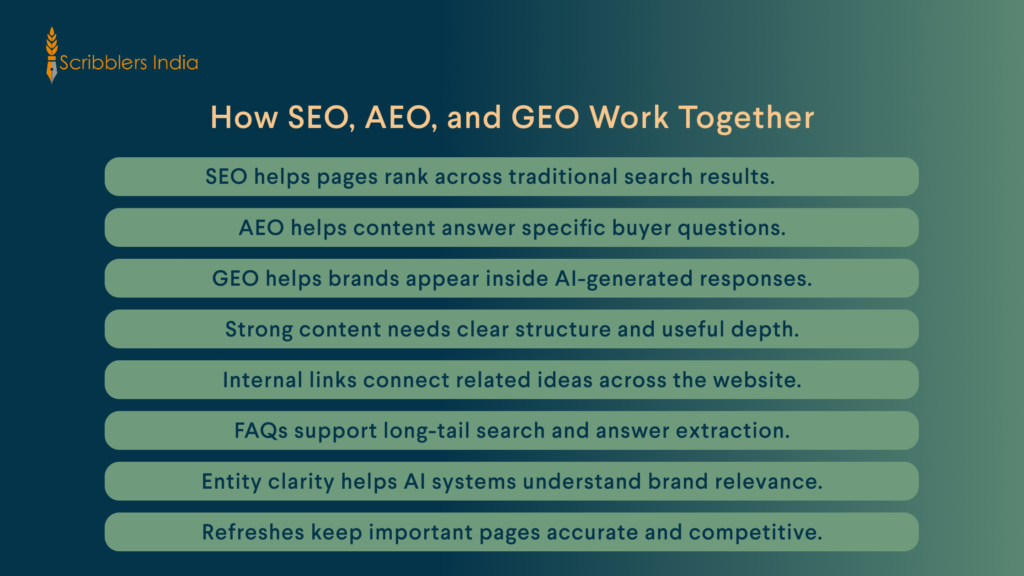
SEO, AEO, GEO, and content marketing strategy address different parts of the same discovery system. SEO supports indexation and organic visibility. AEO improves answer readiness, while GEO strengthens citations and entity authority. A comprehensive content marketing guide connects these disciplines with audience needs and measurable business priorities.
- SEO Builds the Discovery Foundation: SEO helps search systems find, process, and rank useful pages. It includes technical access, internal links, metadata, topic relevance, and page experience. Google confirms that established SEO practices remain foundational for generative features such as AI Overviews and AI Mode.
- AEO Improves Answer Readiness: Answer engine optimization helps content respond clearly to specific questions. Useful techniques include descriptive headings, direct explanations, focused tables, definitions, and contextual FAQs. Our answer engine optimization services preserve depth while improving clarity and extraction.
- GEO Strengthens Source Authority: Generative engine optimization improves how brands appear within generated answers across several platforms. It involves original evidence, entity consistency, credible external mentions, and source-worthy expertise. Brands must learn how generative engine optimization services can extend visibility beyond owned website pages.
- Content Strategy Connects the System: Content strategy determines which audience questions merit investment and which assets should answer them. It also assigns distribution, ownership, and performance measures. Without this layer, SEO and AI optimization can become disconnected technical exercises.
What Content Formats Should Your Content Marketing Guide Prioritize?
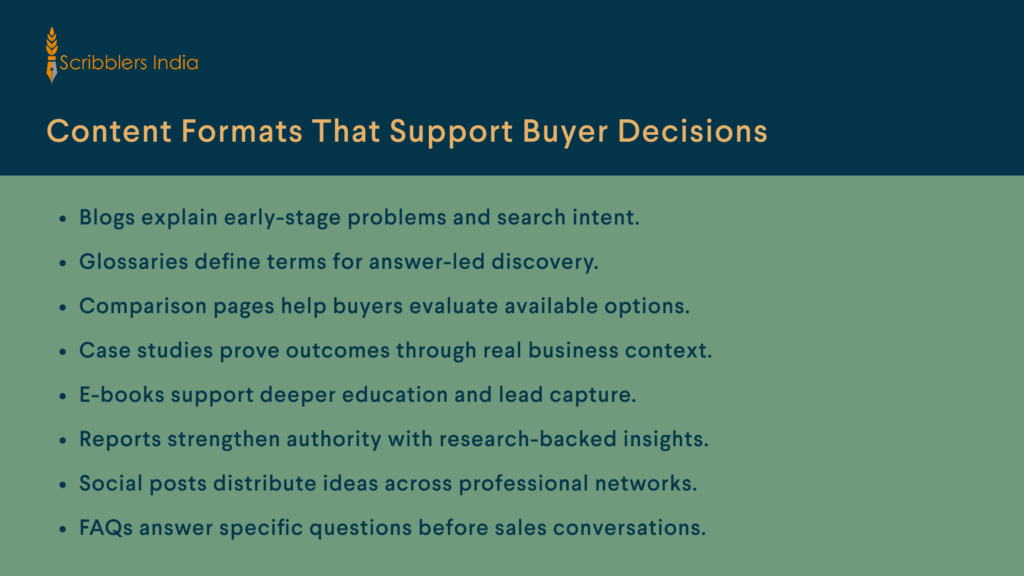
Brands should prioritize formats according to buyer intent, information depth, available expertise, and conversion goals. Blogs remain useful, yet they cannot support every decision alone. A balanced portfolio combines educational assets, commercial pages, original authority content, and distribution formats that reinforce the same strategic themes.
| Content Format | Best Use | Strategic Value |
| Pillar guides | Comprehensive category education | Establishes topic depth |
| Blog posts | Specific buyer questions | Expands topical coverage |
| Glossary pages | Definitions and terminology | Supports answer-led discovery |
| Service pages | Offer and process clarity | Converts commercial interest |
| Comparison pages | Vendor or approach evaluation | Supports shortlist decisions |
| Case studies | Proof and implementation context | Reduces perceived risk |
| Research reports | Original data and authority | Creates citation opportunities |
| E-books | Deep education or lead capture | Supports high-consideration buyers |
| Newsletters | Ongoing audience relationship | Builds owned distribution |
| Founder articles | Expert authority and perspective | Connects people with topics |
| Social content | Reach and repeated recall | Extends asset lifespan |
| Sales resources | Objection and stakeholder support | Improves buyer enablement |
Brands should avoid selecting formats because competitors use them. Each format needs a specific audience need and measurable role. For instance, professional ebook writing services can turn complex expertise into practical educational assets. However, gated content should provide more value than a standard blog.
How Should Brands Create Content That AI Search Can Use?
Brands should create content that answers real questions, contributes original value, and remains easy to navigate. AI search readiness does not require robotic writing or artificial paragraph fragments. Strong content combines direct explanations with supporting evidence, practical examples, useful visuals, and clear relationships between topics.
- Step 1 – Define the Page’s Job: Every brief should identify the intended reader and business goal. It should also define the question that the page must answer. Avoid asking one asset to educate beginners and close late-stage buyers simultaneously.
- Step 2 – Capture Expert Knowledge: Interview founders, customer-facing teams, and subject experts before drafting. Ask for examples and points of disagreement. Expert input gives the page ideas that generic research cannot provide.
- Step 3 – Build an Answer Architecture: Use complete question-led H2s where they match natural search behavior. Place a direct answer beneath each H2 before adding depth. The answer should remain useful when read independently, yet it must not oversimplify the topic.
- Step 4 – Add Evidence and Context: Support important claims through credible sources, original research, and real examples. Explain what each statistic means for the reader. Avoid adding data only to make the article appear researched.
- Step 5 – Design the Reader Journey: Use internal links where readers need supporting definitions or guidance on deeper evaluation. Add tables when they simplify structured decisions. The CTA should match the reader’s stage rather than forcing a sales call.
- Step 6 – Complete an Editorial Review: Check accuracy, sentence logic, source quality, brand positioning, and originality. Remove repetitive summaries and unsupported claims. Google recommends unique, non-commodity content rather than material that merely restates common online information.
What Makes Content Source-Worthy for AI Answers?
Source-worthy content gives answer systems information that is useful, verifiable, and difficult to replace with a generic summary. Original research creates one path, yet brands can also contribute strong definitions, expert frameworks, practical processes, and detailed comparisons. The value must come from substance rather than formatting alone.
- Distinctive Evidence: Surveys, internal benchmarks, anonymized customer data, and original analyses provide other publishers with reasons to reference the brand. Publish the methodology and limitations beside every major finding.
- First-Hand Expertise: A founder or practitioner can explain what works under specific conditions. Firsthand experience is valuable when the writer shares decisions and their consequences. Broad opinions without evidence rarely create the same authority.
- Useful Decision Frameworks: A framework should simplify a real choice without pretending that every situation follows a single formula. It can help readers compare options or diagnose problems. Naming a generic checklist does not make it original.
- Clear Factual Support: Definitions and statistics should point toward credible sources. Readers should understand which statement each source supports. Source visibility protects trust when AI systems summarize the material elsewhere.
- Consistent Entity Information: Company profiles, founder bios, service pages, and external contributions should describe the brand consistently. Conflicting language can create incorrect AI summaries. The same consistency should apply across thought leadership content and founder profiles.
How Should Content Distribution Work in the Era of AI Search?
Content distribution should begin during planning because each channel needs a different version of the core idea. Search supports durable discovery, while social platforms create faster reach. Email builds an owned audience, and sales distribution helps prospects evaluate decisions. External contributions can strengthen authority and source diversity.
- Search Distribution: Search distribution begins with indexing and internal links. Topic clusters should connect foundational explanations with comparisons, service pages, and proof assets. Refresh older pages that remain relevant but lack up-to-date evidence.
- Founder-Led Distribution: Founders can extend long-form insights through LinkedIn posts, interviews, newsletters, and bylines. Their content should add perspective rather than repeat the company blog. Our personal branding services align founder themes with wider brand positioning.
- Email Distribution: Email provides brands with direct access to subscribers without relying entirely on external algorithms. Use newsletters to share insights and customer lessons. Avoid sending every new blog without explaining why it matters.
- Sales Enablement: Sales teams can use comparisons, case studies, implementation guides, and objection resources during active conversations. Ask sales teams which assets they use and where buyers still request clarification.
- External Authority Distribution: Partner contributions, podcasts, expert quotes, and digital PR can broaden the network of sources for a topic. These channels work best when they share genuine expertise rather than promotional guest posts.
How Should Brands Decide Between Updating and Creating Content?
Brands should update an existing page when the topic remains valuable but the asset has weak answers, outdated evidence, unclear structure, or poor conversion paths. Create a new page when the search intent or audience need differs substantially. This decision prevents content duplication and protects existing search equity.
Refresh an Existing Page When:
- The page already receives impressions or qualified visits.
- The core search intent has remained stable.
- Evidence or examples have become outdated.
- Important buyer questions remain unanswered.
- Internal links or conversion paths need improvement.
- Competitors now provide clearer decision support.
Create a New Page When:
- The prompt represents a distinct search intent.
- The audience needs a different content format.
- The topic requires independent depth.
- The existing page would become unfocused.
- A new service or use case needs clear positioning.
- The content supports another buyer stage.
The decision should come from a content gap analysis rather than a fixed publishing quota.
What Tools Should Feature in Your Content Marketing Guide?
Content marketing tools should improve research, workflow, production quality, distribution, or measurement. They cannot replace positioning or expert judgment. Teams should select a small working stack aligned with their process, then document how each tool supports decision-making rather than collecting unused subscriptions.
| Function | Tool Categories | Primary Use |
| Search research | Search Console, Ahrefs, Semrush | Demand and performance analysis |
| Question discovery | AlsoAsked, forums, sales notes | Audience-language research |
| Planning | Notion, Asana, ClickUp | Ownership and workflow control |
| Drafting | Google Docs, Microsoft Word | Collaborative writing |
| Editing | Grammarly, Hemingway | Language review support |
| Design | Canva, Figma, Adobe tools | Visual production |
| Analytics | GA4, Search Console, CRM | Performance measurement |
| AI visibility | Prompt trackers and manual tests | Mentions and citation review |
| Distribution | Email and social tools | Channel delivery |
| Knowledge management | Internal wikis and call libraries | Expert input preservation |
AI assistants can support research organization, outlines, transcript cleanup, or draft exploration. Human editors must still verify claims and protect the brand voice.
How Should Brands Measure Content Marketing Success?
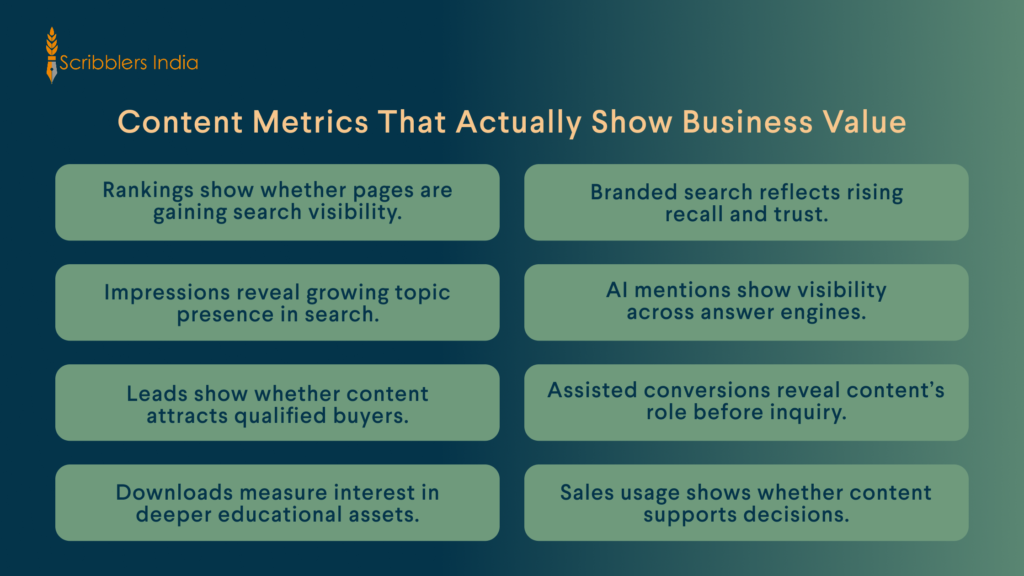
Brands should measure content marketing through AI search visibility, answer-led discovery, engagement quality, conversion behavior, sales usage, and authority growth. Traffic remains useful, yet it cannot show whether content influenced decisions. A balanced framework connects platform signals with business outcomes across several stages of the buyer journey.
ChatGPT had more than 900 million weekly active users by February 2026. Its scale makes platform-specific visibility and referral tracking relevant for many content programs.
| Metric | What It Reveals | Recommended Review |
| Organic impressions | Topic visibility in search | Monthly |
| Qualified organic visits | Relevant search traffic | Monthly |
| AI mentions | Brand presence in generated answers | Monthly |
| Cited URLs | Pages selected as AI sources | Monthly |
| Prompt coverage | Visibility across buyer questions | Quarterly |
| Answer accuracy | Correctness of brand descriptions | Monthly |
| Engagement quality | Depth of reader interaction | Monthly |
| Lead conversion | Direct content-generated demand | Monthly |
| Assisted conversions | Content influence before inquiry | Quarterly |
| Sales usage | Assets supporting active deals | Quarterly |
| External citations | Authority and source recognition | Quarterly |
| Subscriber growth | Owned-audience development | Monthly |
OpenAI states that ChatGPT Search adds utm_source=chatgpt.com to outbound referral links. Publishers can use analytics tools to identify that traffic. Do not combine all signals into a single opaque score. Review individual metrics before drawing strategic conclusions.

What Governance Rules Should Feature in Content Marketing Guide?
Content governance defines how teams approve ideas, verify claims, protect intellectual property, and maintain published assets. It becomes more important when AI tools accelerate production. Clear ownership prevents factual errors, duplicated pages, inconsistent messaging, and unsupported statistics from reaching readers or answer engines.
- Assign Content Ownership: Every asset needs one accountable owner. That person should coordinate subject review, editorial approval, and future updates. Shared responsibility without ownership often leads to neglected pages.
- Verify Claims at the Source: Use original research or primary publishers where possible. Record publication dates and data collection periods. Never cite another blog as proof when the original report remains available.
- Protect Copyright and Confidentiality: Do not copy competitor frameworks or proprietary visuals. Obtain permission before publishing client data or internal examples. Anonymize evidence when confidentiality matters.
- Use AI With Human Oversight: AI can support production, yet editors must review accuracy, originality, tone, and context. Automated drafting should never bypass subject experts. The final content remains the publisher’s responsibility.
- Maintain Accessibility: Use descriptive headings and meaningful alt text. Ensure visuals have readable labels and enough contrast. Accessible pages improve comprehension for every reader.
- Document Update Triggers: Refresh content when facts or services change. Do not change dates without substantive updates. Maintain a list of priority pages requiring frequent review.
What Content Marketing Trends Will Matter Through 2027?
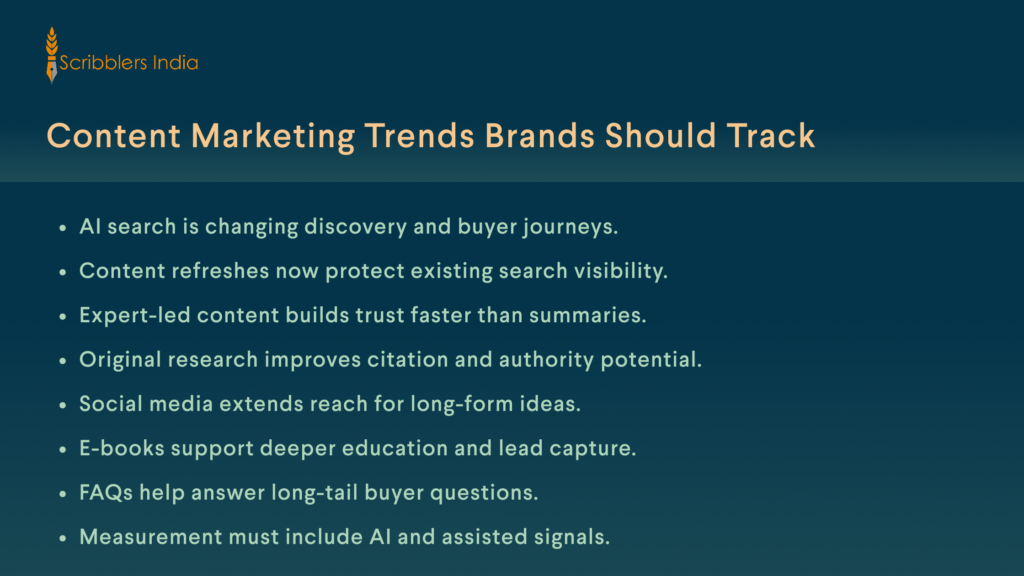
The most important content marketing trends through 2027 will reshape how brands earn visibility and trust across search and AI platforms. Answer-led discovery, original evidence, founder authority, content refreshes, and multimedia formats will become central operating priorities. Teams should treat these shifts as long-term strategic changes that support sustainable growth.
AI Search Measurement Will Become Routine
Marketing teams will add AI citations, answer accuracy, prompt coverage, and recommendation presence to established dashboards. Rankings and traffic will remain useful, yet they will show only part of the AI search discovery journey. Brands will need repeatable prompt testing and platform-specific reporting to understand how AI systems influence visibility and demand.
Original Research Will Gain Strategic Value
Commodity information will become easier to produce, making proprietary evidence and expert interpretation more valuable. Brands should publish fewer reports with stronger methodology, clearer limitations, and useful analysis. Original research can support citations, media coverage, sales conversations, and long-term authority when the findings answer meaningful industry questions across competitive markets.
Founder Expertise Will Support Entity Authority
Consistent founder content can clarify which subjects a company understands and strengthen trust during high-consideration research. Articles, interviews, expert commentary, and public discussions should reflect genuine experience rather than generic opinions. Professional ghostwriting services can preserve the founder’s ideas, natural voice, category perspective, and connection with the brand over time.
Content Refreshes Will Outpace Volume Programs
Teams will invest more in improving proven assets instead of publishing new pages without clear demand. Strategic refreshes can strengthen direct answers, current evidence, internal links, and conversion paths. Performance data should determine which pages deserve updates, helping brands protect existing search equity while improving AI search readiness over time.
Multimedia Content Will Support Wider Discovery
Search and AI platforms increasingly surface videos, images, carousels, and visual explainers beside written content. Multimedia assets can make complex ideas easier to understand and extend one insight across several channels. Teams should create visuals that convey accurate information, support accessibility, and enhance the value of the original page today.
How Does Scribblers India Build Content Marketing Systems?
Scribblers India builds content systems that connect buyer research with search, AI visibility, editorial quality, and measurable business goals. We work as a strategy partner rather than a volume-writing vendor. Each service solves a defined gap in content, authority, distribution, or performance.
- Content audits and gap mapping: Existing pages are reviewed for search performance, buyer intent, answer readiness, internal links, and conversion paths. The findings show which assets need refreshing and where new content can fill meaningful gaps.
- Strategy and topic prioritization: Audience questions and commercial goals shape every recommendation. Our content strategy services turn those findings into focused pillars, supporting assets, distribution plans, and measurable editorial priorities.
- Expert-led content creation: Research, client interviews, sales insights, and clear briefs guide every draft. This approach gives articles stronger examples and meaningful points of view that generic automated content cannot reproduce.
- Search and AI structuring: Our content marketing services connect SEO foundations with answer-ready sections, useful evidence, entity clarity, and contextual internal links across priority pages.
- Authority and founder content: Thought leadership, personal branding, research reports, and ghostwriting turn internal expertise into public authority. These assets support category recognition beyond service pages or short promotional posts.
- Distribution and repurposing: Strong ideas become social posts, newsletters, e-book sections, sales assets, or supporting articles. This process increases each idea’s reach without copying the same text across channels.
- Ongoing optimization: Search performance, AI visibility, conversion behavior, and content gaps guide future updates. We refresh valuable pages before recommending unnecessary production.
Connect with our experts to build a content marketing system designed for modern discovery, credible authority, and qualified demand.
Final Thoughts
A useful content marketing guide must connect strategy with execution. Publishing alone cannot build durable visibility when buyers research across search results, AI answers, professional platforms, and owned channels. Strong programs begin with buyer questions and expert knowledge. They use suitable formats, credible evidence, thoughtful distribution, and recurring measurement. Every asset should help someone understand a problem or make a better decision.
Brands should begin by auditing existing pages before expanding production. Refresh strong assets and close confirmed content gaps. Then build a calendar around the questions buyers ask throughout the decision journey. Scribblers India helps brands replace scattered publishing with strategy-led content systems. Our work connects content marketing strategy with SEO, AEO, GEO, thought leadership, personal branding, and measurable business outcomes.
Frequently Asked Questions
What Is a Content Marketing Guide?
A content marketing guide explains how a brand should research, plan, create, distribute, govern, and measure content. It should connect every asset with an audience need and business goal. Modern guides should also address search visibility, AI discovery, content refreshes, authority development, and performance measurement across relevant channels.
Why Is a Content Marketing Guide Important for Brands?
A content marketing guide creates consistency across strategy and production. It prevents teams from choosing topics based only on search volume or internal preferences. The guide also clarifies which formats support discovery, evaluation, conversion, or retention, helping brands invest resources in assets with defined business roles.
How Is Content Marketing Different From Content Strategy?
Content strategy defines the audience, goals, positioning, topics, formats, governance, and measurement system. Content marketing executes that strategy through creation and distribution. Without strategy, marketing often becomes disconnected publishing. Without execution, a well-designed strategy cannot create search visibility, buyer trust, qualified demand, or measurable commercial outcomes.
Can Content Marketing Improve AI Search Visibility?
Yes, content marketing can improve AI search visibility when assets offer clear answers, original value, credible evidence, and consistent entity information. SEO foundations still matter because AI search systems often retrieve indexed web content. Brands should measure mentions, citations, prompt coverage, answer accuracy, referrals, and competitor presence over time.
Which Content Formats Work Best for B2B Content Marketing?
B2B content marketing usually needs guides, service pages, comparisons, case studies, research reports, newsletters, and founder-led insights. The right mix depends on buyer intent and sales complexity. High-consideration purchases require detailed evidence and implementation context, while simpler decisions may need shorter explanations and clearer conversion pages.
How Often Should Brands Refresh Existing Content?
Brands should review priority content based on topic volatility, business importance, and performance trends. Fast-changing subjects require closer monitoring than stable definitions. Refresh a page when evidence becomes outdated, buyer needs change, rankings decline, service details shift, or new competitors provide more complete answers.
How Should Brands Measure Content Marketing Success?
Brands should combine visibility measures with engagement, conversion, authority, and sales-support outcomes. Useful signals include qualified traffic, AI citations, prompt coverage, leads, assisted conversions, external references, subscriber growth, and asset usage during deals. Evaluate each metric according to the page’s intended role within the buyer journey.
When Should a Brand Outsource Content Marketing Services?
A brand should consider outsourcing when internal teams lack strategy capacity, specialist writing, search expertise, or consistent production resources. The external partner should work with company experts rather than replace them. Strong partnerships convert internal knowledge into useful content while maintaining accuracy, positioning, editorial quality, and measurable business relevance.