
Google’s March 2026 core update clearly named scaled content abuse as its primary enforcement target. Sites publishing hundreds of AI-generated pages without editorial oversight saw traffic drops of 50 to 80% during that update period. These consequences did not result from AI usage itself as the triggering factor.
The real target was low-quality, unedited, generic content published at scale to manipulate rankings. Brands that survived every recent Google core update share one consistent practice. They thoroughly review and edit AI content before any piece goes live on their domain. This editorial discipline protects rankings and builds sustainable credibility across every content category they publish.
TL;DR: Learn why it’s essential to edit AI content for better search results.
|

What Does Google Actually Penalize About AI-Generated Content?
Google does not penalize content for being AI-generated. It penalizes low-quality, generic content published at scale without genuine user value. According to Google AI content guidelines for 2026, the target is scaled content abuse rather than AI usage itself. This distinction determines your entire approach to publishing safe AI content.
Understanding exactly what triggers Google penalties helps you effectively edit AI content. You can then publish at scale without risking your site’s search visibility.
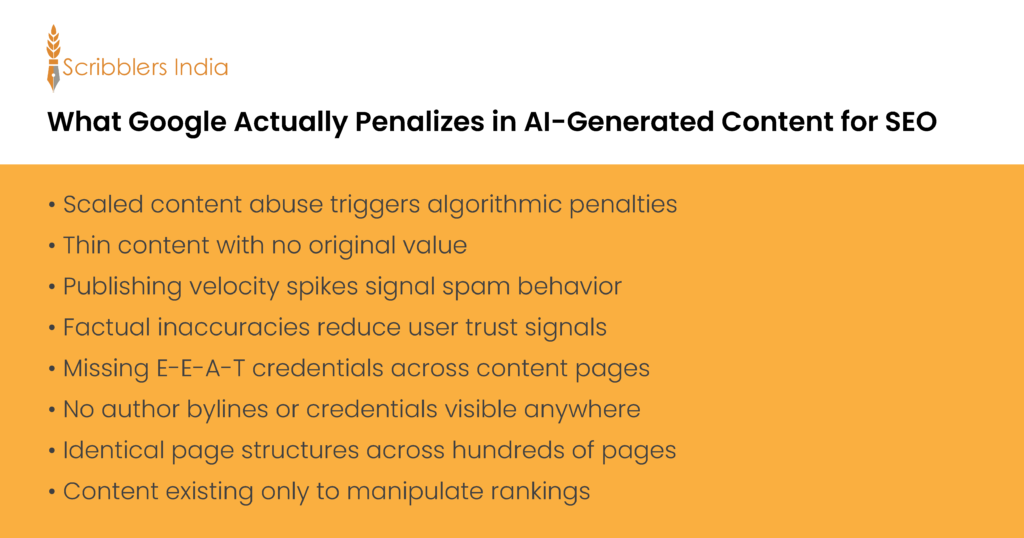
- Scaled content abuse is the actual penalty trigger: Google added it as a specific spam category in early 2025. The March 2026 core update explicitly reinforced this policy. Sites publishing hundreds of near-identical AI pages without editorial oversight experienced 50-80% traffic drops. Publishing patterns, not production tools, trigger the enforcement mechanism every time.
- Thin content without added value signals a quality failure: AI content becomes risky when it repeats information already available on competitor pages. Google may see this as content with no real information gain. Original insights, proprietary data, and first-hand experience make AI-assisted content more useful and safer.
- Publishing velocity spikes attract SpamBrain scrutiny: A sudden rise in publishing volume can prompt Google to suspect content abuse at scale. Follow a steady editorial calendar instead. This gives your team enough time to review, fact-check, and improve every AI-assisted article before publishing.
- Factual inaccuracies accelerate quality-based ranking demotions: AI tools can produce claims that sound correct but contain errors. Wrong statistics, fake attributions, and outdated information weaken content quality. Google may detect these issues through user signals such as quick exits, low engagement, and short dwell time.
What Are the Warning Signs That Your AI Content Needs Editing?
AI drafts that need editing exhibit identifiable patterns that both human readers and Google’s quality systems reliably recognize. Knowing these patterns before publishing allows you to edit AI content systematically instead of trying to catch up after a ranking drop.
The most common warning signs appear in predictable categories that AI content editing experts catch immediately during a structured content review process.
Generic AI vocabulary that readers immediately recognize
Phrases like “delve into,” “it is worth noting,” “comprehensive guide,” and “seamlessly” often appear in raw AI drafts. Readers leave pages that sound generic. Google may treat those bounce signals as indicators of poor quality. Use direct, specific, and conversational language when you edit AI content for publication.
Missing first-person experience and genuine expertise signals
AI tools summarize public information. They cannot share real client outcomes, product test results, or practical lessons from experience. Content without first-hand details may fall short on Google’s E-E-A-T standards. Add real examples and expert insights when you edit AI content.
Factual claims without verified source attribution
AI tools can create facts that sound correct but contain errors. Wrong statistics, fake attributions, and weak technical claims damage user trust. They may also trigger quality demotion signals. Check every statistic, source, and claim before publishing AI-assisted content.
How Do You Edit AI Content to Meet Google’s Quality Standards?
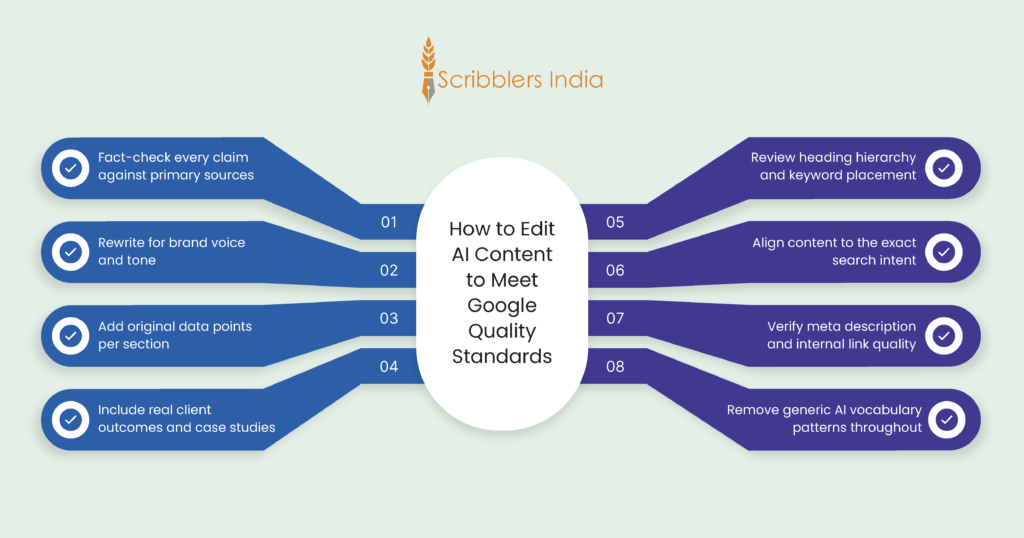
To edit AI content for Google’s quality standards, follow a clear sequence. Start with factual accuracy, then move to brand voice alignment. After that, add original insights and review the content structure. This order helps you improve AI drafts without rewriting every section from scratch.
A structured editing process also protects your content library from long-term quality issues. It helps teams avoid publishing content that sounds generic, repeats what’s already on existing pages, or erodes trust over time.
Fact-verification as the first editing priority
The first task when you edit AI content is verifying every factual claim against a primary source. Check statistics, dates, product specifications, legal references, and technical claims across the piece. AI tools often create information that sounds believable but may be false. These errors can pass through quickly when teams publish without proper review.
A single published hallucination can damage user trust and weaken content quality signals. It can also affect how Google evaluates the wider domain. Strong fact-checking should come before style edits, SEO review, or final proofreading.
Brand voice rewriting to eliminate generic AI patterns
AI drafts often use a generic professional tone that does not match a real brand voice. They may sound polished, but they often lack personality, clarity, and point of view. Editing for brand voice means replacing filler phrases and improving sentence rhythm.
It also means making the content reflect the brand’s actual perspective. This step helps you humanize AI content for SEO without making it sound forced. Readers trust content more when the voice feels consistent across repeated visits.
Adding original data and expert perspectives to every section
Original research, proprietary data, expert comments, and real client examples make content more valuable. These additions give Google a clear reason to trust the page as a useful source. They also give readers information they cannot find in every other article on the topic.
Add at least one original insight or expert perspective to each major section. This could include internal data, product findings, customer lessons, or field experience. These details improve engagement by making the content feel practical and credible.
SEO structure review for search intent alignment
Use the final editing pass to review keyword placement, heading flow, meta description quality, and internal links. Make sure the content answers the target search query directly. Avoid sections that drift into loosely related points or repeat ideas without adding value.
Each heading should clearly match the content that follows it. The relevant section should answer the reader’s question within the first 50 words. This makes the page easier to scan and stronger in aligning with search intent.
How Do You Build E-E-A-T Signals When You Edit AI Content?
E-E-A-T stands for Experience, Expertise, Authoritativeness, and Trustworthiness. Building these four signals into your content when you edit AI content is the most direct way to satisfy Google AI content guidelines for 2026. It also protects your rankings from quality-related penalties.
Google’s quality raters use E-E-A-T as their primary evaluation framework when assessing content quality across all categories and industry verticals they review.
- Add named author credentials to every published piece: Every content asset should show a named author and a detailed professional bio. Link the bio to verifiable credentials, such as work history, certifications, publications, or industry profiles. This gives Google a clear individual-level trust signal. It also helps Google assess whether the author has relevant expertise in that topic area.
- Integrate first-hand case studies and verified real outcomes: Add specific examples from real clients, projects, or professional scenarios. Use measurable outcomes wherever possible, such as growth rates, cost savings, ranking gains, or workflow improvements. These examples clearly illustrate the Experience dimension of E-E-A-T. AI tools cannot create a genuine first-hand experience on their own. Adding these details turns generic AI drafts into stronger, more authoritative content.
- Cite authoritative primary sources for every major claim: Support major claims with reliable primary sources. Use peer-reviewed research, government publications, industry reports, expert statements, or official company documentation. These citations build Trustworthiness signals throughout the content. Remove any claim that you cannot trace to a credible source during the editing review.
- Earn third-party mentions and domain-level authority signals: E-E-A-T also depends on how Google understands the wider domain. Build recognition through respected industry mentions, authoritative backlinks, and active professional profiles. These signals show that trusted external sources recognize the brand or author. They also strengthen the site-level Authoritativeness signals that Google may evaluate across the domain.

What AI Content Detection Tools Help You Review Drafts Before Publishing?
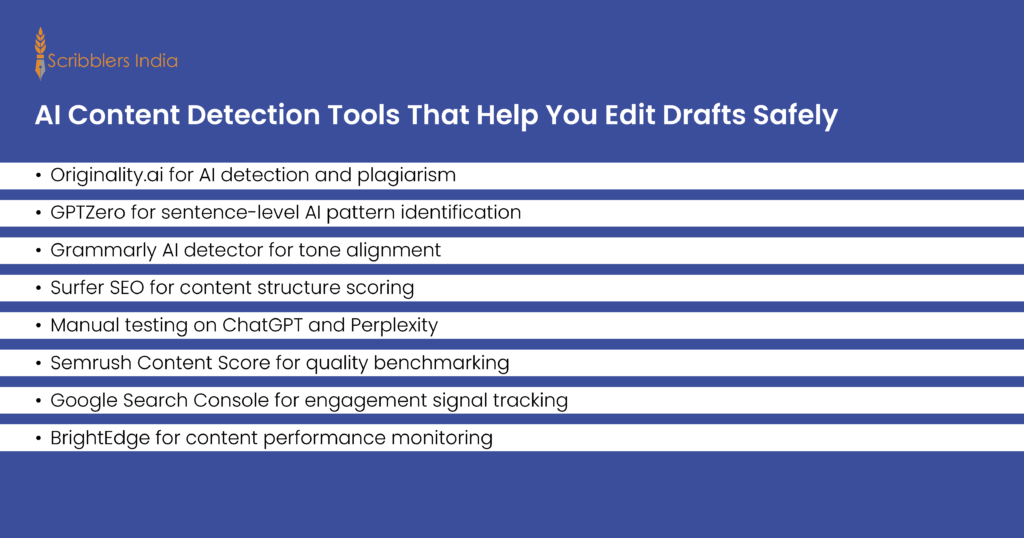
AI content detection tools help you identify the patterns in AI-generated drafts that need editing attention. These tools do not determine whether Google will penalize a piece. They reveal the generic sections that require deeper human editorial intervention to meet quality standards before publication.
Using these tools as part of a structured pre-publication review provides an additional quality checkpoint against publishing poor quality content.
- Originality.ai for combined AI detection and plagiarism review: Originality.ai checks content for AI-generation patterns and duplicate text across the web. This combined review helps editors identify two quality risks in a single pass. It works well for high-volume workflows where teams need to review many AI-assisted drafts. It also helps reduce the risk of publishing copied, thin, or highly detectable AI content at scale.
- GPTZero for sentence-level AI pattern identification: GPTZero gives sentence-level AI probability scores instead of broad document-level scores. This helps editors find the exact paragraphs that need rewriting. Teams can improve specific weak sections without rewriting the full article. Using these tools as part of a structured pre-publication review provides an additional quality checkpoint to prevent the publication of poor-quality content.
- Grammarly’s AI detector for tone and readability alignment: Grammarly’s AI detector combines AI identification with tone analysis and readability checks. This helps editors identify AI-heavy sections and weak writing patterns in a single review. Grammarly can help teams improve clarity, tone, and readability before publishing.
- Manual query testing on ChatGPT and Perplexity: Test published content against target queries in ChatGPT and Perplexity. This shows how AI systems retrieve, summarize, and represent your brand. If your content does not appear as a citation source, review its structure and authority signals. The gap may show where editorial improvements can make the page more useful and easier to cite.
How Do You Avoid AI Content Penalties by Managing Publishing Behavior?
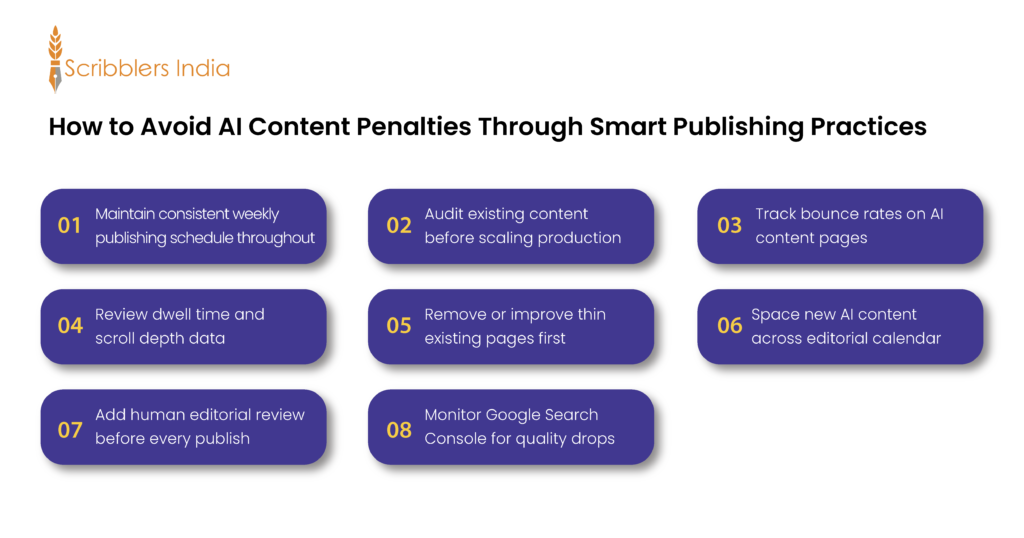
Avoid AI content penalty risks by controlling how quickly and consistently you publish AI-assisted content. Sudden publishing spikes can create a strong behavioral signal for Google. Its SpamBrain system may treat these spikes as possible scaled content abuse across a domain.
A disciplined approach to edit AI content manages publishing cadence along with content quality. This helps you avoid algorithmic scrutiny caused by sudden volume changes. It also gives editors enough time to review, fact-check, and improve each AI-assisted draft before publication.
- Maintain a consistent editorial calendar rather than publishing in bursts: Publishing ten pieces in one day after low activity can signal automated content production. Google’s crawlers may treat this pattern as rushed or weakly reviewed publishing. A steady schedule of two to four pieces per week shows stronger editorial control. It also gives teams enough time to check quality, structure, and originality before each page goes live.
- Audit existing AI content before adding more new pages: Before scaling AI-assisted production, review your current content library. Look for thin pages, generic sections, weak engagement, and repeated information. Remove low-quality pages or improve them with stronger insights and verified sources. This raises the overall domain quality signal before Google indexes new content. It also protects new pages from weaker content already present on the site.
- Track engagement signals to identify underperforming AI pages: Monitor bounce rate, dwell time, and scroll depth on AI-assisted content pages. Use Google Analytics to compare these pages with similar human-written content. Poor engagement may show that the page feels generic, unclear, or weakly aligned with intent. Improve these pages before adding more AI-assisted content to the same topic cluster. This keeps quality issues from spreading across related pages.
Why Do You Need AI Content Editing Services in India to Stay Safe?
India’s content marketing services sector has entered a high-output phase because AI has reduced first-draft effort. However, faster drafting has created a new bottleneck at the editorial stage. Many small and mid-sized teams now publish more content than they can verify, improve, or differentiate. This leads to a silent quality problem across the content library.
The risk does not come from AI usage alone. It comes from publishing AI-assisted drafts without enough human judgment. These drafts often repeat competitor pages, miss first-hand insights, and include claims that no editor has verified. Over time, this creates pages that look complete but offer limited information gain. Google’s quality systems can treat such content as low-value, especially when engagement signals weaken.
Professional AI content editing services help brands close this gap between speed and quality. They bring structure to a process that many teams still treat as basic proofreading. A strong workflow to edit AI content checks factual accuracy, removes generic AI patterns, improves brand voice, and adds expert context. It also ensures that each page addresses a real search need rather than adding another similar article to the web.
At Scribblers India, we help brands use AI without letting AI define their content quality. Our editing process turns AI-assisted drafts into accurate, original, and brand-aligned assets. We focus on the signals that matter most under Google’s current quality expectations. These include verified claims, firsthand examples, a clear structure, the author’s credibility, and useful information beyond existing search results.
Scribblers India AI Content Editing Framework
Here is how our AI content editing framework helps us create a 360-degree content strategy to help you address the shortcomings in mass-generated content:
- Domain-specific fact-checking and hallucination removal: We assign editors with relevant industry knowledge to every client account. Our fact-checking process verifies every statistic, attribution, technical claim, and product detail against a primary source. This helps us catch AI hallucinations that grammar tools and detection tools often miss.
- Brand voice alignment and AI pattern elimination: We document each client’s voice through a structured review of their best-performing content. We then apply that voice standard to every AI draft we edit. This removes generic AI phrases, improves sentence rhythm, and makes the content sound more on-brand. Over time, this also protects engagement signals across repeated publishing cycles.
- E-E-A-T signal integration across every edited piece: We add named author credentials, real-world examples, primary-source citations, and expert perspectives where relevant. These additions turn AI drafts into stronger content assets with clearer authority signals. They also help the content meet Google AI content guidelines 2026 across experience, expertise, authority, and trust.
- SEO alignment and structural quality review included: Every piece goes through an SEO review before final approval. We check keyword placement, heading hierarchy, meta description quality, and internal linking alignment. This keeps search optimization within the editorial workflow rather than treating it as a separate step after writing.
Thought leadership and executive content development integration: We combine AI editing with thought leadership writing and personal branding services. This helps executive content retain a clear point of view, genuine expertise, and a recognizable voice across every platform.
Connect with Scribblers India today to build an AI content editing workflow that produces high-quality output at the velocity your content strategy requires.
FAQs
Does Google penalize all AI-generated content across every industry and niche?
No. Google does not penalize content for being AI-generated under any industry or niche classification. It penalizes low-quality, thin, and generic content regardless of how it was produced. According to Google’s own guidance, using AI to generate content with the primary purpose of manipulating rankings violates spam policies. Content that is helpful, accurate, and genuinely valuable for users ranks well regardless of production method.
How do you fix AI content that has already caused a Google ranking drop?
To how to fix AI content for Google that has caused ranking drops: conduct a full content audit to identify thin pages, add original research and expert perspectives to the most important pages, remove or substantially improve the weakest pages, verify all factual claims against primary sources, and add named author credentials to every retained piece. Recovery typically requires three to six months of consistent, systematic quality improvement across the affected content.
What is the difference between scaled content abuse and responsible AI content use?
Scaled content abuse occurs when a site publishes large volumes of AI-generated content with no original value, no editorial review, and no genuine purpose beyond ranking manipulation. Responsible AI content use involves treating AI drafts as a starting point that human editors significantly improve before publication. The difference is editorial oversight, original information addition, and genuine user value rather than the volume or method of content production.
How often should you edit and refresh existing AI content to maintain safe rankings?
Refreshing AI content quarterly is the standard recommendation from most SEO professionals working with AI-assisted content libraries. Each quarterly review should update statistics, refresh examples, verify factual accuracy against current information, and add new, original insights that increase the page’s informational value. This freshness maintenance protects content from quality degradation and consistently supports better engagement signals over time.
Can AI content detection tools accurately predict whether Google will penalize a page?
No. AI content detection tools identify patterns associated with AI generation but do not predict Google’s ranking decisions because Google does not evaluate content based on AI detection scores. According to Ahrefs research on 600,000 pages, the correlation between AI content percentage and ranking position is essentially zero statistically. Use detection tools to identify and edit AI content patterns rather than as predictors of algorithmic penalties.