
AEO and GEO are becoming essential for brands that want to stay visible as search moves away from traditional clicks. Your content may rank on the first page, your keyword tracking tool may show steady impressions, yet your traffic report may tell a completely different story. This scenario is playing out across industries, and the cause has a specific name: Zero-click search.
Zero-click search occurs when users find the answer directly in the search results without visiting a website. Google AI Overviews, featured snippets, knowledge panels, and direct answer widgets now resolve more queries directly in the search interface. A recent industry analysis found that nearly 80% of searches triggering AI Overview results end without a click, showing how AI-led search is accelerating zero-click behavior.
For marketers, this changes how search visibility works. Traffic alone no longer reflects content performance. Brands now need AEO and GEO strategies that earn citations, answer visibility, and authority across AI-led search experiences.
TL;DR: How AEO and GEO are Leading Transition to Zero-Click Search?
|
Why Do AEO and GEO Matter as Zero-Click Search Grows
Zero-click search occurs when users get the answer directly in the search results without visiting a website. This no-click search method is becoming popular as search engines now resolve more queries through AI Overviews, featured snippets, knowledge panels, and direct answer boxes before users reach any organic results.
Earlier, zero-click behavior was limited to simple queries such as weather updates, currency conversions, definitions, and sports scores. The shift became more disruptive when AI search started handling layered questions. Users can now compare options, understand concepts, review summaries, and gather recommendations directly in the search interface.
This changes the value of ranking on page one. A page can still earn impressions, appear below an AI-generated answer, and lose the click because the user already has enough information. According to a 2025 study, AI Overviews reduced clicks to top-ranking pages by 34.5% for informational keywords.
For content teams, the real issue is no longer visibility alone. The challenge is earning a place inside the answer layer. Content now needs clear questions, direct answers, expert-backed insights, and original value that search engines can cite rather than summarize without attribution.
How Does Zero-Click Search Affect Content Marketing Performance?
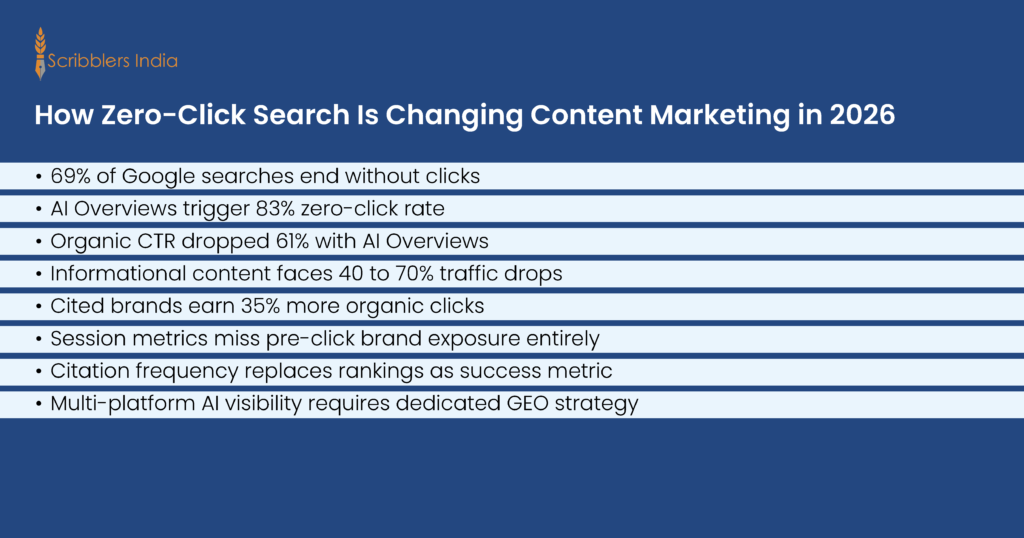
Zero-click search affects content marketing by separating search exposure from website visits. Your brand may appear in AI Overviews, featured snippets, answer boxes, and People Also Ask results while analytics records fewer sessions. This means performance must be judged through citations, branded demand, assisted conversions, and answer visibility.
A focused AEO and GEO strategy helps content teams respond to this shift by treating search visibility as a citation, extraction, and brand recall challenge rather than a traffic-only goal.
Traffic Metrics No Longer Capture Full Visibility
Most content dashboards still measure what happens after the click. They track sessions, rankings, conversions, and pageviews. Zero-click search shifts much of audience exposure to the search results page, where standard analytics tools capture limited evidence of brand discovery.
This creates a measurement blind spot for content teams. A user may read your cited answer, remember your brand, compare you later, and convert through another channel. Search visibility now needs impression analysis, branded search growth, assisted pipeline tracking, and citation monitoring alongside organic traffic.
Informational Content Faces the Highest Disruption Risk
Informational content carries the highest zero-click risk because it often answers questions that AI systems can summarise inside the results page. Definitions, comparisons, process guides, basic explainers, and FAQ-led pages are easier to compress. Experts found that keywords with AI Overviews had a zero-click rate between 35% and 46%, depending on whether an AI Overview appeared.
This does not mean informational content has lost value. It means generic information has become easier to replace. Content needs sharper experience, original examples, practical frameworks, expert input, and brand-owned viewpoints. This is something that AI systems can cite rather than blending into a single summary.
Citation Visibility Becomes the New Performance Indicator
Citation visibility measures whether your brand appears inside the answer layer, not only below it. This matters because users increasingly treat AI-generated summaries as the first layer of trust. Seer Interactive found that brands cited in AI Overviews earned 35% higher organic CTR than uncited brands.
The deeper insight is behavioral. A citation serves as a pre-click trust signal, even when the user does not visit immediately. Content teams should monitor which pages, authors, brand entities, and expert profiles AI systems cite across priority topics.
Audience Discovery Shifts to Multi-Platform Behavior
Google is still important, yet discovery now happens across ChatGPT, Perplexity, Gemini, Claude, LinkedIn, YouTube, and industry communities. Each platform uses different signals to decide which brands deserve visibility. Traditional rankings alone cannot explain why one brand appears in AI answers while another disappears.
This shift changes the content strategy. Publishing on your website is no longer enough for modern search visibility. Brands need consistent entity signals across owned content, expert profiles, third-party publications, social conversations, and digital PR so AI systems can connect the brand with specific areas of authority.
How Does AEO Address Zero-Click Search for Content Teams?
AEO helps content teams win visibility where users now get answers without clicking. Answer Engine Optimization structures content so search engines can identify, extract, and display the most useful response inside AI Overviews, featured snippets, People Also Ask results, and voice-led search surfaces.
In a zero-click environment, the goal is not limited to ranking below the answer. The stronger goal is to become part of the answer itself. When Google cites a brand inside an AI Overview or featured result, that brand earns authority before the user reaches any website.
This changes how content teams should plan informational pages. AEO requires tighter page architecture, clearer section intent, stronger topical coverage, and source-backed answers. Instead of writing long introductions before the main point, teams need to answer the query early and support that answer with context, examples, and expert signals.
Which AEO Best Practices Can Help Improve Zero-Click Search Visibility?
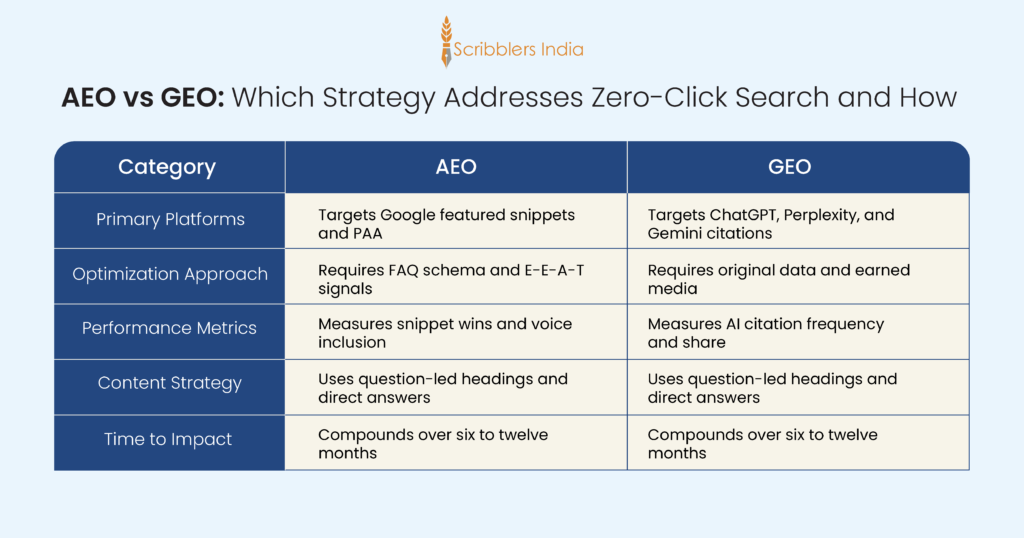
Within an AEO and GEO strategy, AEO handles the search engine side of answer visibility. It prepares content for featured snippets, People Also Ask results, voice responses, and Google AI Overviews.
Experienced AEO service providers focus on making content easier for search engines to understand and select. The following elements help content teams create pages that perform across traditional SEO results and answer-led search surfaces.
- Question-based heading structure: Use H2 and H3 headings that match how users ask questions in search. This helps Google understand the query each section answers. It also creates clean extraction points for featured snippets, People Also Ask results, and AI Overview citations.
- Direct answer paragraphs at the top of each section: Place a complete answer in the first 40 to 60 words after every major heading. This gives search engines a clear summary to extract. Long build-ups reduce answer clarity and make the page harder to use inside zero-click search results.
- FAQ schema markup on priority pages: Add FAQPage schema where the content includes genuine question-and-answer sections. Schema provides search engines with structured signals about the page’s format. It can support visibility in People Also Ask results, voice search responses, and other answer-led search features.
- E-E-A-T signal investment: Strengthen content with named authors, expert review, cited sources, original examples, and clear brand authority. Answer engines prefer sources they can trust. These signals help search systems decide whether your page deserves citation inside zero-click results.
- Entity clarity across the page: Define your brand, service area, audience, and expertise with consistent wording. AI systems rely on entity associations to understand who you are and what you should be cited for. Clear entity signals help connect your content to relevant answer opportunities.
- Content depth beyond the direct answer: AEO does not mean writing thin answers. The direct answer earns extraction potential, while the supporting content builds trust. Add context, practical examples, limitations, and decision-making guidance so the page remains valuable when users choose to click.
How Does GEO Handle Zero-Click Results on AI Platforms Beyond Google?
GEO helps brands earn visibility inside AI-generated answers across ChatGPT, Perplexity, Gemini, Claude, and similar platforms. These platforms do not show a simple ranked list of links. They select, summarize, and cite sources, providing users with a complete answer within the same interface.
This makes GEO different from traditional SEO. A brand may never receive a click, yet it can still shape the answer a buyer reads. That citation can influence trust, recall, vendor comparison, and later branded search.
Semrush found that 92% to 94% of Google AI Mode searches ended without a click. The original GEO research also found that optimization methods can improve visibility in generative engine responses by up to 40%. These findings show why brands need a citation-first content strategy, not a traffic-only plan.
How GEO Can Help Improve AI Citation Visibility?
The GEO side of an AEO and GEO strategy focuses on how AI platforms select, synthesize, and cite brand information from multiple sources. Here is how it helps improve upir AI visibility:
- Original data with a clear citation purpose: AI systems prefer sources that add information unavailable across many similar pages. Proprietary surveys, benchmark reports, industry datasets, and internal trend analyses give them a reason to cite your brand. This information advantage is a durable GEO asset that a brand can build through its content marketing strategy.
- Earned media across authoritative publications: AI platforms look beyond your website when assessing credibility. A personal or company brand mentioned in respected industry publications sends stronger signals of authority than a self-published claim alone. Digital PR, expert columns, founder interviews, and thought leadership articles help build a broader citation footprint.
- Entity clarity across every brand touchpoint: AI systems need to understand what your company does, who it serves, and where its expertise sits. Use consistent descriptions across website copy, author bios, press pages, LinkedIn profiles, and third-party mentions. This reduces confusion and improves brand representation in generated answers.
- Expert quotes with verifiable credentials: AI platforms favor content that carries visible human expertise. Add named expert commentary, credentials, job titles, publication dates, and review notes where relevant. This helps distinguish your content from generic pages that repeat the same surface-level information.
- Content built for answer absorption: GEO success depends on how much of your content supports the final AI response. Use clear definitions, structured comparisons, step-by-step explanations, decision frameworks, numerical facts, and source-backed claims.
- Ongoing citation monitoring: AI visibility changes across prompts, platforms, and time. Track recurring queries, cited domains, brand mentions, and missing citation opportunities each month. This helps teams identify where content needs stronger evidence, better structure, or more third-party authority.
What Does an AEO and GEO Strategy Look Like in Practice?
A focused AEO and GEO strategy shifts content investment toward visibility inside search answers, AI summaries, and citation layers. It no longer focuses only on driving clicks to owned websites. Instead, it combines AEO, SEO, and GEO into a unified visibility strategy. This approach helps brands appear wherever users now ask questions, compare vendors, or gather information, all without leaving the platform. Success depends on becoming the source that AI systems extract, summarise, and cite.
Auditing the Content Portfolio for Zero-Click Risk
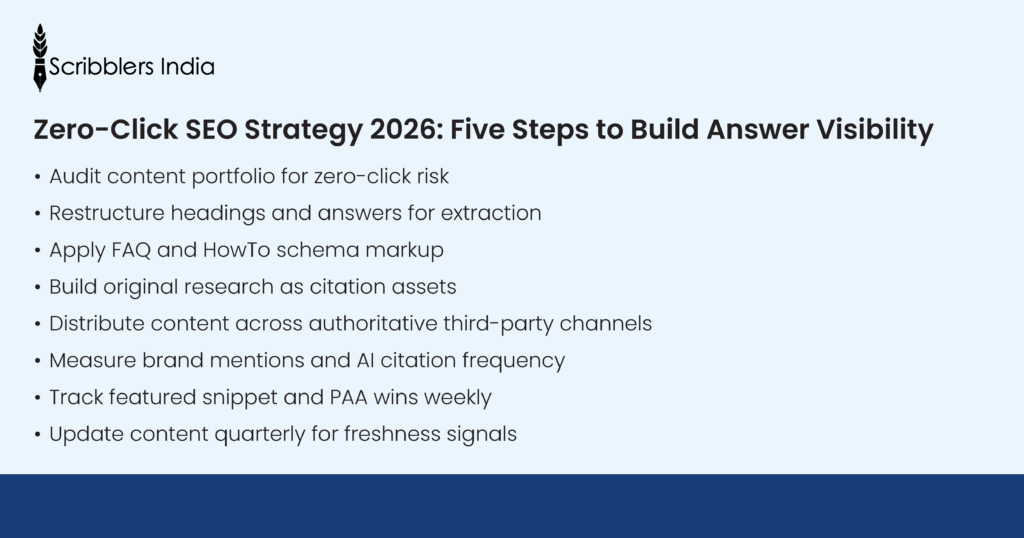
The first step in any zero-click SEO strategy in 2026 is identifying which content categories are most at risk of zero-click disruption. Query research reveals which target keywords now consistently trigger AI Overviews or featured snippets. Pages competing for these queries face the greatest risk of click loss. They require the most urgent restructuring for citation visibility, not click-through optimization. Tools like Semrush and Ahrefs accurately and quickly surface this data.
Restructuring Informational Content for Extraction
Every high-value informational page in the content portfolio needs a structural audit. The audit focuses specifically on AEO readiness. This means converting section headings to natural-language questions. It means placing a complete answer paragraph in the first 50 words of each section. Implying, adding the FAQ schema to the appropriate pages. It also means removing long introductions that delay the answer and significantly reduce the extraction probability.
Building Original Research as a Citation Asset
A zero-click SEO strategy that depends entirely on reformatting existing content reaches its ceiling quickly. Original research creates content assets that AI systems have a specific reason to cite. Branded surveys, proprietary data analyses, and first-hand expert frameworks fall into this category. Each original data point published under a brand name is a potential citation trigger. It compounds in value as AI platforms index it across multiple retrieval contexts over time.
Diversifying Brand Visibility Across AI Platforms
Google AI Overviews represent one important zero-click search surface. They are not the only one that matters for brand discovery in 2025. A comprehensive visibility strategy distributes original thought leadership content across channels that AI platforms actively index. Publish insights across industry publications, LinkedIn, podcasts, webinars, professional communities, and trusted media outlets. This creates the multi-source authority profile that GEO relies on for sustained visibility.
Measuring Success Through Visibility Metrics
Zero-click performance requires different success metrics. Monitor brand mentions inside AI-generated answers, featured snippet ownership, People Also Ask visibility, and AI Overview citations. Track branded search growth and impression share in Google Search Console to measure awareness before clicks happen. These indicators reveal whether your brand is becoming part of the answer layer users increasingly rely on.
Why Do You Need AEO and GEO Services in India to Stay Visible in Search?
Brands in India need AEO and GEO services because users now discover information through answers and AI citations before websites. Search visibility depends on being selected as a trusted source across Google and AI platforms. This requires structured content, original insights, entity clarity, and consistent authority signals online today.
India’s AI search behavior is moving from early curiosity to daily work usage. ChatGPT now has 100 million weekly active users in India, according to OpenAI CEO Sam Altman. This scale makes answer-led discovery a serious visibility channel for Indian businesses.
For brands, the risk is clear. A competitor with stronger answer-ready content may shape buyer perception before your website receives a visit. AEO helps you win Google’s answer surfaces. GEO helps you build visibility across AI platforms where users compare brands and shortlist vendors.
At Scribblers India, we help brands build this visibility layer with content strategy, AEO restructuring, GEO planning, and authority-building assets. The goal is simple. Your content should rank, earn citations, support buyer decisions, and strengthen brand recall.
Scribblers India AEO and GEO Framework
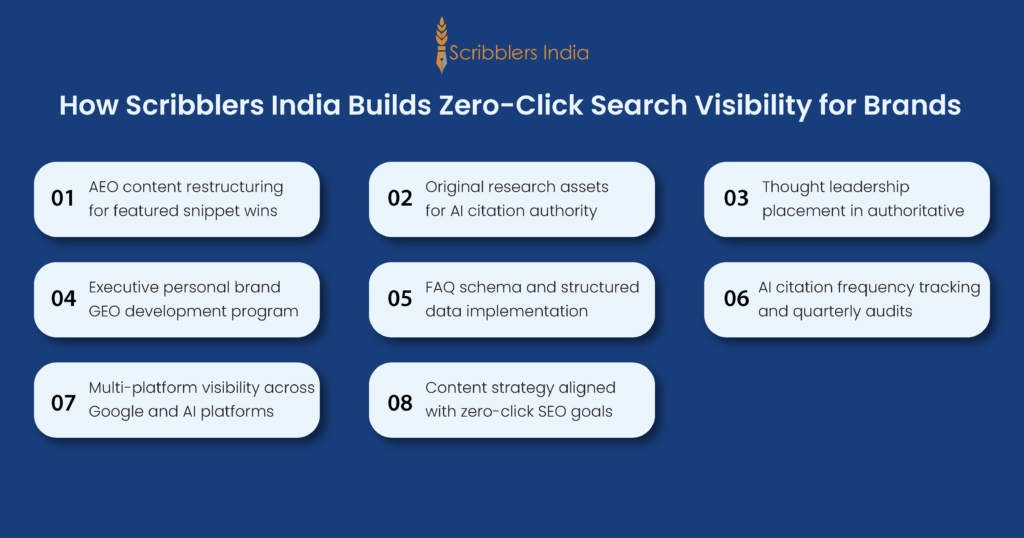
Our AEO and GEO framework strengthens how your brand answers questions, earns citations, builds authority, and appears across AI-led discovery journeys.
- AEO-ready content restructuring across your portfolio: We audit your existing content for zero-click exposure risk. Then we restructure high-priority pages with question-led headings, direct answer blocks, FAQ schema, and stronger expert signals. This improves extraction potential across snippets, AI Overviews, People Also Ask results, and voice-led answers.
- Original research for GEO citation authority: AI platforms need sources with unique value. We convert your internal knowledge into surveys, benchmark reports, trend analyses, and expert frameworks. These assets give AI systems a clear reason to cite your brand instead of summarising generic competitor content.
- Thought leadership for wider authority signals: Your website alone cannot carry every trust signal. We develop thought leadership for industry publications, founder profiles, LinkedIn, newsletters, and guest features. This builds the third-party footprint AI systems use to understand brand authority.
- Executive visibility for stronger entity recognition: AI platforms connect people, companies, topics, and areas of expertise across the web. We help founders and senior leaders publish consistent expert-led content. This strengthens the association between your personal brand and its core areas of authority.
- Quarterly visibility measurement: Traffic alone cannot measure zero-click search performance. We track AI citations, featured snippet wins, People Also Ask appearances, branded search movement, and share of voice in AI-generated answers. This gives your team a clearer view of modern search performance.
AEO and GEO are no longer optional additions to content marketing. They are becoming the foundation for brands that want to stay visible when users find answers before they reach a website.
Connect with our team today to build a zero-click search strategy that captures brand authority, earns AI citations, and positions your content for visibility in every layer of the search environments your audience uses daily.
FAQs
What is the role of AEO and GEO in content marketing?
AEO and GEO are content optimization approaches built for answer-first search behaviour. AEO helps content appear in featured snippets, People Also Ask results, voice search responses, and AI Overviews. GEO helps brands earn citations inside AI-generated answers across platforms such as ChatGPT, Perplexity, Gemini, and Claude.
What is zero-click search and why does it matter?
Zero-click search happens when users get the answer they need directly on the search results page. They may see the answer through AI Overviews, featured snippets, knowledge panels, or direct answer boxes. It matters because brands can lose measurable traffic even when their content still appears prominently in search results.
How do AEO and GEO help with zero-click search visibility?
AEO and GEO help brands stay visible when users find answers before visiting a website. AEO structures content for direct extraction by search engines, while GEO builds citation authority across generative AI platforms. Together, they help brands earn visibility through snippets, mentions, AI citations, and answer-layer placements.
How does zero-click search affect website traffic?
Zero-click search can reduce organic traffic because users may get complete answers without clicking through to a website. Informational content, such as definitions, guides, comparisons, and FAQs, often faces the highest disruption. However, strong citation visibility can still support brand recall, branded searches, lead quality, and downstream conversions.
How is an AEO and GEO strategy different from traditional SEO?
Traditional SEO focuses on keyword rankings, organic traffic, backlinks, and click-through rates. An AEO and GEO strategy also focuses on answer visibility, AI citations, featured snippets, branded mentions, and entity authority. It still supports rankings, while preparing content for search experiences where users may not click.
What type of content works best for AEO and GEO?
The best content for AEO and GEO answers specific questions with clarity, depth, and credible support. Research-backed guides, expert-led explainers, comparison articles, FAQs, original reports, and data-led insights perform well because AI systems need trustworthy information. Clear headings, direct answers, structured data, and expert attribution improve citation potential.
Can zero-click search still support business growth?
Yes, zero-click search can support business growth when brands measure visibility beyond website sessions. A citation inside an AI Overview or featured answer can influence trust before the user clicks. Over time, this exposure can improve branded search demand, sales conversations, referral quality, and recognition across decision-making journeys.
How long does it take to see results from AEO and GEO?
Early AEO and GEO results can appear within 60 to 90 days when content is structured, indexed, and refreshed with purpose. These results may include featured snippet wins, People Also Ask appearances, and initial AI citations. Stronger citation authority usually builds over six to twelve months of consistent publishing.