A thought leadership agency helps founders, executives, consultants, and brands turn expertise into visible authority. In 2026, this work is no longer limited to blogs or LinkedIn posts. It now supports trust, category recall, organic search, AI Overviews, ChatGPT visibility, and buyer confidence.
The old version of thought leadership was simple. Share opinions, publish articles, speak at events, and build professional visibility. That still matters, but the search environment has changed. Buyers now discover brands through Google, LinkedIn, ChatGPT, Perplexity, Gemini, newsletters, podcasts, and AI-generated answers.
This means thought leadership content must do more than sound impressive. It must answer real questions, explain a clear point of view, support entity clarity, cite credible sources where needed, and help both readers and search systems understand why the brand is credible.
A strong thought leadership content agency does not simply write polished articles. It captures your expertise, sharpens your positioning, builds content pillars, develops original ideas, and turns those ideas into assets that can travel across search, social, sales, PR, and AI-led discovery.
At Scribblers India, we treat thought leadership as a content system. We help founders and brands create content that builds trust with humans while improving visibility across SEO, AEO, and GEO surfaces.
TL;DR
|
Why is Thought Leadership Critical in the AI Search Era?
Thought leadership matters because buyers now research before they speak to a brand. They read posts, compare viewpoints, ask AI tools for recommendations, and evaluate credibility long before a sales conversation begins. Strong thought leadership gives them a reason to trust your expertise early.
The 2025 Edelman-LinkedIn B2B Thought Leadership Impact Report shows that thought leadership helps build trust and alignment inside complex buying groups. That matters because many business decisions are shaped by internal influencers who may never appear on a sales call.
AI search has made this even more important. Gartner predicted that traditional search volume would drop by 25% by 2026 because of AI chatbots and virtual agents. McKinsey also reported that AI-powered search could influence $750 billion in revenue by 2028.
For founders and brands, this creates a clear shift. Your best ideas should not stay trapped inside sales calls, investor decks, webinars, or internal strategy documents. They need to become structured content assets that search engines, AI systems, and real buyers can understand.
Scribblers India Takeaway: Thought leadership is no longer a brand-building extra. It is a visibility asset. If your expertise is not clearly published, buyers and AI systems may rely on competitors who explain the same topic more effectively.

What Services Does a Thought Leadership Agency Offer?
A thought leadership agency offers strategy, research, writing, content planning, publishing support, and performance review. The goal is to turn expertise into content that builds authority, improves discovery, and supports business outcomes. The best agencies connect ideas with audience needs, not only content calendars.
1. Thought Leadership Strategy
A thought leadership strategy defines what you want to be known for. It maps your audience, category, point of view, content pillars, proof points, and conversion goals. Without this foundation, content can become scattered, repetitive, or too broad to create authority.
A good strategy answers:
- What topics should you own?
- Who needs to trust your expertise?
- Which questions should your content answer?
- What makes your point of view distinct?
- How should content support business growth?
2. Founder and Executive Voice Capture
Strong thought leadership should sound like the person’s personal brand. Agencies capture voice through interviews, past writing, speeches, podcasts, webinars, LinkedIn posts, sales conversations, and internal documents.
The goal is not to make every founder sound polished in the same way. The goal is to make the content sound clear, credible, and recognizably theirs. This is especially important for ghostwritten founder content.
3. Original Idea Development
A strong thought leadership agency helps you build original ideas, not recycled opinions. This may include frameworks, opinion essays, market observations, industry analysis, lessons from client work, or practical models that make your expertise easier to remember.
This is where real authority gets built. Generic advice rarely earns trust. A strong idea gives people something to quote, challenge, discuss, or associate with your name.
4. Thought Leadership Content Writing
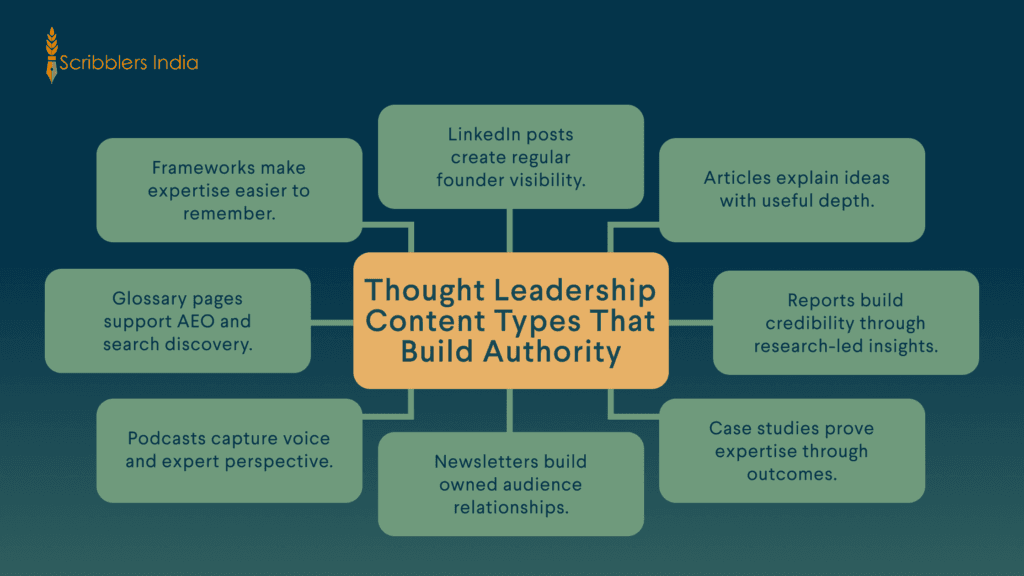
Thought leadership content writing can include LinkedIn posts, long-form articles, newsletters, whitepapers, founder essays, reports, guides, speeches, podcast scripts, and opinion-led website content.
Each format has a role. LinkedIn builds visibility. Long-form articles build depth. Reports build credibility. Newsletters build owned audience relationships. Case-led content builds proof.
5. SEO, AEO, and GEO Alignment
In 2026, thought leadership should also support search and AI visibility. This means content must answer questions clearly, include useful definitions, support entity clarity, and provide source-backed explanations where needed.
Google’s guidance for generative AI features says site owners should continue to focus on helpful, reliable, people-first content. That aligns closely with strong thought leadership work. Content should help readers first, then structure that expertise so search and AI systems can understand it.
6. Content Repurposing
A strong thought leadership idea should not live in one format. A founder interview can become a LinkedIn post, a newsletter, a blog, a podcast script, a carousel, and a sales enablement asset.
Repurposing saves time and increases consistency. It also helps the same core idea appear across channels where different buyers may discover the brand.
7. Performance Review
Thought leadership performance should not be judged only by likes or impressions. A serious agency tracks signals such as profile visits, inbound inquiries, branded search, newsletter growth, speaking invitations, sales conversations, media mentions, AI citations, and content-assisted leads.
The right metrics depend on the goal. A founder building investor trust needs different metrics from a SaaS brand trying to build category authority.
What Types of Thought Leadership Content Should Brands Create?
Thought leadership content should match the audience, business goal, and level of trust required. Some formats build visibility, while others build proof, depth, or search authority. The strongest brands use a mix of short-form, long-form, and source-backed assets.
| Content Type | Best Use | Why It Matters |
| Founder LinkedIn posts | Visibility and daily recall | Builds familiarity with the founder’s thinking |
| Long-form articles | Search and authority | Explains ideas in depth for serious readers |
| Opinion essays | Point of view | Shows what the brand believes |
| Whitepapers and reports | Proof and credibility | Supports high-consideration buyers |
| Case studies | Evidence | Shows how expertise works in practice |
| Newsletters | Audience ownership | Reduces dependence on algorithms |
| Podcasts and webinars | Relationship building | Helps audiences hear the expert directly |
| Glossary pages | AEO and GEO support | Defines key terms for search and AI systems |
| Comparison content | Decision support | Helps buyers evaluate options |
| Framework explainers | Recall and differentiation | Makes your expertise easier to remember |
A thought leadership content agency should not push every format at once. It should choose formats based on the brand’s audience, sales cycle, founder availability, and business priorities.
For example, a SaaS founder may need LinkedIn posts, category essays, comparison pages, and product-led thought leadership. A consultant may need frameworks, case studies, newsletters, and podcast-led content. A professional services firm may need reports, service explainers, expert articles, and partner-led content.
How Does Thought Leadership Support AEO and GEO?
Thought leadership supports AEO and GEO by making expertise easier to extract, summarise, cite, and associate with a brand. Answer engines need clear explanations, trusted entities, original insights, and structured content. Strong thought leadership gives them better material to work with.
AEO Support
AEO, or answer engine optimization, focuses on clear answers to specific questions. Thought leadership content can support AEO when it includes direct answers, definitions, FAQs, tables, and practical explanations.
For example, a section titled “What is founder-led thought leadership?” should answer the question in the first few lines. This helps readers and answer systems understand the topic quickly.
GEO Support
GEO, or generative engine optimization, focuses on visibility inside AI-generated responses. This depends on entity clarity, source depth, consistent brand messaging, and citation-worthy content.
A founder with strong thought leadership across LinkedIn, website articles, podcasts, reports, and case studies gives AI systems more context. This can improve the chances of accurate brand understanding over time.
Search Trust
Search systems and AI tools need trust signals. These include author bios, company pages, source-backed claims, original insights, case studies, and consistent topical coverage. Thought leadership content can strengthen all of these signals when built correctly.
| Why AI Search Changes Thought Leadership?
AI search compresses research. Buyers may ask ChatGPT, Perplexity, or Gemini for the best agencies, frameworks, tools, or expert perspectives. If your ideas are not clearly published, AI systems have little reason to mention you. Thought leadership turns expertise into visible, reusable content. |
What Are the Benefits of Working with a Thought Leadership Agency?
Working with a thought leadership agency helps founders and brands create sharper, consistent, and credible content. The benefit is not only saving time. The real value is turning scattered expertise into a structured authority system that supports trust, search visibility, and business growth.
- Clearer Positioning: A thought leadership agency helps define what you should be known for. This makes your content sharper and easier to remember. Without positioning, even high-quality content can feel disconnected.
- Stronger Founder Voice: Good agencies capture how founders think, speak, and explain ideas. This prevents ghostwritten content from sounding generic. Voice matters because audiences trust people who sound consistent and real.
- Better Content Quality: Thought leadership content needs depth, not surface-level advice. Agencies bring research, editorial structure, examples, and content discipline. This helps turn your ideas into useful assets rather than scattered posts.
- Consistent Publishing: Consistency is hard for busy founders and marketing teams. A thought leadership agency keeps the content engine moving through interviews, idea banks, calendars, drafts, reviews, and repurposing.
- Search and AI Visibility: Strong thought leadership can support SEO, AEO, and GEO. It creates content that answers questions, builds topical authority, and gives AI systems a clearer context about your expertise.
- Better Sales Conversations: When prospects read your ideas before a call, they arrive with more trust. This can shorten education time and improve lead quality. Thought leadership works as pre-sales education.
- Owned Audience Growth: Newsletters, reports, and long-form content help you build an audience beyond social platforms. This reduces dependence on algorithm changes and creates a more durable relationship with readers.
- Stronger Category Authority: Consistent thought leadership helps audiences associate your name with specific topics. Over time, this supports brand recall, referral conversations, speaking invitations, and media interest.
How Should You Choose the Right Thought Leadership Agency?
Choose a thought leadership agency for your personal or company brand by reviewing its strategy process, research depth, writing quality, voice capture method, SEO/AEO/GEO understanding, and performance review approach. The right partner should understand your business goals before recommending content formats or publishing frequency.
Use this evaluation table before shortlisting an agency.
| What to Check | Why It Matters | Red Flag |
| Strategy process | Connects content with goals | They start with post volume |
| Voice capture | Makes content authentic | Every client sounds similar |
| Research depth | Builds credibility | Content repeats common advice |
| SEO/AEO/GEO knowledge | Supports modern visibility | Search is treated as an afterthought |
| Long-form capability | Builds authority assets | Agency only writes short posts |
| Reporting quality | Tracks business relevance | Reports focus only on likes |
| Review process | Protects quality | No clear editorial workflow |
Questions to Ask Before Hiring a Thought Leadership Agency?
- How do you define thought leadership for our brand?
- How will you capture the founder or executive voice?
- What formats do you recommend and why?
- How will content support SEO, AEO, and GEO?
- How do you measure content quality and business value?
- Will we get an idea bank and content calendar?
- How do you handle revisions and approvals?
- Can you support long-form authority assets?
A good thought leadership agency should ask you strong questions before proposing a plan. If the agency only discusses posting frequency, content volume, or viral hooks, it may not be the right fit for authority-building work.
What Mistakes Should Brands Avoid in Thought Leadership Content?
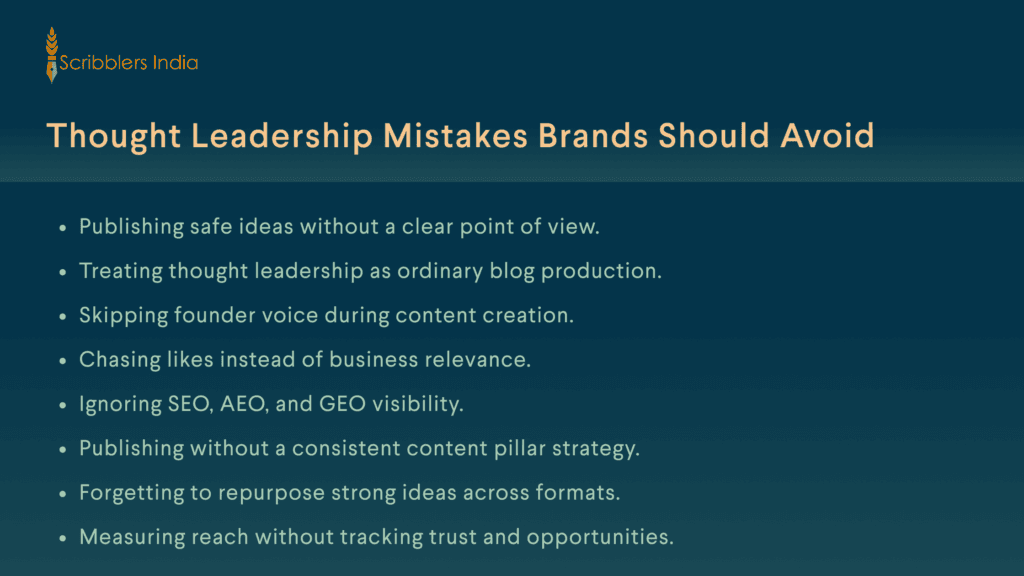
Common thought leadership content writing mistakes include publishing generic advice, chasing viral formats, ignoring search intent, skipping founder voice, and measuring only engagement. These mistakes create activity without authority. They can also make content weak for AI search and buyer trust.
- Publishing Without a Point of View: Many brands publish safe content that says what everyone already knows. This rarely builds authority. A strong point of view gives readers a reason to remember and quote the brand.
- Treating Thought Leadership as Blogging: Blogging can be part of thought leadership, but it is not the full strategy. Thought leadership needs positioning, opinion, experience, research, distribution, and a clear connection to business goals.
- Ignoring Founder Voice: Founder-led content should sound like the founder. If the writing sounds like a polished template, audiences notice. Strong agencies invest in interviews, examples, and editorial calibration.
- Chasing Likes Instead of Trust: Engagement can be useful, but it is not the only metric. A thoughtful post with fewer likes can still influence a serious buyer, investor, partner, or journalist.
- Ignoring AEO and GEO: Thought leadership that is not structured for search and AI discovery loses long-term value. Content should include clear headings, useful answers, credible sources, and internal links.
How Does Scribblers India Approach Thought Leadership?
Scribblers India works as a strategy-led thought leadership agency for founders, consultants, executives, SaaS companies, and B2B service brands. We turn expertise into content systems that support authority, search visibility, AI discovery, and buyer trust.
Our work starts with positioning. We define what the founder or brand should be known for, who the content must influence, which topics matter, and how each asset supports business goals.
We then build a content system around that positioning. This may include founder interviews, idea banks, LinkedIn posts, long-form articles, newsletters, reports, case studies, glossary content, and website authority assets.
Here is what our thought leadership framework looks like:
- Positioning and Narrative: We define the core narrative, audience, content pillars, and unique point of view. This gives every content asset a clear strategic role.
- Voice and Idea Extraction: Our team captures the founder’s or expert’s voice through interviews, voice notes, past writing, sales insights, and professional stories. This makes the content sound authentic.
- Authority Content Creation: Then, we create LinkedIn content, blogs, reports, articles, case studies, and long-form assets that turn expertise into clear, useful, structured content.
- SEO, AEO, and GEO Alignment: Our editors structure content for people and search systems. This includes question-led headings, direct answers, internal links, FAQs, source support, and entity clarity.
- Review and Optimization: We review content performance, audience response, search movement, AI visibility signals, and business outcomes. Then we refine the content system over time.

What Thought Leadership Metrics Should Brands Track?
Thought leadership metrics should measure authority, trust, visibility, and business relevance. Likes and impressions are useful, but they are incomplete. A strong measurement system should track how content influences discovery, perception, engagement, and qualified opportunities.
| Metric Category | What to Track |
| Visibility | Impressions, reach, profile visits, branded search |
| Engagement | Comments, saves, shares, newsletter replies |
| Authority | Speaking invites, media mentions, podcast invites |
| Search | Keyword growth, organic traffic, AI Overview presence |
| GEO | Brand mentions in ChatGPT, Perplexity, Gemini |
| Leads | Inbound inquiries, consultation calls, referral quality |
| Sales support | Content shared in proposals or sales conversations |
| Audience ownership | Newsletter subscribers and repeat readers |
The best metrics depend on the goal. A founder building investor trust may track warm introductions and investor conversations. A SaaS brand may track demo requests, category rankings, and branded search. A consultant may track qualified inquiries and newsletter replies.
How Much Do Thought Leadership Services Cost?
The cost of thought leadership services in India depends on the depth of strategy, founder involvement, writing volume, research needs, content formats, visual support, and distribution scope. A one-time strategy workshop costs less than a full monthly program that includes ghostwriting, long-form content, newsletters, and a performance review.
| Service Scope | Typical Deliverables | Pricing Factor |
| Strategy sprint | Positioning, content pillars, narrative | One-time strategy depth |
| Founder ghostwriting | LinkedIn posts, comments, articles | Monthly content volume |
| Long-form authority assets | Blogs, essays, reports, guides | Research and writing depth |
| Newsletter support | Edition planning, writing, repurposing | Publishing cadence |
| Full thought leadership program | Strategy, writing, visuals, review | Retainer scope |
The cheapest option may not create authority if it lacks strategy and voice capture. Brands should compare processes, samples, research depth, review workflows, and business alignment before making a price-based decision.
Why Choose Scribblers India as Your Thought Leadership Agency?
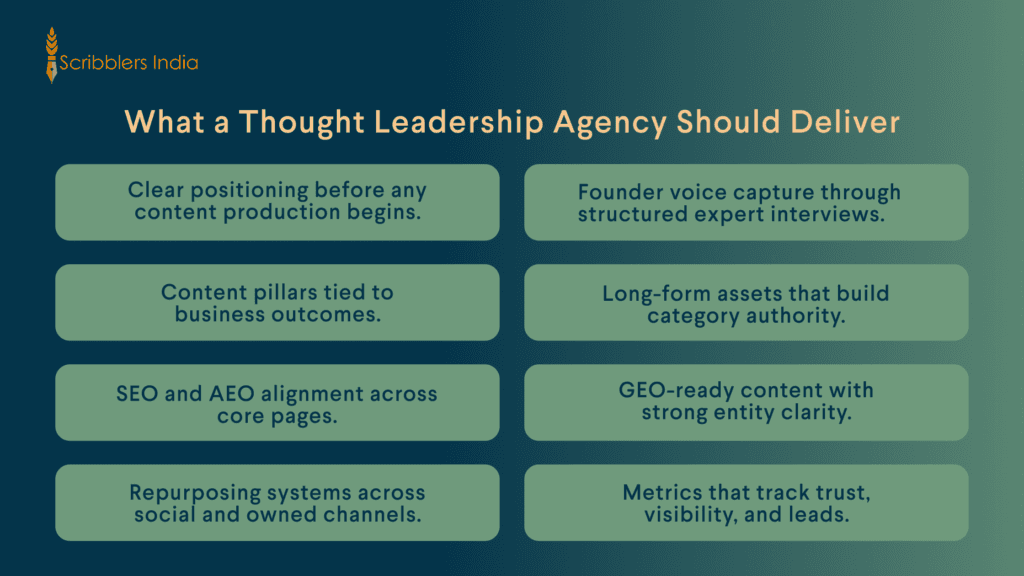
Scribblers India helps founders and brands build thought leadership that supports visibility, trust, and business growth. We combine positioning, founder voice capture, long-form writing, SEO, AEO, GEO, content refresh, and personal branding into one system. The goal is authority that compounds across search, social, AI, and sales.
Here is a cleaner version with varied sentence openings and less repetition.
- Strategy Before Content: Every engagement begins with positioning, audience questions, business goals, and the topics the brand should own. This gives the content a clear direction before the first calendar is built.
- Founder Voice Depth: Interviews, examples, stories, and opinion mapping help capture how founders and experts explain ideas. The result feels authentic and avoids the generic tone common in outsourced ghostwriting.
- Search and AI Readiness: Content is written for readers first, then structured for SEO, AEO, and GEO. Direct answers, credible references, internal links, FAQs, and entity clarity support better search and AI discovery.
- Long-Form Authority: Articles, reports, frameworks, case studies, and guides help build authority beyond social posts. These assets give serious buyers more depth before they speak to the brand.
- Ongoing Optimization: Regular reviews show what is working, what needs refinement, and where new content gaps are emerging. This keeps the thought leadership program relevant as audience needs and search behavior evolve.
Get in touch with our team to turn your expertise into thought leadership content that builds trust, visibility, and long-term authority.
Frequently Asked Questions
What does a thought leadership agency do?
A thought leadership agency helps founders, executives, consultants, and brands turn expertise into authority-building content. The work can include positioning, idea development, ghostwriting, long-form writing, content strategy services, and distribution planning. The goal is to build trust, visibility, and category relevance through useful expert-led content.
Why should founders work with a thought leadership agency?
Founders should work with a thought leadership agency when they have strong expertise but limited time to convert it into content. The agency captures their voice, shapes their ideas, and builds a consistent content system across articles, newsletters, and social media content. This helps founders earn trust from buyers, investors, partners, and talent.
How is thought leadership different from content marketing?
Content marketing usually focuses on attracting and converting audiences through useful content. Thought leadership goes deeper by building authority around a point of view, expertise, and original thinking. A strong content strategy can include both, with thought leadership creating trust and content marketing supporting discovery and conversion.
Can thought leadership improve SEO and AI search visibility?
Yes, thought leadership can improve SEO and AI search visibility when well structured. Clear answers, expert authorship, original frameworks, credible sources, and consistent topical coverage help search systems understand the brand. This works best when thought leadership is supported by strong content strategy services and regular content refreshes.
What types of content are best for thought leadership?
The best thought leadership formats include LinkedIn posts, long-form articles, newsletters, reports, case studies, frameworks, podcasts, webinars, and glossary pages. E-books also work well when the topic needs deeper education and are useful for authority-building campaigns. The right mix depends on the audience and business goal.
How do you measure thought leadership success?
Thought leadership success can be measured through profile visits, branded search growth, inbound inquiries, newsletter replies, speaking invitations, media mentions, AI citations, and sales conversations. Engagement metrics from your social media content still matter, but they should not be the only measure. The strongest programs connect visibility with business relevance.
How long does thought leadership take to work?
Thought leadership usually compounds over several months. Early signals may appear through engagement, profile visits, or inbound conversations, while stronger authority takes longer to build. Consistent publishing, strong positioning, useful ideas, and aligned content marketing services improve the chances of long-term visibility and trust.