
Content-led growth is a strategy where useful content drives discovery, trust, engagement, and customer acquisition. Instead of relying solely on ads or outbound sales, brands create content that helps buyers understand their problems, compare options, and make decisions before they speak with a sales team.
This has become more important because buyers conduct thorough research before contacting vendors. The 2025 Edelman-LinkedIn B2B Thought Leadership Impact Report found that 56% of target buyers and 55% of hidden buyers use thought leadership during vendor evaluation. The report drew insights from nearly 2,000 global professionals.
Search behavior is also changing. Google said at I/O 2026 that AI Overviews had more than 2.5 billion monthly active users. Google also said AI Mode had surpassed 1 billion monthly users globally, which shows why content must now support rankings, citations, and answer-led discovery.
Key Takeaways
|
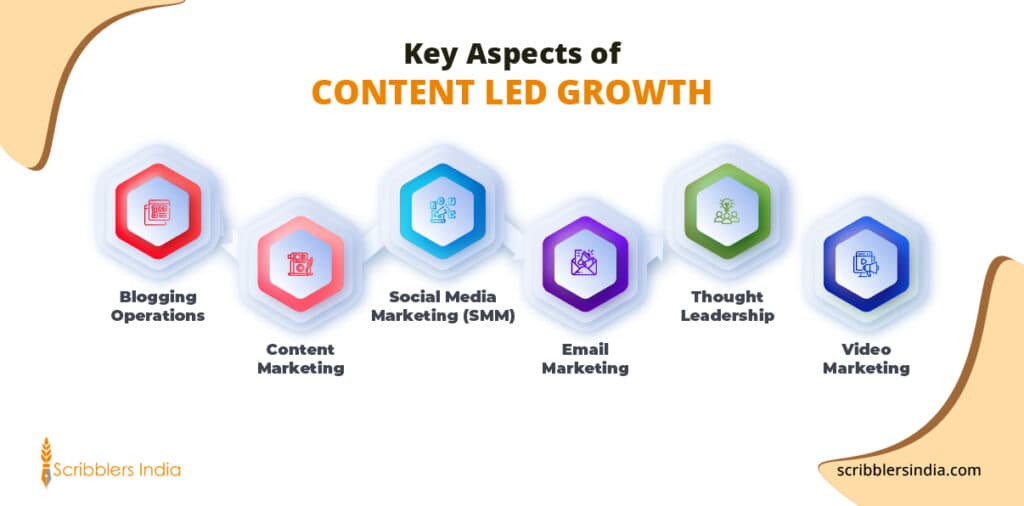
What Does Content-led Growth Involve?
Content-led growth uses valuable content as the primary engine to attract, educate, convert, and retain customers. It places content at the center of marketing strategy. The goal is to build trust before buyers reach the sales conversation.
This approach works because modern buyers want answers before they want pitches. They compare options, study frameworks, read founder views, check proof, and ask AI tools for recommendations. Helpful content reaches them during that research stage.
A strong content-led growth strategy does not publish random blogs. It maps content to buyer questions, funnel stages, search intent, sales objections, and authority gaps. Every content asset should support a clear business purpose.
| Content-led growth element | What it does | Why it matters |
| Audience research | Identifies buyer questions and decision triggers | Prevents generic content planning |
| SEO content | Builds organic search visibility | Captures high-intent demand |
| AEO content | Creates answer-ready content blocks | Supports direct extraction in answers |
| GEO content | Strengthens AI citation and mention potential | Improves generative search visibility |
| Thought leadership | Shares original ideas and expert views | Builds trust with serious buyers |
| Case studies | Prove outcomes and decision fit | Supports mid-funnel evaluation |
| Content refreshes | Updates older pages and examples | Protects existing search equity |
| Measurement | Tracks traffic, leads, citations, and revenue impact | Keeps strategy accountable |
Content-led brands win because they become useful before they become promotional. They earn attention by solving the questions buyers already have.
Why Is Content-led Growth More Important Than Traditional Campaigns?
Content-led growth is more critical than isolated campaigns because it compounds over time. Campaigns usually end when budgets stop. Useful content can continue to attract search traffic, buyer attention, AI citations, social engagement, and sales conversations long after publication.
Traditional campaigns often push messages toward audiences. Content-led marketing pulls buyers in through education, insight, and trust. That difference matters when customers do not want interruption during early research.
Content also creates a reusable asset base. A strong report can become blogs, LinkedIn posts, webinars, newsletter editions, sales decks, short videos, and AI-ready website sections. One well-developed idea can serve many channels.
- Longer asset life: Paid campaigns stop when spending stops, but useful content can keep working through search, links, referrals, and internal sales use. This makes content a stronger long-term asset when teams refresh and distribute it well.
- Better buyer education: Content helps buyers understand the problem before they evaluate a solution. Educated buyers ask better questions and move faster because they already understand the category, trade-offs, and decision criteria.
- Higher trust potential: Strong content gives buyers proof that the brand understands their world. This trust grows when the content includes examples, research, experience, frameworks, and credible viewpoints rather than surface-level advice.
- Lower dependence on paid acquisition: Content-led growth does not eliminate paid marketing, but it reduces overall dependence on it. A strong content base can support organic traffic, remarketing, email nurturing, sales enablement, and AI search visibility.
What Are the Main Benefits of Content-led Growth?
The main benefits of content-led growth include greater authority, improved organic visibility, higher buyer trust, reduced dependence on acquisition, and improved sales readiness. It also gives teams reusable assets that support search, social, email, sales, partnerships, and AI discovery benchmarking.
Content-led growth benefits increase when brands build a system rather than a publishing habit. A few useful assets can outperform large volumes of generic content when they answer important buyer questions deeply. The strongest benefits appear across the following five areas.
- Authority and trust: Consistent thought leadership content helps the brand become known for a defined topic. Buyers are more likely to trust companies that explain problems clearly before promoting solutions.
- Organic discovery: Search-ready blogs, glossary pages, comparison pages, and guides create more entry points for buyers. These pages can capture demand across educational, comparison, and decision-stage queries.
- AI search visibility: Answer-ready pages and source-worthy assets improve the brand’s ability to appear inside AI-generated answers. This is crucial as buyers use Google AI features, ChatGPT, Gemini, Perplexity, and other answer-led platforms.
- Sales enablement: Content helps sales teams address objections more clearly. Case studies, explainers, guides, and comparison assets give prospects useful material before and after meetings.
- Audience insight: Content performance reveals which questions, objections, and themes matter most to buyers. Teams can use those signals to improve messaging, product positioning, and future content planning.
What Are the Core Pillars of a Content-led Growth Strategy?
A content-led growth strategy needs audience insight, topic architecture, expert content, distribution, conversion planning, and measurement. These pillars help content support business growth rather than only publishing activity. Each pillar should connect with a defined buyer question or business goal.
The Content Marketing Institute’s 2025 B2B research found that only 29% of marketers with a documented content strategy rated it as extremely or very effective. This shows that having a plan is essential for effective execution and measurement.
A strong strategy should cover the following pillars.
- Topic and funnel mapping: Each content topic should support a buyer stage. Awareness pages explain problems, comparison pages support evaluation, and proof assets help buyers make decisions.
- SEO, AEO, and GEO planning: SEO improves page discovery, AEO helps content answer questions clearly, and GEO builds authority for generative search. These disciplines should work together rather than sit in separate workflows.
- Expert-led content creation: Buyers can find generic answers anywhere. Brands need original examples, founder views, customer lessons, research, and frameworks that make their content worth remembering.
- Distribution and repurposing: Publishing is not distribution. Strong teams turn one idea into multiple formats across search, LinkedIn, email, video, webinars, and sales enablement.
- Conversion pathways: Content should guide readers toward the right next step. That may be a consultation, a download, a newsletter, a case study, a demo, or a related educational page.
- Performance measurement: Teams should review traffic, rankings, leads, citations, assisted conversions, pipeline influence, and content quality signals.
Scribblers India’s content strategy services help brands consolidate these pillars into a single editorial system rather than treating blogs, SEO pages, thought leadership, and lead assets as separate projects. We map buyer questions, search intent, AEO opportunities, GEO priorities, internal links, and content refreshes into a clear roadmap.
How Does Content-led Growth Support AI Search Visibility?
Content-led growth supports AI search discovery by creating clear, useful, and credible information that engines can understand. Strong content helps AI platforms describe the brand, cite owned pages, and connect the company with relevant topics across buyer questions.
Latest AI search trends indicate the increased importance of content. Buyers can now ask tools to compare vendors, explain categories, summarize options, and recommend approaches. Brands need content that answers those questions directly and accurately.
Google AI Mode may consider several related questions before generating a single answer. This makes connected content more valuable. Brands need pillar pages, glossary pages, comparison guides, case studies, and expert articles that support the same topic from different angles.
- AEO improves extraction: Answer engine optimization services structure pages with direct answers, question-led headings, FAQs, definitions, tables, and concise explanations. These elements help both readers and answer systems find useful information faster.
- GEO strengthens authority: Generative engine optimization focuses on brand mentions, citation readiness, entity clarity, and external authority signals. This helps AI systems understand why a brand should appear in response to relevant prompts.
- Thought leadership adds source depth: Original insights, founder perspectives, research reports, and opinion-led assets give AI systems richer context. This matters when generated answers need expert viewpoints rather than commodity definitions.
- Content refreshes protect relevance: Older content can lose value when examples, data, or buyer needs change. Refreshing priority pages keeps source material accurate and useful for search engines, buyers, and AI platforms.
What Content Formats Work Best for Content-led Growth?
The best content-led growth formats answer buyer questions at different stages of the journey. Strong formats include pillar pages, glossary pages, comparison guides, case studies, thought leadership articles, e-books, newsletters, videos, and sales enablement assets. Each format plays a different role in growth.
Choosing formats without strategy leads to waste. A brand does not need every format immediately. It needs the formats that match buyer questions, team capacity, search opportunity, and sales needs.
| Content format | Best use case | Growth role |
| Pillar pages | Broad category education | Builds topical authority |
| Glossary pages | Definition-led queries | Captures early search intent |
| Comparison guides | Vendor or solution evaluation | Supports mid-funnel research |
| Case studies | Proof and outcome validation | Supports sales decisions |
| Thought leadership | Original viewpoint and trust | Builds category authority |
| E-books and reports | Deep education and lead capture | Creates durable authority assets |
| LinkedIn content | Founder-led visibility | Builds recall and distribution |
| Newsletters | Audience nurturing | Builds repeat engagement |
| Videos | Visual learning and product education | Simplifies complex topics |
| Sales enablement assets | Objection handling | Shortens decision cycles |
HubSpot Academy shows how education can support software adoption through free courses and lessons and Ahrefs Academy uses SEO education to help users understand its tools and the wider category. These content-led growth examples share a pattern. They use education to create trust, reduce friction, and build brand preference before the purchase decision.
How Do You Build a Content-led Growth Plan?
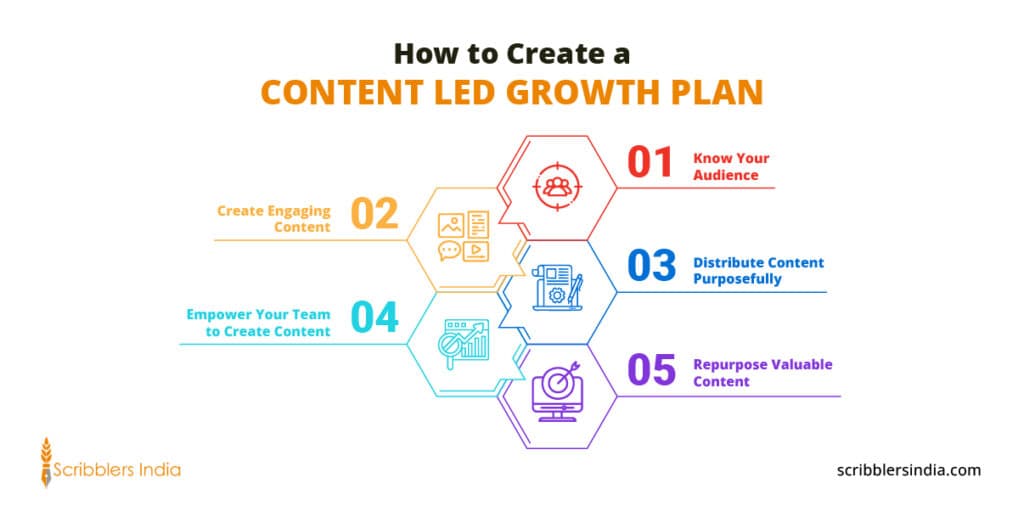
You have to build a content-led growth plan by identifying buyer questions, mapping topics to the journey, creating useful assets, distributing them properly, and measuring business impact. The plan should integrate content marketing and search visibility to build long-term authority.
A good plan starts with diagnosis. Brands should audit current content, rankings, AI visibility framework, sales objections, funnel gaps, and customer questions before creating a new calendar. This prevents teams from producing more content without fixing existing weaknesses.
The content-led growth strategy should follow a simple sequence.
- Step 1: Define buyer questions: Collect questions from sales calls, search terms, customer interviews, support conversations, community discussions, and AI search prompts. These questions show what buyers need before they trust your brand.
- Step 2: Map journey stages: Group questions into awareness, consideration, decision, onboarding, and retention stages. This prevents the blog from becoming awareness-heavy while sales teams lack comparison and proof assets.
- Step 3: Audit existing assets: Review old blogs, service pages, case studies, newsletters, videos, and downloadable resources. Many brands already have useful content that needs stronger structure, internal links, examples, and updated data.
- Step 4: Build topic clusters: Create pillar pages, supporting blogs, glossary pages, comparison assets, and proof-led content around priority themes. Internal links should guide readers from education to evaluation.
- Step 5: Add expert input: Bring in founders, product leaders, sales teams, customer success teams, or consultants. Real experience gives content a voice that generic research cannot replace.
- Step 6: Distribute intentionally: Repurpose core assets into LinkedIn posts, newsletters, email sequences, sales notes, webinars, short videos, and thought leadership pieces. Distribution should start before the content goes live.
Scribblers India’s content marketing services help brands turn this plan into a practical publishing and optimization system.
What Mistakes Slow Down Content-led Growth?
The biggest content-led growth mistakes include publishing without strategy, prioritizing volume, ignoring buyer intent, skipping distribution, underusing expert input, and measuring only traffic. These mistakes create activity without business impact. Strong teams build content around questions, proof, authority, and measurable growth.
Many brands fail because they treat content as output. They publish blogs, posts, and newsletters without asking what role each asset plays in the journey. The result is a large library with weak conversion value.
- Publishing without a clear strategy: Random content creates scattered visibility. A strategy should define topics, audiences, business goals, funnel stages, internal links, and expected outcomes before production begins.
- Chasing volume over usefulness: More content does not always lead to greater growth. Thin articles can dilute topical authority, confuse readers, and waste editorial resources that should strengthen priority pages.
- Ignoring decision-stage content: Many teams overproduce awareness blogs while buyers still need comparisons, case studies, pricing context, objections, and implementation guidance before choosing a vendor.
- Treating distribution as an afterthought: Publishing a blog is not enough. Strong distribution turns content into LinkedIn posts, newsletters, email nurture sequences, video scripts, sales materials, and founder-led commentary.
- Skipping expert interviews: Subject-matter experts add context, examples, and evidence. Without them, content often repeats the same advice already available across search results and AI answers.
- Measuring only traffic: Traffic matters, but growth needs stronger signals. Teams should track qualified leads, assisted conversions, engagement quality, referral sources, content-influenced pipeline, and AI search visibility.
How Should Brands Measure Content-led Growth?
Brands should measure content-led growth through search visibility, engagement quality, conversions, assisted pipeline, retention support, AI citations, and sales feedback. Traffic alone does not show whether content builds trust or influences revenue. Measurement should connect content activity with buyer movement.
The right metrics depend on content type and journey stage. A glossary page may support early discovery, a comparison guide may influence vendor evaluation, and a case study may help close a sales opportunity. Each asset needs a suitable measurement lens.
| Metric | What it shows | Review cycle |
| Organic traffic | Search discovery and reach | Monthly |
| Keyword movement | SEO progress across topics | Monthly |
| Prompt coverage | AI visibility across buyer questions | Monthly |
| AI citations | Source inclusion in generated answers | Monthly |
| Engagement quality | Scrolls, saves, comments, and shares | Monthly |
| Lead conversions | Form fills, calls, and enquiries | Monthly |
| Assisted pipeline | Content influence before sales | Quarterly |
| Sales feedback | Usefulness during conversations | Quarterly |
| Content refresh impact | Performance after updates | Quarterly |
| Retention support | Content value after purchase | Quarterly |
A practical content dashboard should separate leading and lagging indicators. Leading indicators include rankings, engagement, profile actions, and prompt coverage. Lagging indicators include pipeline, revenue influence, customer expansion, and retention.
The Scribblers India AI Visibility Scorecard can help teams track mentions, citations, answer accuracy, competitor presence, and prompt coverage besides traditional content metrics.
How Can Scribblers India Support Content-led Growth?
Scribblers India supports content-led growth by building strategy-led content systems for search, AI visibility, thought leadership, founder authority, and buyer education. We connect planning, writing, optimization, distribution, and refreshes so content becomes a growth asset rather than a publishing routine.
Our work starts with clarity. We identify what buyers ask, what competitors cover, where your current assets underperform, and which topics support business outcomes. Then we turn those findings into content priorities.
- Content strategy and gap analysis: Scribblers India reviews existing pages, buyer questions, competitor coverage, ranking gaps, and AI visibility gaps. The output becomes a practical roadmap for new content, content refreshes, and internal linking improvements.
- SEO, AEO, and GEO content planning: Our team builds content around traditional search, answer extraction, and generative search visibility. This helps priority pages improve rankings, AI citations, brand mentions, and buyer clarity.
- Thought leadership content: We turn founder and expert knowledge into articles, opinion essays, frameworks, and research-led assets. This thought leadership content strategy strengthens authority and gives buyers more reasons to trust the brand.
- Founder personal branding: Content-led growth often improves when visible leaders explain market shifts. Our personal branding services help founders build public authority across LinkedIn, bylines, interviews, and long-form assets.
- E-books and authority assets: Scribblers India creates e-books, reports, guides, and downloadable resources that support lead capture, sales enablement, and category education. These assets give the content program greater depth than blogs alone can.
- Content refresh planning: Older pages often hold the fastest growth opportunity. We update direct answers, examples, sources, internal links, structure, and conversion paths so existing search equity does not weaken over time.
Get in touch with our team today and start building a content-led growth strategy that connects search, AI visibility, thought leadership, and measurable business outcomes for your brand.
Final Take on Content-led Growth Strategy
Content-led growth works when brands stop treating content as a publishing checklist. The strategy should help buyers solve problems, compare choices, trust expertise, and move toward a decision. That requires content depth, consistency, measurement, and regular improvement.
The strongest brands build content systems, not isolated assets. They connect SEO with AEO, GEO, thought leadership, founder visibility, case studies, and sales enablement. Each asset strengthens the next one through internal links, audience recall, and topic authority.
As AI changes discovery, content must become easier to understand, cite, and trust. Brands that invest in useful content now will build a stronger foundation for rankings, generated answers, referrals, and buyer confidence across the next phase of search.
Frequently Asked Questions
What Is Content-led Growth in Simple Terms?
Content-led growth is a strategy where useful content helps attract, educate, convert, and retain customers. Instead of relying only on ads or outbound sales, brands publish content that answers buyer questions. This content builds trust, improves search visibility, supports sales conversations, and creates long-term business value.
How Is Content-led Growth Different From Content Marketing?
Content marketing usually focuses on creating and distributing useful content. Content-led growth goes further by making content central to acquisition, conversion, retention, and product education. It connects content with business outcomes, sales enablement, search visibility, AI discovery, customer education, and long-term authority.
How Long Does a Content-led Growth Strategy Take to Work?
A content-led growth strategy can show early movement in three to six months through traffic, rankings, engagement, and inquiries. Stronger business results often take nine to twelve months because authority compounds over time. The timeline depends on competition, publishing quality, distribution, refreshes, and existing domain strength.
Which Businesses Benefit Most From Content-led Growth?
B2B companies, SaaS brands, professional services, consulting firms, EdTech companies, fintech brands, healthcare providers, and complex product businesses often benefit most. These buyers usually research before purchase. Content helps them understand the problem, compare solutions, trust expertise, and feel more confident before contacting sales.
How Do You Measure Content-led Growth ROI?
Measure content-led growth ROI through organic traffic, keyword movement, qualified leads, assisted conversions, sales feedback, referral quality, and pipeline influence. Also track AI citations, prompt coverage, and answer accuracy where AI search matters. The best measurement connects content performance with buyer movement, not only website visits.
What Content Formats Are Best for Content-led Growth?
The best formats include pillar pages, glossary pages, comparison guides, case studies, thought leadership articles, e-books, newsletters, webinars, videos, and sales enablement assets. Each format should match a buyer question or journey stage. Strong formats work together through internal links, repurposing, and distribution.
Can Small Businesses Use Content-led Growth Effectively?
Yes, small businesses can use content-led growth by focusing on narrow topics, strong examples, and buyer questions. They do not need a large publishing team at the start. A focused cluster of useful assets can outperform broad content volume when it supports a clear market position.
How Does AI Search Change Content-led Growth?
AI search changes content-led growth because buyers can get summaries before clicking websites. Brands now need content that is clear, structured, credible, and source-worthy. AEO and GEO help pages support answer extraction, citations, mentions, and accurate brand descriptions across AI-led search platforms.
What Mistakes Should Brands Avoid in Content-led Growth?
Brands should avoid publishing without strategy, chasing volume, ignoring buyer intent, skipping distribution, and measuring only traffic. They should also avoid thin content that repeats common advice. Strong content-led growth needs expert input, clear internal links, useful examples, conversion pathways, and regular refreshes.
Why Choose Scribblers India for Content-led Growth?
Scribblers India helps brands build content-led growth through content strategy, SEO, GEO, AEO, thought leadership, LinkedIn personal branding, and authority assets. Our team connects buyer questions with useful content and measurable outcomes. The goal is stronger visibility, better trust, and content that supports business growth.