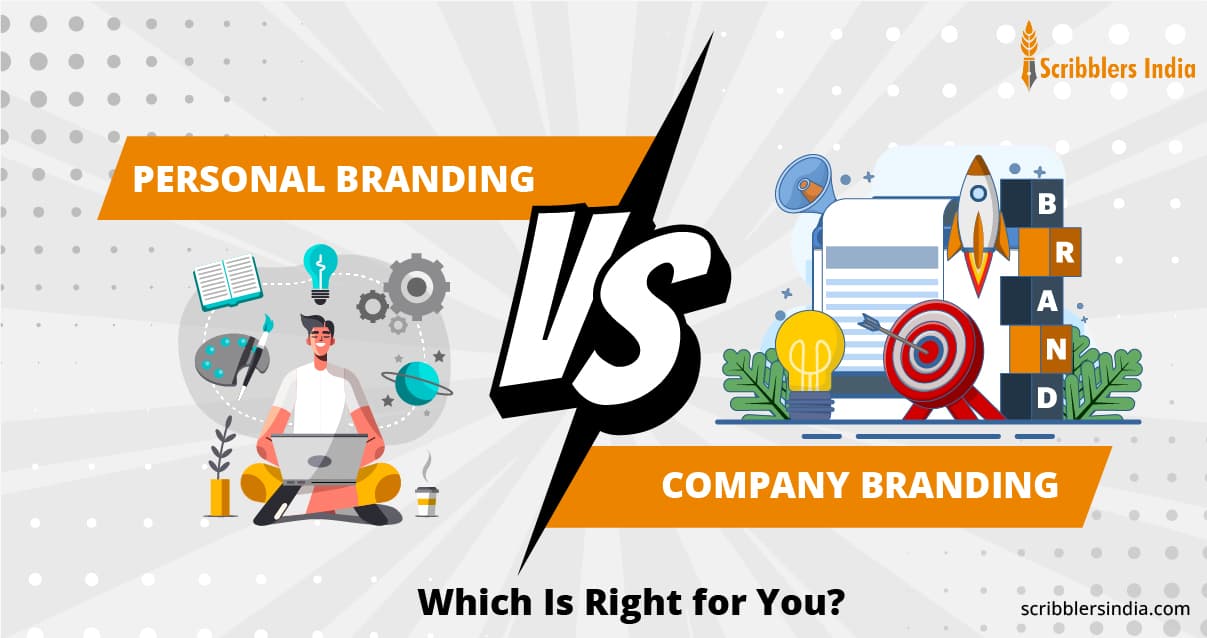
Personal branding vs company branding determines where professional reputation, trust, and recognition accumulate. A personal brand builds those assets around an individual, while a company brand builds them around the organization. Early-stage businesses may rely more heavily on founder visibility, while growing companies usually need more institutional proof and recognition.
A founder can become the strongest source of attention for a company. Their posts travel further, their perspective gives the category a human voice, and customers begin associating the business with the person behind it. That can be useful in the early stages.
The equation changes as the company grows. Buyers start evaluating the team, delivery capabilities, customer experience, product, proof, and the organization’s longevity. A business that remains inseparable from one founder can eventually create a different problem.
That is the real decision behind personal branding vs company branding. The question is less about choosing a winner and more about deciding where trust should sit at this stage of the business and where it needs to move next.
This guide explains which brand should lead at different stages of the company, how both brands can reinforce each other, and how to manage the risks that arise when an individual and an organization share public visibility.
Key Takeaways
|
Personal Branding vs Company Branding: What Is the Practical Difference?
The practical difference between personal branding vs company branding is where reputation accumulates, who owns it, and whether it can move with an individual. A personal brand belongs primarily to the professional. A company brand belongs to the organization and should remain valuable through normal changes in leadership.
A personal brand belongs to an individual. It develops through visible expertise, professional experience, opinions, relationships, public contributions, and evidence connected to that person. If the individual changes companies, the reputation can travel with them.
A company brand belongs to the organization. It develops through positioning, products or services, customer experience, employees, company content, visual identity, proof, and repeated market interactions. Its long-term value depends on the organization remaining recognizable beyond any individual leader.
Forbes Books draws a similar distinction between corporate branding, which centers the organization, and personal branding, which elevates an individual professional identity. Its broader conclusion is that business leaders may need both assets rather than treating one as a substitute for the other.
Personal Branding vs Company Branding: Comparative Analysis
The important differences between these strategies become clearer when the two are compared operationally.
| Area | Personal Brand | Company Brand |
| Primary owner | Individual professional | Organization |
| Core reputation source | Expertise, experience, judgment, personality | Offer, delivery, customer experience, organizational evidence |
| Portability | Travels with the individual | Remains with the organization |
| Editorial freedom | Usually broader and more personal | Usually governed by company positioning and policies |
| Primary proof | Experience, ideas, work, recommendations, achievements | Customers, products, team, processes, cases, market record |
| Continuity risk | Dependent on one person’s activity and reputation | Can survive leadership changes when institutionalized |
| Best early role | Humanize expertise and establish recognition | Clarify the business and provide institutional credibility |
| Long-term role | Maintain individual authority and relationships | Accumulate durable company recognition and trust |
This brand-and-company difference becomes especially important for founders because the individual and the business often begin with considerable overlap. A solo consultant may effectively be the business. A funded company with 300 employees has a very different brand architecture. Treating both situations the same leads to poor allocation decisions.
That is why the next question should be which factors determine where the emphasis belongs.

Should You Prioritize Personal Branding or Company Branding?
You should prioritize personal branding when individual expertise, judgment, or relationships drive evaluation. Prioritize company branding when buyers increasingly depend on organizational proof, team depth, delivery capability, and continuity. Company maturity and the future ownership of trust should determine the final balance.
1. Who Does the Audience Believe It Is Buying?
Start with the buyer’s evaluation process.
For a consultant, coach, advisor, creative professional, recruiter, or specialist firm, the buyer may be evaluating the individual directly. The person’s judgment, experience, and working style form part of the offer.
In those situations, the personal brand deserves substantial attention because separating the person from the service creates little practical value.
The balance changes when buyers evaluate an organization. Enterprise software, financial services, manufacturing, managed services, healthcare systems, and larger professional-services engagements may involve several stakeholders. They need confidence in their delivery beyond a single visible leader.
A strong founder brand can still create attention, while the company brand must answer the institutional questions that follow.
2. How Much of the Sale Depends on Personal Trust?
Some sales begin with the expert.
A founder explains an emerging category. A consultant publishes a useful framework. An executive discusses a shift affecting the market. These contributions can give prospective buyers a useful way to assess how the person thinks before any formal conversation.
That does not mean every company should become founder-led. It means the personal brand can play a larger role where expertise influences evaluation.
The distinction between personal and corporate branding becomes sharper as organizational proof carries more weight than personal familiarity.
3. What Stage Has the Company Reached?
Early companies often have limited institutional proof. The founder may have the stronger network, deeper category knowledge, and more recognizable voice.
As the company gains customers, employees, products, proprietary knowledge, case evidence, and additional leaders, it has more material from which to build its reputation.
Brand investment should follow that progression.
A company with significant organizational evidence should gradually make more of that evidence visible, rather than continuing to route every idea, relationship, and proof point through the founder.
4. How Visible Does the Founder Want or Need to Be?
Founder visibility is an operating commitment.
Publishing, interviews, events, media participation, community engagement, and thought leadership require time and review. Some founders have both the inclination and expertise to play that role consistently. Others create greater value elsewhere.
A company should avoid designing its entire marketing system around a founder who has little capacity or interest in sustained public participation.
The brand system has to match the people available to operate it.
5. Where Should the Reputation Live Five Years From Now?
This is one of the most useful questions in personal branding vs company branding.
If the company plans to scale beyond the founder, build an executive bench, enter institutional buying environments, pursue acquisition, or prepare for leadership succession, more recognition eventually needs to reside with the company.
If the professional expects to move between companies, advisory roles, speaking, investing, or independent work, the portable personal brand carries greater strategic importance.
The correct balance, therefore, depends partly on who should still own the reputation as today’s operating structure changes.
Personal Branding vs Company Branding by Business Stage
Most comparison articles eventually recommend “both.” That answer is directionally reasonable and operationally incomplete. Personal branding and company branding can both exist at every stage while carrying very different responsibilities.
The following matrix analysis will help you make a practical allocation:
| Stage | Brand That Should Usually Lead | Supporting Brand Role | Primary Risk to Watch |
| Solo expert or consultant | Personal brand | Business identity creates professional structure | Building unnecessary separation from the expertise buyers actually want |
| Founder-led startup | Personal brand can lead category visibility | Company explains product, proof, and offer | Company becomes indistinguishable from founder |
| Growth-stage company | Increasingly balanced | Multiple leaders and company evidence build institutional trust | Founder remains the only recognizable authority |
| Mature company | Company brand generally leads | Executives contribute specialized expertise | Company communication becomes anonymous or detached |
| Acquisition, succession, or exit | Company continuity becomes crucial | Founder brand transitions independently | Reputation cannot transfer when leadership changes |
Solo Expert or Consultant
For a solo expert, personal branding vs company branding is often an unnecessary binary.
Clients may be hiring the individual directly. A company name, website, service framework, and visual system can professionalize the offering, while the person’s expertise remains the primary asset for reputation.
Trying to hide that expertise behind an institutional voice can make the business harder to evaluate.
The priority is clarity: who the person helps, what expertise they bring, which problems they address, and what evidence supports that position.
Founder-Led Startup
At an early startup, the founder may possess assets the company has not yet accumulated: a network, category expertise, professional history, operating lessons, or a point of view about the problem being solved.
Using that voice can help explain an unfamiliar category and create context around the company.
The company brand should develop alongside it from the beginning. Product pages, customer evidence, team expertise, company research, positioning, and customer experience should gradually build recognition that does not require the founder to introduce themselves in every interaction.
Founders who are still deciding whether their individual reputation warrants greater investment can use our guide to determine when personal branding becomes strategically useful.
Growth-Stage Company
Growth creates the most important transition.
The company now has more employees, customers, partners, product knowledge, and internal specialists. Continuing to make the founder the exclusive public authority leaves much of that institutional expertise unused.
This is the stage where personal branding vs company branding should begin shifting toward a portfolio model.
The founder can retain a clear area of expertise. Other executives can develop relevant professional voices. The company can own customer evidence, product communication, employer reputation, research, and category resources.
This distribution reduces concentration on a single person while giving audiences several credible entry points into the organization.
Mature Company
At maturity, the organization needs a reputation that can withstand normal leadership changes.
Customers should understand the company’s capabilities. Employees should recognize its culture and direction. Partners should be able to evaluate the institution. Market authority should exist across customer evidence, research, teams, products, and multiple experts.
Visible executives can still strengthen the company. Their role becomes more specialized and governed.
For senior leaders operating under those conditions, our guide to executive branding explains how stakeholder complexity, governance, and reputation risk change the personal-brand model.
Acquisition, Succession, or Founder Exit
A company that expects a leadership transition eventually faces a difficult question: What remains when the visible founder leaves?
Customer relationships, market reputation, intellectual property, category knowledge, community, content assets, and trust should have meaningful institutional expression before a transition occurs.
The founder’s personal brand may continue into a new role. The company needs sufficient independent equity to remain understood without the same person at the center.
This is where transferability becomes one of the most important differences between a personal brand vs corporate brand.
How Should Personal and Company Brands Work Together?
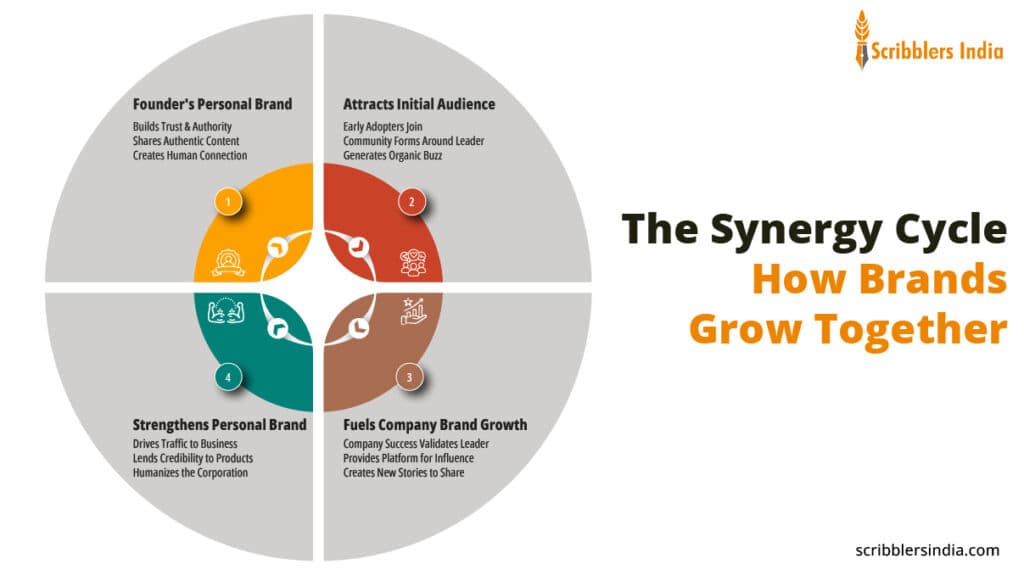
Effective personal branding vs company branding management requires coordination rather than duplication. If every founder post repeats the company account, audiences have little reason to follow both. If the founder discusses themes completely unrelated to the business, the company derives limited benefit from that visibility.
The two brands should share selected strategic foundations while preserving different forms of expression.
| Shared Element | What Alignment Means |
| Category narrative | Both explain the market and problem using compatible logic |
| Core facts | Product, customer, company, and performance claims remain consistent |
| Expertise themes | Individual topics connect naturally with areas the organization understands deeply |
| Evidence standards | Important claims rely on credible sources and approved company information |
| Strategic direction | Public communication avoids contradicting major company commitments without deliberate reason |
What Can Remain Distinct
The founder or executive should still have an individual voice. Personal experiences, career lessons, interests, leadership observations, and informed opinions can make a personal brand richer than a company’s editorial calendar.
The company has different responsibilities. It needs to communicate product information, customer proof, organizational news, employer messaging, operational expertise, and broader institutional knowledge.
A useful test is whether each account or content asset gives the audience a distinct reason to engage.
Create Content Handoffs Instead of Duplicate Posts
A company research report can become the evidence base for an executive interpretation. A founder’s observation can identify a question worth exploring through company research. A customer case can inform an executive discussion of a broader industry problem.
These handoffs allow intellectual property to move between personal and company channels while adjusting the angle based on who is speaking.
The 2025 Edelman-LinkedIn B2B Thought Leadership research found that 56% of target buyers and 55% of hidden buyers use thought leadership during vendor evaluation. That supports a useful role for expert-led ideas inside a wider company buying journey, without making executive content responsible for the entire decision.
Where executives need a more structured system for developing those ideas, thought leadership services can help convert internal expertise into market-relevant arguments while the company retains its own communication role.
The Founder-Dependence Problem
The risk of personal branding vs company branding arises when one brand becomes the only meaningful source of trust.
Founder visibility can create considerable value. The issue arises when the company fails to develop mechanisms to maintain the reputation the founder helped create.
Watch for these signals:
- Prospects repeatedly ask to work directly with the founder despite a capable wider team.
- Industry audiences recognize the founder while struggling to explain what the company itself represents.
- Important relationships sit primarily in the founder’s personal network.
- Company content relies on reposting one person’s ideas rather than developing institutional expertise.
- Requests for speaking, media, community, and partnerships rarely involve other leaders.
- Customers view the founder’s involvement as necessary proof that delivery will meet expectations.whi
These patterns indicate concentration.
The response should be gradual rather than suppressing the founder’s visibility. Transfer relevant trust into the organization by making team expertise visible, strengthening customer evidence, developing proprietary company assets, giving other leaders defined public roles, and building recognizable company-level intellectual property.
The founder can continue to carry authority while the business becomes more capable of holding some of it independently.
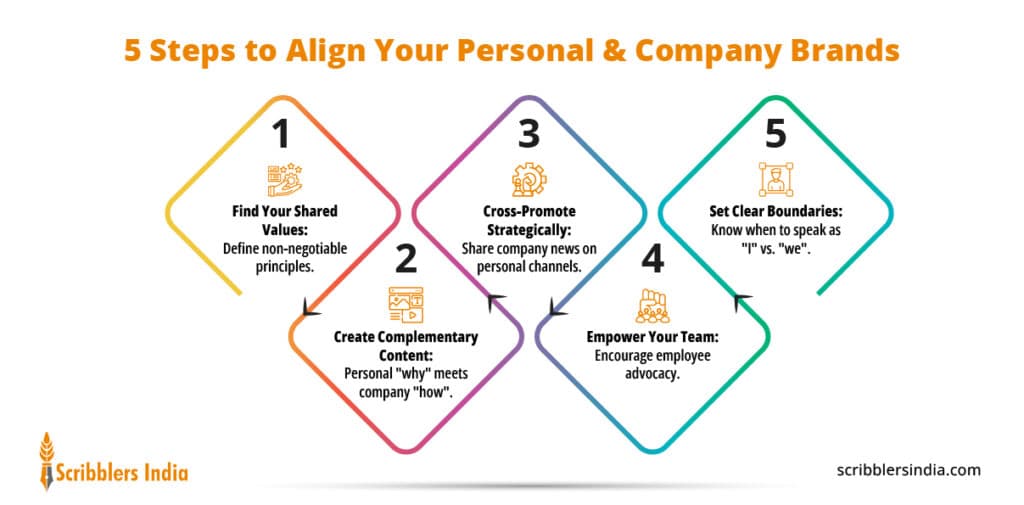
The important shift is to treat trust transfer as an operating process. Team expertise, customer proof, company-owned research, additional spokespersons, and institutional intellectual property should gradually reduce the concentration of reputation around a single founder.
Where Can Personal and Company Branding Alignment Break Down?
Alignment sounds simple until the individual and organization face different incentives. The most useful personal branding vs company branding strategy therefore needs boundaries as well as shared themes.
| Scenario | Potential Problem | Practical Response |
| Founder comments on a sensitive company issue | Personal opinion may be interpreted as official policy | Establish which subjects require communications, legal, or leadership review |
| Executive develops interests beyond company positioning | Company audience may struggle to understand relevance | Separate personal expertise themes from official organizational claims |
| Company changes market direction | Old founder content may reinforce previous positioning | Update core profiles and create context around the strategic shift |
| Founder becomes publicly controversial | Reputation can spill into company evaluation | Assess issue, stakeholder impact, response ownership, and necessary separation |
| Executive leaves the organization | Content and followers remain attached to the person | Maintain company-owned proof, research, customer assets, and multiple visible leaders |
| Company account copies executive content continuously | Audiences receive duplicate value | Give company channels distinct editorial responsibilities |
The right level of governance depends on the role and industry.
A founder of a small consultancy may operate with considerable freedom. A public-company executive, financial-services leader, healthcare professional, or regulated-sector spokesperson may require much clearer boundaries for review.
The objective is to preserve useful individual perspective while preventing ambiguity about who is speaking and in what capacity.
How Should You Allocate Personal and Company Branding Efforts?
Use the following checklist to decide where the immediate emphasis belongs. Give one point to the personal brand column or company brand column each time the statement fits your current situation more closely.
| If This Is True | Prioritize |
| Buyers choose primarily based on your expertise or judgment | Personal brand |
| Your category requires considerable founder-led explanation | Personal brand |
| Your professional reputation is stronger than company recognition | Personal brand |
| You expect independent speaking, advisory, investing, or career opportunities | Personal brand |
| Buyers increasingly evaluate team depth and delivery systems | Company brand |
| Multiple leaders can credibly represent different expertise areas | Company brand |
| The company needs to operate independently of the founder | Company brand |
| Acquisition, succession, or leadership transition is becoming relevant | Company brand |
| Founder visibility already generates attention, while company proof remains weak | Company brand |
| The company is established, while senior expertise remains invisible | Personal/executive brand |
Mostly Personal-Brand Signals
Spend the next 90 days clarifying positioning, strengthening professional proof, publishing expertise, and developing one or two channels where relevant audiences already spend time. For LinkedIn-specific implementation, use our LinkedIn personal branding playbook rather than turning this comparison article into a platform guide.
Mostly Company-Brand Signals
Prioritize customer evidence, positioning, product or service clarity, team visibility, institutional content, and company-owned authority assets. Identify which forms of trust currently disappear when the founder is removed from the customer journey.
A Balanced Score
A balanced result usually indicates that each brand needs a clearer job. Assign expertise territories to visible leaders and define which subjects, evidence, and communication tasks belong to the company. The objective is coordination with enough separation to create two valuable assets.
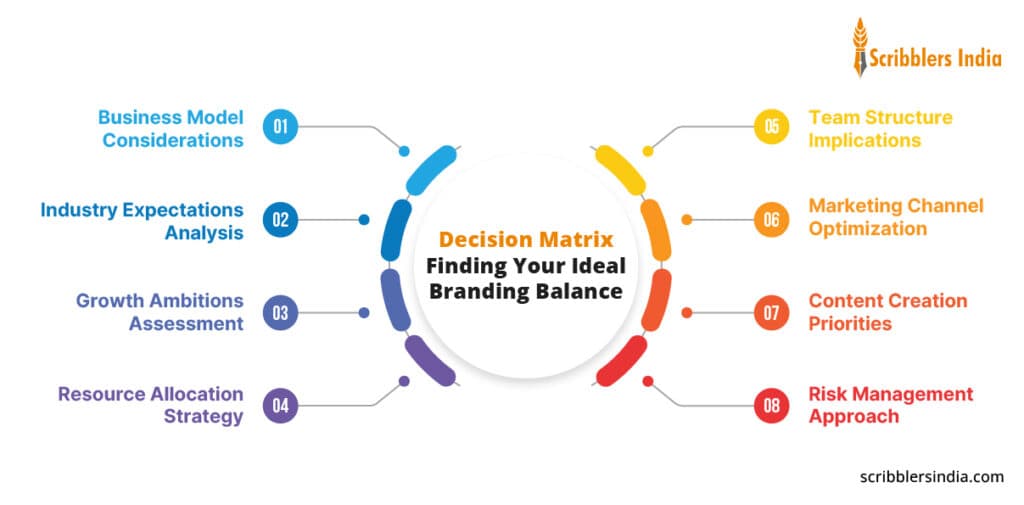
Build the personal brand first when people primarily need to trust the individual and then focus on the company brand aggressively when people increasingly need to trust the organization without that individual being present. Develop both deliberately when the founder still drives attention, but the company must gradually become capable of holding that trust independently.
Personal Branding vs Company Branding: Which Should You Build First?
The answer to personal branding vs company branding depends on the current concentration of trust and the future structure of the business.
A solo expert can rationally make the personal brand dominant. A founder-led startup can leverage individual expertise to create market context while developing proof of concept. A growth-stage business should begin distributing authority across the institution. A mature company needs recognition that remains credible through normal leadership changes.
The transition rarely requires turning off one brand.
Instead, decide what the personal brand should continue to own, what the company needs to own independently, and which forms of trust must gradually move from one to the other.
For founders and executives who need structured positioning, content, and visibility support, Scribblers India’s personal branding services can help build the individual layer while keeping the wider company narrative in view.
Get in touch with our team today to learn more.
Frequently Asked Questions
What Happens to a Founder’s Personal Brand After an Acquisition or Exit?
The personal reputation typically remains associated with the founder, while company-owned assets remain with the organization under the applicable agreements and ownership structure. Before a transition, clarify which intellectual property, channels, content, relationships, and public associations belong to each brand. The founder may also need to reposition gradually around the next professional chapter.
Can a Company Build Several Executive Brands Without Weakening the Corporate Brand?
Yes, when each leader has a defined area of expertise and the public narratives remain compatible with the organization’s strategy. Several visible executives can make a company’s expertise easier to access for different audiences. Clear topic ownership, factual standards, disclosure rules, and communication boundaries help prevent duplicated content or contradictory company claims.
How Should a Company Respond When a Founder’s Public Position Conflicts With Company Messaging?
Start by determining the nature of the conflict. A difference in personal perspective requires a different response from an inaccurate company claim, regulatory concern, or reputational incident. Clarify who owns the response, which stakeholders are affected, and whether the founder was speaking personally or as an organization. Higher-risk situations may require involvement from communications, legal, or leadership.
Should a Company Repost Every Founder or Executive Post?
Usually, no. Automatic reposting can make the company channel a duplicate of the executive profile. Share or adapt individual content when it advances a company-relevant discussion. Company channels should still publish customer evidence, product knowledge, research, team expertise, and institutional perspectives that create an independent reason to follow the organization.
How Can a Founder Gradually Transfer Trust to the Company Brand?
Start by identifying which trust signals remain concentrated around the founder. These may include expertise, relationships, proof, speaking visibility, or category knowledge. Then make organizational evidence more visible through customer stories, team experts, proprietary frameworks, research, stronger company content, and additional spokespersons. Trust transfer works best as a gradual expansion of credible sources inside the company.