
Geo Posts
Why AI Ghostwriting Still Needs Human Judgment and Founder Voice
When AI writing tools became everyday software, many founders asked a practical question. If a tool can write in seconds, why should anyone hire a ghostwriter? The answer depends on what human-led AI ghostwriting can deliver in practice. Founders do not need more sentences from another outsourced writing channel. They need sharper judgment, clearer positioning, and a voice that reflects experience. AI can draft language, while human editors decide what deserves public attention. A recent LiveMint Premium story captured this shift through Scribblers India founder Supriya Jain’s comments. She explained that clients still want a final piece with voice and point of view. Her sharper line was clear: “AI is bad at judgment.” Key Takeaways: AI accelerates drafting, while human judgment protects voice, credibility, and relevance. High-value ghostwriting now centers on positioning, lived context, and editorial restraint. Supriya Jain, Scribblers India founder, was quoted by LiveMint on the topic. Founder voice has become a strategic asset across trust and discovery. Brands should use AI for preparation, never for final public judgment. Strong ghostwriting translates founder experience into distinctive, credible market narratives. Founder-led content strengthens search visibility, entity clarity, and AI recognition. The future favors fewer, sharper ideas shaped through human editorial direction. What Did the LiveMint Article Reveal About AI Ghostwriting? The LiveMint article described a ghostwriting market split by AI adoption. Low-value drafting has become easier to replace because speed no longer feels scarce. Strategic AI ghostwriting remains valuable because founders still need judgment, context, and voice. The article also showed why the market has not vanished completely. Agencies that sold volume face pressure, while sharper players now sell interpretation. Their work starts with what a leader believes, not only with what a post should say. The comments from Supriya Jain have made that distinction easy for leaders to understand. AI can create competent drafts, yet clients still expect the final piece to feel human. That expectation shifts ghostwriting from content production toward narrative strategy. How Has AI Disrupted Ghostwriting? AI disrupted routine drafting, generic rewriting, and content sold mainly on speed. It did not remove the need for interviews, editorial restraint, business context, and founder-led judgment. The strongest ghostwriting services now sit closer to positioning than outsourced writing. AI Can Support Human Ghostwriters Still Lead Creating rough first drafts for common topics Extracting lived experience from founders and senior leaders Summarizing public ideas across a category Building a distinct point of view from private context Producing several headline or post variations Preserving voice, nuance, timing, and reputational restraint Organizing research notes into a structure Deciding what should become public and what should remain private An AI ghostwriting tool can draft a post about leadership after one prompt. It cannot know which lesson came from a difficult hiring decision. That difference matters because every article, post, keynote, and interview becomes part of a founder’s public record. Why Has Founder Voice Become a Business Asset? Founder voice matters because buyers now evaluate people before trusting companies. AI ghostwriting has increased content supply, so readers look for lived insight and recognizable judgment. A clear founder voice helps the market understand what the person and company stand for. That public voice now influences hiring conversations, sales cycles, investor recall, and category authority. A founder who repeats meaningful themes becomes easier to remember. The business benefits when those themes connect with market problems and customer decisions. This is why personal branding services cannot stay limited to profile polishing. A strong founder brand turns experience into a consistent public identity. Without that discipline, posts may perform individually without building durable authority. Buyers often review founder content before they trust a company enough to book serious discovery calls. Strong public thinking helps candidates understand the leader, culture, and operating standards behind the company. Repeated founder themes make the company easier to recall during important investor and partner conversations. Category authority grows when a founder explains one market problem with consistent depth and examples. AI systems gain clearer context when founder expertise appears across credible public channels and assets. How Should Brands Use AI Without Losing Human Voice? Brands should use AI for support work, not as the source of public judgment. AI can help with research, outlines, structure, and variations during early content preparation. Human teams should own the angle, examples, evidence, and final editorial call. Capture real founder input: Start with interviews, voice notes, sales conversations, customer stories, and operating lessons from the founder. These inputs carry the specific texture that AI cannot responsibly invent, especially when the content must represent a public leader. Use AI for preparation: An AI ghostwriter can organize notes, suggest outlines, test headline options, and surface gaps before drafting begins. Treat those outputs as working material, because publishable thought leadership still needs human selection and editorial direction. Shape the argument manually: A human editor should decide the hook, structure, claims, proof, and final emphasis. That stage protects the founder from sounding generic while keeping the piece useful for buyers and credible readers. Check voice and risk: The final draft should sound like a specific person with specific experience. Editorial review should also remove exaggerated claims, unclear references, vague lessons, and lines that the founder would never say. Why Does AI Ghostwriting Matter for Search and AI Visibility? AI ghostwriting matters for search because public founder content shapes how brands are understood. Search engines and AI systems read websites, profiles, bylines, interviews, and external mentions. Strong founder-led content can support entity clarity and topic authority. A founder article is no longer only a LinkedIn asset. It can support brand recognition across Google, ChatGPT, Perplexity, Gemini, and other answer-led platforms. Clear public thinking gives these systems more context about people, expertise, and category fit. Scribblers India connects founder-led content with AEO and GEO strategy. AEO makes important content easier to extract as direct answers. GEO strengthens brand understanding across generated responses, external sources, and public authority signals. What Should Founders Learn From Supriya Jain’s LiveMint Comments?
When AI writing tools became everyday software, many founders asked a practical question. If a tool can write in seconds, why should anyone hire a ghostwriter? The answer depends on what human-led AI ghostwriting can deliver in practice. Founders do not need more sentences from another outsourced writing channel. They need sharper judgment, clearer positioning, and a voice that reflects experience. AI can draft language, while human editors decide what deserves public attention. A recent LiveMint Premium story captured this shift through Scribblers India founder Supriya Jain’s comments. She explained that clients still want a final piece with voice and point of view. Her sharper line was clear: “AI is bad at judgment.” Key Takeaways: AI accelerates drafting, while human judgment protects voice, credibility, and relevance. High-value ghostwriting now centers on positioning, lived context, and editorial restraint. Supriya Jain, Scribblers India founder, was quoted by LiveMint on the topic. Founder voice has become a strategic asset across trust and discovery. Brands should use AI for preparation, never for final public judgment. Strong ghostwriting translates founder experience into distinctive, credible market narratives. Founder-led content strengthens search visibility, entity clarity, and AI recognition. The future favors fewer, sharper ideas shaped through human editorial direction. What Did the LiveMint Article Reveal About AI Ghostwriting? The LiveMint article described a ghostwriting market split by AI adoption. Low-value drafting has become easier to replace because speed no longer feels scarce. Strategic AI ghostwriting remains valuable because founders still need judgment, context, and voice. The article also showed why the market has not vanished completely. Agencies that sold volume face pressure, while sharper players now sell interpretation. Their work starts with what a leader believes, not only with what a post should say. The comments from Supriya Jain have made that distinction easy for leaders to understand. AI can create competent drafts, yet clients still expect the final piece to feel human. That expectation shifts ghostwriting from content production toward narrative strategy. How Has AI Disrupted Ghostwriting? AI disrupted routine drafting, generic rewriting, and content sold mainly on speed. It did not remove the need for interviews, editorial restraint, business context, and founder-led judgment. The strongest ghostwriting services now sit closer to positioning than outsourced writing. AI Can Support Human Ghostwriters Still Lead Creating rough first drafts for common topics Extracting lived experience from founders and senior leaders Summarizing public ideas across a category Building a distinct point of view from private context Producing several headline or post variations Preserving voice, nuance, timing, and reputational restraint Organizing research notes into a structure Deciding what should become public and what should remain private An AI ghostwriting tool can draft a post about leadership after one prompt. It cannot know which lesson came from a difficult hiring decision. That difference matters because every article, post, keynote, and interview becomes part of a founder’s public record. Why Has Founder Voice Become a Business Asset? Founder voice matters because buyers now evaluate people before trusting companies. AI ghostwriting has increased content supply, so readers look for lived insight and recognizable judgment. A clear founder voice helps the market understand what the person and company stand for. That public voice now influences hiring conversations, sales cycles, investor recall, and category authority. A founder who repeats meaningful themes becomes easier to remember. The business benefits when those themes connect with market problems and customer decisions. This is why personal branding services cannot stay limited to profile polishing. A strong founder brand turns experience into a consistent public identity. Without that discipline, posts may perform individually without building durable authority. Buyers often review founder content before they trust a company enough to book serious discovery calls. Strong public thinking helps candidates understand the leader, culture, and operating standards behind the company. Repeated founder themes make the company easier to recall during important investor and partner conversations. Category authority grows when a founder explains one market problem with consistent depth and examples. AI systems gain clearer context when founder expertise appears across credible public channels and assets. How Should Brands Use AI Without Losing Human Voice? Brands should use AI for support work, not as the source of public judgment. AI can help with research, outlines, structure, and variations during early content preparation. Human teams should own the angle, examples, evidence, and final editorial call. Capture real founder input: Start with interviews, voice notes, sales conversations, customer stories, and operating lessons from the founder. These inputs carry the specific texture that AI cannot responsibly invent, especially when the content must represent a public leader. Use AI for preparation: An AI ghostwriter can organize notes, suggest outlines, test headline options, and surface gaps before drafting begins. Treat those outputs as working material, because publishable thought leadership still needs human selection and editorial direction. Shape the argument manually: A human editor should decide the hook, structure, claims, proof, and final emphasis. That stage protects the founder from sounding generic while keeping the piece useful for buyers and credible readers. Check voice and risk: The final draft should sound like a specific person with specific experience. Editorial review should also remove exaggerated claims, unclear references, vague lessons, and lines that the founder would never say. Why Does AI Ghostwriting Matter for Search and AI Visibility? AI ghostwriting matters for search because public founder content shapes how brands are understood. Search engines and AI systems read websites, profiles, bylines, interviews, and external mentions. Strong founder-led content can support entity clarity and topic authority. A founder article is no longer only a LinkedIn asset. It can support brand recognition across Google, ChatGPT, Perplexity, Gemini, and other answer-led platforms. Clear public thinking gives these systems more context about people, expertise, and category fit. Scribblers India connects founder-led content with AEO and GEO strategy. AEO makes important content easier to extract as direct answers. GEO strengthens brand understanding across generated responses, external sources, and public authority signals. What Should Founders Learn From Supriya Jain’s LiveMint Comments?
AI Search Visibility: Meaning, Metrics and Action Plans
AI search visibility shows whether AI platforms mention, describe, recommend, or cite your brand when users ask relevant questions. It covers discovery across Google AI features, ChatGPT Search, Perplexity, Gemini, and other answer-led platforms where buyers now research brands before visiting websites. This visibility matters because generated answers can shape early awareness, comparisons, and shortlists. A brand may appear during category research, problem-solving, vendor evaluation, or final validation. However, appearance alone does not prove that the platform described the brand correctly or cited the right source. This glossary explains how AI search visibility works, which metrics matter, and how brands can improve it through AEO, GEO, content strategy, personal branding, and credible authority-building. It also explains why repeatable measurement matters more than occasional manual searches. Key Takeaways AI search visibility measures mentions, citations, recommendations, accuracy, and prompt coverage across answer platforms. Strong visibility influences buyer awareness before website visits or direct sales conversations begin. Stable prompt sets make AI visibility measurement more reliable across review periods. Citation tracking should remain separate from brand mentions and recommendations. AEO improves extraction from clear, useful, answer-ready content assets. GEO strengthens authority across owned pages, external sources, and expert profiles. Repeated testing separates durable visibility movement from routine answer variation. Business metrics connect AI visibility with qualified demand and commercial outcomes. What is AI search visibility meaning? AI search visibility measures how often and how accurately a brand appears inside AI-generated answers for relevant prompts. It includes direct mentions, recommendations, linked citations, and descriptions. Strong visibility means the brand enters useful buyer conversations before users visit its website. AI search platforms do not present one fixed list of ten organic results. They create answers using retrieved sources, model behavior, user context, and prompt wording. Brands must therefore evaluate both the appearance rate and the quality of representation instead of treating every mention as positive. A company may receive visibility without a citation to its website. Another may receive a citation without being recommended as a provider. This difference makes AI citations, brand mentions, and recommendation context separate parts of the same visibility review. Why does AI search visibility matter for brands? AI search visibility matters because generated answers can influence awareness, trust, and shortlisting before users reach a company website. Brands that appear accurately in relevant answers can shape early consideration. Brands absent from those answers may lose influence even when traditional rankings remain strong. OpenAI reported more than 900 million weekly active ChatGPT users and over 9 million paying business users in February 2026. That scale shows why conversational discovery has become relevant for both consumer and professional research journeys. Google also introduced dedicated Search Console generative AI performance reports in June 2026. These reports give eligible site owners dedicated views of impressions from AI Overviews, AI Mode, and generative AI features in Discover. Visibility also matters because clicks may not reflect total influence. A 2026 study on Google AI Overviews and Wikipedia estimated that exposure to AI Overviews reduced daily traffic to English Wikipedia articles by about 15%. This reinforces the need to measure citations, mentions, and zero-click influence. For brands, the message is clear. AI search visibility is not only a traffic question. It is a discovery, authority, positioning, and measurement question that sits beside SEO, AEO, GEO, and content strategy. How is AI search visibility different from traditional SEO? SEO measures how pages perform within conventional search results, while AI search visibility measures how brands appear inside generated answers. The two areas share technical and content foundations. However, their outputs differ because generated answers can influence users without producing a ranking or click. Search result format: SEO usually tracks pages within ranked search results. AI visibility tracks mentions, citations, descriptions, and recommendations inside synthesized answers across answer-led platforms. Primary unit: SEO uses keywords, pages, positions, impressions, and clicks. AI visibility uses prompts, answer sets, brand inclusion, cited URLs, and recommendation context across repeated checks. Competitive comparison: SEO compares ranking positions for chosen keywords. AI visibility compares brand presence, answer accuracy, and competitor inclusion across stable prompt libraries and relevant platforms. Content outcome: SEO aims to earn discoverability and qualified visits. Answer engine optimization services also prepare content for direct extraction within answers. Authority signals: Traditional SEO values crawlability, relevance, links, and content quality. Generative engine optimization extends the review across entity clarity, external authority, and source depth. Google states that established SEO practices remain relevant for AI Overviews and AI Mode. It also says there are no additional special requirements for inclusion, which means strong SEO foundations still matter for AI search visibility. Where can a brand gain AI search visibility? Brands can gain AI search visibility across answer-led platforms where users ask questions, compare options, or validate decisions. Each platform has different source patterns and interface rules. A complete visibility review should focus on the channels that influence the brand’s actual buyers. Platform or Surface Visibility Opportunity What Brands Should Review Google AI Overviews Summary visibility and supporting links Cited pages, answer accuracy, impressions Google AI Mode Conversational discovery inside Search Prompt coverage and source inclusion ChatGPT Search Brand mentions and cited sources Referral traffic, cited URLs, answer context Perplexity Research-style answers with citations Source visibility and competitor presence Gemini Conversational discovery and web-informed answers Brand descriptions and topic associations Copilot Workplace and browser-linked discovery Professional queries and source context YouTube or video search Visual explanation visibility Video titles, transcripts, and usefulness LinkedIn and expert content Public expertise signals Founder visibility and topic consistency Review platforms Third-party validation Sentiment, descriptions, and category fit Industry publications External source authority Mentions, bylines, and cited claims Google explains that AI Overviews and AI Mode may use query fan-out to issue related searches across subtopics and data sources. This means a brand can gain visibility through supporting content that answers narrower questions within a larger user prompt. Platform coverage should follow audience behavior. A B2B services firm may prioritize Google, ChatGPT, Perplexity, and LinkedIn. Another category
AI search visibility shows whether AI platforms mention, describe, recommend, or cite your brand when users ask relevant questions. It covers discovery across Google AI features, ChatGPT Search, Perplexity, Gemini, and other answer-led platforms where buyers now research brands before visiting websites. This visibility matters because generated answers can shape early awareness, comparisons, and shortlists. A brand may appear during category research, problem-solving, vendor evaluation, or final validation. However, appearance alone does not prove that the platform described the brand correctly or cited the right source. This glossary explains how AI search visibility works, which metrics matter, and how brands can improve it through AEO, GEO, content strategy, personal branding, and credible authority-building. It also explains why repeatable measurement matters more than occasional manual searches. Key Takeaways AI search visibility measures mentions, citations, recommendations, accuracy, and prompt coverage across answer platforms. Strong visibility influences buyer awareness before website visits or direct sales conversations begin. Stable prompt sets make AI visibility measurement more reliable across review periods. Citation tracking should remain separate from brand mentions and recommendations. AEO improves extraction from clear, useful, answer-ready content assets. GEO strengthens authority across owned pages, external sources, and expert profiles. Repeated testing separates durable visibility movement from routine answer variation. Business metrics connect AI visibility with qualified demand and commercial outcomes. What is AI search visibility meaning? AI search visibility measures how often and how accurately a brand appears inside AI-generated answers for relevant prompts. It includes direct mentions, recommendations, linked citations, and descriptions. Strong visibility means the brand enters useful buyer conversations before users visit its website. AI search platforms do not present one fixed list of ten organic results. They create answers using retrieved sources, model behavior, user context, and prompt wording. Brands must therefore evaluate both the appearance rate and the quality of representation instead of treating every mention as positive. A company may receive visibility without a citation to its website. Another may receive a citation without being recommended as a provider. This difference makes AI citations, brand mentions, and recommendation context separate parts of the same visibility review. Why does AI search visibility matter for brands? AI search visibility matters because generated answers can influence awareness, trust, and shortlisting before users reach a company website. Brands that appear accurately in relevant answers can shape early consideration. Brands absent from those answers may lose influence even when traditional rankings remain strong. OpenAI reported more than 900 million weekly active ChatGPT users and over 9 million paying business users in February 2026. That scale shows why conversational discovery has become relevant for both consumer and professional research journeys. Google also introduced dedicated Search Console generative AI performance reports in June 2026. These reports give eligible site owners dedicated views of impressions from AI Overviews, AI Mode, and generative AI features in Discover. Visibility also matters because clicks may not reflect total influence. A 2026 study on Google AI Overviews and Wikipedia estimated that exposure to AI Overviews reduced daily traffic to English Wikipedia articles by about 15%. This reinforces the need to measure citations, mentions, and zero-click influence. For brands, the message is clear. AI search visibility is not only a traffic question. It is a discovery, authority, positioning, and measurement question that sits beside SEO, AEO, GEO, and content strategy. How is AI search visibility different from traditional SEO? SEO measures how pages perform within conventional search results, while AI search visibility measures how brands appear inside generated answers. The two areas share technical and content foundations. However, their outputs differ because generated answers can influence users without producing a ranking or click. Search result format: SEO usually tracks pages within ranked search results. AI visibility tracks mentions, citations, descriptions, and recommendations inside synthesized answers across answer-led platforms. Primary unit: SEO uses keywords, pages, positions, impressions, and clicks. AI visibility uses prompts, answer sets, brand inclusion, cited URLs, and recommendation context across repeated checks. Competitive comparison: SEO compares ranking positions for chosen keywords. AI visibility compares brand presence, answer accuracy, and competitor inclusion across stable prompt libraries and relevant platforms. Content outcome: SEO aims to earn discoverability and qualified visits. Answer engine optimization services also prepare content for direct extraction within answers. Authority signals: Traditional SEO values crawlability, relevance, links, and content quality. Generative engine optimization extends the review across entity clarity, external authority, and source depth. Google states that established SEO practices remain relevant for AI Overviews and AI Mode. It also says there are no additional special requirements for inclusion, which means strong SEO foundations still matter for AI search visibility. Where can a brand gain AI search visibility? Brands can gain AI search visibility across answer-led platforms where users ask questions, compare options, or validate decisions. Each platform has different source patterns and interface rules. A complete visibility review should focus on the channels that influence the brand’s actual buyers. Platform or Surface Visibility Opportunity What Brands Should Review Google AI Overviews Summary visibility and supporting links Cited pages, answer accuracy, impressions Google AI Mode Conversational discovery inside Search Prompt coverage and source inclusion ChatGPT Search Brand mentions and cited sources Referral traffic, cited URLs, answer context Perplexity Research-style answers with citations Source visibility and competitor presence Gemini Conversational discovery and web-informed answers Brand descriptions and topic associations Copilot Workplace and browser-linked discovery Professional queries and source context YouTube or video search Visual explanation visibility Video titles, transcripts, and usefulness LinkedIn and expert content Public expertise signals Founder visibility and topic consistency Review platforms Third-party validation Sentiment, descriptions, and category fit Industry publications External source authority Mentions, bylines, and cited claims Google explains that AI Overviews and AI Mode may use query fan-out to issue related searches across subtopics and data sources. This means a brand can gain visibility through supporting content that answers narrower questions within a larger user prompt. Platform coverage should follow audience behavior. A B2B services firm may prioritize Google, ChatGPT, Perplexity, and LinkedIn. Another category
ChatGPT Visibility Strategy: Meaning, Signals, and Playbook
ChatGPT now influences how buyers research categories, compare providers, assess evidence, and validate expertise before contacting a company. This gives brands another discovery surface where clear positioning, credible sources, and public authority can shape early consideration. A strong ChatGPT visibility strategy helps marketing teams manage that surface with purpose. It connects prompt research, answer-ready content, external authority, crawler access, and repeatable measurement. The goal is not random mentions. The goal is accurate brand inclusion across valuable buyer conversations. OpenAI reported more than 900 million weekly active ChatGPT users and over 50 million consumer subscribers in February 2026. That scale makes ChatGPT visibility relevant for brands that depend on search, content, founder authority, and trust-led buying journeys. Key Takeaways ChatGPT visibility starts with buyer prompts that influence research, comparison, and provider shortlisting. Accurate brand descriptions matter more than random mentions across low-value or unrelated conversations. ChatGPT Search can show citations, source panels, and referral traffic from selected results. Owned content and external authority work together to shape public understanding of the brand. AEO improves extraction from direct answers, FAQs, comparisons, and service pages. GEO strengthens entity clarity, source depth, founder expertise, and third-party validation. Fixed prompt libraries help teams distinguish real progress from temporary variation in answers. Measurement should track mentions, citations, accuracy, competitors, referrals, and prompt coverage. What Does a ChatGPT Visibility Strategy Mean for Brands? A ChatGPT visibility strategy is a planned approach for earning accurate mentions, citations, and descriptions inside ChatGPT answers. It connects content, entity signals, technical access, and measurement. The strategy focuses on prompts that influence buyer research. This visibility matters because users may ask ChatGPT to explain a category, compare options, recommend providers, or validate a decision. A brand that appears accurately in those answers can enter consideration earlier, even before the user opens a website or searches its name directly. The strategy should not chase every mention. It should prioritize prompts connected with real buyer intent, relevant markets, and accurate brand positioning. Scribblers India’s content strategy services help brands map priority prompts to pages, founder assets, external sources, and refresh opportunities across the complete decision journey. How Does ChatGPT Search Use Sources and Citations? ChatGPT Search can use web results when a question benefits from current or external information. Responses may include inline citations, and users can open a Sources panel when citations appear separately. This makes source visibility part of ChatGPT discovery, not only traditional search performance. OpenAI states that ChatGPT may automatically search the web for answers to questions that require web information. It also explains that cited sources may appear as inline citations or inside a Sources panel. Brands therefore need content that can be discovered, understood, and trusted when ChatGPT Search retrieves information. Publisher-side access also matters. OpenAI says publishers that allow OAI-SearchBot to access their content can track referral traffic from ChatGPT, and ChatGPT includes utm_source=chatgpt.com in referral URLs. This creates one measurable signal within a broader visibility program. This does not mean every strong page will be cited. It means eligible, useful, and well-supported content has a clearer path into search-backed answers. Brands should combine crawler access, strong content, entity clarity, and external authority rather than relying on one technical fix. What Signals Can Influence ChatGPT Brand Mentions? ChatGPT brand mentions depend on the information available to the system, the prompt context, source retrieval, and the brand’s public visibility. No brand can force inclusion. However, companies can improve the information environment ChatGPT uses when answering relevant commercial or professional prompts. Clear entity signals: ChatGPT needs consistent information about who the brand is, what it does, who it serves, and why it is credible. About pages, service pages, author bios, founder profiles, directories, and external mentions should describe the company consistently across the web. Useful owned content: Service pages, glossary assets, comparison guides, case studies, and detailed blogs give ChatGPT clearer material to understand the brand. Thin pages that repeat common definitions provide little evidence for accurate descriptions or relevant mentions across buyer prompts. Search-backed source access: ChatGPT Search can retrieve information from the web when needed. Pages blocked from discovery or poorly structured for readers may have slighter chances of supporting search-backed answers. Technical access should therefore sit beside editorial quality and source depth. External validation: Third-party mentions, interviews, reviews, industry articles, research references, and founder bylines can help reinforce brand credibility. External sources are especially useful when prompts ask for comparisons, recommendations, or category leaders rather than one company’s own claims. Prompt relevance: ChatGPT answers depend heavily on the question asked. A brand may appear for narrow, high-fit prompts and remain absent from broad category prompts. That is why prompt research should reflect buyer journeys rather than vanity questions. These signals work together. Scribblers India’s GEO services strengthen entity clarity, source quality, external authority, and expert visibility so brands become easier to understand and reference across relevant AI search journeys. Why Does ChatGPT Visibility Matter for Modern B2B Brands? ChatGPT visibility matters because B2B buyers increasingly use conversational tools to research problems, compare providers, and validate decisions. These answers can shape early shortlists. Brands absent from relevant ChatGPT conversations may lose influence before formal search or sales engagement begins. The scale of usage makes the shift harder to ignore. OpenAI stated that more than 9 million paying business users relied on ChatGPT for work in February 2026, alongside more than 900 million weekly active users overall. This shows both consumer scale and workplace relevance. Visibility alone is not enough. A brand may appear with outdated positioning, weak context, or inaccurate service descriptions. Teams must review whether ChatGPT names the brand correctly, cites the right pages, compares it fairly, and reflects the expertise the company wants to own. This is where thought leadership content and personal branding services become important. Founder-led articles, expert commentary, bylines, and public frameworks provide ChatGPT with more consistent public signals about the brand’s expertise and category position. Which Prompt Categories Should Brands Track for ChatGPT Visibility?
ChatGPT now influences how buyers research categories, compare providers, assess evidence, and validate expertise before contacting a company. This gives brands another discovery surface where clear positioning, credible sources, and public authority can shape early consideration. A strong ChatGPT visibility strategy helps marketing teams manage that surface with purpose. It connects prompt research, answer-ready content, external authority, crawler access, and repeatable measurement. The goal is not random mentions. The goal is accurate brand inclusion across valuable buyer conversations. OpenAI reported more than 900 million weekly active ChatGPT users and over 50 million consumer subscribers in February 2026. That scale makes ChatGPT visibility relevant for brands that depend on search, content, founder authority, and trust-led buying journeys. Key Takeaways ChatGPT visibility starts with buyer prompts that influence research, comparison, and provider shortlisting. Accurate brand descriptions matter more than random mentions across low-value or unrelated conversations. ChatGPT Search can show citations, source panels, and referral traffic from selected results. Owned content and external authority work together to shape public understanding of the brand. AEO improves extraction from direct answers, FAQs, comparisons, and service pages. GEO strengthens entity clarity, source depth, founder expertise, and third-party validation. Fixed prompt libraries help teams distinguish real progress from temporary variation in answers. Measurement should track mentions, citations, accuracy, competitors, referrals, and prompt coverage. What Does a ChatGPT Visibility Strategy Mean for Brands? A ChatGPT visibility strategy is a planned approach for earning accurate mentions, citations, and descriptions inside ChatGPT answers. It connects content, entity signals, technical access, and measurement. The strategy focuses on prompts that influence buyer research. This visibility matters because users may ask ChatGPT to explain a category, compare options, recommend providers, or validate a decision. A brand that appears accurately in those answers can enter consideration earlier, even before the user opens a website or searches its name directly. The strategy should not chase every mention. It should prioritize prompts connected with real buyer intent, relevant markets, and accurate brand positioning. Scribblers India’s content strategy services help brands map priority prompts to pages, founder assets, external sources, and refresh opportunities across the complete decision journey. How Does ChatGPT Search Use Sources and Citations? ChatGPT Search can use web results when a question benefits from current or external information. Responses may include inline citations, and users can open a Sources panel when citations appear separately. This makes source visibility part of ChatGPT discovery, not only traditional search performance. OpenAI states that ChatGPT may automatically search the web for answers to questions that require web information. It also explains that cited sources may appear as inline citations or inside a Sources panel. Brands therefore need content that can be discovered, understood, and trusted when ChatGPT Search retrieves information. Publisher-side access also matters. OpenAI says publishers that allow OAI-SearchBot to access their content can track referral traffic from ChatGPT, and ChatGPT includes utm_source=chatgpt.com in referral URLs. This creates one measurable signal within a broader visibility program. This does not mean every strong page will be cited. It means eligible, useful, and well-supported content has a clearer path into search-backed answers. Brands should combine crawler access, strong content, entity clarity, and external authority rather than relying on one technical fix. What Signals Can Influence ChatGPT Brand Mentions? ChatGPT brand mentions depend on the information available to the system, the prompt context, source retrieval, and the brand’s public visibility. No brand can force inclusion. However, companies can improve the information environment ChatGPT uses when answering relevant commercial or professional prompts. Clear entity signals: ChatGPT needs consistent information about who the brand is, what it does, who it serves, and why it is credible. About pages, service pages, author bios, founder profiles, directories, and external mentions should describe the company consistently across the web. Useful owned content: Service pages, glossary assets, comparison guides, case studies, and detailed blogs give ChatGPT clearer material to understand the brand. Thin pages that repeat common definitions provide little evidence for accurate descriptions or relevant mentions across buyer prompts. Search-backed source access: ChatGPT Search can retrieve information from the web when needed. Pages blocked from discovery or poorly structured for readers may have slighter chances of supporting search-backed answers. Technical access should therefore sit beside editorial quality and source depth. External validation: Third-party mentions, interviews, reviews, industry articles, research references, and founder bylines can help reinforce brand credibility. External sources are especially useful when prompts ask for comparisons, recommendations, or category leaders rather than one company’s own claims. Prompt relevance: ChatGPT answers depend heavily on the question asked. A brand may appear for narrow, high-fit prompts and remain absent from broad category prompts. That is why prompt research should reflect buyer journeys rather than vanity questions. These signals work together. Scribblers India’s GEO services strengthen entity clarity, source quality, external authority, and expert visibility so brands become easier to understand and reference across relevant AI search journeys. Why Does ChatGPT Visibility Matter for Modern B2B Brands? ChatGPT visibility matters because B2B buyers increasingly use conversational tools to research problems, compare providers, and validate decisions. These answers can shape early shortlists. Brands absent from relevant ChatGPT conversations may lose influence before formal search or sales engagement begins. The scale of usage makes the shift harder to ignore. OpenAI stated that more than 9 million paying business users relied on ChatGPT for work in February 2026, alongside more than 900 million weekly active users overall. This shows both consumer scale and workplace relevance. Visibility alone is not enough. A brand may appear with outdated positioning, weak context, or inaccurate service descriptions. Teams must review whether ChatGPT names the brand correctly, cites the right pages, compares it fairly, and reflects the expertise the company wants to own. This is where thought leadership content and personal branding services become important. Founder-led articles, expert commentary, bylines, and public frameworks provide ChatGPT with more consistent public signals about the brand’s expertise and category position. Which Prompt Categories Should Brands Track for ChatGPT Visibility?
How Should Brands Use a Content Marketing Guide in 2026 for AI Search Visibility?
A modern content marketing guide should help brands earn attention across search results, AI answers, professional platforms, and owned channels. It must connect buyer questions with useful content, credible expertise, and measurable business goals. Publishing more articles without this system usually creates cost without durable visibility. Buyer research now moves between Google Search, ChatGPT, AI Overviews, newsletters, videos, and trusted professional voices. Prospects may compare providers or test objections before visiting any company website. Your content must therefore influence discovery before the first direct interaction. This guide explains how to research audience needs, select formats, structure AEO content, strengthen authority, distribute ideas, and measure business value. It treats content marketing as a connected operating system rather than a publishing calendar. Use it to plan campaigns, refresh existing assets, or evaluate agency support. TL;DR Build content around complete buyer research journeys. Search visibility now extends into AI answers. Original expertise creates stronger citation opportunities. Every format needs a defined business role. Distribution should begin before content gets published. AEO content requires clarity without shallow writing. Measurement must connect visibility with qualified demand. Refresh strong assets before creating unnecessary pages. Why Does Your Brand Need a Fresh Content Marketing Guide? Your brand needs an updated content marketing guide because discovery, evaluation, and conversion now happen across several connected surfaces. Traditional rankings remain valuable, yet buyers increasingly use AI-generated answers during research. Content must therefore earn attention, provide evidence, and support decisions before a website visit occurs. AI Search Has Become a Buyer Research Channel Forrester reported that 94% of B2B buyers used AI during their purchase process in its 2025 Buyers’ Journey Survey. Buyers also rated generative AI or conversational search above many traditional information sources. This behavior places content inside earlier discovery and evaluation stages. Your content must answer the questions buyers ask before they know your brand. It should also clarify which problems you solve and where your offer fits. Generative Search Has Reached Mainstream Scale Google reported more than 2.5 billion monthly active users for AI Overview by May 2026. AI Mode also passed one billion monthly users within its first year. These experiences now represent a major layer within Google Search rather than a niche experiment. This growth does not remove the value of SEO. It increases the need for useful, indexable, and source-worthy pages. Click Patterns Are Becoming Less Predictable Pew Research found that users clicked on conventional results in 8% of visits that included an AI summary. The rate reached 15% when no summary appeared. The March 2025 analysis shows why traffic alone can no longer measure content influence. Brands also need visibility metrics covering citations, accurate mentions, branded searches, and assisted conversions. Trust Requires Verifiable Expertise Generic articles can explain common knowledge, yet they rarely prove why a specific brand deserves attention. Buyers need informed opinions, current examples, and transparent evidence. Your content marketing strategy should transform internal expertise into useful public assets. These assets can include research reports, detailed guides, founder commentary, case evidence, and clear service explanations. What Should a Content Marketing Guide Include for AI Search Visibility? For AI search visibility, a practical content marketing guide should define business goals, audience needs, editorial positioning, content formats, distribution, governance, and measurement. It should explain why each asset exists and how it supports the buyer journey. Without these foundations, a publishing calendar becomes activity rather than a business strategy. Content System Element Core Question Expected Output Business goals What commercial outcome should content support? Defined objectives and success measures Audience research Which questions shape buyer decisions? Buyer needs and objection map Editorial positioning Which ideas should the brand own? Clear point of view Content gap analysis What is missing or underperforming? Prioritized refresh and creation plan Format planning Which asset suits each intent? Funnel-based content portfolio Search planning How will users discover the content? SEO and prompt research Distribution Where should each idea travel? Channel-specific promotion plan Conversion design What should readers do next? Relevant internal links and CTAs Governance Who reviews facts and positioning? Editorial ownership workflow Measurement What shows meaningful progress? Reporting framework and review cadence This framework turns content into a managed business asset. It also prevents teams from publishing disconnected pieces that compete for the same intent. How to Build Your Content Marketing Guide Around Buyer Intent? A well-rounded content marketing guide should feature questions buyers ask as they identify problems, compare options, validate claims, and make decisions. Search volumes reveal demand, yet they cannot explain the complete buying context. Teams need customer evidence before choosing topics, formats, or publication priorities. Review Search and Prompt Behavior Search Console, keyword platforms, People Also Ask results, and AI prompt tests reveal how people describe a topic. Group similar questions by intent rather than creating one page for every phrase. Google warns against producing many pages for minor prompt variations. Its systems can understand semantic relationships without exact keyword repetition. Study Sales Conversations Sales teams hear questions that rarely appear inside keyword platforms. Common examples include implementation concerns, pricing expectations, proof requirements, and doubts about switching providers. These insights often support comparison pages, objection articles, case studies, and service-page improvements. Use Customer and Support Inputs Customer interviews reveal why buyers selected the brand and which information influenced them. Support tickets show where existing explanations remain unclear. Both sources can improve onboarding content and help teams identify useful retention resources. Analyze Competitor Coverage Competitive research should identify gaps in information rather than duplicate topics. Review which questions competitors answer and which assumptions remain unsupported. A meaningful gap may involve stronger evidence, clearer examples, deeper implementation guidance, or a more useful decision framework. Listen to Professional Communities LinkedIn discussions, industry forums, reviews, and webinars reveal language used by practitioners. They also expose emerging concerns before those topics gain measurable search volume. Your content should respond to genuine conversations without manufacturing engagement or fabricated social proof. How Can Brands Map Content to Buyer Intent? Brands should map content to
A modern content marketing guide should help brands earn attention across search results, AI answers, professional platforms, and owned channels. It must connect buyer questions with useful content, credible expertise, and measurable business goals. Publishing more articles without this system usually creates cost without durable visibility. Buyer research now moves between Google Search, ChatGPT, AI Overviews, newsletters, videos, and trusted professional voices. Prospects may compare providers or test objections before visiting any company website. Your content must therefore influence discovery before the first direct interaction. This guide explains how to research audience needs, select formats, structure AEO content, strengthen authority, distribute ideas, and measure business value. It treats content marketing as a connected operating system rather than a publishing calendar. Use it to plan campaigns, refresh existing assets, or evaluate agency support. TL;DR Build content around complete buyer research journeys. Search visibility now extends into AI answers. Original expertise creates stronger citation opportunities. Every format needs a defined business role. Distribution should begin before content gets published. AEO content requires clarity without shallow writing. Measurement must connect visibility with qualified demand. Refresh strong assets before creating unnecessary pages. Why Does Your Brand Need a Fresh Content Marketing Guide? Your brand needs an updated content marketing guide because discovery, evaluation, and conversion now happen across several connected surfaces. Traditional rankings remain valuable, yet buyers increasingly use AI-generated answers during research. Content must therefore earn attention, provide evidence, and support decisions before a website visit occurs. AI Search Has Become a Buyer Research Channel Forrester reported that 94% of B2B buyers used AI during their purchase process in its 2025 Buyers’ Journey Survey. Buyers also rated generative AI or conversational search above many traditional information sources. This behavior places content inside earlier discovery and evaluation stages. Your content must answer the questions buyers ask before they know your brand. It should also clarify which problems you solve and where your offer fits. Generative Search Has Reached Mainstream Scale Google reported more than 2.5 billion monthly active users for AI Overview by May 2026. AI Mode also passed one billion monthly users within its first year. These experiences now represent a major layer within Google Search rather than a niche experiment. This growth does not remove the value of SEO. It increases the need for useful, indexable, and source-worthy pages. Click Patterns Are Becoming Less Predictable Pew Research found that users clicked on conventional results in 8% of visits that included an AI summary. The rate reached 15% when no summary appeared. The March 2025 analysis shows why traffic alone can no longer measure content influence. Brands also need visibility metrics covering citations, accurate mentions, branded searches, and assisted conversions. Trust Requires Verifiable Expertise Generic articles can explain common knowledge, yet they rarely prove why a specific brand deserves attention. Buyers need informed opinions, current examples, and transparent evidence. Your content marketing strategy should transform internal expertise into useful public assets. These assets can include research reports, detailed guides, founder commentary, case evidence, and clear service explanations. What Should a Content Marketing Guide Include for AI Search Visibility? For AI search visibility, a practical content marketing guide should define business goals, audience needs, editorial positioning, content formats, distribution, governance, and measurement. It should explain why each asset exists and how it supports the buyer journey. Without these foundations, a publishing calendar becomes activity rather than a business strategy. Content System Element Core Question Expected Output Business goals What commercial outcome should content support? Defined objectives and success measures Audience research Which questions shape buyer decisions? Buyer needs and objection map Editorial positioning Which ideas should the brand own? Clear point of view Content gap analysis What is missing or underperforming? Prioritized refresh and creation plan Format planning Which asset suits each intent? Funnel-based content portfolio Search planning How will users discover the content? SEO and prompt research Distribution Where should each idea travel? Channel-specific promotion plan Conversion design What should readers do next? Relevant internal links and CTAs Governance Who reviews facts and positioning? Editorial ownership workflow Measurement What shows meaningful progress? Reporting framework and review cadence This framework turns content into a managed business asset. It also prevents teams from publishing disconnected pieces that compete for the same intent. How to Build Your Content Marketing Guide Around Buyer Intent? A well-rounded content marketing guide should feature questions buyers ask as they identify problems, compare options, validate claims, and make decisions. Search volumes reveal demand, yet they cannot explain the complete buying context. Teams need customer evidence before choosing topics, formats, or publication priorities. Review Search and Prompt Behavior Search Console, keyword platforms, People Also Ask results, and AI prompt tests reveal how people describe a topic. Group similar questions by intent rather than creating one page for every phrase. Google warns against producing many pages for minor prompt variations. Its systems can understand semantic relationships without exact keyword repetition. Study Sales Conversations Sales teams hear questions that rarely appear inside keyword platforms. Common examples include implementation concerns, pricing expectations, proof requirements, and doubts about switching providers. These insights often support comparison pages, objection articles, case studies, and service-page improvements. Use Customer and Support Inputs Customer interviews reveal why buyers selected the brand and which information influenced them. Support tickets show where existing explanations remain unclear. Both sources can improve onboarding content and help teams identify useful retention resources. Analyze Competitor Coverage Competitive research should identify gaps in information rather than duplicate topics. Review which questions competitors answer and which assumptions remain unsupported. A meaningful gap may involve stronger evidence, clearer examples, deeper implementation guidance, or a more useful decision framework. Listen to Professional Communities LinkedIn discussions, industry forums, reviews, and webinars reveal language used by practitioners. They also expose emerging concerns before those topics gain measurable search volume. Your content should respond to genuine conversations without manufacturing engagement or fabricated social proof. How Can Brands Map Content to Buyer Intent? Brands should map content to
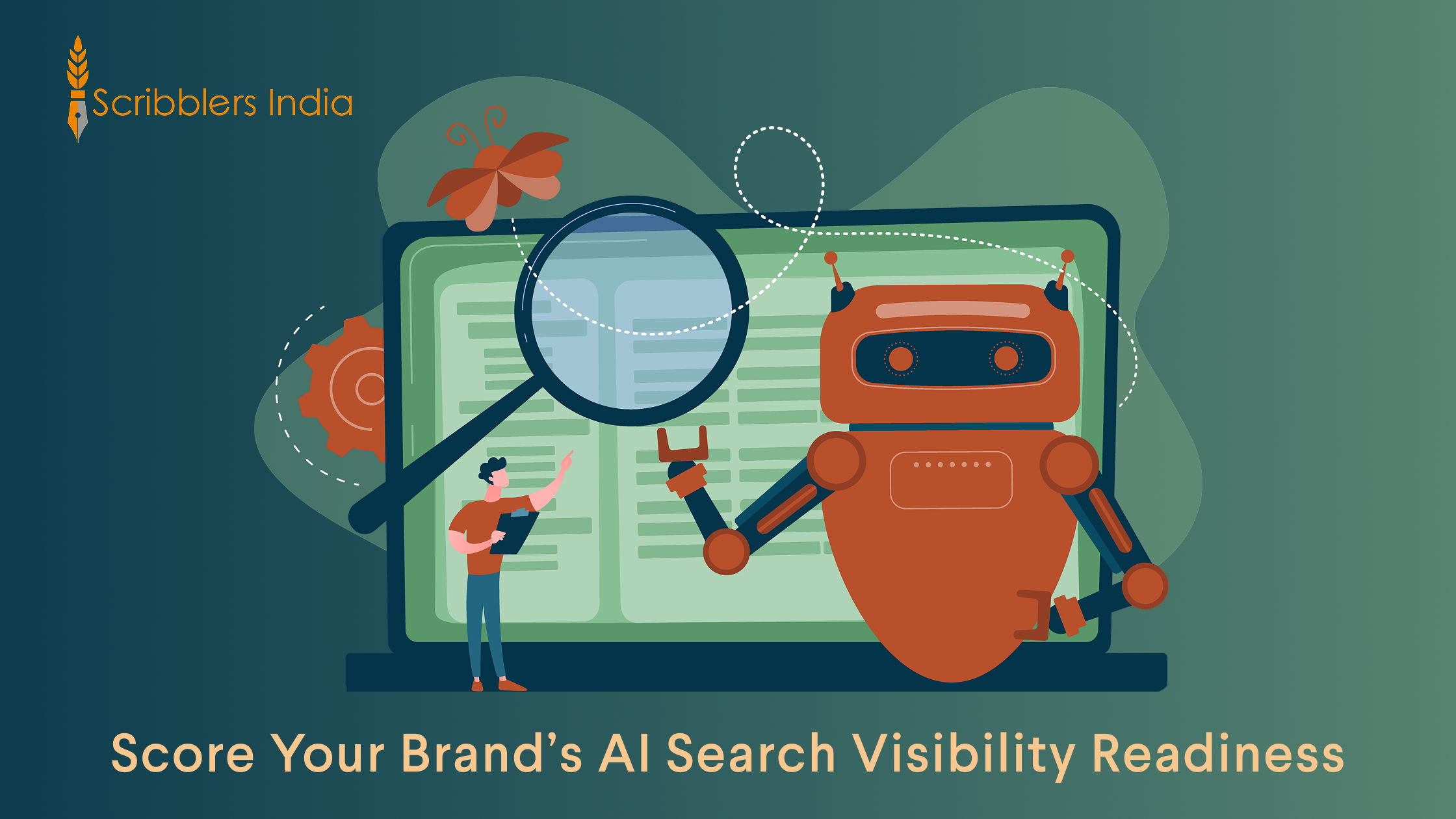
Scribblers India AI Visibility Scorecard
AI search visibility is changing how customers discover, compare and trust brands. Search is no longer limited to blue links, featured snippets and organic rankings. Buyers now ask Google AI Overviews, AI Mode, ChatGPT, Perplexity, Gemini and Copilot for recommendations, summaries and shortlists. Google said in 2026 that AI Overviews had crossed 2.5 billion monthly active users, while AI Mode had crossed 1 billion monthly active users. This matters because AI systems do not simply “rank” websites. They interpret entities, compare sources, retrieve supporting evidence and generate answers. A brand can rank on Google and remain invisible inside AI-generated recommendations. The Scribblers India AI Visibility Scorecard helps founders, marketing teams, consultants, agencies and B2B service firms evaluate whether their brand is ready for AI-led discovery. You will learn how to assess entity clarity, content depth, answer readiness, third-party trust, expert authority and conversion infrastructure. At Scribblers India, we use this framework to integrate SEO, AEO, GEO, thought leadership, ghostwriting, and personal branding into a single measurable visibility system. TL;DR AI visibility now extends beyond Google rankings. LLMs need clear, consistent brand entities. Thin content weakens answer engine inclusion chances. Third-party validation improves brand citation readiness. Founder authority supports trust and recommendation signals. Structured answers improve AEO and GEO performance. Measurement must include prompts, mentions and citations. Scorecard gaps should guide content priorities. Executive Summary AI search has created a new layer of visibility between brands and buyers. Traditional SEO still matters, but it no longer explains the full discovery journey. A brand must now be findable, understandable, and trustworthy across search engines, AI answer engines, and generative assistants. This shift is already visible. OpenAI reported that ChatGPT had 700 million weekly active users by mid-2025, based on a privacy-preserving analysis of 1.5 million conversations. The same study found that three-quarters of ChatGPT conversations focus on practical guidance, information seeking and writing. For businesses, this means prospects may form opinions before visiting the website. They may ask AI search visibility tools which agency, consultant, SaaS platform, service provider or expert they should consider. If the brand lacks structured content, credible proof and external validation, AI systems may ignore it. This resource provides a practical scoring model for AI visibility readiness. It does not claim to predict exact LLM rankings. Instead, it helps teams identify where their brand is weak across the signals that commonly support AI discovery. Scribblers India recommends that brands move from “keyword-first SEO” to “entity-first authority building.” This means clear positioning, answer-led pages, expert authorship, original insights, comparison assets, third-party mentions and measurable prompt testing. The scorecard can support content planning, AEO audits, GEO strategy, personal branding, founder-led visibility and lead-generation campaigns. Why does AI search visibility matter now? AI search visibility matters because buyers increasingly receive answers before they reach a website. Brands must now influence what AI systems understand, summarize and recommend, not only where their pages rank in search results. McKinsey’s 2025 global AI survey found that nearly nine out of ten respondents said their organizations regularly use AI, although adoption depth remains uneven. [McKinsey, 2025] HubSpot reported that more than 92% of marketers plan to use or already use SEO optimization for traditional and AI-powered search engines. [HubSpot, 2026] Statcounter’s May 2026 AI chatbot market share showed ChatGPT at 79.08%, Perplexity at 7.67%, Gemini at 7.03%, Copilot at 3.23% and Claude at 2.98%. [Statcounter, 2026] Key Finding: AI visibility is not a future SEO trend. It is already part of how customers ask, compare, and shortlist. How is AI search visibility different from traditional SEO? AI search visibility differs from traditional SEO because it retrieves, compares and synthesizes information across multiple sources. A brand does not win only by ranking. It wins by being easy to understand, verify and cite. Google says AI Overviews and AI Mode may use query fan-out, in which multiple related searches are run across subtopics and data sources to develop a response. [Google Search Central, 2026] Semrush analyzed more than 10 million keywords and found that AI Overviews appeared for 6.49% of keywords in January 2025, peaked near 25% in July and stood at 15.69% in November. [Semrush, 2025] Semrush also found that informational queries fell from 91.3% of AI Overview-triggering queries in January to 57.1% by October, while commercial and transactional AI Overviews increased. [Semrush, 2025] Ahrefs re-ran its AI Overview CTR study using December 2025 data and found a 58% lower average click-through rate for the top-ranking page when an AI Overview appeared. [Ahrefs, 2026] Scribblers India Takeaway: SEO still forms the foundation, but AEO and GEO determine whether a brand is visible within answer-led environments. Brands need content that answers sharply, cites credible sources, builds entity confidence and gives AI systems enough context to describe them correctly. What do LLMs need to trust a brand? LLMs need consistent brand identity, expert authorship, clear service pages, credible third-party mentions and source-backed content. If a brand appears differently across its website, social profiles and external mentions, AI systems may struggle to classify it. Google’s structured data guidance says structured data gives explicit clues about the meaning of a page and helps Google understand people, companies and content. [Google Search Central, 2026] Google’s helpful content guidance says ranking systems prioritize reliable, people-first content created for users, not content created mainly to manipulate rankings. [Google Search Central, 2026] Similarweb launched AI chatbot traffic as a distinct analytics source in 2025, covering traffic from platforms such as ChatGPT, Perplexity and Claude. [Similarweb, 2025] LinkedIn Ads says the platform reaches more than 1 billion professionals worldwide. [LinkedIn, 2026] What LLMs Need to Trust a Brand AI systems need repeated, verifiable signals. These include a clear organization entity, expert profiles, detailed service pages, structured answers, external mentions, source-backed articles, public reviews, case studies and consistent language across platforms. Which content assets improve AI search visibility? The strongest AI search visibility assets answer buyer questions, define category expertise, compare options and show proof.
AI search visibility is changing how customers discover, compare and trust brands. Search is no longer limited to blue links, featured snippets and organic rankings. Buyers now ask Google AI Overviews, AI Mode, ChatGPT, Perplexity, Gemini and Copilot for recommendations, summaries and shortlists. Google said in 2026 that AI Overviews had crossed 2.5 billion monthly active users, while AI Mode had crossed 1 billion monthly active users. This matters because AI systems do not simply “rank” websites. They interpret entities, compare sources, retrieve supporting evidence and generate answers. A brand can rank on Google and remain invisible inside AI-generated recommendations. The Scribblers India AI Visibility Scorecard helps founders, marketing teams, consultants, agencies and B2B service firms evaluate whether their brand is ready for AI-led discovery. You will learn how to assess entity clarity, content depth, answer readiness, third-party trust, expert authority and conversion infrastructure. At Scribblers India, we use this framework to integrate SEO, AEO, GEO, thought leadership, ghostwriting, and personal branding into a single measurable visibility system. TL;DR AI visibility now extends beyond Google rankings. LLMs need clear, consistent brand entities. Thin content weakens answer engine inclusion chances. Third-party validation improves brand citation readiness. Founder authority supports trust and recommendation signals. Structured answers improve AEO and GEO performance. Measurement must include prompts, mentions and citations. Scorecard gaps should guide content priorities. Executive Summary AI search has created a new layer of visibility between brands and buyers. Traditional SEO still matters, but it no longer explains the full discovery journey. A brand must now be findable, understandable, and trustworthy across search engines, AI answer engines, and generative assistants. This shift is already visible. OpenAI reported that ChatGPT had 700 million weekly active users by mid-2025, based on a privacy-preserving analysis of 1.5 million conversations. The same study found that three-quarters of ChatGPT conversations focus on practical guidance, information seeking and writing. For businesses, this means prospects may form opinions before visiting the website. They may ask AI search visibility tools which agency, consultant, SaaS platform, service provider or expert they should consider. If the brand lacks structured content, credible proof and external validation, AI systems may ignore it. This resource provides a practical scoring model for AI visibility readiness. It does not claim to predict exact LLM rankings. Instead, it helps teams identify where their brand is weak across the signals that commonly support AI discovery. Scribblers India recommends that brands move from “keyword-first SEO” to “entity-first authority building.” This means clear positioning, answer-led pages, expert authorship, original insights, comparison assets, third-party mentions and measurable prompt testing. The scorecard can support content planning, AEO audits, GEO strategy, personal branding, founder-led visibility and lead-generation campaigns. Why does AI search visibility matter now? AI search visibility matters because buyers increasingly receive answers before they reach a website. Brands must now influence what AI systems understand, summarize and recommend, not only where their pages rank in search results. McKinsey’s 2025 global AI survey found that nearly nine out of ten respondents said their organizations regularly use AI, although adoption depth remains uneven. [McKinsey, 2025] HubSpot reported that more than 92% of marketers plan to use or already use SEO optimization for traditional and AI-powered search engines. [HubSpot, 2026] Statcounter’s May 2026 AI chatbot market share showed ChatGPT at 79.08%, Perplexity at 7.67%, Gemini at 7.03%, Copilot at 3.23% and Claude at 2.98%. [Statcounter, 2026] Key Finding: AI visibility is not a future SEO trend. It is already part of how customers ask, compare, and shortlist. How is AI search visibility different from traditional SEO? AI search visibility differs from traditional SEO because it retrieves, compares and synthesizes information across multiple sources. A brand does not win only by ranking. It wins by being easy to understand, verify and cite. Google says AI Overviews and AI Mode may use query fan-out, in which multiple related searches are run across subtopics and data sources to develop a response. [Google Search Central, 2026] Semrush analyzed more than 10 million keywords and found that AI Overviews appeared for 6.49% of keywords in January 2025, peaked near 25% in July and stood at 15.69% in November. [Semrush, 2025] Semrush also found that informational queries fell from 91.3% of AI Overview-triggering queries in January to 57.1% by October, while commercial and transactional AI Overviews increased. [Semrush, 2025] Ahrefs re-ran its AI Overview CTR study using December 2025 data and found a 58% lower average click-through rate for the top-ranking page when an AI Overview appeared. [Ahrefs, 2026] Scribblers India Takeaway: SEO still forms the foundation, but AEO and GEO determine whether a brand is visible within answer-led environments. Brands need content that answers sharply, cites credible sources, builds entity confidence and gives AI systems enough context to describe them correctly. What do LLMs need to trust a brand? LLMs need consistent brand identity, expert authorship, clear service pages, credible third-party mentions and source-backed content. If a brand appears differently across its website, social profiles and external mentions, AI systems may struggle to classify it. Google’s structured data guidance says structured data gives explicit clues about the meaning of a page and helps Google understand people, companies and content. [Google Search Central, 2026] Google’s helpful content guidance says ranking systems prioritize reliable, people-first content created for users, not content created mainly to manipulate rankings. [Google Search Central, 2026] Similarweb launched AI chatbot traffic as a distinct analytics source in 2025, covering traffic from platforms such as ChatGPT, Perplexity and Claude. [Similarweb, 2025] LinkedIn Ads says the platform reaches more than 1 billion professionals worldwide. [LinkedIn, 2026] What LLMs Need to Trust a Brand AI systems need repeated, verifiable signals. These include a clear organization entity, expert profiles, detailed service pages, structured answers, external mentions, source-backed articles, public reviews, case studies and consistent language across platforms. Which content assets improve AI search visibility? The strongest AI search visibility assets answer buyer questions, define category expertise, compare options and show proof.
How Do Leaders Build a Personal Brand People Actually Trust?
Before a hiring decision, funding conversation, partnership request or sales call begins, people usually search online first. They check your LinkedIn profile, published articles, website bio, public opinions and search results. That is why you need a personal branding strategy that builds trust before the first conversation. A 2025 Aurora University study found that 50% of American professionals believe a strong personal brand matters more than a strong resume. The number rises to 61% among business executives. For founders, this shift matters because reputation now influences buyers, investors, talent and partners before direct interaction. This guide explains how to build a personal branding strategy in 2026 using positioning, LinkedIn, thought leadership, ghostwriting, AI search visibility and owned audience systems. If you need support turning your expertise into a structured visibility engine, Scribblers India’s personal branding services can help you build the foundation. TL;DR Start with positioning before publishing any content. Founder authority now affects AI search visibility. LinkedIn works best with focused content pillars. AI should support, not replace, original thinking. Thought leadership assets build durable authority. Owned audiences reduce social platform dependence. Metrics should track trust and business outcomes. Scribblers India builds strategy-led branding systems. Why You Need a Comprehensive Personal Branding Strategy in 2026? A comprehensive personal branding strategy in 2026 can help you become known, trusted, and discoverable across search, LinkedIn, AI platforms, and professional networks. It integrates your positioning, proof, publishing rhythm, audience ownership, and measurement into a single system, so your expertise builds trust before the first conversation begins. You cannot build a strong personal brand by posting randomly when time permits. You need to define what you want to be known for, who should remember you, and which content assets will continue to build authority when you are not actively online. If you are starting out without an audience, you can also read our guide to building a personal brand with zero followers. It explains how early authority can begin with positioning, profile clarity, and searchable content before audience size grows. A useful personal branding strategy should answer five questions before content creation begins. Strategic Question Why It Matters What should you be known for? It creates category recall around your expertise. Who should trust you? It keeps your content focused on the right audience. What proof supports your authority? It makes your expertise believable and specific. Where should you publish? It prevents platform overload and scattered visibility. What action should readers take? It connects visibility with business outcomes. Why Does Personal Branding Matter for AI Search Visibility? Personal branding matters for AI search visibility because AI systems increasingly summarize people, companies and service providers from multiple sources. If your positioning, author profiles, LinkedIn presence, and website content are consistent, you give AI systems stronger signals to understand and accurately describe your expertise. Your personal brand is no longer limited to social reach. Your name, company profile, website bio, service pages, articles, reports, guest posts and third-party mentions can influence how you appear across Google AI Overviews, ChatGPT, Perplexity, Gemini and other discovery surfaces. Google reported in 2026 that AI Overviews reached 2 billion monthly users across 200 countries and territories. OpenAI reported in 2026 that ChatGPT had 700 million weekly active users during its usage study. HubSpot reported in 2026 that nearly 24% of marketers are exploring SEO updates for generative AI search. A 2026 empirical study found that Google Search, Gemini and AI Overviews retrieve substantially different source sets. Scribblers India Takeaway: You should not treat personal branding as a LinkedIn-only activity. You need a connected authority footprint across your website, founder profile, long-form content, social presence and third-party mentions so humans and AI systems can understand your expertise consistently. Our GEO strategy guide can help you evaluate those gaps more clearly. What Are the Core Elements of a Founder Personal Brand? Your founder personal brand needs clear positioning, credible proof, focused content pillars, platform consistency and measurable business outcomes. Without these elements, your content becomes activity rather than strategy. The goal is to connect your expertise with the exact audience, problem and category you want to own. Here is what the Scribblers India founder authority framework looks like: Pillar What It Covers Why It Matters Positioning What you should be known for Creates recall and category association Proof Experience, stories, results and examples Makes expertise believable and specific Publishing LinkedIn, blogs, newsletters and videos Builds consistent visibility across platforms Search Visibility SEO, AEO, GEO and AI discoverability Helps AI systems understand your authority Owned Audience Newsletter, website and lead magnets Reduces dependence on rented platforms Measurement Profile visits, leads, mentions and branded search Shows whether authority is converting This framework keeps your personal branding strategy focused on business value. It prevents you from copying creators, chasing short-lived trends or publishing disconnected content that earns attention but does not build trust, recall or demand. Positioning: Define Your Authority Territory Your positioning should explain the exact area where your experience, audience need and market opportunity overlap. If you write about “business growth,” you blend into the crowd. If you write about “AI search visibility for B2B service firms,” you become easier to remember and recommend. Proof: Make Your Expertise Believable Your proof does not always need dramatic numbers. It can include client patterns, anonymized examples, lessons from execution, founder stories, frameworks, research notes and practical decision guides. The goal is to show how you think and why your perspective deserves attention. Consistency: Align Every Public Signal Your LinkedIn headline, About section, website bio, author profile, podcast introduction and guest article bio should reinforce the same authority territory. Readers and AI systems both need repeated signals before they associate your name with a specific area of expertise. How Should You Use LinkedIn for Personal Branding? You should use LinkedIn as a trust-building and demand-shaping channel, not only as a posting platform. A strong LinkedIn personal branding strategy connects your profile positioning, content pillars, founder opinions, comments,
Before a hiring decision, funding conversation, partnership request or sales call begins, people usually search online first. They check your LinkedIn profile, published articles, website bio, public opinions and search results. That is why you need a personal branding strategy that builds trust before the first conversation. A 2025 Aurora University study found that 50% of American professionals believe a strong personal brand matters more than a strong resume. The number rises to 61% among business executives. For founders, this shift matters because reputation now influences buyers, investors, talent and partners before direct interaction. This guide explains how to build a personal branding strategy in 2026 using positioning, LinkedIn, thought leadership, ghostwriting, AI search visibility and owned audience systems. If you need support turning your expertise into a structured visibility engine, Scribblers India’s personal branding services can help you build the foundation. TL;DR Start with positioning before publishing any content. Founder authority now affects AI search visibility. LinkedIn works best with focused content pillars. AI should support, not replace, original thinking. Thought leadership assets build durable authority. Owned audiences reduce social platform dependence. Metrics should track trust and business outcomes. Scribblers India builds strategy-led branding systems. Why You Need a Comprehensive Personal Branding Strategy in 2026? A comprehensive personal branding strategy in 2026 can help you become known, trusted, and discoverable across search, LinkedIn, AI platforms, and professional networks. It integrates your positioning, proof, publishing rhythm, audience ownership, and measurement into a single system, so your expertise builds trust before the first conversation begins. You cannot build a strong personal brand by posting randomly when time permits. You need to define what you want to be known for, who should remember you, and which content assets will continue to build authority when you are not actively online. If you are starting out without an audience, you can also read our guide to building a personal brand with zero followers. It explains how early authority can begin with positioning, profile clarity, and searchable content before audience size grows. A useful personal branding strategy should answer five questions before content creation begins. Strategic Question Why It Matters What should you be known for? It creates category recall around your expertise. Who should trust you? It keeps your content focused on the right audience. What proof supports your authority? It makes your expertise believable and specific. Where should you publish? It prevents platform overload and scattered visibility. What action should readers take? It connects visibility with business outcomes. Why Does Personal Branding Matter for AI Search Visibility? Personal branding matters for AI search visibility because AI systems increasingly summarize people, companies and service providers from multiple sources. If your positioning, author profiles, LinkedIn presence, and website content are consistent, you give AI systems stronger signals to understand and accurately describe your expertise. Your personal brand is no longer limited to social reach. Your name, company profile, website bio, service pages, articles, reports, guest posts and third-party mentions can influence how you appear across Google AI Overviews, ChatGPT, Perplexity, Gemini and other discovery surfaces. Google reported in 2026 that AI Overviews reached 2 billion monthly users across 200 countries and territories. OpenAI reported in 2026 that ChatGPT had 700 million weekly active users during its usage study. HubSpot reported in 2026 that nearly 24% of marketers are exploring SEO updates for generative AI search. A 2026 empirical study found that Google Search, Gemini and AI Overviews retrieve substantially different source sets. Scribblers India Takeaway: You should not treat personal branding as a LinkedIn-only activity. You need a connected authority footprint across your website, founder profile, long-form content, social presence and third-party mentions so humans and AI systems can understand your expertise consistently. Our GEO strategy guide can help you evaluate those gaps more clearly. What Are the Core Elements of a Founder Personal Brand? Your founder personal brand needs clear positioning, credible proof, focused content pillars, platform consistency and measurable business outcomes. Without these elements, your content becomes activity rather than strategy. The goal is to connect your expertise with the exact audience, problem and category you want to own. Here is what the Scribblers India founder authority framework looks like: Pillar What It Covers Why It Matters Positioning What you should be known for Creates recall and category association Proof Experience, stories, results and examples Makes expertise believable and specific Publishing LinkedIn, blogs, newsletters and videos Builds consistent visibility across platforms Search Visibility SEO, AEO, GEO and AI discoverability Helps AI systems understand your authority Owned Audience Newsletter, website and lead magnets Reduces dependence on rented platforms Measurement Profile visits, leads, mentions and branded search Shows whether authority is converting This framework keeps your personal branding strategy focused on business value. It prevents you from copying creators, chasing short-lived trends or publishing disconnected content that earns attention but does not build trust, recall or demand. Positioning: Define Your Authority Territory Your positioning should explain the exact area where your experience, audience need and market opportunity overlap. If you write about “business growth,” you blend into the crowd. If you write about “AI search visibility for B2B service firms,” you become easier to remember and recommend. Proof: Make Your Expertise Believable Your proof does not always need dramatic numbers. It can include client patterns, anonymized examples, lessons from execution, founder stories, frameworks, research notes and practical decision guides. The goal is to show how you think and why your perspective deserves attention. Consistency: Align Every Public Signal Your LinkedIn headline, About section, website bio, author profile, podcast introduction and guest article bio should reinforce the same authority territory. Readers and AI systems both need repeated signals before they associate your name with a specific area of expertise. How Should You Use LinkedIn for Personal Branding? You should use LinkedIn as a trust-building and demand-shaping channel, not only as a posting platform. A strong LinkedIn personal branding strategy connects your profile positioning, content pillars, founder opinions, comments,
Zero-Click Search
Search engines used to function as directories, pointing users to websites that held the answer. Today, they increasingly function as answer machines. This shift has led to what is known as Zero-Click Search, where users type a question, the search engine delivers the answer directly on the results page, and the user leaves without visiting a single website. This behavior defines zero-click search, and it is reshaping how brands measure visibility, plan content, and approach digital marketing altogether. According to research, around 60% of all Google searches in 2025 end without a click. On mobile devices, that figure climbs to 77%. For brands that depend on organic search as a primary traffic channel, this represents one of the most significant structural shifts in the history of digital marketing. What is a Zero-Click Search and What Causes It? A zero-click search occurs when a user finds the information they need directly on the search results page, without clicking through to any external website. The search engine resolves the query within its own interface, making a website visit unnecessary for the user to complete their information need. Several search features drive this behavior. Google’s AI Overviews synthesize answers from multiple sources and display them at the top of results. Featured snippets present a highlighted block of text extracted directly from a web page. Knowledge panels surface structured information about entities: brands, people, and locations, without requiring the user to visit any individual source website. Local packs, weather cards, calculator tools, and conversion widgets resolve informational and transactional queries entirely within the search environment. Voice search accelerates this trend significantly. When a user asks a smart speaker or mobile assistant a question, the device reads a single answer aloud, with no link provided, making the concept of a click entirely irrelevant to how the content is discovered and consumed. How Does Zero-Click Search Affect Organic Traffic and Content Marketing? Zero-click search creates a direct tension between traditional content marketing goals and the reality of how modern search now works. Brands that built their traffic models on organic clicks from informational content report measurable declines even when their search rankings remain strong. The impact is not uniform across all content types. Informational content — definitions, how-to guides, conversion tools, and factual queries — faces the heaviest disruption because these query types are precisely what AI Overviews and featured snippets are designed to resolve. Transactional, commercial, and navigational queries that require a website visit to complete an action are far less disrupted, which is why a diversified content strategy that covers multiple intent types performs more resiliently in a zero-click environment. Impression share grows while click share shrinks: A brand’s content can appear at the top of a search results page and earn significantly fewer clicks than it would have two years ago, because the AI Overview or featured snippet above it already answered the user’s question before they considered clicking. Brand awareness benefits remain substantial: When a brand’s content is cited in an AI Overview or featured snippet, it gains exposure at the exact moment the user is asking a relevant question. This awareness-level visibility influences brand recall, direct search behavior, and downstream conversions even when no click occurs during the session. Content authority becomes the primary competitive advantage: Zero-click search rewards brands whose content is trusted enough to be selected as the source for a displayed answer. Building that trust through thought leadership content writing and original research delivers compounding brand authority that benefits both zero-click visibility and traditional organic performance simultaneously. What Is the Difference Between Zero-Click Search and AI-Powered Search? Zero-click search is a behavioral outcome: the user gets the answer without clicking. AI-powered search is the mechanism increasingly responsible for producing that outcome, through features like AI Overviews, synthesized Perplexity responses, and ChatGPT direct answers. The two terms are related but not interchangeable in a content strategy context. Scope of the concept: Zero-click search predates AI-powered search by several years. Featured snippets, knowledge panels, local packs, and weather widgets all produced zero-click outcomes long before AI Overviews launched. AI-powered search has dramatically accelerated the zero-click rate, but the trend itself began well before generative AI entered the search experience. Source attribution patterns: Traditional zero-click features, such as featured snippets, typically attribute the answer to a single source and display the URL clearly below the extracted text. AI-powered search responses may synthesize content from multiple sources simultaneously, citing several or none, making attribution more complex for brands trying to accurately measure their zero-click visibility. Query complexity coverage: Traditional zero-click features resolved simple, factual queries most effectively. AI-powered search extends zero-click behavior into more complex, multi-part, and conversational queries that previously required users to visit multiple websites to fully satisfy their information needs. Optimization approach required: Featured snippets and knowledge panels respond to structured data, concise answer paragraphs, and schema markup. AI-powered search also responds to entity authority, original information gain, and multi-platform brand credibility, which is why AEO and GEO strategies extend the optimization framework well beyond traditional zero-click tactics. Measurement framework differences: Zero-click search performance has traditionally been measured through featured snippet wins and impression share in Google Search Console. AI-powered zero-click visibility additionally requires tracking brand mentions in AI-generated responses, citation frequency across platforms, share of voice in AI-mediated discovery, and downstream branded search volume lift as indirect indicators. How Can Brands Adapt Their Content Strategy to Zero-Click Search? Adapting to zero-click search does not mean abandoning organic content investment. It means restructuring how content gets created, measured, and distributed to capture visibility at the answer layer rather than relying solely on click-through traffic as the primary measure of success. The most effective brands in a zero-click environment take a visibility-first approach. They optimize for citation, brand mentions, and authority signals rather than for clicks. A strong content marketing strategy for the zero-click era integrates traditional SEO with AEO and GEO principles, ensuring the brand performs across all layers of the modern search experience
Search engines used to function as directories, pointing users to websites that held the answer. Today, they increasingly function as answer machines. This shift has led to what is known as Zero-Click Search, where users type a question, the search engine delivers the answer directly on the results page, and the user leaves without visiting a single website. This behavior defines zero-click search, and it is reshaping how brands measure visibility, plan content, and approach digital marketing altogether. According to research, around 60% of all Google searches in 2025 end without a click. On mobile devices, that figure climbs to 77%. For brands that depend on organic search as a primary traffic channel, this represents one of the most significant structural shifts in the history of digital marketing. What is a Zero-Click Search and What Causes It? A zero-click search occurs when a user finds the information they need directly on the search results page, without clicking through to any external website. The search engine resolves the query within its own interface, making a website visit unnecessary for the user to complete their information need. Several search features drive this behavior. Google’s AI Overviews synthesize answers from multiple sources and display them at the top of results. Featured snippets present a highlighted block of text extracted directly from a web page. Knowledge panels surface structured information about entities: brands, people, and locations, without requiring the user to visit any individual source website. Local packs, weather cards, calculator tools, and conversion widgets resolve informational and transactional queries entirely within the search environment. Voice search accelerates this trend significantly. When a user asks a smart speaker or mobile assistant a question, the device reads a single answer aloud, with no link provided, making the concept of a click entirely irrelevant to how the content is discovered and consumed. How Does Zero-Click Search Affect Organic Traffic and Content Marketing? Zero-click search creates a direct tension between traditional content marketing goals and the reality of how modern search now works. Brands that built their traffic models on organic clicks from informational content report measurable declines even when their search rankings remain strong. The impact is not uniform across all content types. Informational content — definitions, how-to guides, conversion tools, and factual queries — faces the heaviest disruption because these query types are precisely what AI Overviews and featured snippets are designed to resolve. Transactional, commercial, and navigational queries that require a website visit to complete an action are far less disrupted, which is why a diversified content strategy that covers multiple intent types performs more resiliently in a zero-click environment. Impression share grows while click share shrinks: A brand’s content can appear at the top of a search results page and earn significantly fewer clicks than it would have two years ago, because the AI Overview or featured snippet above it already answered the user’s question before they considered clicking. Brand awareness benefits remain substantial: When a brand’s content is cited in an AI Overview or featured snippet, it gains exposure at the exact moment the user is asking a relevant question. This awareness-level visibility influences brand recall, direct search behavior, and downstream conversions even when no click occurs during the session. Content authority becomes the primary competitive advantage: Zero-click search rewards brands whose content is trusted enough to be selected as the source for a displayed answer. Building that trust through thought leadership content writing and original research delivers compounding brand authority that benefits both zero-click visibility and traditional organic performance simultaneously. What Is the Difference Between Zero-Click Search and AI-Powered Search? Zero-click search is a behavioral outcome: the user gets the answer without clicking. AI-powered search is the mechanism increasingly responsible for producing that outcome, through features like AI Overviews, synthesized Perplexity responses, and ChatGPT direct answers. The two terms are related but not interchangeable in a content strategy context. Scope of the concept: Zero-click search predates AI-powered search by several years. Featured snippets, knowledge panels, local packs, and weather widgets all produced zero-click outcomes long before AI Overviews launched. AI-powered search has dramatically accelerated the zero-click rate, but the trend itself began well before generative AI entered the search experience. Source attribution patterns: Traditional zero-click features, such as featured snippets, typically attribute the answer to a single source and display the URL clearly below the extracted text. AI-powered search responses may synthesize content from multiple sources simultaneously, citing several or none, making attribution more complex for brands trying to accurately measure their zero-click visibility. Query complexity coverage: Traditional zero-click features resolved simple, factual queries most effectively. AI-powered search extends zero-click behavior into more complex, multi-part, and conversational queries that previously required users to visit multiple websites to fully satisfy their information needs. Optimization approach required: Featured snippets and knowledge panels respond to structured data, concise answer paragraphs, and schema markup. AI-powered search also responds to entity authority, original information gain, and multi-platform brand credibility, which is why AEO and GEO strategies extend the optimization framework well beyond traditional zero-click tactics. Measurement framework differences: Zero-click search performance has traditionally been measured through featured snippet wins and impression share in Google Search Console. AI-powered zero-click visibility additionally requires tracking brand mentions in AI-generated responses, citation frequency across platforms, share of voice in AI-mediated discovery, and downstream branded search volume lift as indirect indicators. How Can Brands Adapt Their Content Strategy to Zero-Click Search? Adapting to zero-click search does not mean abandoning organic content investment. It means restructuring how content gets created, measured, and distributed to capture visibility at the answer layer rather than relying solely on click-through traffic as the primary measure of success. The most effective brands in a zero-click environment take a visibility-first approach. They optimize for citation, brand mentions, and authority signals rather than for clicks. A strong content marketing strategy for the zero-click era integrates traditional SEO with AEO and GEO principles, ensuring the brand performs across all layers of the modern search experience
Retrieval-Augmented Generation (RAG)
AI platforms carry a fundamental limitation. They can only respond based on what they absorbed during training. That training data has a fixed cutoff date, which creates a real problem for brands and businesses alike. They need AI systems to deliver accurate, current, and domain-specific answers. Retrieval-Augmented Generation (RAG) solves this problem directly. It connects a large language model to up-to-date external knowledge sources before generating a response. This connection dramatically improves the accuracy and trustworthiness of the AI’s output. For content marketers and digital strategists, understanding RAG is now essential. It determines how AI search platforms decide which sources to cite when answering user queries. What Is Retrieval-Augmented Generation and How Does It Work? Retrieval-Augmented Generation (RAG) is an AI framework. It enhances large language models by connecting them to external knowledge bases before generating a response. Rather than relying only on training data, a RAG system retrieves relevant documents in real time. It then uses that retrieved content to ground the answer it produces for the user. The process follows a clear sequence. A user submits a query. The RAG system converts it into a vector, i.e., a numerical representation the system searches with. The system then scans a knowledge base for documents semantically similar to the query. It selects the most relevant sources and feeds them into the language model alongside the original question. The language model then synthesizes a response. It draws from its training knowledge and the retrieved documents simultaneously. It often cites the external sources that informed its answer. This retrieve-then-generate workflow powers AI search platforms like Perplexity and Google AI Overviews. Well-structured, authoritative content earns citations more consistently than generic or outdated material. Why Does RAG Matter for Content Marketing and Brand Visibility? RAG directly determines which content an AI platform retrieves and cites. It forms the core mechanism behind Answer Engine Optimization and GEO strategies that brands invest in today. When a RAG-powered platform generates a response, it evaluates candidate documents for relevance, authority, recency, and structural clarity. Content that scores well across these dimensions earns a citation in the AI output. Content that is poorly structured or outdated gets excluded from the response pool entirely. This exclusion happens regardless of how well it ranks in traditional search results. Content structure becomes a retrieval signal: RAG systems favor content organized for extraction. They prioritize clear headings, concise answer paragraphs, and direct statements the system can lift and synthesize without losing meaning. A content strategy built around RAG-friendly formatting consistently improves AI citation rates across major platforms. Original information gives the retriever a specific reason to select content: RAG systems have no reason to cite a source that restates what is already available elsewhere. Original research and proprietary data give the retrieval component a specific reason to select a brand’s content over a competitor’s during the scoring phase. Content recency directly improves retrievability: RAG systems actively favor fresh content. Their purpose is to ground AI responses in accurate, current information. Regular content updates directly improve a brand’s position in the retrieval pool of RAG-powered platforms. E-E-A-T signals strengthen the probability of citation: RAG systems retrieve from demonstrably credible sources. Author credentials, cited sources, and third-party brand mentions all increase the likelihood that a brand’s content is selected during the retrieval scoring phase. What Are the Four Key Components of a RAG System? A RAG system operates through four interconnected components. Together, they determine the quality, accuracy, and relevance of the generated output for any given user query. The knowledge base: The external repository that the RAG system queries when a user submits a prompt. It can include internal documents, product databases, web-indexed content, and research papers. The quality and organization of this knowledge base directly determines how accurately the system retrieves relevant content. The retriever: This component converts the user query into a vector. It then searches the knowledge base for semantically similar content. It evaluates relevance mathematically and selects the most contextually appropriate documents to pass to the language model. Stronger retrieval quality leads to more accurate final responses for the user. The integration layer: This component coordinates the overall RAG pipeline. It combines retrieved documents with the original user query through prompt engineering techniques. It instructs the language model to synthesize retrieved information into a coherent, accurate response that accurately represents the source material. The generator: This is the large language model that produces the final response. It simultaneously draws on retrieved documents and its own training knowledge. Models such as GPT-4, Claude, Gemini, and Llama commonly serve as generators. They combine external evidence with broad language understanding to produce accurate, citation-supported outputs. What Are the Benefits and Challenges of Retrieval-Augmented Generation? RAG transforms what large language models can accomplish. It carries both significant advantages and practical challenges that organizations must navigate thoughtfully to achieve reliable results. Benefits of RAG Reduced AI Hallucinations: RAG decreases instances of false information by grounding every response in verifiable, retrieved documents. This approach improves factual accuracy for high-stakes queries in the finance and healthcare industries. Dynamic Knowledge Updates: Organizations can keep their AI systems current without the high cost of retraining a model from scratch. The knowledge base updates independently whenever new information becomes available in the data source. Improved Source Transparency: RAG provides users with specific citations within each generated response to increase overall trust. These citations allow audiences to verify information directly, especially in regulated and high-credibility industries. Cost-Effective Specialization: This technology enables targeted applications by connecting a general-purpose model to a specialized knowledge base. A single model serves multiple industry contexts without requiring separate, expensive training runs. Challenges of RAG Risk of Contextual Misinterpretation: Systems occasionally retrieve factually correct documents that are contextually misleading for the specific query. The language model may then produce a response that combines accurate data with an incorrect conclusion. Dependence on Data Quality: The quality of the final output depends heavily on the organization and structure of the knowledge base. Poorly
AI platforms carry a fundamental limitation. They can only respond based on what they absorbed during training. That training data has a fixed cutoff date, which creates a real problem for brands and businesses alike. They need AI systems to deliver accurate, current, and domain-specific answers. Retrieval-Augmented Generation (RAG) solves this problem directly. It connects a large language model to up-to-date external knowledge sources before generating a response. This connection dramatically improves the accuracy and trustworthiness of the AI’s output. For content marketers and digital strategists, understanding RAG is now essential. It determines how AI search platforms decide which sources to cite when answering user queries. What Is Retrieval-Augmented Generation and How Does It Work? Retrieval-Augmented Generation (RAG) is an AI framework. It enhances large language models by connecting them to external knowledge bases before generating a response. Rather than relying only on training data, a RAG system retrieves relevant documents in real time. It then uses that retrieved content to ground the answer it produces for the user. The process follows a clear sequence. A user submits a query. The RAG system converts it into a vector, i.e., a numerical representation the system searches with. The system then scans a knowledge base for documents semantically similar to the query. It selects the most relevant sources and feeds them into the language model alongside the original question. The language model then synthesizes a response. It draws from its training knowledge and the retrieved documents simultaneously. It often cites the external sources that informed its answer. This retrieve-then-generate workflow powers AI search platforms like Perplexity and Google AI Overviews. Well-structured, authoritative content earns citations more consistently than generic or outdated material. Why Does RAG Matter for Content Marketing and Brand Visibility? RAG directly determines which content an AI platform retrieves and cites. It forms the core mechanism behind Answer Engine Optimization and GEO strategies that brands invest in today. When a RAG-powered platform generates a response, it evaluates candidate documents for relevance, authority, recency, and structural clarity. Content that scores well across these dimensions earns a citation in the AI output. Content that is poorly structured or outdated gets excluded from the response pool entirely. This exclusion happens regardless of how well it ranks in traditional search results. Content structure becomes a retrieval signal: RAG systems favor content organized for extraction. They prioritize clear headings, concise answer paragraphs, and direct statements the system can lift and synthesize without losing meaning. A content strategy built around RAG-friendly formatting consistently improves AI citation rates across major platforms. Original information gives the retriever a specific reason to select content: RAG systems have no reason to cite a source that restates what is already available elsewhere. Original research and proprietary data give the retrieval component a specific reason to select a brand’s content over a competitor’s during the scoring phase. Content recency directly improves retrievability: RAG systems actively favor fresh content. Their purpose is to ground AI responses in accurate, current information. Regular content updates directly improve a brand’s position in the retrieval pool of RAG-powered platforms. E-E-A-T signals strengthen the probability of citation: RAG systems retrieve from demonstrably credible sources. Author credentials, cited sources, and third-party brand mentions all increase the likelihood that a brand’s content is selected during the retrieval scoring phase. What Are the Four Key Components of a RAG System? A RAG system operates through four interconnected components. Together, they determine the quality, accuracy, and relevance of the generated output for any given user query. The knowledge base: The external repository that the RAG system queries when a user submits a prompt. It can include internal documents, product databases, web-indexed content, and research papers. The quality and organization of this knowledge base directly determines how accurately the system retrieves relevant content. The retriever: This component converts the user query into a vector. It then searches the knowledge base for semantically similar content. It evaluates relevance mathematically and selects the most contextually appropriate documents to pass to the language model. Stronger retrieval quality leads to more accurate final responses for the user. The integration layer: This component coordinates the overall RAG pipeline. It combines retrieved documents with the original user query through prompt engineering techniques. It instructs the language model to synthesize retrieved information into a coherent, accurate response that accurately represents the source material. The generator: This is the large language model that produces the final response. It simultaneously draws on retrieved documents and its own training knowledge. Models such as GPT-4, Claude, Gemini, and Llama commonly serve as generators. They combine external evidence with broad language understanding to produce accurate, citation-supported outputs. What Are the Benefits and Challenges of Retrieval-Augmented Generation? RAG transforms what large language models can accomplish. It carries both significant advantages and practical challenges that organizations must navigate thoughtfully to achieve reliable results. Benefits of RAG Reduced AI Hallucinations: RAG decreases instances of false information by grounding every response in verifiable, retrieved documents. This approach improves factual accuracy for high-stakes queries in the finance and healthcare industries. Dynamic Knowledge Updates: Organizations can keep their AI systems current without the high cost of retraining a model from scratch. The knowledge base updates independently whenever new information becomes available in the data source. Improved Source Transparency: RAG provides users with specific citations within each generated response to increase overall trust. These citations allow audiences to verify information directly, especially in regulated and high-credibility industries. Cost-Effective Specialization: This technology enables targeted applications by connecting a general-purpose model to a specialized knowledge base. A single model serves multiple industry contexts without requiring separate, expensive training runs. Challenges of RAG Risk of Contextual Misinterpretation: Systems occasionally retrieve factually correct documents that are contextually misleading for the specific query. The language model may then produce a response that combines accurate data with an incorrect conclusion. Dependence on Data Quality: The quality of the final output depends heavily on the organization and structure of the knowledge base. Poorly
Answer Engine Optimization (AEO)
Search behavior has changed in ways that traditional SEO alone cannot address. Over 60% of Google searches now end without a single click, and platforms like ChatGPT serve more than 800 million users every week. Brands that want to stay visible in this environment need a sharper strategy. Answer Engine Optimization (AEO) is that strategy. It focuses on structuring content so that AI-powered platforms deliver it as a direct answer to user queries, rather than as a link in a results list. For content marketers and digital brands, AEO has become a measurable, high-priority discipline that determines where and how a brand gets discovered. What is AEO and Why Does It Matter Today? Answer Engine Optimization (AEO) is the practice of structuring content so that AI-driven platforms can extract and surface it as a direct, cited answer to a user query. Platforms like Google AI Overviews, ChatGPT, Perplexity, and voice assistants all operate as answer engines. Unlike traditional SEO, which targets ranking positions and website clicks, AEO targets the answer itself. The goal is for a brand’s content to become the source that an AI platform cites, summarizes, or reads aloud when a user asks a relevant question. This shift matters because users today expect instant, trustworthy answers. Voice assistants, AI chatbots, and AI Overviews deliver exactly that, which means brands that do not optimize for answers risk becoming invisible even when their content holds a strong traditional search ranking. How Does Answer Engine Optimization (AEO) Differ from Traditional SEO? AEO and SEO share the same foundation, yet they target different outcomes, measurement frameworks, and content formats in meaningful ways. AEO prioritizes being the source of an answer over earning a click. Traditional SEO measures success through rankings, traffic, and click-through rates. AEO measures success through citations in AI responses, brand mentions in answer engines, and the share of voice a brand holds across AI-powered platforms. Target platform: Traditional SEO targets Google’s ranked link results. AEO targets AI-generated answer surfaces, including AI Overviews, Perplexity responses, voice search outputs, and featured snippets where answers appear above organic results. Content format requirements: Traditional SEO rewards comprehensive, keyword-rich pages. AEO rewards concise, question-forward content that leads with a direct answer in the first 40 to 60 words. This makes it easy for AI systems to extract, synthesize, and deliver to the user. Intent alignment: Traditional SEO ranks pages for broad keyword clusters. AEO demands content that aligns closely with the specific conversational question a user types or speaks. This requires a deeper understanding of natural-language search intent across every topic area. Authority signal weight: AEO places greater emphasis on E-E-A-T signals: experience, expertise, authoritativeness, and trustworthiness. This is because answer engines actively evaluate whether a source is credible enough to be cited in a response that reaches millions of users at once. What Are the Core Components That Drive AEO Success? AEO builds on a set of interconnected content, technical, and authority signals that, together, tell answer engines that a brand is worth citing in their responses. The question-forward content structure is the most fundamental component. Organizing content around the exact questions an audience asks and using those questions as headings allows AI systems to locate and extract answers efficiently. Direct, answer-first writing in the opening sentences of each section signals that the content exists to inform rather than to sell. Structured data and schema markup: These allow answer engines to parse content meaning with precision. FAQPage, HowTo, Article, and Organization schema types signal the nature of content to AI crawlers, improving the likelihood of inclusion in rich results and AI-generated responses across all major platforms. Concise, extractable paragraphs: Paragraphs in the 40 to 60 word range match the format that AI Overviews and featured snippets consistently pull from. Longer, unbroken text blocks are harder for AI systems to summarize and attribute accurately to the correct source. Multi-platform brand presence: Answer engines draw from review platforms, social content, third-party publications, and discussion forums alongside a brand’s own website, which means consistency of brand representation across all surfaces matters significantly for AEO performance. Why Does E-E-A-T Signal Matter for AEO? E-E-A-T stands for Experience, Expertise, Authoritativeness, and Trustworthiness. These four signals determine whether an answer engine considers a source credible enough to cite in a direct response to a user query. Answer engines do not rank blue links. They recommend sources to users who trust those recommendations completely. For an AI platform to cite a brand’s content, it needs clear evidence that the content comes from a genuinely knowledgeable source with a documented track record. Experience: Content that demonstrates first-hand knowledge through case studies, real outcomes, and practitioner insights signals authenticity that AI systems recognize as more reliable than purely theoretical coverage of a subject. Expertise: Clear author profiles, bylines linked to credible sources, and content that demonstrates depth rather than breadth show answer engines that the content comes from someone with genuine authority in the specific subject area being covered. Authoritativeness and Trustworthiness: Third-party mentions, backlinks from reputable sources, accurate statistics, and consistent publishing history build the entity authority that AI platforms use to assess whether a brand deserves a citation in a generated response delivered to users. What Are the Key AEO Strategies for Digital Marketers? Effective AEO requires a deliberate shift in how content is planned, structured, and distributed across channels. Brands that lead with answers consistently perform better in AI-generated answer surfaces than those that bury the response in long introductions. Placing a direct, complete response to the query in the first paragraph of each content section aligns with how AI platforms retrieve and display information. This approach also signals to the platform that the content immediately resolves the user’s question, rather than requiring them to scroll through multiple paragraphs. Build content hubs around specific questions: Organize service pages, blog posts, and glossary content around the precise natural-language questions an audience asks. Tools like Google’s People Also Ask boxes, search autocomplete, and branded
Search behavior has changed in ways that traditional SEO alone cannot address. Over 60% of Google searches now end without a single click, and platforms like ChatGPT serve more than 800 million users every week. Brands that want to stay visible in this environment need a sharper strategy. Answer Engine Optimization (AEO) is that strategy. It focuses on structuring content so that AI-powered platforms deliver it as a direct answer to user queries, rather than as a link in a results list. For content marketers and digital brands, AEO has become a measurable, high-priority discipline that determines where and how a brand gets discovered. What is AEO and Why Does It Matter Today? Answer Engine Optimization (AEO) is the practice of structuring content so that AI-driven platforms can extract and surface it as a direct, cited answer to a user query. Platforms like Google AI Overviews, ChatGPT, Perplexity, and voice assistants all operate as answer engines. Unlike traditional SEO, which targets ranking positions and website clicks, AEO targets the answer itself. The goal is for a brand’s content to become the source that an AI platform cites, summarizes, or reads aloud when a user asks a relevant question. This shift matters because users today expect instant, trustworthy answers. Voice assistants, AI chatbots, and AI Overviews deliver exactly that, which means brands that do not optimize for answers risk becoming invisible even when their content holds a strong traditional search ranking. How Does Answer Engine Optimization (AEO) Differ from Traditional SEO? AEO and SEO share the same foundation, yet they target different outcomes, measurement frameworks, and content formats in meaningful ways. AEO prioritizes being the source of an answer over earning a click. Traditional SEO measures success through rankings, traffic, and click-through rates. AEO measures success through citations in AI responses, brand mentions in answer engines, and the share of voice a brand holds across AI-powered platforms. Target platform: Traditional SEO targets Google’s ranked link results. AEO targets AI-generated answer surfaces, including AI Overviews, Perplexity responses, voice search outputs, and featured snippets where answers appear above organic results. Content format requirements: Traditional SEO rewards comprehensive, keyword-rich pages. AEO rewards concise, question-forward content that leads with a direct answer in the first 40 to 60 words. This makes it easy for AI systems to extract, synthesize, and deliver to the user. Intent alignment: Traditional SEO ranks pages for broad keyword clusters. AEO demands content that aligns closely with the specific conversational question a user types or speaks. This requires a deeper understanding of natural-language search intent across every topic area. Authority signal weight: AEO places greater emphasis on E-E-A-T signals: experience, expertise, authoritativeness, and trustworthiness. This is because answer engines actively evaluate whether a source is credible enough to be cited in a response that reaches millions of users at once. What Are the Core Components That Drive AEO Success? AEO builds on a set of interconnected content, technical, and authority signals that, together, tell answer engines that a brand is worth citing in their responses. The question-forward content structure is the most fundamental component. Organizing content around the exact questions an audience asks and using those questions as headings allows AI systems to locate and extract answers efficiently. Direct, answer-first writing in the opening sentences of each section signals that the content exists to inform rather than to sell. Structured data and schema markup: These allow answer engines to parse content meaning with precision. FAQPage, HowTo, Article, and Organization schema types signal the nature of content to AI crawlers, improving the likelihood of inclusion in rich results and AI-generated responses across all major platforms. Concise, extractable paragraphs: Paragraphs in the 40 to 60 word range match the format that AI Overviews and featured snippets consistently pull from. Longer, unbroken text blocks are harder for AI systems to summarize and attribute accurately to the correct source. Multi-platform brand presence: Answer engines draw from review platforms, social content, third-party publications, and discussion forums alongside a brand’s own website, which means consistency of brand representation across all surfaces matters significantly for AEO performance. Why Does E-E-A-T Signal Matter for AEO? E-E-A-T stands for Experience, Expertise, Authoritativeness, and Trustworthiness. These four signals determine whether an answer engine considers a source credible enough to cite in a direct response to a user query. Answer engines do not rank blue links. They recommend sources to users who trust those recommendations completely. For an AI platform to cite a brand’s content, it needs clear evidence that the content comes from a genuinely knowledgeable source with a documented track record. Experience: Content that demonstrates first-hand knowledge through case studies, real outcomes, and practitioner insights signals authenticity that AI systems recognize as more reliable than purely theoretical coverage of a subject. Expertise: Clear author profiles, bylines linked to credible sources, and content that demonstrates depth rather than breadth show answer engines that the content comes from someone with genuine authority in the specific subject area being covered. Authoritativeness and Trustworthiness: Third-party mentions, backlinks from reputable sources, accurate statistics, and consistent publishing history build the entity authority that AI platforms use to assess whether a brand deserves a citation in a generated response delivered to users. What Are the Key AEO Strategies for Digital Marketers? Effective AEO requires a deliberate shift in how content is planned, structured, and distributed across channels. Brands that lead with answers consistently perform better in AI-generated answer surfaces than those that bury the response in long introductions. Placing a direct, complete response to the query in the first paragraph of each content section aligns with how AI platforms retrieve and display information. This approach also signals to the platform that the content immediately resolves the user’s question, rather than requiring them to scroll through multiple paragraphs. Build content hubs around specific questions: Organize service pages, blog posts, and glossary content around the precise natural-language questions an audience asks. Tools like Google’s People Also Ask boxes, search autocomplete, and branded
Generative Engine Optimization (GEO)
Search has changed fundamentally. Millions of users today turn to AI-powered platforms like ChatGPT, Perplexity, and Google AI Overviews to get direct answers rather than scrolling through a list of links. Brands that want to stay visible in this environment need a sharper strategy. Generative Engine Optimization (GEO) is exactly that strategy. It focuses on structuring content so that AI platforms can retrieve, understand, and cite it when synthesizing answers for users. For digital marketers and content creators, GEO has become a core pillar of any serious, future-ready visibility strategy. What Is Generative Engine Optimization and How Does It Use RAG? Generative Engine Optimization (GEO) is the practice of creating and structuring content so that AI-driven platforms can surface and cite it within their generated responses. The goal is not a ranking position but inclusion in the AI’s authored answer. Most AI search platforms rely on a process called Retrieval-Augmented Generation, or RAG. The system first retrieves relevant documents from an index or the live web, then passes those documents to a Large Language Model (LLM) to generate a synthesized, coherent response for the user. Content that is authoritative, clearly structured, and information-rich scores higher during that retrieval stage. This means a brand does not need to hold the top organic ranking; it needs to be credible and useful enough for an AI system to select it as a trusted reference source. Why Is GEO Important for Your Digital Presence? AI search platforms are permanently reshaping how audiences discover brands, and businesses that do not adapt stand to lose meaningful visibility across the channels that matter most. It creates reach beyond traditional search results: AI platforms like ChatGPT now serve hundreds of millions of users every week. A brand that gets cited in AI-generated responses gains exposure to audiences who may never interact with a conventional search results page, opening entirely new discovery channels. It attracts high-intent, conversion-ready audiences: Visitors who arrive through AI referrals tend to convert at significantly higher rates than standard organic traffic. These users have already received a recommendation from a trusted AI system, which means they arrive with a much stronger intent to engage or purchase. It strengthens brand authority across platforms: When AI systems consistently cite a brand as a reliable source, that pattern compounds over time. It reinforces the brand’s authority with audiences across multiple platforms and positions it as a recognized expert in its category. It future-proofs content marketing investments: As AI-generated summaries replace traditional search results for a growing share of queries, brands with a strong GEO foundation will maintain their visibility. Brands that delay this transition risk watching their organic reach erode, with limited options to recover it quickly. What Are the Key Components of Generative Engine Optimization (GEO)? GEO is a system of interconnected signals that, together, tell AI platforms whether a brand is worth citing. Here are the key components of Generative Engine Optimization: Content authority and information gain: AI platforms prioritize sources that offer original, verifiable insights. Proprietary data, expert perspectives, cited statistics, and first-hand analysis give an AI system a specific, citable reason to reference a particular source over a competitor that publishes only generic information. Semantic clarity and logical structure: Content must be written in direct, natural language with well-organized formatting. Clear headings, concise paragraphs, and specific answers enable AI systems to accurately extract and reassemble information during synthesis without distortion. Entity and sentiment accuracy: AI platforms build associations between brands, products, and attributes based on how content is written across the web. Ensuring that a brand’s content reinforces accurate, positive attributes helps AI systems characterize the brand correctly in generated responses. Technical accessibility for AI crawlers: GEO cannot function if AI systems cannot access a website’s content. Clean site architecture, proper robots.txt configuration, schema markup, and fast page load times all contribute to a site’s retrievability by AI-powered crawlers and indexing systems. Multi-platform brand presence: AI models draw from a wide range of sources like websites, review platforms, forums, social media, and third-party publications. A consistent, authoritative brand presence across all of these channels strengthens the overall signal that an AI system uses to evaluate credibility. How Does Generative Engine Optimization (GEO) Work in Digital Marketing? Generative Engine Optimization follows a retrieve-then-synthesize workflow that is fundamentally different from that of traditional search engines. Understanding this process is what separates a well-executed GEO strategy from one that simply borrows SEO tactics and relabels them. When a user poses a question to an AI platform, the system scans its index or the live web for the most semantically relevant documents. This is not keyword matching; it is concept matching. A piece of content about content strategy for SaaS brands may surface in a response about B2B digital marketing even if that exact phrase does not appear in the article. Relevance is determined by meaning, not by a specific string of words. Once the AI retrieves its candidate sources, it evaluates each one for authority, recency, factual accuracy, and structural quality. Sources that are clear, well-cited, and information-dense score higher in this evaluation. This is the stage where optimized content earns its advantage: it gets selected, while generic, thin, or poorly structured content is excluded from the synthesis pool entirely. In the final stage, the AI generates a unified response and attributes portions of it to specific sources via citations or footnotes. Brands whose content is structured for extraction with strong opening statements, clear entity definitions, and original data points are likely to receive an explicit citation in that final response, which is the primary visibility goal of an effective GEO strategy. What Are the Benefits and Challenges of GEO in Content Marketing? GEO presents a significant opportunity for brands willing to invest in it, though the path forward comes with real challenges that require careful navigation. Here are the key benefits of GEO in content marketing: Benefits Brands cited in AI-generated responses gain visibility in a discovery channel that
Search has changed fundamentally. Millions of users today turn to AI-powered platforms like ChatGPT, Perplexity, and Google AI Overviews to get direct answers rather than scrolling through a list of links. Brands that want to stay visible in this environment need a sharper strategy. Generative Engine Optimization (GEO) is exactly that strategy. It focuses on structuring content so that AI platforms can retrieve, understand, and cite it when synthesizing answers for users. For digital marketers and content creators, GEO has become a core pillar of any serious, future-ready visibility strategy. What Is Generative Engine Optimization and How Does It Use RAG? Generative Engine Optimization (GEO) is the practice of creating and structuring content so that AI-driven platforms can surface and cite it within their generated responses. The goal is not a ranking position but inclusion in the AI’s authored answer. Most AI search platforms rely on a process called Retrieval-Augmented Generation, or RAG. The system first retrieves relevant documents from an index or the live web, then passes those documents to a Large Language Model (LLM) to generate a synthesized, coherent response for the user. Content that is authoritative, clearly structured, and information-rich scores higher during that retrieval stage. This means a brand does not need to hold the top organic ranking; it needs to be credible and useful enough for an AI system to select it as a trusted reference source. Why Is GEO Important for Your Digital Presence? AI search platforms are permanently reshaping how audiences discover brands, and businesses that do not adapt stand to lose meaningful visibility across the channels that matter most. It creates reach beyond traditional search results: AI platforms like ChatGPT now serve hundreds of millions of users every week. A brand that gets cited in AI-generated responses gains exposure to audiences who may never interact with a conventional search results page, opening entirely new discovery channels. It attracts high-intent, conversion-ready audiences: Visitors who arrive through AI referrals tend to convert at significantly higher rates than standard organic traffic. These users have already received a recommendation from a trusted AI system, which means they arrive with a much stronger intent to engage or purchase. It strengthens brand authority across platforms: When AI systems consistently cite a brand as a reliable source, that pattern compounds over time. It reinforces the brand’s authority with audiences across multiple platforms and positions it as a recognized expert in its category. It future-proofs content marketing investments: As AI-generated summaries replace traditional search results for a growing share of queries, brands with a strong GEO foundation will maintain their visibility. Brands that delay this transition risk watching their organic reach erode, with limited options to recover it quickly. What Are the Key Components of Generative Engine Optimization (GEO)? GEO is a system of interconnected signals that, together, tell AI platforms whether a brand is worth citing. Here are the key components of Generative Engine Optimization: Content authority and information gain: AI platforms prioritize sources that offer original, verifiable insights. Proprietary data, expert perspectives, cited statistics, and first-hand analysis give an AI system a specific, citable reason to reference a particular source over a competitor that publishes only generic information. Semantic clarity and logical structure: Content must be written in direct, natural language with well-organized formatting. Clear headings, concise paragraphs, and specific answers enable AI systems to accurately extract and reassemble information during synthesis without distortion. Entity and sentiment accuracy: AI platforms build associations between brands, products, and attributes based on how content is written across the web. Ensuring that a brand’s content reinforces accurate, positive attributes helps AI systems characterize the brand correctly in generated responses. Technical accessibility for AI crawlers: GEO cannot function if AI systems cannot access a website’s content. Clean site architecture, proper robots.txt configuration, schema markup, and fast page load times all contribute to a site’s retrievability by AI-powered crawlers and indexing systems. Multi-platform brand presence: AI models draw from a wide range of sources like websites, review platforms, forums, social media, and third-party publications. A consistent, authoritative brand presence across all of these channels strengthens the overall signal that an AI system uses to evaluate credibility. How Does Generative Engine Optimization (GEO) Work in Digital Marketing? Generative Engine Optimization follows a retrieve-then-synthesize workflow that is fundamentally different from that of traditional search engines. Understanding this process is what separates a well-executed GEO strategy from one that simply borrows SEO tactics and relabels them. When a user poses a question to an AI platform, the system scans its index or the live web for the most semantically relevant documents. This is not keyword matching; it is concept matching. A piece of content about content strategy for SaaS brands may surface in a response about B2B digital marketing even if that exact phrase does not appear in the article. Relevance is determined by meaning, not by a specific string of words. Once the AI retrieves its candidate sources, it evaluates each one for authority, recency, factual accuracy, and structural quality. Sources that are clear, well-cited, and information-dense score higher in this evaluation. This is the stage where optimized content earns its advantage: it gets selected, while generic, thin, or poorly structured content is excluded from the synthesis pool entirely. In the final stage, the AI generates a unified response and attributes portions of it to specific sources via citations or footnotes. Brands whose content is structured for extraction with strong opening statements, clear entity definitions, and original data points are likely to receive an explicit citation in that final response, which is the primary visibility goal of an effective GEO strategy. What Are the Benefits and Challenges of GEO in Content Marketing? GEO presents a significant opportunity for brands willing to invest in it, though the path forward comes with real challenges that require careful navigation. Here are the key benefits of GEO in content marketing: Benefits Brands cited in AI-generated responses gain visibility in a discovery channel that