Your website ranks on page one of Google. Traffic is solid. Then something shifts. Rankings hold, yet organic clicks drop. You investigate and find that Google is answering your audience’s questions before they ever reach your site. This scenario is playing out across industries in 2026, and it describes why the AEO vs SEO conversation has moved from theoretical to urgent.
According to industry reports, 69% of Google searches now end without a click, up from 56% just 12 months earlier. This 13-point jump correlates directly with the expansion of Google AI Overviews, which extracts answers from multiple sources and delivers them at the top of the results page. For every 1,000 searches, only 360 clicks reach the open web.
Traditional search engine optimization gets your content into the index. Answer engine optimization helps your content appear in the answer. The difference between AEO vs SEO is not about choosing one over the other. It is about understanding how each works, where they overlap, and how to run both to capture visibility across every layer of modern search.

What Is AEO and What Does It Mean in Digital Marketing?
Answer Engine Optimization (AEO) refers to the practice of structuring content so that AI-powered platforms, voice assistants, and AI-generated search features can extract, synthesize, and deliver it as a direct response to a user’s query.
AEO in digital marketing emerged as a direct response to the rise of platforms like Google AI Overviews, ChatGPT, Perplexity, and voice assistants that answer user questions without displaying a ranked list of links. Rather than competing for a position on a results page, brands optimizing for AEO compete to become the cited, trusted source within the answer itself.
The core objective of answer engine optimization vs search engine optimization comes down to this distinction: SEO optimizes for being found through a link. AEO optimizes for being used as the answer. Both forms of visibility have commercial value, but they operate through fundamentally different mechanisms and require different content structures to achieve.
What Is the Difference Between AEO and SEO in Practice?
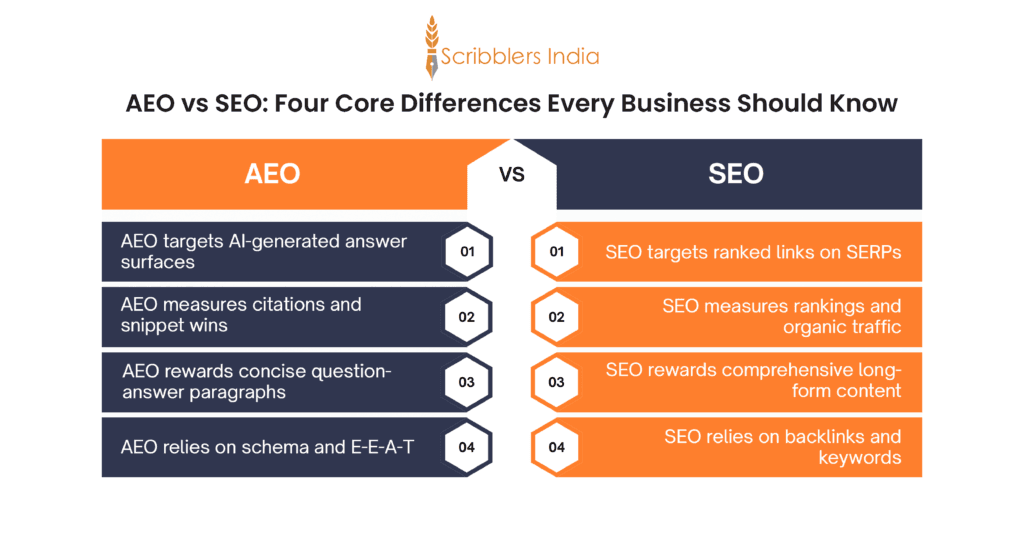
The difference between AEO and SEO lies in their target output, success metrics, content format requirements, and the platforms they optimize for. SEO aims to rank a page. AEO aims to become the answer that a platform generates when a user asks a relevant question.
Here is how the AEO vs SEO distinction plays out across the five dimensions that matter most to a content strategy:
Target Platform and Output
SEO targets traditional search engines, primarily Google and Bing, where the output is a ranked list of links that users browse and click. AEO vs SEO in terms of platform: AEO targets AI-powered answer surfaces, including Google AI Overviews, ChatGPT, Perplexity, Amazon Alexa, and Apple Siri.
Here, the output is a synthesized response that may or may not include a clickable attribution. A business that appears in an AI Overview earns visibility even when the user never clicks through to the site.
Success Metrics
SEO success is measured through ranking positions, organic traffic volume, click-through rates, and keyword visibility scores. AEO success is measured through:
- Featured snippet wins
- AI Overview citation frequency
- Voice search answer inclusion
- People Also Ask appearances
- Brand mention volume across AI-generated responses
Businesses moving into AEO need a measurement framework that captures answer-layer visibility rather than relying on website traffic as the sole indicator of search performance.
Content Format Requirements
SEO rewards comprehensive, keyword-rich, long-form content that covers a topic with enough depth and breadth to satisfy a range of search queries. The difference between AEO and SEO in content format is significant. AEO rewards concise, direct, question-answering paragraphs of 40 to 60 words that allow an AI system to extract a complete answer from a single content block.
The structure that works best for AEO uses question-based headings followed immediately by a complete, standalone answer. This is the exact format that AI Overviews and voice assistants extract and deliver.
Optimization Signals
SEO optimization relies on keyword research, backlink building, metadata refinement, internal linking, site speed, and Core Web Vitals. The answer engine optimization vs search engine optimization comparison on signals indicates that AEO optimization relies on:
- Structured data markup (FAQPage, HowTo, Organization schema)
- E-E-A-T signals, including author credentials and citing original research
- Entity clarity that allows AI systems to understand exactly what a brand is, what it does, and who it serves.
Relationship to Click-Through Traffic
SEO is fundamentally traffic-oriented. Its commercial logic depends on users clicking through to the website where conversion opportunities exist. When it comes to AEO vs SEO on traffic indicates that AEO operates partly outside the click economy.
When a brand’s content is cited in an AI Overview or read aloud by a voice assistant, it earns brand awareness and authority with an audience that may never visit the site during that session. This awareness-level visibility influences direct search behavior, branded queries, and offline purchase decisions in ways that click-based analytics do not capture.
How Does SEO Work in 2026?
SEO helps search engines discover, index, and rank your content for relevant queries. It remains essential in 2026 because the majority of commercial, transactional, and navigational queries continue to drive website clicks, and because strong SEO is the technical foundation AEO builds on.
SEO operates across three interconnected disciplines.
- Technical SEO ensures that search engines can crawl, index, and understand your site structure. It is done through fast load times, clean URL architecture, proper robots.txt configuration, and schema markup.
- On-page SEO aligns your content with the specific queries your audience uses through keyword research, heading structure, meta descriptions, and internal linking.
- Off-page SEO builds domain authority, which signals to search engines that your site is a credible, trusted source through backlink acquisition and brand mentions across the web.
Is SEO Still Relevant in 2026?
The commercial case for continued SEO investment is clear. According to a recent analysis, 36% of searches still result in clicks. For transactional queries, where someone is ready to purchase a product, book a service, or request a consultation, the click rate is higher than the overall average.
A business that abandons SEO to pursue AEO exclusively loses visibility in the remaining share of searches. These queries still drive direct website traffic and commercial conversion.
SEO also functions as the infrastructure on which AEO vs SEO strategies depend. AI systems that power answer engines draw from content that is already well-indexed and recognized as authoritative by traditional search engines. A domain with poor technical SEO, thin backlink profiles, and weak on-page optimization is unlikely to earn AI citations.
This happens regardless of how well its content is structured for AEO. Strong SEO makes AEO possible. AEO extends SEO into the AI-powered discovery layer.
How Does AEO Work and Why Does Your Business Need It Now?
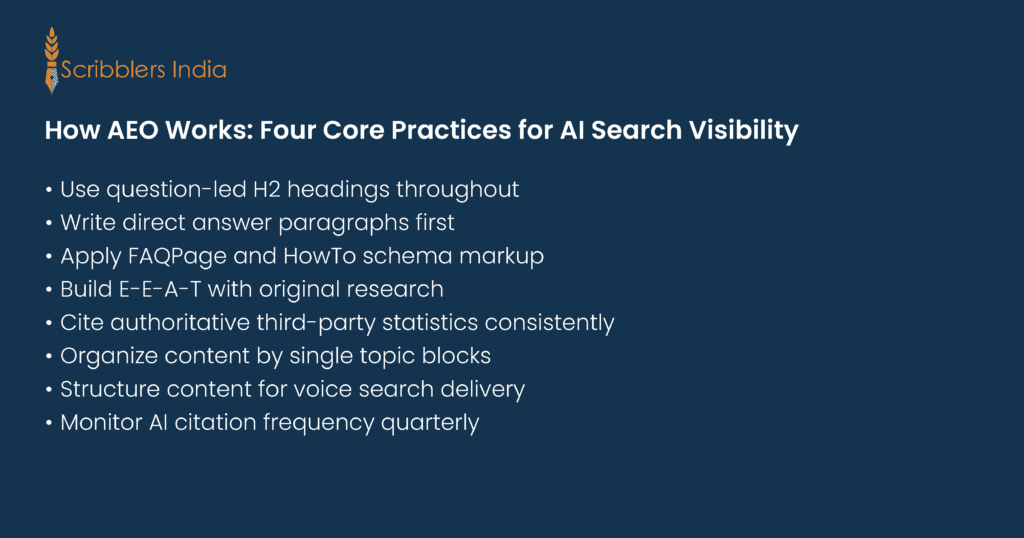
AEO works by structuring content so that AI-powered platforms can retrieve, synthesize, and deliver it as a direct answer to a user query. It requires a different content architecture from traditional SEO and demands that brands think about their content as answers rather than as documents.
The operational principles of answer engine optimization vs search engine optimization at the content level break down into four specific practices:
- Question-led content structure: Every piece of AEO-optimized content organizes itself around the precise questions an audience asks. H2 headings written as complete natural-language questions signal to AI systems that the following content is a direct answer to a specific query. This structure is what featured snippets and AI Overviews extract from.
- Direct, extractable answer paragraphs: The first 40 to 60 words following each question heading must provide a complete, standalone answer. AI systems extract content at the paragraph level, which means an answer that requires reading the entire article to understand will not be selected for a synthesized response.
- Schema markup and structured data: FAQPage, HowTo, Article, and Organization schema give AI crawlers machine-readable context about the nature of the content on a page. This additional context improves the accuracy with which AI systems categorize and retrieve content during the synthesis phase.
- E-E-A-T signal investment: Answer engines prioritize content from sources that demonstrate genuine experience, expertise, authoritativeness, and trustworthiness. Author credentials, original data, cited statistics, and third-party brand mentions all contribute to the E-E-A-T signals that AI platforms use when deciding which sources to include in a generated response.
Which Strategy is Better for Your Business: AEO or SEO?
Businesses should not ask the question ‘Which is better: AEO or SEO’. The accurate framing is: which layer of earch visibility am I currently missing, and how do I build a strategy that captures both? For most businesses in 2026, the answer requires investment in both disciplines simultaneously.
The AEO vs SEO debate misses the point that the two strategies are complementary, not competing.
- Strong SEO provides the domain authority and technical accessibility that AI systems rely on when selecting citation sources.
- Strong AEO ensures that your already-indexed, authoritative content is structured in a way that AI platforms can extract and use.
A business that has excellent SEO but no AEO is well-ranked but increasingly invisible in AI-generated answers. A business that has an excellent AEO structure but weak SEO has no domain authority for AI systems to trust.
Here is how to assess the priority for your specific situation:
When to Prioritize AEO Investment First
AEO deserves priority investment when your business generates significant revenue from informational queries, the category of searches most heavily affected by AI Overviews. If your audience searches for how-to guides, definitions, comparisons, recommendations, and explanations, your content is directly competing with AI-generated answers that resolve those queries without a click.
According to industry research, 88.1% of queries that trigger AI Overviews are informational. If informational content drives your lead generation, AEO is urgent.
When to Prioritize SEO Investment First
SEO deserves priority when your site has technical deficiencies such as poor page speed, indexing errors, thin content, or very low domain authority. Without a strong SEO foundation, AEO optimization cannot deliver consistent results because AI systems will not reliably cite content from domains they do not recognize as authoritative.
Building domain authority through SEO is the prerequisite for AEO citation at scale.
When to Run Both Simultaneously
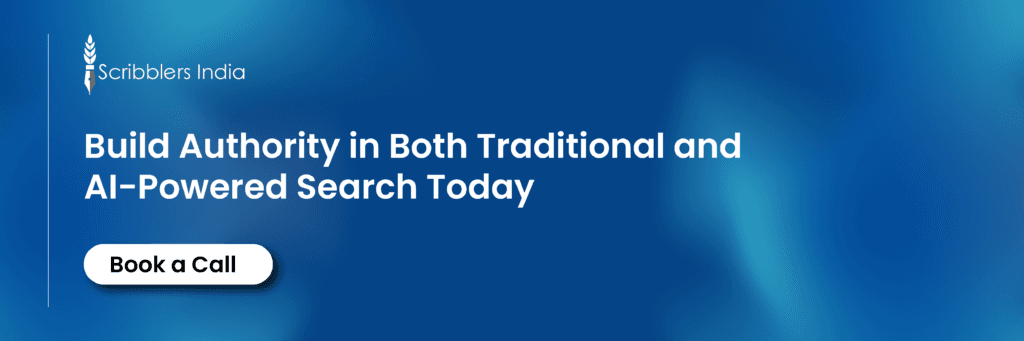
For most established businesses with functional SEO, the right path is to run both simultaneously. Align your existing SEO content with AEO best practices by restructuring key pages around question-based headings and direct answer paragraphs.
Apply schema markup to your highest-traffic informational content. Invest in original research that gives AI systems something unique to cite. Monitor both traditional ranking data and AI citation frequency as parallel metrics of success.
What Content Strategy Works for Both AEO and SEO Together?
A content strategy that serves both AEO vs SEO objectives builds on the same foundational principle. It requires you to create useful, authoritative, and clearly structured content available for a specific topic. You must then format it for both human readers and AI extraction systems.
The overlap between SEO and AEO content principles is substantial:
- Reward original, well-researched, accurate content.
- Penalize thin, generic, low-effort content strategy.
- Benefit from strong domain authority and consistent publishing.
AEO vs SEO: Content Strategy Differences
The key content strategy differences between AEO vs SEO lie in formatting, structural priority, and the measurement framework used to evaluate success.
- Publish comprehensive topic hubs with AEO-formatted sections: A pillar page that covers a topic comprehensively for SEO can simultaneously serve AEO by organizing each subsection around a specific question and providing a direct answer paragraph at the top of each section. This dual-format structure serves the reader who wants depth and the AI system that extracts a specific answer.
- Prioritize original data and proprietary insights: Both SEO and AEO reward content that contains information unavailable elsewhere. Original research, branded surveys, and expert analysis give traditional search engines a reason to rank your content above competitors. It also gives AI systems a specific, unique fact to cite in their generated responses.
- Build a thought leadership content program as the anchor of both strategies: Consistently published thought leadership content builds the E-E-A-T signals that both traditional search algorithms and AI retrieval systems use to evaluate credibility. A content marketing strategy that includes regular articles, research reports, and opinion pieces from named experts builds authority that compounds across both the SEO and AEO layers of search.
- Use FAQ sections with schema on every key page: FAQ sections structured with FAQPage schema markup serve multiple search objectives simultaneously. They capture People Also Ask visibility in traditional search and provide directly extractable content blocks for AI Overviews. They also address the voice search queries that mobile users direct at assistants throughout their day.
Why Do You Need AEO Services in India for Your Business?
India’s B2B and professional services market is experiencing the same AI-driven search shift as the US market. Businesses that invest in answer engine optimization vs search engine optimization early will hold a compounding advantage over competitors who delay. The window for building AI citation authority before it becomes as competitive as traditional SEO is open right now.
At Scribblers India, we combine AEO services, content marketing expertise, and thought leadership strategy to help brands capture visibility across every layer of modern search.
How Does Scribblers India AEO Framework Improve Your AI Visibility?
Let’s understand how our AEO framework works to enhance your AI visibility:
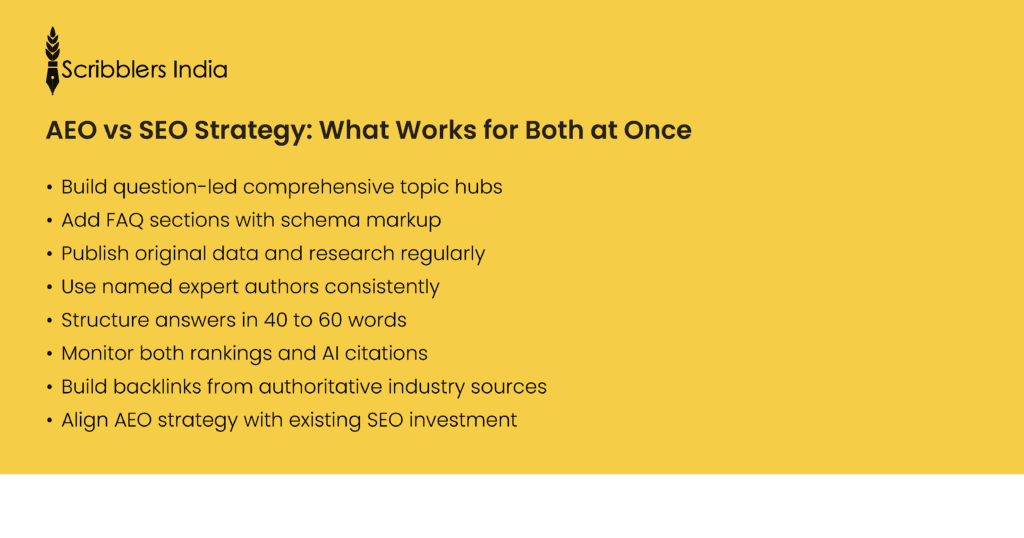
- Structured content that wins both AEO and SEO simultaneously: We produce content that follows AEO formatting principles. This includes question-led headings, direct answer paragraphs, and FAQ schema sections. At the same time, we maintain the depth and keyword alignment that traditional SEO requires. Every piece we produce serves both search layers.
- Original research and data assets that AI platforms cite: Our content strategy services identify the specific topics and questions where your brand has proprietary knowledge that no competitor has published. We develop that knowledge into original research, data-backed articles, and expert analyses. This gives AI platforms a unique reason to cite your brand in generated responses.
- E-E-A-T signal development for AI authority: We build the complete set of E-E-A-T signals that answer engines evaluate. This includes author credential documentation, expert contributor frameworks, original data sourcing, and third-party citation programs. It ensures your content meets the trust threshold required for consistent AI citation across ChatGPT, Perplexity, and Google AI Overviews.
- Executive visibility through personal branding and thought leadership: When your leadership publishes expert-led content consistently, AI systems associate their personal brand with those areas. We develop executive content programs that contribute directly to both individual visibility and organizational AEO performance.
- Full-funnel measurement across AEO and SEO metrics: We track traditional SEO performance through rankings, organic traffic, and click-through rates. We monitor AEO performance through AI Overview citations, featured snippet wins, branded search volume trends, and People Also Ask visibility. This helps us give you a complete picture of how your brand performs across all search surfaces.
Connect with Scribblers India today to build a search visibility strategy that performs across both AEO and SEO to position your brand as a leader in AI-powered search environment.
FAQs
Is AEO replacing SEO, or do businesses need to run both?
AEO vs SEO is not an either-or decision for most businesses. SEO remains essential for driving website traffic through traditional search clicks and for building the domain authority that AI systems use to evaluate citation worthiness. AEO extends that authority into AI-generated answer surfaces where 69% of searches now end. Running both simultaneously captures the full spectrum of modern search visibility.
How does AEO fit into a digital marketing strategy?
AEO has a critical part to play in digital marketing. It includes structuring content around natural-language questions, writing direct answer paragraphs, and applying structured data schema markup. AEO focuses on building E-E-A-T authority signals through expert authorship and original research, and monitoring citation frequency across AI platforms. The practical output is content that appears in Google AI Overviews, ChatGPT responses, Perplexity answers, and voice search results.
How is the difference between AEO and SEO reflected in content writing style?
The difference between AEO and SEO in writing style is most visible in the opening paragraph of each content section. SEO content typically builds to the main point through an introduction. AEO content places the complete answer in the first 40 to 60 words of each section. This allows AI systems to extract and deliver it without reading the full piece.
Which industries benefit most from investing in AEO services right now?
Industries where informational queries drive business development benefit most from SEO vs AEO for businesses investment right now. These include professional services, B2B technology, healthcare, financial services, consulting, and legal services. These are sectors where potential clients research extensively before making contact. In these industries, appearing in AI-generated responses to high-intent questions positions a brand as the authoritative answer before the prospect visits any website.
How long does it take to see results from an AEO strategy compared to SEO?
AEO vs SEO in terms of timeline: AEO results can appear faster than traditional SEO for some content types. Featured snippet wins and People Also Ask appearances can occur within weeks of publishing properly structured content. AI Overview citations take longer to establish because they depend on domain authority and E-E-A-T signals that compound over months. Traditional SEO for competitive keywords typically requires three to six months of sustained investment before significant ranking changes occur.