
Your content team is producing more than ever. AI writing tools have made that possible. Blog posts, product pages, LinkedIn articles, and email sequences that once took days now take hours. The volume is impressive but the risk, when that volume goes live without proper editorial review, is significant.
AI content editing services are the professional layer that sits between your AI-generated drafts and your published content. They are staffed by human editors who fix what AI tools consistently get wrong. This includes factual accuracy, brand voice, logical flow, audience tone, and the specific patterns that search engines have learned to penalize at scale.
Nearly 90% of content marketers now use AI writing tools regularly, according to industry research. That shows how common AI-assisted writing has become across content teams. The real advantage, however, comes when you pair AI’s speed with a human editor’s judgment.
Unedited AI content can weaken your brand statement, introduce factual errors, and affect how readers trust your expertise. A skilled editor fixes these gaps through fact-checking, voice alignment, flow improvement, and SEO review. That is how your AI-assisted draft becomes credible and ready to publish.
TL;DR: What you must know about AI content editing services?
|
What Are AI Content Editing Services?
AI content editing services are professional editing solutions that help you turn AI-generated drafts into brand-ready and publishable content. Instead of treating an AI draft as the final version, these services add human judgment at the most critical stage of the content workflow.
A skilled editor checks whether the content is factually correct, easy to read, aligned with your brand voice, and useful for your target audience. They also remove common AI writing patterns that make content feel generic or low-effort.
In simple terms, AI gives you the first draft. Human editing makes it credible, clear, and ready to represent your business.
What Do AI Content Editing Services Include?
AI content editing services include a structured review process. Here, trained human editors assess and improve AI-generated content for factual accuracy, brand voice, tone consistency, flow, originality, and SEO alignment before publication.
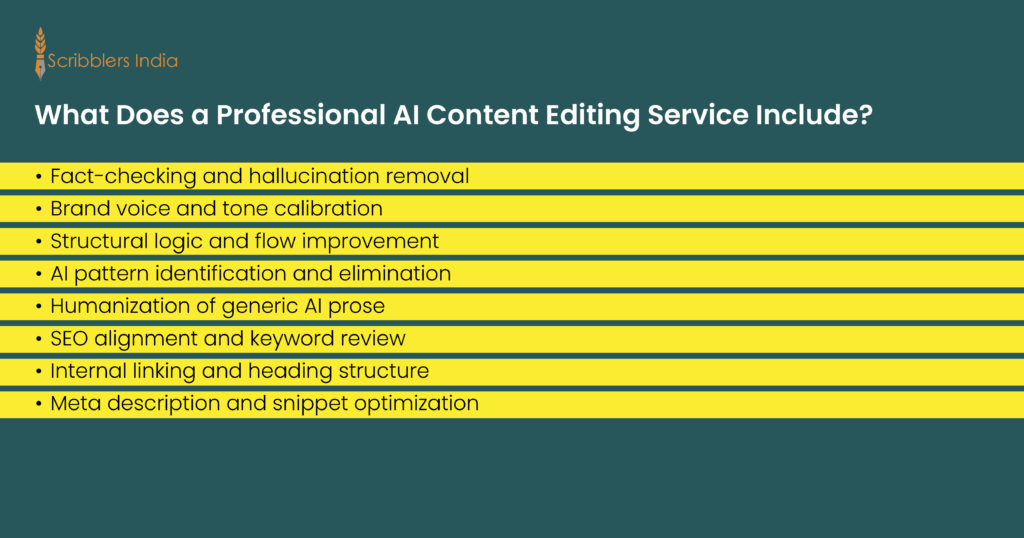
The scope of AI-generated content editing goes well past spell-checking and grammar correction. Here is what a comprehensive engagement covers:
Fact-Checking and Hallucination Removal
AI language models generate plausible-sounding text by predicting statistically likely word sequences. That process sometimes produces confident-sounding claims that are factually incorrect, a behavior known as hallucination.
A human editor with domain knowledge catches invented statistics, incorrect company attributions, outdated regulatory information, and fabricated study citations before any of these errors reach your audience. On YMYL pages, content covering finance, health, or legal topics, a single hallucinated fact can trigger a Google quality demotion. This exposes the business to legal risk and permanently damages reader trust in the brand.
Brand Voice Alignment and Tone Calibration
AI tools generate content in a generalized professional register that rarely matches a specific brand’s established voice. A company that communicates with sharp wit sounds identical in an AI draft to one that leads with analytical precision.
A professional AI content editing team applies the brand’s documented tone guidelines to every paragraph, ensuring the published content sounds like the organization rather than a capable but generic writing algorithm. This matters most for thought leadership content, where a distinctive voice is the primary asset the content is meant to build.
Structural Logic and Flow Improvement
AI-generated content frequently suffers from structural issues that grammar tools miss. Sections repeat points made earlier. Transitions between ideas feel abrupt. Arguments build toward a conclusion that is then contradicted in the following paragraph.
A human editor restructures the logic, removes redundancy, and creates the coherent flow that keeps a reader engaged through a 1,500-word article rather than abandoning it at the third paragraph. This structural quality directly affects dwell time, bounce rate, and the engagement signals that search algorithms use to evaluate content relevance.
AI Pattern Elimination and Humanization
AI writing carries recognizable stylistic fingerprints: overuse of three-part lists, formulaic transitions, repetitive sentence openers, heavy reliance on em dashes, and a tendency toward hedged, non-committal conclusions.
An experienced AI content review service identifies these patterns and rewrites them into genuinely natural prose that reads as though a knowledgeable human wrote every sentence with a specific audience in mind. This humanization process is distinct from basic editing. It requires a writer who understands both how AI tends to construct language and how actual professionals in each industry communicate.
SEO Optimization and Search Alignment
AI content editing services include a final pass for search optimization that a grammar-focused editor alone cannot complete. This covers keyword density review, heading structure alignment, featured snippet formatting, internal linking recommendations, and meta description refinement.
The goal is to produce content that serves both the human reader and the search systems that determine whether that reader ever finds the page.
Why Is Publishing Unedited AI Content a Serious Risk for Your Business?
Publishing unedited AI content risks Google penalties, damage to already strong brand reputation, and erosion of audience trust. Google does not penalize content for being AI-generated. It penalizes low-quality, inaccurate, or scaled content without editorial value, regardless of how it was produced.
The evidence from 2025 onward is consistent and specific. A comprehensive analysis of AI-generated domains found that sites with 90% or more unedited AI content experienced mass deindexing within 3-6 months. Sites that combined AI drafts with human editing for AI content, expert citations, and structured data remained stable through multiple core updates. The difference was the editorial process applied after the tool finished generating.
The Factual Accuracy Problem
AI tools fabricate with confidence. They generate statistics from nonexistent studies, attribute quotes to the wrong people, describe non-existent regulatory requirements, and state technical specifications that are incorrect.
A business that publishes these errors at scale faces consequences across multiple dimensions simultaneously: search demotion from quality signals, audience loss from broken trust, and in regulated industries, potential legal liability from publishing inaccurate professional information.
The Brand Voice Erosion Problem
When an organization publishes AI-generated content at volume without consistent editorial oversight, its brand voice gradually disappears from its own published content. Readers who have engaged with the brand for years notice that articles feel impersonal, generic, and detached from the organization’s actual expertise and perspective.
This erosion is slow and cumulative, which makes it harder to detect and much harder to reverse than a single factual error that can be corrected with an update.
The Google Scaled Content Abuse Problem
Google’s spam guidelines specifically target what they call “scaled content abuse”. It is content produced at high volume primarily to manipulate search rankings rather than to genuinely serve users.
AI tools make high-volume production trivially easy, which means the temptation to publish without editorial review increases precisely as the risk of doing so also increases. The recovery timeline for sites hit by these penalties ranges from six months to permanent loss of pre-update ranking positions.
The Audience Trust Deficit
Modern readers are increasingly adept at recognizing AI-generated text. The patterns are consistent enough that a significant portion of your professional audience will identify the content as unedited AI output. This will directly reduce their trust in the organization’s expertise.
Trust lost through the perceived publication of low-effort content is extremely difficult to recover through subsequent high-quality content alone.
How Does the AI Content Editing Process Work?
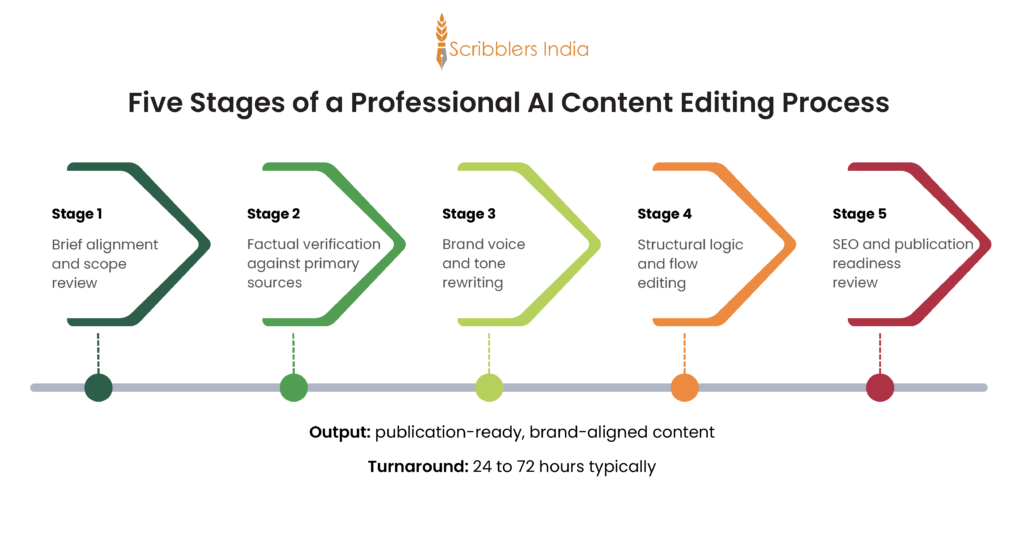
The process of editing AI content follows a structured workflow. It moves AI-generated drafts through multiple quality checkpoints before any content is approved for publication.
At a professional level, editing AI-generated content involves the following sequence:
Stage One: Brief Alignment Review
Before editing begins, the editor reviews the original brief and target audience alongside the AI draft. They also check the brand voice guidelines to assess tone fit. This comparison shows whether the draft addresses the right audience and covers the intended topic scope.
It also confirms whether the tone matches the brand’s expected communication style.
Any misalignment is flagged before line-level editing begins. This prevents structural rewrites after detailed sentence-level work is complete.
Stage Two: Factual Verification
Every claim, statistic, attribution, and date in the draft is checked against primary sources. Regulatory references and technical specifications are also verified before the content moves forward. This is often the most time-intensive phase of the editing process. AI tools can write fluently, but they can also present inaccurate claims with confidence.
An editor does not assume that a confidently stated figure is accurate. They verify the source, confirm the claim, or correct the information before approval.
Stage Three: Voice and Tone Rewriting
After confirming factual accuracy, the editor rewrites the draft to align with the core elements of brand voice. This phase turns generic AI prose into content that reflects the organization’s specific register. The editor uses the brand’s preferred terminology and aligns the content with its point of view. They also make the language feel familiar to the audience.
This stage separates professional AI content editing from simple proofreading. It ensures the final piece sounds like your brand, not an AI-generated draft.
Stage Four: Structural and Flow Edit
The editor then reads the piece as a continuous argument, assessing whether each section follows logically from the previous one. They verify that the opening makes a claim that the body supports. The editor also checks whether the conclusion delivers on the promise made by the introduction.
The editor consolidates repeated points and improves weak transitions. They revise or remove sections that dilute the core argument.
Stage Five: SEO and Publication Readiness Review
The final stage addresses search optimization. It focuses on keyword usage, heading hierarchy, internal link recommendations, meta description alignment, and featured snippet formatting.
The editor produces a version of the content that is ready to copy into the CMS and publish. No additional quality intervention required between editorial delivery and live publication.
What Types of Businesses Need AI Content Editing Services Most Urgently?
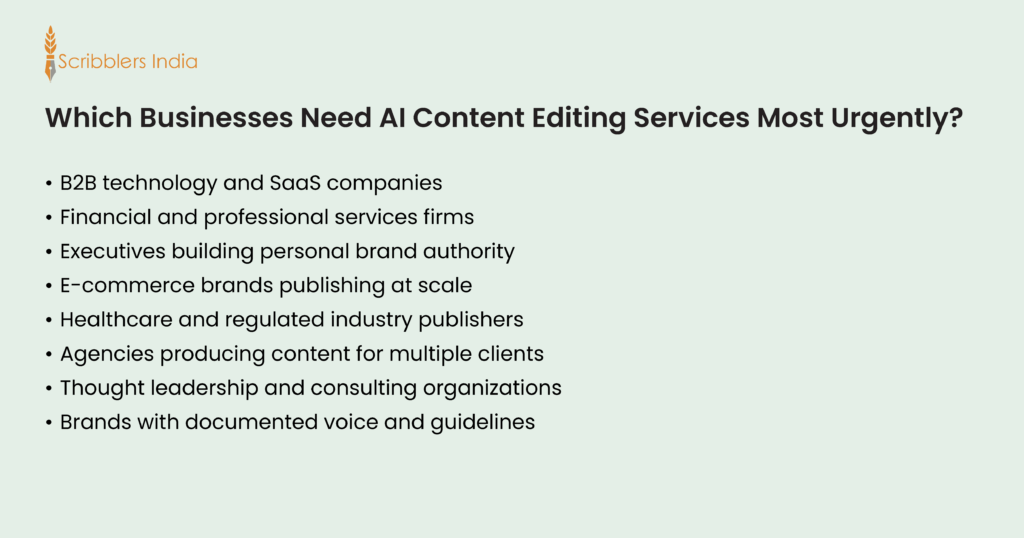
AI content editing services are critical for businesses or individuals that publish at scale or operate in trust-sensitive industries. Anyone who has invested significantly in brand authority also needs these services. Unedited AI content can undermine the value of a personal or corporate brand within a single publishing cycle.
The following industries face the highest risk from AI-generated content and can benefit most from structured editorial oversight:
- B2B Technology and SaaS Companies: B2B technology buyers are advanced and well-informed. They read vendor content to evaluate whether they genuinely understand the problems. AI-generated content uses vague terminology or misrepresents technical concepts. This signals to the audience that the vendor lacks real domain expertise. A single poorly researched article can undermine the credibility that a thought leadership content strategy took months to build.
- Financial Services and Professional Services Firms: Regulated industries face serious consequences from factual errors in published content. A financial advisory firm that publishes an AI-generated article containing an inaccurate regulatory reference creates immediate liability exposure. For professional services firms, their entire commercial value proposition is expert knowledge. Publishing content that is inaccurate is more damaging to them than publishing no content at all.
- Executives Building Personal Brands Through Published Content: Senior leaders who use AI tools to support their personal branding content program need AI content editing services to ensure that every published piece reflects their real expertise and genuine perspective. Content that reads like polished but generic AI output strips away the experience-based authority.
- E-Commerce and Retail Brands Publishing at Scale: E-commerce businesses that use AI to generate product descriptions, category pages, and editorial content at scale risk violating Google’s scaled content abuse guidelines. Human editorial review across high-volume content production ensures that each piece meets a quality threshold that protects the domain’s overall search health.
How Do You Choose the Right AI Content Editing Agency for Your Business?
Choosing the right AI content editing agency requires evaluating their editorial depth, industry experience, turnaround capacity, and ability to consistently apply a brand voice across high volumes of content. The selection criteria matter as much as the investment.
The most important distinguishing factor between a basic proofreading service and a genuine AI content editing agency is domain knowledge. An editor who cannot evaluate whether a technical claim is plausible cannot identify hallucinations before they go live.
Ask any prospective agency for samples of AI-edited content in your industry and test the factual accuracy of the claims in those samples independently before committing to an engagement.
Breadth of Editorial Services Offered
A comprehensive AI content review service covers the full range of editorial interventions. It ranges from structural rewrites and voice calibration down to SEO optimization and publication preparation. Agencies that offer only proofreading and grammar correction leave the most consequential editing problems unaddressed. Confirm that the agency’s process includes explicit fact-checking, explicit voice alignment, and explicit SEO review as defined deliverables rather than implied inclusions.
Turnaround Time and Volume Capacity
AI content editing services must keep pace with AI-assisted content production timelines. If your team generates 20 pieces of content per week, your editing partner needs to process 20 pieces per week without degrading quality. Ask specifically about their average turnaround time per piece, their maximum weekly volume, and what quality control measures they apply when operating at peak capacity.
Revision Policy and Quality Guarantees
Professional AI-generated content editing engagements include a defined revision policy that specifies how many rounds of feedback are included. It also covers how quickly revisions are delivered, and what recourse the client has if the delivered content does not meet the agreed quality standard. An agency that cannot describe its revision policy clearly has not systematized its quality assurance. This is the single most important operational requirement for high-volume editorial services.

Why Do You Need AI Content Editing Services in India Specifically?
India’s professional publishing landscape has embraced AI writing tools faster than most global markets. This makes the need for structured AI content editing services proportionally more urgent for businesses operating in or serving markets where content quality directly influences commercial outcomes.
Scribblers India AI Content Editing and Humanization Framework
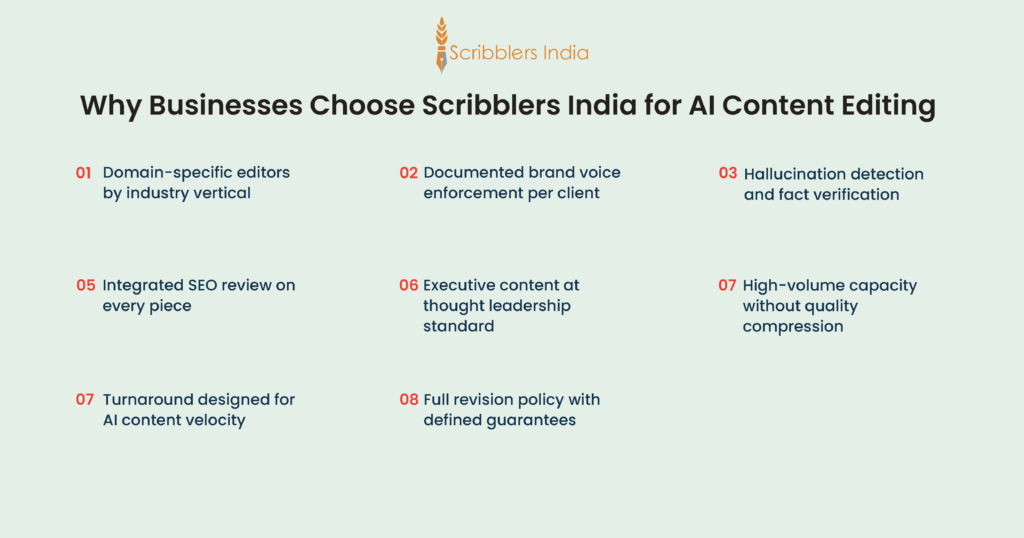
Here is what makes our AI content editing framework distinct:
- Domain-specific editorial teams: Our editors are matched to client accounts by industry vertical. For instance, a technology client works with an editor who understands SaaS terminology. This domain alignment is the foundation of the fact-checking accuracy that generic editing services cannot deliver.
- Brand voice documentation and enforcement: We begin every professional AI content editing engagement with a voice audit of your existing best-performing content. We document the specific patterns, terminology, and register that define your brand voice, then apply that document as the editorial standard against which every AI draft is assessed and rewritten. This integrates directly with our content marketing services.
- Integrated SEO review on every piece: Every piece we edit exists with an SEO review covering keyword density, heading structure, meta description, and featured snippet formatting. We treat search optimization as an editorial function rather than a separate technical task.
- Thought leadership standard for executive content: When editing AI-assisted content for founders, CEOs, or senior leaders, we apply a higher editorial standard that ensures the published piece carries the depth, specificity, and original perspective that a personal branding strategy requires. Generic AI prose is transformed into content that advances professional reputation.
- High-volume capacity with consistent quality: Our editorial system is designed to scale without degrading quality. We deliver consistent editorial standards across 20, 50, or 100 pieces per month through structured quality checkpoints that do not buckle under volume pressure, ensuring every piece that bears your name meets the same bar regardless of the week’s volume demands.
Connect with our experts to discuss how our AI content editing services can transform your AI-assisted content into a brand asset that builds authority, protects rankings, and earns genuine reader trust.
FAQs
Does Google penalize content that was written with AI tools?
Google does not penalize content for being AI-generated. It penalizes content that is low-quality, inaccurate, or scaled without editorial value. This is what Google calls “scaled content abuse.” Sites publishing high volumes of unedited AI content without human review consistently saw traffic drops of 40% to 90% in the 2024 and 2025 core updates. AI content editing services protect against this outcome through structured human editorial oversight.
What is the difference between AI content editing and regular proofreading?
Regular proofreading corrects spelling, grammar, and punctuation. AI content editing services go significantly further by verifying factual accuracy, rewriting for brand voice, restructuring logical flow, eliminating AI-specific writing patterns, and optimizing for search performance. An AI-generated draft that passes proofreading may still contain hallucinated statistics, misaligned brand voice, and structural problems. Only a strategic human editor with domain knowledge can identify and resolve these issues
Can AI content editing services support ghostwriting and ebook writing projects?
Yes. Our AI content editing services can support ghostwriting initiatives by helping shape early drafts from rough ideas or voice notes. Our human editors refine the content to reflect the leader’s authentic perspective and tone. They also support the ebook writing process by improving flow, removing repetition, and shaping AI-assisted sections into a clear, long-form asset.
How do human editors identify and fix AI hallucinations in content?
Experienced human editors in professional AI content editing engagements approach every factual claim with skepticism toward verification rather than assuming accuracy. They check statistics against primary sources, verify attributions against original publications, confirm regulatory references against current official documentation, and flag untraceable claims.
How long does it take to receive edited content from an AI content editing service?
Most professional AI content editing services deliver edited content within 24 to 72 hours, depending on piece length, complexity, and the volume of factual verification required. High-volume retainer clients typically receive a consistent daily or weekly delivery cadence that integrates directly with their content publishing calendar. Rush turnarounds of 12 to 24 hours are available from many providers for an additional fee.
Can AI content editing services help content that has already been published?
Yes. An AI content review service can audit and improve already-published AI-generated content that may underperform in search or receive negative audience feedback. A content audit engagement reviews existing pages for factual accuracy, voice consistency, structural quality, and SEO alignment. They then produce an edited version of each piece, along with recommendations for any pages that are too thin or inaccurate to improve through editing alone.
How do AI content editing services relate to annual report writing services?
AI content editing services strengthen annual report writing processes when AI supports the first draft. Human editors check accuracy, improve clarity, and maintain a consistent business narrative. They review leadership commentary, operational highlights, and stakeholder-facing information with care. This ensures the final annual report sounds professional and remains publication-ready.