
AI search is changing how buyers discover, compare and shortlist brands. Users now ask ChatGPT, Gemini, Perplexity and Google AI Overviews for direct recommendations, summaries and buying guidance before they visit a website. That is why brands need to optimize content for AI-generated answers if they want to stay visible across the platforms that shape modern search behavior.
Google AI Overviews had already reached over 2 billion monthly users across more than 200 countries and territories by July 2025. This scale shows why brands need to optimize content for AI answers through a clear Generative Engine Optimization framework. GEO combines answer-first writing, entity clarity, authorship signals, structured data, technical accessibility and cross-platform authority building.
At Scribblers India, AI search visibility is no longer a future-facing content experiment. It is now a practical requirement for content marketing for brands that want to stay visible across ChatGPT, Gemini, Perplexity, AI Overviews, and future answer engines. This blog covers 11 expert tips to help you optimize content for AI answers across four connected areas: content structure, authority signals, technical accessibility, and multi-platform presence.
TL;DR
|
How Can Content Structure Help You Optimize Content for AI Answers?
Content structure helps AI platforms extract, summarize and cite your information with greater confidence. When every section starts with a direct answer, a question-based heading, and clear supporting context, ChatGPT, Gemini, and Perplexity can understand the page faster and use it more reliably in their generated responses.
A strong content structure is the foundation of every GEO strategy. AI platforms scan pages for answer units, topical completeness and source clarity. If the answer appears after a long build-up, generic introduction, or loosely connected explanation, the page becomes harder to cite.
A 2026 longitudinal study of Google AI Overviews found that AI Overviews appeared for 13.7% of all tested queries, rising to 64.7% for question-form queries. This makes question-led headings and direct answer blocks especially important for brands building AI visibility.
The following structural practices help improve content optimization for AI answers across major generative search platforms.
Tip 1: Use Answer-First Structure on Every Page
Answer-first structure means placing the clearest possible response within the first few lines of every section. This makes your content easier for AI platforms to extract, summarize and cite when users ask direct questions across ChatGPT, Gemini, Perplexity or Google AI Overviews.
Traditional blog writing often delays the answer. It starts with context, market background or broad observations before reaching the actual point. That approach works poorly for AI search because generative systems need concise answer blocks that resolve the user’s query immediately.
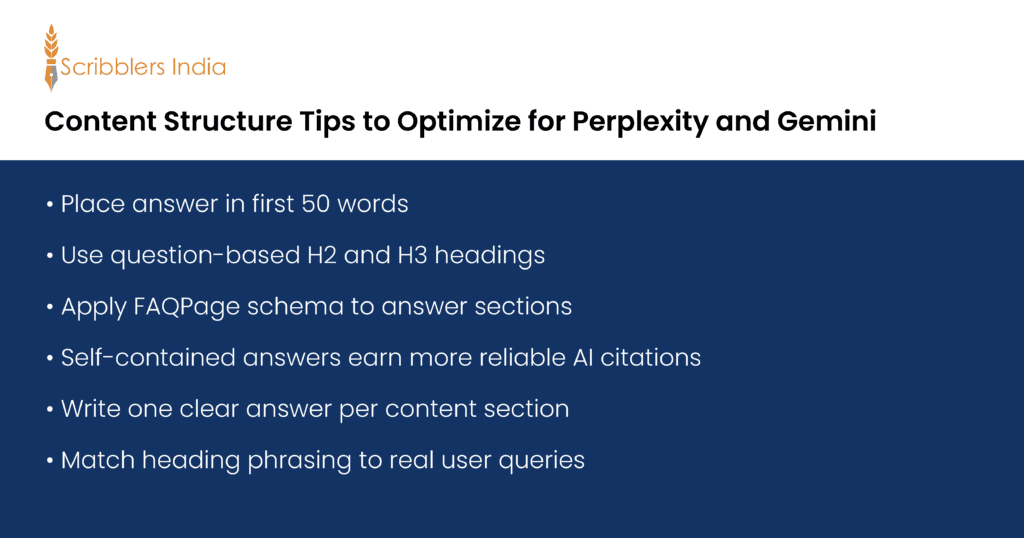
- A better structure follows this order:
- Question-based heading
- Direct answer in the opening paragraph
- Short explanation with context
- Example, data point or comparison
- Practical takeaway
This format works especially well for commercial and informational pages. For example, instead of opening a section with “In today’s digital landscape, AI search has become important,” start with the exact answer: “To optimize content for ChatGPT, structure every section around a direct answer, verified source signals and clear entity context.”
This gives the AI system a clean response unit it can reuse. It also helps human readers find the answer faster, improving readability and engagement
Tip 2: Use Question-Based Headings That Mirror User Prompts
Question-based headings help AI systems connect your content with natural user queries. When your H2s and H3s mirror the way people ask questions in ChatGPT, Gemini or Perplexity, your page becomes easier to retrieve for answer-led search experiences.
Any content targeting AI search should avoid vague headings such as “Importance,” “Benefits,” or “Best Practices.” These headings provide weak semantic signals. Instead, use complete questions that reflect how users search.
For example:
- What Is Content Optimization for AI Answers?
- How Can You Optimize Content for ChatGPT?
- How Can You Optimize Content for Gemini?
- How Can You Optimize Content for Perplexity?
- What Schema Helps AI Platforms Understand Your Content?
These headings create a direct match between user intent and page structure. They also improve passage-level relevance because each section clearly answers one query.
For Scribblers India blogs, question-led headings work especially well because they support SEO, AEO and GEO at the same time. They make the article easier to scan, extract, and repurpose into FAQs, LinkedIn posts, or sales enablement assets.
Tip 3: Add Definitions, Examples, and Use Cases Within Each Section
Definitions, examples and use cases make your content more useful for AI answers because they add clarity and information gain. AI platforms prefer sections that explain a concept, then support it with practical context. This helps readers understand the topic more quickly and gives AI systems stronger material to extract with greater confidence.
- Start with a clear definition before expanding the idea. A section on GEO for ChatGPT should first explain what the term means, then move into how it affects content visibility across AI-generated answers.
- Add examples that show how the concept works. If you explain content optimization for AI answers, include a sample section structure, heading format or answer-first paragraph that readers can understand and apply.
- Use real scenarios to build practical relevance. For example, explain how a SaaS brand can optimize content for Perplexity by publishing comparison pages, expert guides and source-friendly answer sections.
- Answer the next logical question within the same section. After defining the concept, explain why it matters, how it works in practice and what the reader should do next.
- Avoid generic explanations that repeat common information. Add original framing, brand-specific examples or expert observations so your content gives AI platforms something more useful than a standard summary.
Tip 4: Add FAQ Sections With Clear Answer Blocks
FAQ sections help AI platforms identify direct question-and-answer pairs within your content. When written well, FAQs create additional answer units that can appear across ChatGPT, Gemini, Perplexity, AI Overviews and traditional search results.
Every key page should include five to eight FAQs that address high-intent user questions. These questions should come from keyword research, sales conversations, customer objections and People Also Ask insights.
A strong FAQ answer should be concise, specific and self-contained. Avoid vague answers that depend on previous sections for context. Each FAQ should make sense even if an AI system extracts it separately from the full article.
For example, a weak FAQ answer would say: “Yes, it helps because it improves visibility.”
A stronger answer would say: “Yes. GEO helps small businesses improve AI search visibility by structuring pages around direct answers, expert signals and trusted external references that generative platforms can verify before citing.”
This answer has context, subject clarity and practical value. That makes it more useful for both readers and AI retrieval systems.
What Authority Signals Help You Optimize Content for AI Answers?
Authority signals help AI platforms decide whether your brand, author or website deserves to be cited. To optimize content for AI answers, you need credible authorship, original research, third-party validation and consistent entity information across trusted sources.
Generative platforms do not evaluate a page in isolation. They look for signs that the source is reliable, up to date, and supported by broader web consensus. This is why GEO strategy goes beyond on-page SEO. It includes brand authority, author identity, external mentions and source corroboration.
The following authority signals are especially important for brands that want to optimize content for ChatGPT, Gemini and Perplexity.
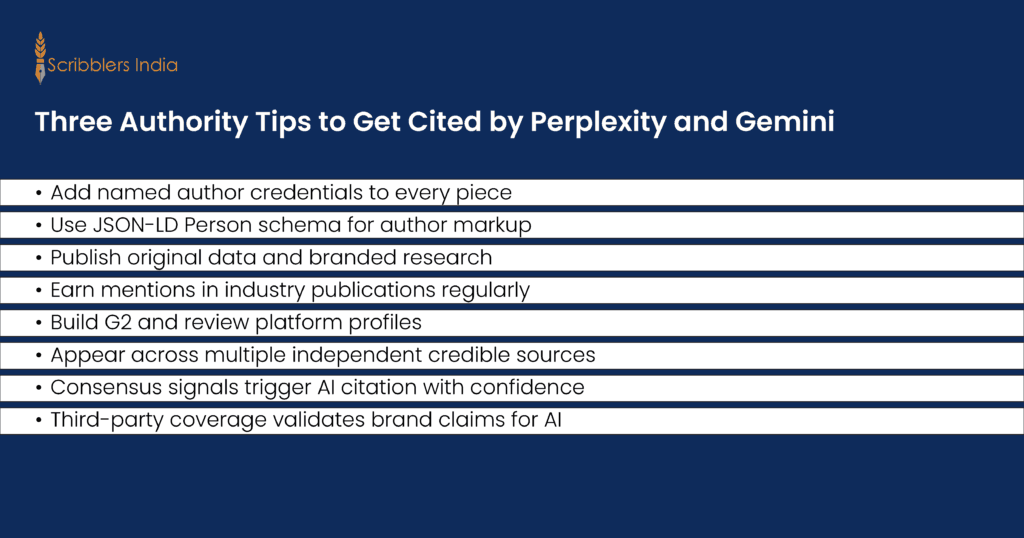
Tip 5: Add Named Author Credentials to Every Content Piece
Named author credentials help AI platforms and human readers understand who created the content and why they are qualified to explain the topic. Every important blog, guide and glossary page should include a credible author bio with relevant experience, expertise and profile links.
Generic “admin” authorship weakens trust. It gives AI systems limited information about the person behind the content. For topics involving marketing, finance, healthcare, SaaS, legal, technology or business decisions, authorship clarity becomes even more important.
A strong author section should include:
- Full author name
- Role or designation
- Years of relevant experience
- Core area of expertise
- LinkedIn or professional profile link
- Relevant publication history where available
You can also use Person schema to make the author identity machine-readable. This helps search systems understand the relationship between the article, author and organization.
Tip 6: Publish Original Research, Data and Expert Frameworks
Original research gives AI platforms a clear reason to cite your brand instead of another similar source. Proprietary data, surveys and expert frameworks create information gain that generic content cannot match. This helps you optimize content for AI answers with stronger credibility and more source-worthy insights.
- Industry Survey Reports: Run short surveys around buyer behavior, platform usage, or industry challenges. Convert the findings into charts, insights and expert commentary. This creates original data that ChatGPT, Gemini and Perplexity can reference when answering niche questions.
- Benchmark Reports: Compare performance trends, adoption rates or process gaps across a defined market segment. Add clear methodology and sample details. A well-structured benchmark report provides AI platforms with sourceable figures rather than another broad, opinion-based explanation.
- Expert-Led Frameworks: Build branded models that explain how your team solves specific content, SEO or GEO challenges. Name the framework and explain each step clearly. This helps AI systems associate your brand with a distinct point of view.
- First-Party Trend Analysis: Use internal campaign learnings, customer conversations or content audits to identify recurring patterns. Present these insights with practical examples. This turns everyday agency experience into citation-worthy material that supports content optimization for AI answers.
Tip 7: Earn Third-Party Mentions Across Trusted Platforms
Third-party mentions help AI systems verify that your brand exists beyond its own website. Mentions in industry publications, review platforms, podcasts, expert roundups, LinkedIn conversations and community discussions strengthen entity trust across the wider web.
This matters because generative platforms often look for consensus. If your website says you are an expert, that is a claim. If respected external sources mention your work, review your services, or quote your experts, that becomes corroboration.
Useful third-party signals include:
- Mentions in industry media
- Guest articles on relevant publications
- Podcast appearances
- LinkedIn thought leadership engagement
- G2, Clutch or Capterra profiles where relevant
- Reddit or community discussions with useful participation
- YouTube interviews or explainers
For GEO for Perplexity AI, this is particularly useful because Perplexity often surfaces source-backed answers from live web references. For GEO for Gemini, external signals also help strengthen entity understanding across Google’s broader search ecosystem. The goal is not to manufacture mentions. The goal is to create real authority signals through useful participation, expert commentary and publishable insights.
Which Technical Steps Help You Optimize Content for AI Answers?
Technical optimization helps AI platforms access, interpret and connect your content with the right entities. To optimize content for AI answers, your priority pages should be crawlable, indexable, structured with relevant schema and supported by clean technical signals.
Technical GEO does not replace good content. It makes good content easier to understand. If your pages are blocked, poorly indexed, missing structured data or buried behind scripts, AI platforms may struggle to retrieve them.
The following technical practices help improve AI search visibility across ChatGPT, Gemini and Perplexity.
Tip 8: Use Structured Data Across Priority Pages
Structured data helps search systems understand your content, authors, organization and page format. While schema alone does not guarantee AI citations, it provides platforms with clearer context when evaluating pages for search features and answer-led experiences.
Use a schema that matches the page type. Avoid adding irrelevant markup only for visibility. The goal is to clarify the page, not overload it.
- Important schema types include:
- Article schema for blogs and guides
- FAQPage schema for question-and-answer sections
- Organization schema for brand identity
- Person schema for author profiles
- HowTo schema for step-by-step instructional pages
- Product or Service schema where relevant
Article schema should include headline, author, datePublished and dateModified fields. This helps communicate freshness and authorship more clearly. The organization schema should match your brand name, logo, website, social profiles, and business details across platforms.
For content optimization for AI answers, structured data works best when the visible content and markup match. Do not mark up FAQs that are hidden, thin or unrelated to the page. AI platforms and search engines need consistency between what users see and what machines read.
Tip 9: Make Priority Pages Accessible to Search and AI Crawlers
Crawler accessibility determines whether AI and search systems can discover your content. If important pages are blocked through robots.txt, llms.txt, noindex tags, login walls, broken canonicals, or technical errors, they may remain outside the retrieval pool.
For traditional search, check the accessibility of Googlebot and Bingbot. For AI search, review access for relevant crawlers such as OAI-SearchBot and PerplexityBot. OpenAI uses OAI-SearchBot for search-related discovery, while Perplexity documents PerplexityBot as the crawler that surfaces and links websites in Perplexity search results.
- A basic technical audit should check:
- Robots.txt rules
- Noindex tags
- Canonical tags
- Sitemap submission
- Server response codes
- Page speed and rendering
- Blocked JavaScript or CSS
- Mobile usability
- Internal linking depth
You should also manually test priority pages. Search for your brand, service pages, and expert guides inside ChatGPT, Gemini, and Perplexity. Check whether the platforms can retrieve your pages in response to relevant prompts. This step is often missed. Many brands invest in strong content but lose visibility because their technical setup prevents reliable discovery.
How Does Multi-Platform Presence Help You Optimize Content for AI Answers?
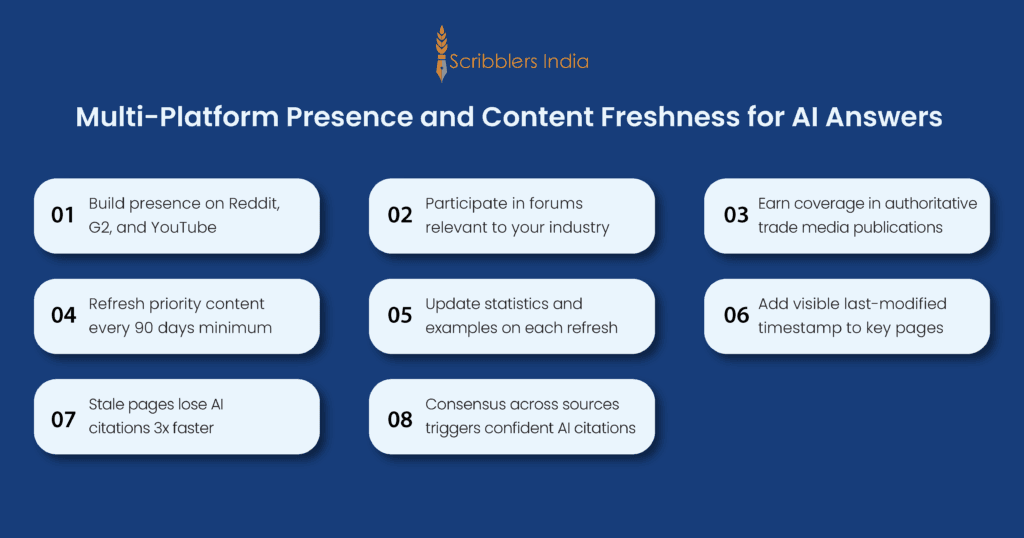
Multi-platform presence strengthens the entity consistency and consensus signals that AI systems use before citing a brand. When your positioning appears consistently across search, social, video, review platforms and industry communities, AI platforms can verify your authority with greater confidence.
AI search visibility is no longer limited to your website. ChatGPT, Gemini and Perplexity may draw context from indexed pages, third-party mentions, profiles, reviews, videos, articles and trusted discussions. This makes brand consistency a key part of any GEO strategy.
The following two practices help brands build stronger external visibility.
Tip 10: Build Presence Across LinkedIn, YouTube, Forums and Review Platforms
A strong multi-platform presence provides AI systems with more reliable references to understand your brand. If your website, LinkedIn profile, YouTube content, review listings and industry mentions all communicate the same positioning, your entity becomes easier to identify and cite.
For service businesses, this matters even more. AI platforms need to understand what the brand does, who it serves and why it is credible. Your website alone may not provide enough corroboration.
Useful platforms include:
- LinkedIn for founder-led thought leadership
- YouTube for expert explainers and product walkthroughs
- Reddit for genuine community participation where appropriate
- G2, Clutch or Capterra for B2B service credibility
- Industry publications for editorial validation
- Podcast directories for expert-led visibility
- Google Business Profile for local and brand trust
The language across these platforms should remain consistent. If your website calls you a GEO content agency, your LinkedIn page should not describe you only as a blog writing company. If your service pages focus on AI search visibility, your founder posts, case studies and external profiles should support that positioning.
This is how multi-platform content supports GEO for ChatGPT, Gemini, and Perplexity AI simultaneously.
Tip 11: Refresh High-Priority Content on a Regular Cycle
Regular content refreshes help preserve relevance, accuracy and citation readiness across AI search platforms. ChatGPT, Gemini and Perplexity evolve quickly, so outdated examples can weaken trust. A planned refresh cycle helps brands optimize content for AI answers without rebuilding every page from scratch.
- Update Statistics and Examples: Review every important data point, tool reference and platform-specific example during each refresh. Replace outdated figures with current sources. This keeps the page useful for readers and helps AI platforms identify it as a reliable, current resource.
- Improve FAQs and Answer Blocks: Add new FAQs based on user prompts, sales questions and AI search testing. Rewrite weak answers into direct, standalone responses. This improves content optimization for AI answers by creating more extractable sections within the same page.
- Strengthen Internal Links and Schema: Add fresh internal links to newer blogs, service pages and related resources. Review Article, FAQPage and Organization schema fields. Update dateModified details where relevant so search systems receive clearer freshness and structure signals.
- Add New Expert Insights: Include new observations from campaign results, client conversations or content audits. Turn these insights into short examples or practical recommendations. This helps the page move beyond generic advice and gives AI platforms stronger context to reference.
Why Do Indian Brands Need GEO Services to Optimize Content for AI Answers?
Indian brands need to focus on Generative Engine Optimization because AI search is becoming a major discovery layer for B2B buyers, SaaS users, founders and decision-makers. A strong GEO strategy helps brands structure their expertise so ChatGPT, Gemini, Perplexity and AI Overviews can understand, verify and cite it.
India has a fast-growing digital content market. Competition is increasing across SaaS, fintech, healthcare, education, ecommerce, manufacturing and professional services. Traditional SEO remains important, but it no longer covers the full discovery journey.
A buyer may now ask:
- Which agency offers GEO content services in India?
- Which SaaS tool is best for my use case?
- What are the best alternatives to a known competitor?
- Which company has the strongest expertise in a niche category?
- Which guide explains this topic clearly?
- If your content does not appear in these AI-assisted discovery journeys, your brand may lose visibility before the buyer reaches Google search results.
GEO services help close this gap by aligning your content with how AI platforms retrieve and generate answers. This includes answer-first content, author authority, structured data, entity optimization, original insights and external trust signals.
At Scribblers India, GEO is not a replacement for SEO. It is the next layer of content visibility.
How Does Scribblers India Build GEO Visibility Across Leading AI Platforms?
Scribblers India helps brands optimize content for AI answers through a structured GEO framework. Our approach combines content strategy, expert-led writing, technical readiness and authority building across leading AI platforms.
- Answer-First Content Restructuring: We audit high-value pages and restructure them around direct answers, question-based headings and clearly defined content sections. This helps ChatGPT, Gemini, Perplexity and AI Overviews extract your content with better context and confidence.
- GEO Keyword Mapping: We map keywords beyond traditional search volume by studying prompts users ask during research, comparison and vendor discovery journeys. This helps us create content aligned with real AI search behavior instead of relying on basic keyword placement.
- Original Research Development: We help brands convert internal expertise into proprietary reports, expert frameworks, benchmark insights and comparison resources. These assets create information gain and give AI platforms stronger reasons to cite your brand over generic competing sources.
- Author Authority Building: We strengthen E-E-A-T signals through named author bios, expert contributor pages and consistent editorial positioning. For founder-led brands, we connect website content with LinkedIn thought leadership, industry commentary and relevant external publishing opportunities.
- Technical Content Readiness: We recommend structured data improvements across Article, FAQPage, Organization and Person schema where relevant. We also review crawlability, indexation, metadata, and internal linking so that search systems can clearly understand the relationships among your content.
- AI Citation Monitoring: We track visibility across ChatGPT, Gemini, Perplexity and AI Overviews through structured manual testing and query tracking. Based on these insights, we refine sections, update examples, improve FAQs and strengthen authority signals over time.
Connect with our team today to build a GEO strategy that helps your brand appear consistently across AI-generated discovery experiences.
Final Thoughts
AI search is reshaping how users discover brands, compare solutions and make decisions. Traditional search visibility still matters, but it no longer gives the full picture of digital discoverability. Brands now need content that can rank, answer, persuade and get cited. That requires a stronger approach to structure, authority, technical readiness and multi-platform trust.
A 2026 field study on ChatGPT referral traffic found that total ChatGPT referrals grew 5.7x, while untreated pages on the same domain grew 3.5x during the same period. This shows why brands should separate platform-wide AI growth from the actual impact of GEO interventions.
When you optimize content for AI answers, you give ChatGPT, Gemini, Perplexity and AI Overviews a clearer reason to understand and reference your brand. The brands that act early will build citation authority before their competitors treat GEO as a serious content strategy.
At Scribblers India, we help brands make that shift with expert-led GEO content strategy, AI search visibility planning and content assets built for the next generation of digital discovery.
Frequently Asked Questions
What does it mean to optimize content for AI answers?
To optimize content for AI answers means structuring pages so that ChatGPT, Gemini, Perplexity, and AI Overviews can understand, verify, and cite them confidently. It includes answer-first writing, question-led headings and credible authorship signals. Strong schema, crawlable pages, up-to-date examples, and external trust signals help AI platforms accurately validate the source.
How do you optimize content for ChatGPT?
To optimize content for ChatGPT, make key pages crawlable, clear and rich with direct answers. Use expert-led sections, named authors and consistent brand information across the web. Support important claims with credible sources, original insights and external mentions, so ChatGPT can understand your entity and cite your content with confidence.
How do you optimize content for Gemini?
To optimize content for Gemini, create helpful pages that answer questions clearly and signal strong entities. Use structured data, author credibility, updated information and clear topical coverage across priority content. Since Gemini is closely connected to Google’s search ecosystem, your content should align with quality signals that support reliable source understanding.
How do you optimize content for Perplexity?
To optimize content for Perplexity, create source-friendly pages with concise answers, current examples and citation-worthy insights. Perplexity often relies on retrieval, source links and current web references. Keep pages crawlable, well-structured, and up to date, while building external mentions and original data that clearly establish your brand authority across the web.
Is GEO different from traditional SEO?
Yes. SEO focuses on improving organic visibility in search results, while GEO focuses on visibility inside AI-generated answers. Both need helpful content, technical soundness and clear topic relevance. GEO places deeper emphasis on answer extraction, entity consistency, third-party corroboration, author authority, structured data, freshness and AI crawler accessibility signals overall.
How long does it take to see results from GEO?
Most brands can identify early GEO movement within 60 to 90 days after improving structure, schema and crawlability across priority pages. Faster gains may appear on niche or low-competition prompts. Stronger AI citation authority usually takes longer because original research, external mentions, content refreshes and entity trust signals build over time.
Can small businesses appear in ChatGPT, Gemini and Perplexity answers?
Yes. Small businesses can appear in ChatGPT, Gemini, and Perplexity answers by addressing niche questions with greater depth than larger competitors. The strongest opportunities come from expert-led content, original insights and category-specific authority. Clear pages with crawlable, source-friendly answers improve citation potential across focused search intents and local queries too.
How should brands measure AI search visibility?
Brands should measure AI search visibility through manual prompt testing, citation frequency and referral traffic from AI platforms. They should also track branded search growth, assisted conversions and rankings for question-led queries. Testing must cover ChatGPT, Gemini, Perplexity and AI Overviews because each platform may cite different sources differently online.