
AI search has rewritten the rules of brand visibility, but most websites still play by old ones. An AI content gap analysis shows where your pages fail to answer the questions users now ask across ChatGPT, Perplexity, Gemini, and Google AI Overviews. These platforms read the open web, weigh sources, and cite the clearest answer. Your brand wins when those gaps no longer exist on your pages.
The shift is sharper than most teams realize. According to Conductor’s analysis of 21.9 million queries, AI Overviews appear in 25.11% of Google searches, up from 13.14% in March 2025. That growth has exposed weak content libraries across every industry.
Most brands continue writing for keywords, while answer engines reward structure, examples, and verified detail. A page can rank on page one of Google and still earn zero AI citations. The two visibility games are connected yet measured differently.
This blog covers 10 problems we most often see during AI content gap analysis audits. Each gap quietly cuts citation share and is fixable inside the next content sprint.
TL;DR
|
What Is AI Content Gap Analysis?
AI content gap analysis is the process of finding missing answers, weak details, and shallow sections that stop AI engines from citing your page. It maps your coverage against real prompts and flags gaps that prevent ChatGPT, Perplexity, and AI Overviews from extracting clean answers. Closing these gaps lifts brand mention share.
Traditional gap analysis focused on missing keywords. Content gap analysis for AI search works differently because engines look for ideas, facts, and context rather than match density.
- Missing direct answer means your page covers the topic without ever stating the actual answer cleanly.
- Shallow comparison mentions options without showing real differences across price, scope, or fit.
- Outdated example uses 2022 references while users want fresh, grounded proof tied to current behavior.
- Missing entity skips the brand, tool, or expert name AI engines link to the topic.
- Claim without a source forces AI tools to verify your statement against stronger competing pages.
Why Does AI Content Gap Analysis Matter More Than Traditional SEO?
Content gaps in AI search are crucial because answer engines reward useful detail over keyword matches. AI tools synthesize answers from several sources at once. A page with gaps loses to one with sharper coverage, even when both rank closely.
- AI content gap analysis matters more than traditional SEO because answer engines reward useful detail over keyword matches. AI tools synthesize answers from several sources at once. A page with gaps loses to one with sharper coverage, even when both rank closely on classic search.
- Pages compete for inclusion, not clicks: AI Overviews summarize multiple sources, so weak sections lose citation share even on terms where your page ranks well in classic search.
- Click loss compounds visibility loss: Ahrefs data shows AI Overviews reduce clicks to sites listed below them by 34.5%, hurting brands whose content stops at the surface.
- Information gain determines citation order: Engines favor pages that add new facts, fresh framing, or original data rather than pages that repeat the same definitions everyone else publishes.
- Brand pages own the consideration stage: BrightEdge analysis found brand-owned commercial pages capture between 42% and 79% of consideration-stage citations across most industries studied.
- Generic explainers lose to specialist content: AI tools cite sources with named brands, structured comparisons, and verifiable outcomes, leaving thin definitional content with little chance of inclusion.
Which AI Search Content Gaps Do Most Brands Miss?
Most brands miss 10 crucial AI search content gaps that quietly cut citation share across results. These gaps appear on pages that already rank in Google. They block AI engines from extracting the clean, structured answers needed for citation inside ChatGPT, Perplexity, Gemini, or AI Overviews. Closing them lifts visibility across answer engines.
1. Missing Direct Answers
Many pages still open with long introductions before answering the main question. That creates friction for readers and answer engines. A stronger section gives the direct answer within the first few lines after the H2, then expands on it with context, examples, and supporting evidence.
For example, a section titled “What is AI search visibility?” should define the term first. It can then explain why it matters, where it appears, and how brands can improve it. This structure helps users get value faster and gives AI systems a cleaner answer to extract.
2. Weak or Generic Examples
Generic examples make content sound safe, but they rarely build trust. Phrases such as “many brands use this strategy” or “companies see better results” do not help readers understand what actually works. AI systems also struggle to treat vague statements as citation-worthy.
Useful examples should name the situation, audience, channel, and outcome. For example, instead of saying “a SaaS company improved visibility,” explain that “a B2B SaaS brand refreshed comparison pages to answer buyer objections before demo calls.” Specificity helps the content feel grounded and easier to trust.
3. Shallow Comparison Depth
Comparison pages often fail because they list options without explaining trade-offs. Buyers want to know which option fits their size, budget, use case, maturity level, and risk tolerance. AI tools also prefer sources that explain differences clearly rather than offering surface-level statements.
A strong comparison should cover fit, features, limitations, pricing logic, support, integrations, and decision triggers. For example, a “freelancer vs agency” section should explain when a founder needs speed, when they need strategy, and when they need a broader editorial system. That makes the content genuinely helpful.
4. Poor Topical Coverage
One blog post is rarely enough to build authority around a subject. AI systems look for depth across the website, not only one page. If a brand wants to own AI search visibility, it needs supporting pages on AEO, GEO, content gaps, entity clarity, AI citations, and content refreshes.
This is where topic clusters matter. A pillar guide can explain the main concept, while supporting blogs answer specific buyer questions. Together, they show that the website understands the topic from several angles. That makes the brand easier to associate with the category.
5. Missing Entity Mentions
AI systems understand topics through connected entities. A page about AI search visibility should mention relevant platforms, concepts, sources, formats, and use cases. If the content avoids these connections, it may look too isolated from the wider topic ecosystem.
Entity coverage does not mean keyword stuffing. It means naming the right tools, ideas, and industry terms where they naturally belong. For example, a GEO section can mention ChatGPT, Perplexity, Gemini, Google AI Overviews, citations, entity clarity, and structured answers. These connections help define the page’s context.
6. Outdated Statistics and References
Old references weaken trust, especially in fast-changing topics like AI search. A page discussing AI visibility should not rely on outdated search behavior, old ranking studies, or pre-AI content marketing strategy. Readers need current context to make better decisions.
The fix is simple. Review important pages every few months and replace old references with recent, credible sources. Update examples, screenshots, platform names, buyer behavior, and tool references. This keeps the page useful and helps search systems treat it as a maintained resource.
7. No Structured Data or Clear Formatting
AI search visibility depends heavily on how easy the page is to understand. If a page lacks headings, FAQs, tables, definitions, author context, internal links, or schema, it creates unnecessary ambiguity. Readers may still understand the page, but machines receive fewer signals.
A strong page should use clean H2s, descriptive H3s, concise answers, comparison tables, FAQ sections, and relevant schema where possible. For example, a service page can use FAQ schema, Organization schema, and clear internal links to related services. This gives search and AI systems better context.
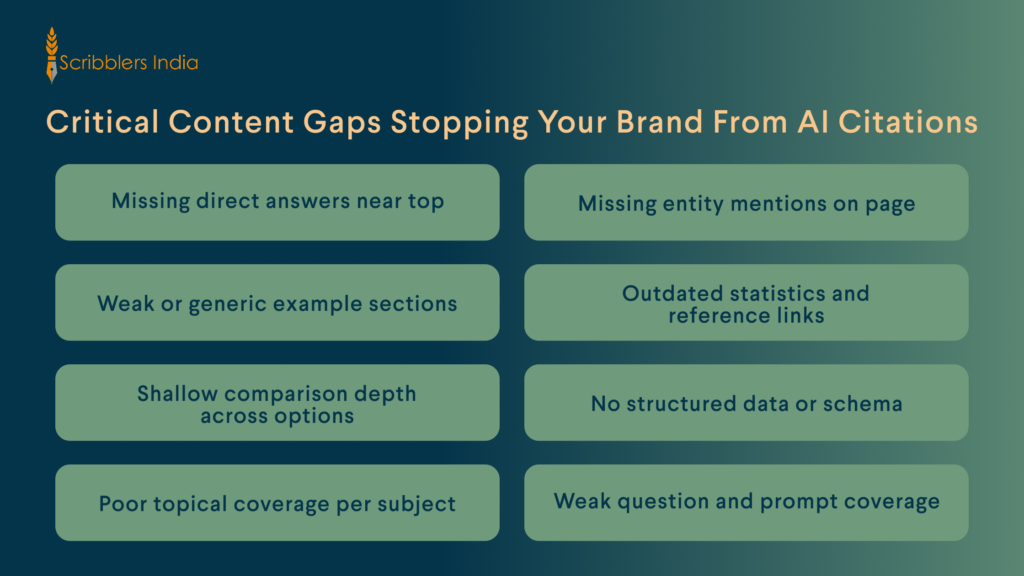
8. Weak Question Coverage
Many blogs answer the main keyword and stop there. That creates a thin page because real users rarely ask only one question while researching a topic. They ask follow-up questions about cost, process, risks, examples, comparisons, and next steps.
A stronger page maps the full question journey. For example, a blog on AI search visibility should also answer how it differs from SEO, how to measure it, what content formats work, and why AI citations change by platform. This helps the page serve several related prompts rather than a single narrow search query.
The fix is to build each section around a question your buyer may ask. Use H2s for major questions and H3s for supporting doubts. Add FAQs only for questions not already answered in the main body. This makes the content easier for readers to scan and easier for AI systems to understand.
9. Missing Comparison Tables
Some topics need structure rather than longer paragraphs. When a reader is comparing tools, agencies, services, formats, or strategies, a table helps them quickly understand the differences. It also forces the writer to clarify what matters rather than hide weak analysis in broad prose.
Comparison tables work best when they answer a real decision. For example, a table comparing SEO, AEO, and GEO should cover their purposes, content structures, success metrics, and when each matters. A table comparing freelancer and agency support should cover the depth of strategy, speed, quality control, scalability, and accountability.
Do not add tables only for design variety. Use them when the reader needs side-by-side clarity. A strong table can turn a vague section into a decision-support asset, especially in middle-funnel content where buyers are comparing options before speaking to a vendor.
10. No Original Insight or Point of View
Pages without a point of view sound interchangeable. They repeat the same definitions, benefits, and best practices already available across ranking pages. That weakens trust because the reader cannot tell why your brand should be cited, remembered, or chosen.
Original insight does not always require a large survey or proprietary dataset. It can come from client work, internal audits, expert interviews, content teardowns, campaign lessons, or a framework built from repeated observations. For example, an agency can explain the five content gaps it sees most often during AI content gap analysis audits.
The goal is to add something the reader cannot get from every other page. A clear opinion, a named framework, a practical checklist, or a real example provides the content with greater informational value. It also helps AI systems associate the brand with a sharper area of expertise.
How Can You Run AI Content Gap Analysis for AEO and GEO?
You can run AI content gap analysis for AEO and GEO by auditing prompts, checking your AI citation share, and reviewing the topical coverage of ranking pages. The goal is to identify questions you fail to answer, comparisons you skip, and examples you avoid. These signals decide your share of AI citations.
Here is a step-by-step guide to conducting a content gap analysis for an AI workflow.
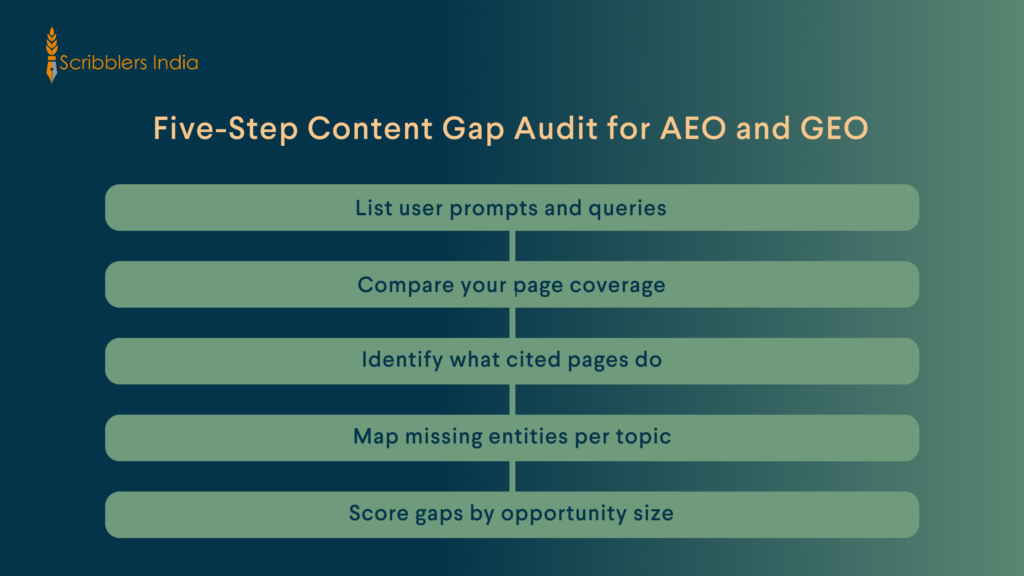
- List the questions users ask: Pull prompts from ChatGPT, Perplexity, and Google PAA. Test your top topics with real prompt-style queries.
- Compare your coverage to cited sources: Run the prompts. Note which domains the engine cites for each answer.
- Identify what cited pages do better: Look for direct answers, structured tables, named examples, and supporting data.
- Map missing entities: Check whether your page mentions the brands, tools, or concepts AI engines link to your topic.
- Score gaps by opportunity: Rank gaps by search demand, AI Overview presence, and the effort needed to close them.
This audit gives a clear picture of which gaps matter most. According to 2026 reports, only 14% of marketers currently use AI citation tracking. Brands that close the measurement gap first will close the content gap fastest.
How to Use AI Content Gap Analysis to Identify Ranking Opportunities?
You can turn AI citation gaps into ranking opportunities by rewriting sections to deliver direct answers, adding comparison tables, expanding examples, and improving topical depth. Every gap fix should help AI engines extract a clean answer. The result is better visibility across AI Overviews, ChatGPT, Perplexity, and Google AI Mode.
| Gap Type | Fix | Impact on AI Search |
| Missing direct answers | Add a 40-60 word answer after each H2 | Improves snippet and AI Overview extraction |
| Shallow comparisons | Build a structured comparison table | Wins middle-funnel citations |
| Weak examples | Add named brands, tools, and outcomes | Increases information gain signal |
| Sparse topical coverage | Publish supporting blogs and link them | Builds topical authority for citations |
| Missing schema | Add FAQ, article, and author schema | Lifts AI answer eligibility by 3x |

What Common Mistakes Weaken AI Content Gap Analysis?
Common mistakes that weaken AI content gap analysis include keyword stuffing, copying competitor structures, ignoring real user intent, and skipping prompt research. These mistakes produce content that ranks for keywords yet earns no AI citations. Avoiding them lifts visibility across both Google and answer-led search surfaces.
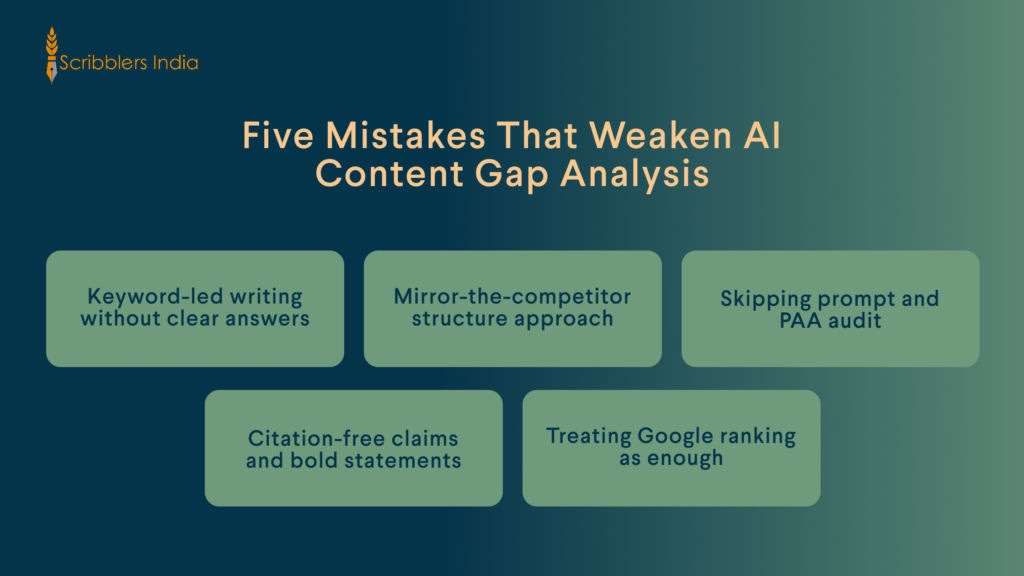
The mistakes below appear in most underperforming blog libraries we audit. They share one root cause: teams confuse SEO output with AI search value.
- Keyword-Led Writing: Many teams still treat AI search like old SEO and fill sections with keyword variations. The better approach is to answer the question clearly, define the topic, provide useful context, and structure the section so that both readers and AI systems can quickly understand the meaning.
- Mirror-the-Competitor Approach: Copying H2s from ranking pages may help you match the search result, but it rarely helps you stand out. Add original examples, frameworks, use cases, decision criteria, or lessons from audits so the page gives AI systems something new to cite.
- Skipping the Prompt Audit: Teams often write based on internal assumptions rather than checking what buyers ask in ChatGPT, Perplexity, Gemini, or Google AI Overviews. A prompt audit reveals question patterns, missing comparisons, follow-up doubts, and competitor mentions that normal keyword research may miss.
- Citation-Free Claims: Bold claims without credible sources weaken trust and reduce citation value. Use named research, expert sources, recent studies, client examples, or transparent methodology wherever needed, so AI systems can connect your answer to verifiable proof instead of unsupported opinion.
- Treating Ranking as the Finish Line: A page-one Google ranking does not automatically mean the page will earn AI citations. AI systems may prefer clearer, fresher, better-structured sources, so ranking pages still need direct answers, entity clarity, examples, tables, FAQs, and stronger source signals.
How Can You Measure AI Content Gap Analysis Progress?
You can measure progress in AI content gap analysis by tracking whether your brand is becoming easier to find and describe across AI-led discovery surfaces. Traditional analytics still matter, but they do not show the full picture because AI answers may mention your brand without a website visit.
- Prompt-Level Visibility: Build a fixed list of prompts your buyers are likely to ask across ChatGPT, Perplexity, Gemini, and Google AI Overviews. Track whether your brand appears, which competitors appear, what sources are cited, and whether your services are described accurately.
- Citation Quality: A mention is useful, but a citation to the right page is stronger. Track whether AI systems cite your service pages, guides, comparison content, case studies, reports, or founder-led thought leadership assets.
- Gap Closure Rate: Review how many identified content gaps were fixed after every sprint. These gaps may include missing direct answers, weak examples, poor entity coverage, outdated references, missing FAQs, unclear comparison tables, or thin supporting content.
- Business Movement: AI search visibility should support buyer trust, not only citation counts. Track branded search, qualified inquiries, consultation requests, profile visits, newsletter signups, and sales conversations influenced by improved content.
- Competitive Share of Voice: Review how often your brand appears compared with direct competitors across the same set of prompts. This shows whether your gap work is improving category visibility or only strengthening isolated pages.
- Cited Page Mix: Track which pages AI systems cite most often. A healthy mix should include service pages, guides, FAQs, comparison content, reports, case studies, and thought leadership assets, not only one generic blog.
A simple monthly dashboard can show prompt visibility, AI mentions, cited pages, closed gaps, search movement, and conversion signals together. This gives marketing teams a better way to defend content investment when traffic alone no longer tells the complete story.
How Does Scribblers India Deliver AI Content Gap Analysis for AI Search?
At Scribblers India, AI content gap analysis starts with one question: where is your brand missing from the answers buyers now trust? The process examines how your content appears across AI-led discovery platforms and identifies missing answers, weak pages, unclear entity signals, and content gaps that limit visibility.
Our approach brings together SEO content strategy, GEO content development, content refresh, AEO-focused planning, and thought leadership. The goal is to make your brand easier for buyers, search engines, and AI systems to understand, cite, mention, and recommend.
Each engagement begins with a review of your current content footprint across Google, AI Overviews, ChatGPT, Perplexity, Gemini, and other relevant discovery surfaces. From there, we identify which pages need sharper answers, stronger examples, better comparisons, clearer entity coverage, or new supporting assets.
The final output is not a static audit. It becomes a practical execution roadmap that covers content refreshes, new blog posts, service pages, comparison assets, internal linking, FAQs, founder-led content, and measurement priorities.
Scribblers India AI Content Gap Analysis Framework
Let’s have a look at our approach to AI content gap analysis that provides us an edge over our competitors:
- Prompt-Led Visibility Audit: Real buyer prompts are tested across ChatGPT, Perplexity, Gemini, Google AI Overviews, and Google AI Mode where relevant. The audit shows whether your brand appears, which competitors are cited, what sources AI systems trust, and which questions your content fails to answer.
- AI Content Gap Mapping: Existing pages are reviewed for missing answers, weak sections, outdated references, unclear examples, thin comparison areas, and poor entity coverage. This separates simple refresh opportunities from deeper gaps that require new blog posts, guides, service pages, or comparison assets.
- Question-Led Blog Structures: Each blog is built around buyer questions, direct answers, supporting H3s, examples, FAQs, and internal links. This format helps readers scan faster while giving AI systems cleaner sections to understand, summarize, and cite across multiple prompt variations.
- Entity and Authority Strengthening: Brand, service, expert, audience, and proof signals are made clearer across the website. This includes About pages, service pages, author bios, internal links, case studies, founder content, and consistent language that supports GEO and AI search understanding.
- Content Refresh and Optimization: Not every gap needs a new page. Many existing assets only need sharper direct answers, stronger examples, updated sources, better tables, clearer CTAs, or improved internal links to become useful and citation-ready.
- Founder Thought Leadership Support: Founder-led thought leadership content adds opinion, expertise, and category association beyond the website. These assets support personal branding, LinkedIn visibility, brand mentions, and stronger authority signals across the wider AI discovery ecosystem.
Get in touch with our team to turn content gaps into search-ready, citation-worthy content assets built for AI-led discovery.
FAQs
What is AI content gap analysis?
AI content gap analysis is the process of finding missing answers, weak structures, or shallow sections that stop AI engines from citing your page. It can show up as a missing definition, a thin comparison, or an outdated example set. Closing these gaps improves brand mention share across ChatGPT, Perplexity, and Google AI Overviews.
How do I run AI content gap analysis for ChatGPT and Perplexity visibility?
Run your priority topics as real prompts inside ChatGPT and Perplexity, then note the cited domains. Compare their coverage to your pages on the same subject. Look for direct answers, structured comparisons, named examples, and verified data points. The gaps show up as missing answers, weak depth, or absent entity mentions on your side.
Do AEO content gaps affect Google AI Overview rankings?
Yes. Google AI Overviews draw on sources that offer the cleanest, most useful answers across the open web. Pages with AEO content gaps lose citation share even when they rank well in classic search results. BrightEdge data show that 5 of 6 AI Overview citations come from outside page 1, so gap closure matters more than position.
How often should I run AI content gap analysis on my blog library?
A quarterly cycle works well for most brands across SaaS, services, and B2B categories. AI search behavior shifts quickly as engines update their citation logic and ranking weights. Quarterly AI content gap analysis reviews catch outdated stats, new prompt patterns, and competitor gap closures before they cut your citation share inside ChatGPT or Perplexity.
Can closing AI citation gaps also improve traditional SEO rankings?
Yes. Closing AI citation gaps improves both AI citations and classic search rankings because the same signals matter to both systems. Direct answers, structured tables, and topical depth lift Google rankings while feeding AI engines clean extraction material. The work compounds. One sprint of gap closure improves visibility across both traditional SERPs and answer-led surfaces.