A founder can turn a detailed interview into several possible content angles, while an executive can organize months’ worth of audience questions without having to review every note manually. These efficiencies explain the growing interest in AI for personal branding, especially when professionals already produce substantial knowledge through their work.
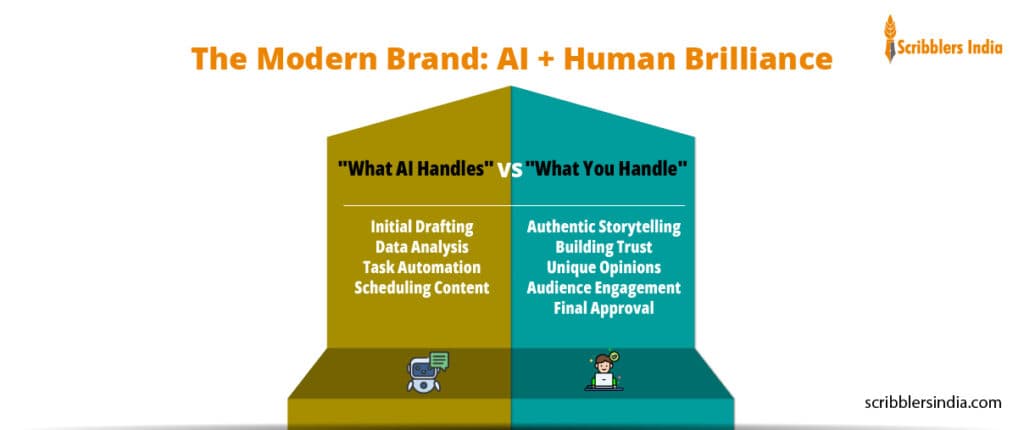
The risk begins when AI starts supplying the expertise it was meant to communicate. Effective AI for personal branding uses technology to organize, compare, draft, transform, and analyze approved material while the professional retains ownership of experiences, facts, opinions, confidential information, and the final publication decision.
This article focuses on that operating model rather than on AI search optimization or another debate about humans versus machines. For the wider positioning, proof, channel, networking, and distribution system, use our how to build a personal brand online guide as the broader strategic foundation.
Key Takeaways
|
What Can AI for Personal Branding Handle Safely?
AI for personal branding can reduce repetitive work across research, organization, drafting, editing, repurposing, and performance review. The safest boundary depends on the consequence of an error: AI can assist with processing information, while human owners remain responsible for professional claims, judgment, sensitive facts, and publication.
A practical workflow separates tasks according to who owns the source material, who can accelerate the work, and where human review is mandatory. This avoids treating every task as equally suitable for automation simply because a model can technically produce an answer.
| Task | Human Owns | AI Can Assist With | Human Review |
| Professional Positioning | Expertise territory and audience | Alternatives, objections, clarity checks | Always |
| Career Facts | Verified roles and achievements | Organizing approved information | Always |
| Personal Experiences | What happened and why it matters | Theme extraction and structure | Always |
| Point of View | Final opinion and judgment | Counterarguments and implications | Always |
| Research | Source standards and final conclusions | Question clustering and synthesis | Always |
| Drafting | Argument and approved inputs | Initial prose and restructuring | Always |
| Repurposing | Original meaning and channel boundaries | Format adaptation | Always |
| Performance Analysis | Business interpretation | Pattern detection and summarization | Always |
| Publication | Final accountability | Formatting and preflight checks | Always |
Which Personal Branding Tasks Should Remain Human-Owned?
Human ownership should remain strongest where errors can alter professional identity, credibility, or accountability. Positioning, personal experience, judgment, sensitive facts, and final approval need direct human control, while AI can support organization, critique, restructuring, and alternative wording within defined boundaries.
- Keep positioning decisions with the professional because they determine the expertise, audience, and publicly built reputation.
- Require personal experiences and stories to come from verified memory, notes, interviews, or other genuine first-hand sources.
- Reserve professional judgments and opinions for human owners, even when AI helps test objections or alternative interpretations.
- Verify achievements, client results, dates, and career facts independently before allowing them to appear in published content.
- Keep sensitive reputation decisions under human review, especially when content involves employers, clients, regulated topics, or confidential information.
- Make final publication approval a human responsibility so that every claim, example, and viewpoint is clearly accountable.
How Do You Build a Source Library for AI for Personal Branding?
Recurring AI for personal branding becomes more reliable when each session starts with verified material rather than a blank prompt. Build a controlled source-of-truth library containing approved biography facts, professional claims, experience stories, viewpoints, voice references, and restricted topics before asking AI to support recurring content production.
| Source Library Component | What to Store | Why It Helps |
| Verified Biography | Current role, previous positions, credentials, links | Prevents invented or outdated career facts |
| Approved Claims | Public company facts, disclosed results, approved milestones | Creates boundaries around usable evidence |
| Experience Bank | Decisions, failures, lessons, customer conversations | Supplies genuine narrative material |
| Point-of-View Library | Beliefs, supporting experience, limits, disagreements | Preserves real professional judgment |
| Voice References | Transcripts, posts, articles, presentations, emails | Improves wording and tone calibration |
| Restricted Topics | Confidential, regulated, privileged, or unpublished information | Prevents unsafe workflow inputs |
How Should You Build a Professional Point-of-View Library?
For each important topic, document what the professional believes, why they believe it, which experience supports the position, and where the argument has limits. This creates better source material than a generic instruction asking AI to sound “authoritative,” “bold,” or “thought-provoking.”
A founder discussing AI adoption, for example, should provide actual operating experience and documented views rather than asking a model to invent a provocative stance. The same principle applies when building thought leadership around executives whose professional credibility depends on informed judgment.
How Can AI for Personal Branding Improve Research and Audience Listening?
Research is one of AI’s strongest roles in a personal-brand workflow because models can quickly organize large collections of questions, notes, transcripts, comments, and supplied documents. The value comes from finding patterns in real material, while source selection and final interpretation remain human responsibilities.
Start with audience evidence already generated through professional activity. Sales-call notes, webinar questions, conference discussions, LinkedIn comments, customer FAQs, interviews, and internal subject-matter notes can reveal recurring objections, misconceptions, decision questions, and areas where audiences repeatedly need clearer explanations.
Can AI Turn Real Audience Questions Into Better Content Ideas?
Ask AI to cluster similar questions, identify recurring themes, and separate introductory questions from decision-stage concerns. The output becomes an editorial research map that professionals can evaluate against their expertise, rather than a generic trend list produced without evidence about the intended audience.
This also helps distinguish popular subjects from useful subjects. A theme that appears repeatedly among relevant buyers or professional peers may deserve deeper attention even when it attracts less broad search volume than a generic industry trend with limited connection to the individual’s expertise.
How Should You Verify AI-Assisted Research?
Treat statistics, quotations, regulations, study findings, company facts, and technical claims as unverified until they are checked against the original source. Keep important source URLs or approved documents alongside the draft so reviewers can validate the evidence without having to reconstruct the research process later.
This is particularly important for executives discussing regulated, financial, scientific, legal, or technical subjects. AI can accelerate synthesis, although a generated summary should never become the only evidence behind a public claim made under a professional’s name.
How Can AI for Personal Branding Improve Ideation Without Inventing Expertise?
AI can improve ideation by pressure-testing a real professional position rather than generating authority from scratch. Give the model a genuine observation, argument, or professional problem and ask it to surface objections, ambiguities, audience questions, missing evidence, and alternative interpretations.
Suppose a consultant wants to become known for “AI transformation for mid-market companies.” AI can expose how broad that phrase is by asking what transformation covers, which decision-maker owns the problem, what evidence supports the position, and which adjacent specialists could make the same claim.
What Prompts Produce Better Personal Branding Ideas?
Useful prompts begin with source material and a decision task. Ask which claims need stronger evidence, which objections an informed buyer may raise, what a skeptical peer would challenge, which examples would clarify the idea, or where the argument becomes less reliable.
This form of AI-assisted personal branding produces stronger ideas than asking for thirty viral posts. AI broadens the thinking surface, while the professional selects the angle they can genuinely defend and connects it to the experiences or evidence that make the final argument distinct.
The professional positioning itself should still be established separately. Our personal brand statement guide explains how to define the professional association first, giving later AI-assisted ideation a clearer strategic boundary.
How Should AI for Personal Branding Support Drafting and Voice?
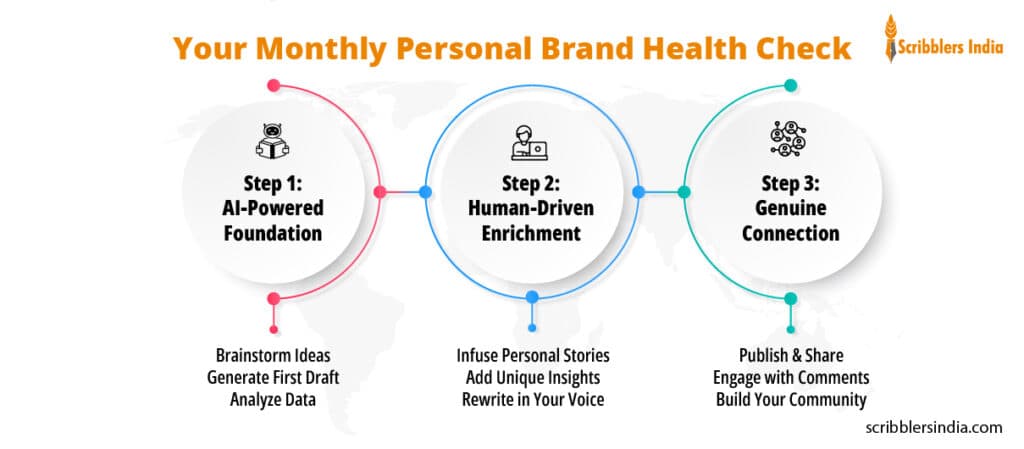
Drafting works best when the model begins with an interview transcript, a voice note, a presentation, a detailed brief, approved research, or an existing article. It can help structure and express those ideas, while the core argument should still originate from the professional or editorial team representing them.
A useful sequence is source review, argument definition, outline, working draft, factual review, voice calibration, and final approval. Separating substance from style prevents a polished voice from hiding weak reasoning, unsupported examples, invented details, or conclusions that the professional would not defend publicly.
How Do You Keep AI-Generated Drafts in the Professional’s Real Voice?
Calibrate against several examples that genuinely sound like the person. Compare sentence length, vocabulary, technical detail, examples, certainty, humor, transitions, and preferred explanations instead of relying on vague voice labels such as “confident” or “conversational.”
A useful voice review should also identify what the professional would never say. Certain clichés, exaggerated claims, sales-oriented phrases, or levels of certainty may be inconsistent with the intended communication, even when the resulting draft appears polished and grammatically correct.
For founders and executives who need a managed source-to-draft workflow, Scribblers India’s ghostwriting services combine interviews, research, argument development, editing, and voice calibration, with a human editorial layer before publication.
How Can AI for Personal Branding Make Content Repurposing More Efficient?
Repurposing creates a clear efficiency advantage once the source asset has been fact-checked and approved. AI can adapt the same validated idea for different channels, provided each derivative preserves the original evidence, meaning, qualifications, and level of certainty.
The goal is adaptation rather than compression. A 1,500-word founder article might become a LinkedIn argument, a visual framework, a newsletter section, a speaking note, or a short video script, with each format emphasizing a different communication task rather than repeating the same paragraphs.
What Should Stay Consistent During AI Content Repurposing?
Keep the central claim, factual basis, examples, source references, and important limitations aligned with the approved source. Review every derivative against that source because shortened formats can accidentally make cautious claims sound absolute or introduce new examples that were never verified.
Channel conventions can still change the presentation. Our LinkedIn personal branding guide covers platform-specific profile, content, networking, and measurement decisions, whereas this workflow focuses on preserving intellectual consistency as a single approved idea moves across formats.
How Can AI for Personal Branding Help Analyze Content Performance?
Analytics is another useful AI application because models can organize post data, audience comments, search queries, and performance reports faster than manual review can. They can identify recurring themes and generate hypotheses, while humans should decide what those patterns mean for future strategy.
Useful analysis can compare which topics attract the intended audience, which pieces generate profile activity, where substantive comments appear, which questions recur, and which content precedes useful inbound conversations. This helps editorial teams identify patterns across a larger body of work rather than judging isolated posts.
Can AI Explain Why a Personal Branding Post Performed Well?
AI can suggest possible explanations, although it cannot prove causality from performance data alone. Topic relevance, timing, distribution, network effects, audience composition, format, current events, and platform behavior can all influence results, so a strong analysis separates observation from interpretation.
Use the model to propose hypotheses for the next test rather than declaring that one hook, format, or posting time caused the result. For deeper outcome measurement, our personal branding ROI guide separates visibility signals from authority, opportunities, attribution, and financial return.
What Privacy Risks Should You Consider With AI for Personal Branding?
Privacy controls determine whether an AI-assisted workflow is safe enough for professional use. Before uploading executive interviews, customer information, internal strategy, unpublished company material, or personal data, check the exact product, account type, organizational policy, and contractual restrictions governing that information.
Privacy rules also differ between consumer and commercial products. OpenAI states that business data from ChatGPT Business, Enterprise, Edu, Healthcare, Teachers, and its API platform is not used for model training by default. Individual ChatGPT users can control eligible training use through Data Controls.
Anthropic similarly states that inputs and outputs from commercial products such as Claude for Work and its API are not used for model training by default. Consumer products have separate settings and conditions, which makes the exact account type an important part of tool evaluation.
What Information Should Stay Outside AI Personal Branding Workflows?
Create a do-not-upload list based on legal, security, privacy, client, and employer requirements. Typical restricted material can include unreleased financial information, confidential customer data, employee matters, credentials, privileged legal communication, security weaknesses, pending transactions, and information protected by non-disclosure agreements.
The list should be specific to the organization rather than copied from a generic policy. A public founder biography creates little sensitivity, while an unpublished restructuring plan or customer record may create significant legal and reputational exposure if placed into an unauthorized workflow.
When Does AI-Generated Personal Brand Content Need Disclosure?
There is no universal rule requiring disclosure whenever AI helps draft or edit professional content. Requirements depend on jurisdiction, content type, platform rules, employer policies, client terms, and the degree of AI involvement, so higher-risk uses should receive appropriate legal or communications review.
In the EU, Article 50 transparency obligations have applied since 2 August 2026. They cover specific situations including machine-readable marking of certain AI-generated or manipulated content, deepfakes, and certain public-interest text published without human review or editorial control.
Which AI Personal Branding Tools Should You Use?
Choose AI personal branding tools based on the job being improved, rather than adopting every new application. Tool names and features change quickly, so the more durable system is a workflow that separates research, transcription, drafting, editing, design, and analysis while preserving human review at each consequential stage.
The categories below are more useful than a long vendor list because they keep the selection process focused on the task and associated risk. Privacy, source handling, review requirements, and data retention should be evaluated alongside speed or output quality.
| Tool Category | Useful Role | Human Control Point |
| Research Assistants | Organize questions and supplied sources | Verify evidence and conclusions |
| General AI Assistants | Ideation, outlining, drafting, critique | Own facts, judgment, and approval |
| Transcription Tools | Convert interviews into working text | Check accuracy and sensitive material |
| Editing Tools | Identify repetition and clarity problems | Protect nuance and intended meaning |
| Design Assistants | Explore visual concepts and derivatives | Verify accuracy, rights, and brand fit |
| Analytics Assistants | Cluster data and audience feedback | Interpret causality and business value |
How Should You Evaluate AI Tools Before Adoption?
Evaluate accuracy, source handling, privacy terms, retention controls, collaboration features, export options, approval workflows, and the ability to work with your existing source library. A feature-rich product can still be unsuitable if it exposes unnecessary data or makes human review difficult.
The objective of personal branding with AI should be a portable editorial system. If a tool changes or disappears, the source library, approval rules, factual standards, and voice references should remain useful rather than forcing the professional brand to rebuild its complete workflow.
What Should You Review Before Publishing AI-Supported Personal Brand Content?
Every AI for personal branding workflow needs a final human review before publication. The reviewer should verify facts, confirm that the professional actually holds the stated view, check that personal experiences are genuine, review sensitive information, and ensure that the final wording remains appropriate for the audience and organization.
A shared review checklist is particularly useful when several writers, agencies, or internal teams support a single executive. It prevents different contributors from inventing examples, using conflicting biographies, applying different privacy assumptions, or removing important qualifications as content moves through the editorial process.
| Review Check | Question Before Publication |
| Facts | Can every material claim be independently verified? |
| Experience | Did this event or lesson actually belong to the professional? |
| Point of View | Does the argument reflect the professional’s real judgment? |
| Evidence | Are important assertions supported by credible sources? |
| Nuance | Did drafting or repurposing remove essential qualifications? |
| Voice | Does the language resemble approved real communication? |
| Privacy | Does the draft expose restricted or confidential information? |
| Approval | Has the right internal reviewer cleared sensitive claims? |
| Disclosure | Do law, policy, platform, or client terms require disclosure? |
| Accountability | Would the professional defend every published sentence publicly? |
The final accountability question is the strongest filter. AI can help produce an efficient draft, although the professional or organization receives the reputational consequences if the content contains a false claim, fabricated experience, careless disclosure, or a position they cannot defend.
How Can Scribblers India Help With AI for Personal Branding?
At Scribblers India, we use AI for personal branding to improve workflow efficiency without letting it become the source of a client’s expertise. Interviews, approved professional experience, research, and existing viewpoints remain the foundation, while AI can support organization, ideation, drafting assistance, repurposing, and analysis.
Our personal branding services connect that workflow with positioning, profile development, thought leadership, ghostwriting, and ongoing editorial management. Human editors remain responsible for research quality, argument strength, factual accuracy, voice consistency, and the suitability of every asset before publication.
We can also build reusable source libraries and editorial systems for founders or executives with recurring content needs. This reduces repetitive briefing while keeping approved claims, stories, voice references, and restricted topics organized across multiple channels and contributors.
Contact our team today to start building a human-led AI content workflow that protects expertise, voice, accuracy, privacy, and professional credibility.
Frequently Asked Questions
Is AI for personal branding a good idea for founders and executives?
Yes, AI for personal branding can improve research, organization, drafting, repurposing, and analysis when genuine expertise remains the source material. Founders and executives should retain control over opinions, sensitive information, factual claims, personal experiences, and final approval, as their professional reputations bear the consequences of errors.
Can AI write personal branding content from scratch?
AI can technically generate content from a short prompt, although that approach creates a higher risk of generic arguments, invented experiences, and weak voice fidelity. Better workflows start with interviews, notes, research, approved examples, or existing thinking, so the model processes professional expertise rather than substituting for it.
How can I stop AI personal branding content from sounding generic?
Provide real source material and several approved voice examples before drafting. Then review the argument separately from the writing style, checking vocabulary, sentence patterns, examples, certainty, and transitions against genuine communication. Generic output often reflects thin inputs rather than an unavoidable limitation of AI-assisted drafting.
Should I disclose that AI helped draft my personal brand content?
Disclosure depends on jurisdiction, platform rules, employer policies, client agreements, content type, and the nature of AI involvement. There is no single rule requiring disclosure for every use in drafting or editing. Synthetic media and specific regulated uses can create additional transparency obligations that need separate review.
What information should never be uploaded to an AI tool?
Do not upload information you lack authority to share. Depending on your role, this may include confidential strategy, customer data, employee information, security details, credentials, privileged legal communication, unreleased financial information, or material protected by an NDA. Follow organizational rules in accordance with the provider’s data policy.
Can AI repurpose one personal brand article into several formats?
Yes. AI can adapt an approved article into social posts, newsletter sections, presentation notes, visual concepts, or short scripts. Each version should preserve the original facts, argument, examples, and qualifications, while changing the presentation to match the communication job and channel rather than simply shortening the same text.
Can AI measure whether personal branding content is working?
AI can summarize performance data, cluster comments, compare themes, and surface possible patterns. Human reviewers should still judge causality, audience relevance, and business significance. A high-performing post does not prove which individual element caused the result, so AI analysis should generate hypotheses rather than unsupported conclusions.
Is AI for personal branding the same as AEO or GEO?
No. AI-supported personal branding uses AI to help create and manage a professional reputation. AEO and GEO focus on how information becomes discoverable or usable across answer and generative search experiences. Brands needing those capabilities can explore our AEO services and GEO services separately.