
You lead a company. You have a track record, a perspective, and a reputation that carries weight in your industry. The question is whether you are managing that reputation deliberately or leaving it to be shaped by whatever others find when they search your name. The distinction between personal branding and executive branding matters more in the current era than at any point in the history of professional visibility.
According to a recent industry report, 84% of people trust friends and family, 80% trust customers like themselves, and 63% trust brand employees for accurate information about a brand. In comparison, only 58% trust the brand’s CEO. That shift explains why investors research the founder before evaluating the business and why talent researches the CEO before accepting an offer. It also reflects why clients study the leadership team before signing the contract.
This blog covers the differences between personal branding vs. executive branding, what each strategy covers and where they overlap. We will also cover which one your role demands is the first step toward building a professional presence that serves as a business asset rather than an afterthought.
TL;DR: Key differences between personal branding vs executive branding.
|

What Is Personal Branding and How Does It Work for Professionals?
Personal branding is the deliberate practice of defining and communicating your unique professional value, expertise, and identity across the platforms where your audience discovers and evaluates you. Harvard Business Review describes it as the intentional, strategic practice of expressing your value to the world.
The need for a robust personal branding strategy applies to professionals at every career stage and seniority level. A rising marketing manager building LinkedIn visibility, a consultant launching an independent practice, and a senior executive exploring new opportunities all use personal branding to control how they appear to the audiences whose decisions affect their professional outcomes.
- The core objective of personal branding is to advance an individual’s career and earn professional recognition.
- It answers the question: how do you want to be known, by whom, and for what?
- A strong personal brand makes a professional memorable and sought-after in their field.
- It generates inbound opportunities: connection requests, speaking invitations, consulting inquiries that outbound networking alone cannot replicate at scale.
According to latest reports, 41% of target buyers and 35% of hidden buyers said a C-suite executive had encouraged them to consider working with a vendor after engaging with that vendor’s thought leadership content. This shows why executive positioning cannot remain vague.
What Is Executive Branding and How Is It Different from Personal Branding?
Executive branding is the strategic practice of building a senior leader’s public presence in deliberate alignment with the organization’s mission, values, and stakeholder expectations. The difference between executive and personal branding lies in scope, audience complexity, and organizational impact.
Let’s analyze personal branding vs. executive branding at the most fundamental level. Personal branding serves the individual’s professional goals, while executive branding serves both the individual and the organization. In fact, a CEO’s brand is never entirely personal. Every public statement, article, and social media post they publish reflects on the company, its investors, its clients, and its employees.
This organizational dimension adds layers of strategic complexity that personal branding for non-executive professionals does not carry. An executive brand must resonate with investors, employees, clients and industry stakeholders whose priorities often differ. A latest report found that corporate reputation delivered $13.8 trillion in shareholder value across S&P 500 companies, a $2 trillion year-on-year increase. That makes executive branding part of a wider reputation-value system, where visible leadership directly shapes trust, valuation, confidence, and business resilience.
Comparing Personal Branding vs Executive Branding
Here is a quick comparison between Personal Branding and Executive Branding:
| Category | Personal Branding | Executive Branding |
| Primary Purpose | Serves individual career growth goals | Aligns with organizational mission and vision |
| Target Audience | Targets peers, recruiters, potential employers | Addresses investors, stakeholders, industry leaders |
| Career Stage Applicability | Relevant at any career stage | Critical at senior leadership levels |
| Impact Scope | Focused on individual reputation building | Directly impacts company reputation and perception |
| Success Metrics | Measures opportunities and career advancement | Measures market trust, influence, company value |
How Does CEO Personal Branding Differ from Company Branding Specifically?
The CEO’s personal branding and the company’s branding address two distinct but connected visibility layers. Company branding builds institutional recognition while CEO personal branding builds human trust that institutions cannot generate.
Difference in Objective of CEO Branding and Company Branding
CEO personal branding vs company branding serves different commercial objectives at each stage of the buyer or stakeholder journey:
- Company branding builds category awareness: A company’s brand establishes market presence, communicates product value, and drives demand generation through advertising, content marketing, and brand campaigns. Company branding operates at scale across large audiences with minimal personalization.
- CEO personal branding builds trust at the decision stage: When a prospect, investor, or potential employee is close to making a consequential decision, they research the leadership. A CEO with a credible and consistent personal brand provides stakeholders with a human point of reference. This accelerates trust in ways no corporate brand asset can replicate.
- Personal brand content earns organic reach that company content cannot: Content published by an individual executive on LinkedIn reaches their personal network first. It earns organic amplification through personal connections and creates the authentic, human-to-human engagement signal. The platform’s algorithm rewards this signal more generously than some company page content that lacks a personal author identity.
CEO personal branding vs company branding produces maximum commercial value when both narratives reinforce each other. An executive whose personal content consistently explores themes that the company’s products or services address creates a compounding authority effect. The individual’s credibility transfers to the brand and the brand’s market position reinforces the individual’s expertise signals.
What Is the Difference Between a Founder’s Personal Brand and a Corporate Brand?
The comparison of a founder’s personal brand vs corporate brand presents a tension that startup founders and growth-stage company leaders manage throughout their careers. Understanding where to draw this line determines both the founder’s long-term career flexibility and the company’s ability to scale independently.
- Purpose and strategic role of each brand: A founder’s personal brand reflects individual vision, expertise, and leadership philosophy. The corporate brand represents the company’s mission, products, and market identity. Maintaining this distinction ensures the business stands independently while the founder builds authority beyond a single venture.
- Risks of overdependence on the founder identity: When the company becomes inseparable from the founder’s identity, scalability challenges emerge. Investors and acquirers perceive higher risk tied to individual dependence. This overassociation can limit valuation potential and create uncertainty around leadership transitions or long-term continuity.
- Impact on stakeholders and talent perception: An overly dominant founder narrative can affect stakeholder confidence and hiring outcomes. Investors question resilience, while senior talent may hesitate due to limited ownership perception. A balanced branding approach signals organizational maturity and encourages broader leadership participation within the company.
- Building a balanced executive branding strategy: An effective approach positions the founder as the visionary while strengthening the company’s independent identity. Content highlights expertise, values, and industry insights without overshadowing the business. This balance enhances company credibility while expanding the founder’s influence across multiple opportunities.
What Are the Key Differences Between Personal Branding and Executive Branding in Practice?
Personal branding builds individual visibility, while executive branding shapes leadership trust at an organizational scale. The difference appears in audience complexity, message governance, reputation risk, and long-term impact. A professional speaks for personal growth. An executive also represents the company’s strategy, values, market confidence and leadership credibility across stakeholder groups.
Audience Complexity
Personal branding usually speaks to one core audience. That may include employers, clients, recruiters, or peers in a defined niche. Executive branding works across a wider stakeholder map. The same message may be read by investors, employees, clients, talent, media and regulators.
| Stakeholder | What They Look For |
| Investors | Leadership clarity, market confidence and long-term growth signals |
| Clients | Expertise, stability and trust in the business |
| Employees | Direction, transparency and confidence in leadership |
| Talent | Culture, ambition and reasons to join the company |
| Media | Fresh perspective, category insight and credible commentary |
Organisational Alignment
Personal branding gives professionals more freedom to express opinions, skills and career goals. Executive branding must connect personal authority with company direction. The leader’s voice should support business priorities without sounding scripted.
A strong executive brand should answer four questions before publishing:
- Does this reflect where the company is heading?
- Does this support the brand’s market position?
- Does this match what the company has already said?
- Does this add leadership perspective without creating confusion?
For example, an executive discussing AI adoption should reflect the company’s actual AI roadmap. A mismatch can weaken trust.
Reputation Risk
A personal branding error usually affects one person’s credibility. An executive branding error can affect the company’s reputation. The risk is higher because executive content carries institutional weight. Stakeholders often read the leader’s view as a signal from the business.
That risk usually appears in four ways:
- Market risk: Investors and analysts may question strategic clarity.
- Culture risk: Employees may question leadership values or internal direction.
- Client risk: Buyers may doubt the company’s stability or expertise.
- Media risk: Journalists may frame one comment as a wider business position.
This does not mean executive content should sound cautious. It means every message needs intent, accuracy and context.
Content Depth
Both personal branding and executive branding need consistent thought leadership. The difference lies in depth. Personal branding can build traction through experience-led posts, practical advice and career lessons. Executive branding must go further. It needs original thinking that helps senior audiences understand change.
Strong executive content usually focuses on:
- What is changing in the market?
Explain the shift before others reduce it to a trend. - Why does it matter to customers?
Connect the insight to real business decisions. - What should leaders do next?
Offer a clear view, not a generic observation. - What has experience taught you?
Turn leadership decisions into useful lessons.
Long-Term Career Value
Personal branding helps professionals become recognized across roles and industries. Executive branding builds leadership equity that outlasts one role. It shapes how the market remembers the leader after they move on. Think of it as the difference between visibility and legacy.
A visible professional is known for what they do today. A credible executive is remembered for how they think, lead and shape outcomes. That long-term value can support board seats, advisory roles, speaking platforms and investment access. It also protects career relevance during transitions.
In practice, personal branding helps people become known. Executive branding helps leaders become trusted, referenced and remembered.

How Do CEOs and Founders Build an Executive Brand That Works Alongside Their Personal Brand?
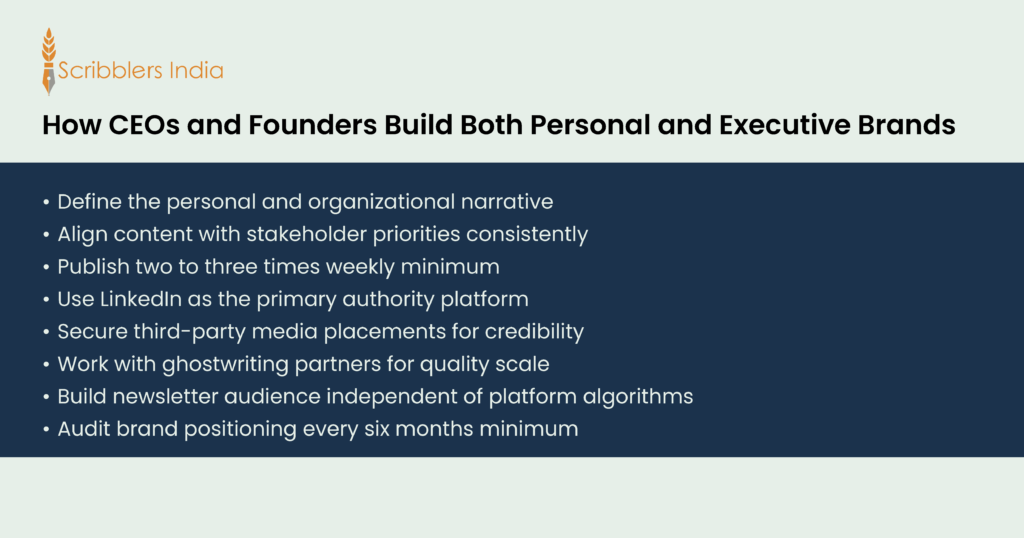
Personal branding vs executive branding for a CEO or founder is not a choice between two competing strategies. CEOs and founders do not need separate branding strategies that compete for attention. They need one connected system. Personal branding shows who they are. Executive branding shows what they lead.
When both work together, the leader builds individual trust while strengthening the company’s authority, reputation and market position.
- Define the narrative that connects individual and organization: The starting point for any branding program is a clear narrative connecting the leader’s expertise with the company’s market position. This narrative explains why this specific person is the right leader for this company at this exact market moment.
- Choose content formats that serve both individual and organizational goals: LinkedIn posts and thought leadership articles demonstrating original industry thinking strengthen both the CEO’s personal brand and the company’s authority. Podcast appearances and speaking engagements extend reach into new audiences, while newsletters build lasting relationships beyond changing platform algorithms.
- Maintain consistency without sacrificing authenticity: The most common executive branding failure is inconsistency, in which leaders publish sporadically rather than maintaining a structured, reliable content cadence. Research consistently shows that executives publishing multiple times weekly build stronger visibility and familiarity than those posting inconsistently, regardless of content quality.
- Work with specialist partners to sustain quality at scale: Most CEOs and founders produce stronger personal branding content by collaborating with specialist writers who capture insights through structured interviews. This model combines genuine expertise with professional writing discipline, ensuring consistent quality while maintaining authenticity and executive-level credibility standards.
Why Do You Need Personal Branding Services in India for Executive Brand Development?
Executive brand development needs more than regular posting or polished writing. It requires a clear leadership narrative, consistent thought leadership, and content that supports both personal credibility and business goals. Personal branding services in India help founders and senior executives build this presence without losing focus on core responsibilities.
At Scribblers India, we build executive branding strategy programs for leaders who need sharper visibility and stronger market authority. We define positioning, extract original insights, and turn them into LinkedIn posts, articles, speeches, newsletters, and media-ready narratives. This helps leaders build credibility, attract opportunities and communicate expertise with consistency.
Scribblers India Executive Branding Framework
Here is how we approach executive branding for business leaders:
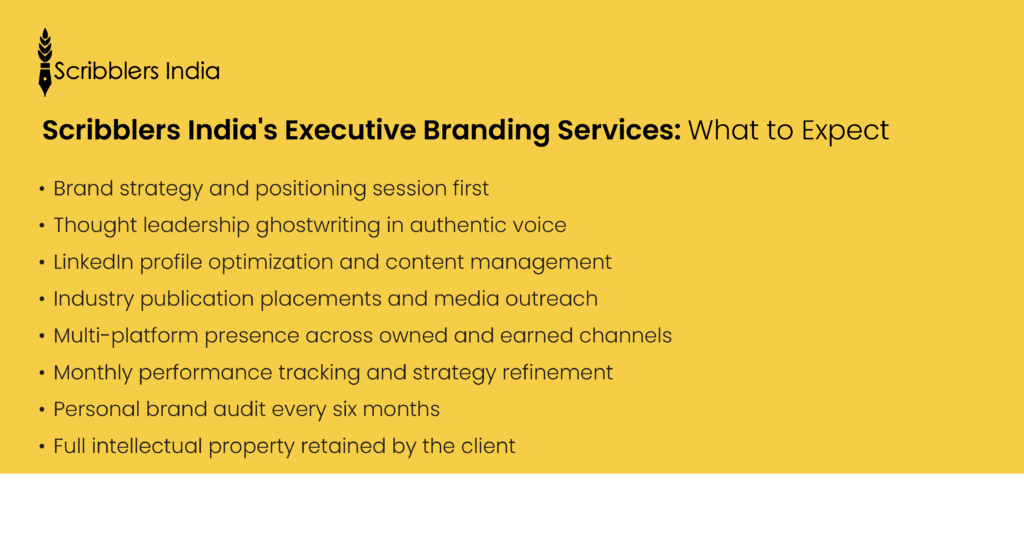
- Executive-specific personal brand strategy development: We begin every engagement with a structured brand positioning session that defines the narrative connecting your individual expertise to your organizational leadership role. Every content decision flows from this strategic foundation rather than from ad hoc inspiration.
- Thought leadership ghostwriting in your authentic voice: Our ghostwriting services capture your genuine thinking through regular recorded conversations. We then transform those insights into polished LinkedIn articles, industry opinion pieces, insightful e-books and long-form thought leadership content that reads exactly like your best professional thinking.
- LinkedIn profile optimization and content program management: We optimize your complete LinkedIn presence. This includes the headline, the about section, the featured content, and the activity pattern. We manage a structured weekly content publishing program that builds algorithmic visibility, audience growth, and inbound message volume on a consistent, measurable timeline.
- Multi-platform brand presence building: We extend your executive brand beyond LinkedIn through content marketing placements in industry publications, podcast outreach, speaker bio development, and media commentary. This builds the third-party citation authority that both your personal brand and your executive brand require to reach the audiences who matter most to your business.
- Ongoing brand performance measurement and strategy refinement: We track the leading and lagging indicators of your executive brand health. This includes LinkedIn profile view growth, content engagement rates, inbound inquiry volume, branded search trends, and media mention frequency. We use that data to continuously refine the content strategy toward the topics and formats that produce the strongest authority signals for your goals.
Connect with Scribblers India today to start building an executive brand that positions your leadership as the most credible and sought-after voice in your industry.
FAQs
What is the main difference between personal branding and executive branding for leaders?
The main difference between executive and personal branding is organizational scope. Personal branding vs. executive branding, in its simplest form: personal branding serves the individual’s career goals, while executive branding serves both the individual and the organization they lead. Executive brands must align with company values, address multiple stakeholder audiences, and carry the awareness that every published piece reflects on the business, not the individual alone.
Can a CEO have a personal brand that is separate from their company brand?
Yes, and many executive brand experts recommend maintaining some distinction between a founder’s personal brand vs corporate brand deliberately. A founder whose brand becomes entirely synonymous with the company creates succession risk. It leads tro exit complexity and organizational dependency that limits the company’s ability to scale independently. An executive who builds a brand rooted in genuine personal values and broader industry expertise preserves both career flexibility and organizational commercial value simultaneously.
How much time does executive branding require from a CEO each week?
Most executive branding strategy programs require two to four hours per week from the executive, with support from a specialist content partner who handles writing, editing, and publishing. The executive’s time focuses on recorded insight conversations, content review and approval, and direct responses to audience engagement. Organizations that invest in ghostwriting and content management significantly reduce this time commitment while maintaining the authentic, expert-led quality that effective personal branding vs. executive branding demands.
How is a personal brand different from a LinkedIn profile for an executive?
A LinkedIn profile is one surface where a personal brand appears; it is the infrastructure, not the brand itself. A personal brand encompasses the full set of associations, perceptions, and reputation signals across search results, media mentions, speaking credits, professional references, and published content. The profile reflects the brand when optimized correctly. The brand generates the opportunities that bring the right people to the profile in the first place.
When should a founder start thinking about executive branding for their business?
A founder should begin building a deliberate executive brand from the moment their company enters a growth phase where investor conversations, strategic hiring, and client acquisition depend on their personal credibility. Research shows 82% of people are more likely to trust a company when its executives actively engage on social media. Waiting until a major funding round, acquisition discussion, or leadership transition to build that trust creates a significant disadvantage that early, consistent executive brand investment would have prevented entirely.